

Crofter
-
Posts
3484 -
Joined
-
Last visited
-
Days Won
11
Everything posted by Crofter
-
That 2300km2 is conveniently just enough to cover all islands from Lewis/Harris (2200km2) down. Not many people appreciate that Lewis & Harris comprises the third biggest island in the British isles. Oh and don't get me started on the bridge
-
I'm looking up the BBA certs of different membranes. The VP400 is not cheap but so far it is clearly the toughest available. For the extra hundred quid or so it might well be worth going for it, as I don't know how long it will be exposed for. Building a roof entirely on your own takes quite a lot of time!!
-
No, not there- the sarking stops at the edge of walls, but when the roof covering goes on it will overhang a bit and I'll make up a barge board to support that. That's some way in the future, though. Thanks, I remember you had 11mm osb sarking so if it's good enough for you... I am considering gluing some strips of osb scrap onto the underside, just to bridge the gap between adjacent boards, and more than anything else to help prevent rainwater getting in through the 3mm gaps that I have dutifuly left between each board.
-
42 degree pitched roof, 6x2 rafters 3.8m long at 600 centres, and then boarded with 11mm OSB as sarking. The sarking is doing a good job of stiffening everything up, but should I install a dwang to support the edge of the sheet? I know that with 22mm timber sarking you obviously don't. It seems a bit weird to have an unsupported sheet edge, though. I don't want any movement across the join between sheets, in case that damages the membrane which is going on next. Just wondering if a dwang would normally be fitted, and if so can this just be a little bit of batten? Thanks
-
The thing is you are never going to have a 'normal' house off grid. You will have significantly higher outgoings due to battery replacement, diesel, and ongoing maintenance. Or you change your lifestyle to suit and give up the big TV and fridge. So 'worth it' is a tricky one because you can't just look at a cheap site with no access to mains electricity and add a lump sum to cover the off-grid system. IMHO the most promising off-grid system would be hydro, but you would be very lucky to have a resource available.
-
PV is the easy bit. Storage is where it gets expensive. You can run a backup generator and live with the fuel costs of course. £13k split between two houses isn't a show stopper- my connection was £2k for a single house and represents about 5% of my total budget.
-
Measure that 12v out, both under load and without any load, and maybe see how it behaves when the system is charging as well. But I would expect it to be much more stable than trying to get 12v direct from the battery.
-
Similarly, it's frustrating for me as a relative young 'un that I have to ask a 'grown up' to tow anything over 750kg for me- even though I have a fair bit of towing experience and get asked by friends to launch boats for them etc.
-
It might be worth using one of those adapters designed for running laptops etc from a car- DC-DC should be more efficient. Generally designed to output 19v but multi-voltage ones are available. Having said that, on the boat I use an inverter all the time since my 50w solar panel produces far more power than I need so 'waste' isn't an issue, whereas destroying something by trying to run it straight from the battery certainly would be!
-
A good trailer will hold its value well. You're looking for Ifor Williams or similar. 8x4 is a pretty standard size. Tipping can add significantly to the cost, and will be a bit harder to find. Your tow vehicle is spot on, by the way! If you passed your test after 1997 you'll be restricted to 750kg laden trailer weight, to go above that you'd need to do a test. Driving with a trailer is easy enough with a bit of practise. Ideally, find a big empty space with nobody watching and drive round and round in reverse until you feel you're getting the hang of it.
-
The 3.5t limit is for the laden trailer, not the train weight. Shortlist of vehicles rated to tow this: - Defender, Range Rover, Disco - LWB Shogun - Nissan Patrol - Grand Cherokee - Fourtrak I happen to remember this because I used to own a 27ft yacht plus trailer, and it was right on the 3.5t limit. So every Discovery owner I ever met became a potential new best friend when I needed to tow it somewhere
-
Great wee project. Have you had much use out of the hut yet?
-
Did you mean "<100g" to get zero road tax? FiL's X3 is a pretty decent vehicle, not cheap but tows over two tonnes and surprisingly economical on both fuel and tax. Has the stop-start system which helps in that respect. He won't lend it to me to tow stuff with though, it's far too nice
-
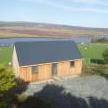
An interesting shed - recycling at its best!
Crofter replied to Stones's topic in Garages & Workshops
Get a carvel hull and all will be good, or even better grp! Boats are plummeting in value as more appear on the market- fibreglass doesn't die. The saying goes that a hull is worth nothing, to get the value of the boat you add up the cost of the bits bolted on to it. Bit depressing when you come to sell, mind. -
Recommendations for breathable roofing membrane?
Crofter replied to Crofter's topic in Roofing, Tiling & Slating
Thanks Dave, I'll look it up. -
Recommendations for breathable roofing membrane?
Crofter posted a topic in Roofing, Tiling & Slating
Wondering if anybody had any preferences or advice on choosing breathable roofing membrane? To be laid directly atop OSB sarking boards, followed by battens, counterbattens, and box profile steel. I plan to lay it vertically so that every joint is battened- this will also be much easier for me as I am likely to be working on my own. Anyway, there seems to be a fair bit of choice available, and the stuff is variously referred to as breather, felt, membrane, etc, which complicates the search somewhat. Finally, is there any advantage to the shiny 'thermo' versions? How would this affect U-values? I presume they don't have any actual insulating properties but is the emissivity different? -
It really is a small world
-
You got me
-
Thanks, it's been a lot of hard work but this stage is very satisfying. I have decided to put the breather on the front and back walls first (tricky job by yourself in a 30mph wind!), then I will board the roof, then breather on the gables, then finally membrane on the roof. This sequence will work best in terms of working space and how the membranes overlap, I think. I've been loaned a fairly basic scaffold tower (visible in picture above, inside the house) and am hoping that this plus the ladders will be sufficient. But if I find myself in a fankle I might well be looking for more/better scaffolding...
-
A mate of mine lives in a rented house and runs it as a B&B- pretty lucrative here on Skye. He does this for a living, so must be pocketing most of the B&B income. Don't know how it works out for the landlord. One bonus would be that a prospective B&B operator would have an incentive to keep the place in good fettle, or so you would hope.
-
We can't leave the back door open because the chickens like to come into the kitchen! Despite me building them a lovely larch clad house to live in. Ideas above their station, I feel.
-
Try here: https://issuu.com/solotimberframe/docs/self_build_design_advice
-
I want to tie my rafters down onto the frame using twist straps (already purchased). There are three places that I can put them: - on the inside of the frame, running down the studs. They would then have a sheet of 50mm PIR placed over them, followed by the VCL and then battens which create the service void. So the batten fixings would hit the metal straps and prevent them from being adequately fixed through to the studs. - on the outside of the frame, fixed through the sheathing and onto the studs, either above or below the breather membrane. The first layer of battens then need to be fixed over the top, so again I have the issue of fixings clashing with the metal strap- although at least this time I'm not also working blind through 50mm of PIR. - on the outside of the frame, but on top of the battens. This minimises the clashing of fixings and metalwork (although the counterbattens will need to be able to run over the top)- but is presumably the least strong out of all the options, and would need longer fixings to reach through te batten, sheathing, and into the stud. Any thoughts would be much appreciated!
-
Space Efficient House Means Cash Efficient Budget
Crofter commented on Ferdinand's blog entry in God is in the Details
Thanks for reviving this thread. Just for the record, my eventual design was 42m2 net internal floor space, on a footprint of about 52 m2. I think for a one bedroom dwelling it will feel spacious enough. I won't be cramming it full of bulky furniture. For an object lesson in living in small spaces, it is remarkable how comfortable you can be aboard a boat. I had a mate who lived on a pretty small wooden yacht for a couple of years. The total floor area where he could stand up was probably less than one square metre. Everything has to serve two purposes, and it does force you to be ruthless with what you regard as 'essential'. -
96 from me too. It's not as hard as you think, Dave!
