Jeremy Harris
-
Posts
26430 -
Joined
-
Last visited
-
Days Won
360
Everything posted by Jeremy Harris
-
One of the reasons Tesla chose Germany was because the pretty big German car industry means that logistic supply chains are already in place. Pretty much every second and third tier parts and components supplier already has a presence in Germany. Tesla also already use some German parts (notably Mercedes switch gear) too, so they already have a relationship with some of those suppliers. It wouldn't surprise me to find that Tesla are starting to impact on German car sales. One reason may well be performance. The Model 3 pretty easily out-performs a BMW M3, for example, and costs a bit less to buy. Not going to be long before all those who have been buying relatively fast BMWs and Audi's switch to Tesla's, if only because they get fed up with losing out at the traffic light grand prix. There aren't really many cars that can pull off the line like a dual motor Model 3, or Model S.
-
6 kW to 8 kW heat output seems about right, and that would draw around 2 kW to 2.8 kW from the grid when running flat out, less than an immersion heater. Most of the time it won't be running flat out, either, so the true power drawn will be a lot less.
-
1.5 kW electrical input to a heat pump is roughly 4.5 kW to 5 kW output. That's enough to heat most homes, and a massive over kill for our house, which only needs around 1.6 kW of heat (so around 0.5 kW of electricity) to heat. A 10 kW to 12 kW input heat pump (apart from being way bigger than is available for domestic use) is going to deliver somewhere between 30 kW and 40 kW of heat, way more than pretty much any normal house is ever going to need.
-
Not really an issue. Even in very cold weather a Model 3 LR will still comfortably do around 220 to 250 miles, and Norway has a pretty good rapid charging network. There's a Norwegian guy on YouTube that is a Tesla fan: https://www.youtube.com/user/bjornnyland and he's done some epic road trips, including right up North, with no issues.
-
Just had a look at the form I filled in for SSE back in 2013. The questions were similar, but this is what they asked then, together with the answers I gave (at the time we were still looking to install a GSHP, that changed when we realised the massive cost implications): There were tick or fill-in boxes by each of these. I selected ground source (should now be air source), filled in the 1.5 kW electrical power (use 1/3rd of the output power, it's good enough), filled in the 6 starts per hours (complete guess, and OTT), selected soft start (this is the choice for inverter controlled pumps), filled in 10 amps as an OTT starting current and added a note that the manufacturer's data sheet was not yet available. SSE didn't query this at all, they just gave us a pretty standard 100 A max supply.
-
It's still a myth, along with a very healthy dose of wishful thinking. Musk didn't even come to the UK looking at any possible site for a Gigafactory, he's always been focussed on Germany. Irrespective of whether the UK was in or out of the EU, the UK would have been a barking mad location for a factory where 95% of it's output is going to be left hand drive cars for the European market. As it happens, the biggest early market is probably Norway (which isn't in the EU) as they have the highest proportion of EVs in Europe, but Norway would have been as barking mad a choice as the UK, for similar logistic reasons. You only need to look at supply chain logistics to see which countries could possible house a factory on this massive scale and which couldn't. Having to ferry all the materials into the UK, then ferry almost all the built cars back out of the UK would have been crazy.
-
Yes, I believe they are. I had to answer very similar questions from SSE. They never queried the answers I gave them, and just gave us a standard supply.
-

Temporary heat source for UFH: Willis heaters
Jeremy Harris commented on oranjeboom's blog entry in Kentish RenoExtension
I thought that the tundish was a requirement in order to provide a visible indication of the PRV letting by? -
Temporary heat source for UFH: Willis heaters
Jeremy Harris commented on oranjeboom's blog entry in Kentish RenoExtension
When my tank boiled, years ago, the noise was enough to wake the dead! I didn't think to clamber up in the loft and see what was going on, didn't occur to me at the time that it would cause a potential problem up there. In my case it would have been the cold water tank that was taking the overflow, so if that was plastic it may well have caused a major problem. I suspect it may well have been a galvanised tank, though, given the age of the house. -
Temporary heat source for UFH: Willis heaters
Jeremy Harris commented on oranjeboom's blog entry in Kentish RenoExtension
TBH, I think you're pretty well covered with the thermostat and the back up safety cut-out. Any additional safety cut-out you add would need to be as least as well-proven as the certified one in the immersion to be useful, I think. I can only once recall having an immersion "run away" and boil a tank, and that was over 40 years ago, before they were fitted with safety over-temperature cut outs. My experience since has been that, if anything, the safety cut-outs tend to operate when there isn't really a problem, as they seem to err on the side of being safe.- 159 comments
-
- 1
-

-
- willis heater
- ufh
- (and 1 more)
-
From what I could gather from the VOA assessor, the only things they use are the gross footprint (measured outside the house), the number of bedrooms and whether or not the house has central heating. I made the point to our assessor that our walls were significantly thicker than those on a less well insulated house, so the internal area would be less. I believe the valuation process is a pretty crude one, really, and much depends on the location and the value of surrounding houses. You can appeal the banding, if you believe that the VOA have got it wrong, although what the chances are of getting any reduction in banding I don't know.
-
Temporary heat source for UFH: Willis heaters
Jeremy Harris commented on oranjeboom's blog entry in Kentish RenoExtension
There will already be a resettable over-temperature cut-out built in to the immersion heaters, in all probability. It's been pretty standard to include such a device for some time now, I think, as a fail safe in the event that the thermostat sticks shut.. -
Plumbing for Dummies: who's the Dummie?
Jeremy Harris replied to ToughButterCup's topic in Waste & Sewerage
Just goes to show the power of marketing hype, re-name an existing product, claim it has magical properties and then have an email ad campaign to try and increase your market share. FWIW, I've never, ever had a problem with a push-fit soil pipe, other than having to pay the sometimes ludicrous price from our nearest merchant (bastard charged me ~£15 for a slip coupler I needed in a hurry, when they are about a fiver from anyone else). -
Exactly my view. Anything that is critical to the comfortable operation and security of the house must have at least a 15 year life. That rules out anything that's reliant on any proprietary cloud service, 'phone app, etc, as the chances are that any such bit of technology will be obsolete or cease to function after maybe 5 years. I started off by building custom electronic solutions for things in our build, and I've gradually been going around replacing them with conventional, well-supported, off-the-shelf stuff.
-
Sips - MVHR
Jeremy Harris replied to Taff's topic in Mechanical Ventilation with Heat Recovery (MVHR)
We find that we don't get anywhere near as much dust in this house as we did in our last house. I suspect that some of this is down to the filtered air coming in through the MVHR and some is down to the absence of any drafts from the good airtightness. Having lived in a house with MVHR there's no way I could live in one without it now. The biggest single thing we've noticed in the house has been the really good air quality. If I had to list the benefits of MVHR then I think the 80% reduction in ventilation heat loss rate would be quite well down the list (even though that takes a massive chunk out of our heating bill). Air quality has to be top of the list, along with the absence of condensation and the way there are never any lingering smells. The way things like towels dry very quickly is another really noticeable advantage. The airtightness also makes the house pretty quiet, almost spookily quiet at times, as with no open windows for ventilation outside noise is pretty much kept out. -
We bought a new house that developed a bad leak around the chimney. Resulted in a fair bit or water damage to a bedroom ceiling. It turned out that the "builder" had fitted the lead flashing with the overlaps the wrong way around, so water was running underneath the lead at the joints . . .
-
Dipping a toe into MVHR
Jeremy Harris replied to Moonshine's topic in Mechanical Ventilation with Heat Recovery (MVHR)
I used the 75mm ducting and found that we ended up with much higher airflow rates than expected, to the extent that the double run of ducting I used for the high flow rate extracts probably wasn't needed, as I ended up fitting restrictor rings that throttled the flow right back. Meeting the BR requirements for extract flow rates is pretty much always the dominant factor as far as duct size goes, just because the duct flow velocity needs to be kept below 2.5m/s. The need to keep the duct velocity down below 2.5m/s is the reason I opted to double up the ducts on the high extract rate rooms. All the fresh air supply ducts run at lower velocities, because the flow rate through each is a fair bit lower than something like the kitchen extract (there should be more fresh air ducts than extract ducts anyway, to make balancing easier). Some of our rooms have a fairly high volume, due to the vaulted ceilings, but ultimately it's the people in the house that pretty much dictate the actual ventilation rate needed, I think. I reduced the flow rates on our system to below the guide figures as we were clearly over-ventilating our 130m² floor area, 338m³ volume, house. I tend to use the measured CO2 level as a guide to how effective the ventilation really is, and it's rare to see that go over about 700ppm; most of the time it tends to be around 550ppm. -
How big is all this 'utilities' equipment?
Jeremy Harris replied to puntloos's topic in New House & Self Build Design
I've got a fireplace app in the car. Can only use it when parked, but it displays a fire on the big screen and turns the heating on, to make things feel cosy. -
Better to have as few pipes going out through the house as possible, as they will form thermal bridges and increase heat loss. Sounds better to have the upstairs en suite draining inside the house via in internal stack to the ground floor foul drain. Even better if this stack can be capped with a AAV and an external foul drain vent provided to avoid having a vent pipe go through the thermal envelope. Only thing to watch with an internal soil pipe stack is noise suppression. I packed all around ours with dense rock wool before boxing it, and that seems to silence it pretty well.
-
Should I connect to the Grid or is their Alternatives
Jeremy Harris replied to GrantMcscott's topic in Photovoltaics (PV)
It's also giving a rather unusual error message: This URL seems to work: https://www.fieldlines.com/index.php?board=5.0 -
Dipping a toe into MVHR
Jeremy Harris replied to Moonshine's topic in Mechanical Ventilation with Heat Recovery (MVHR)
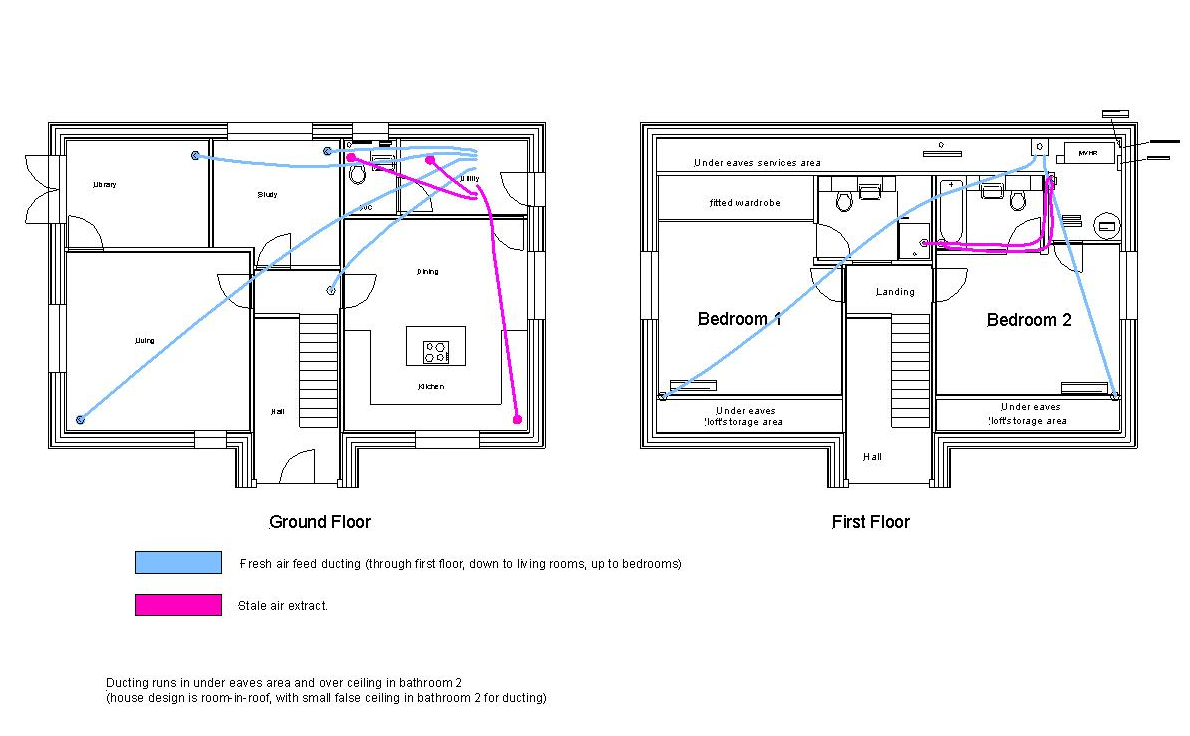
This is the way I ran ours: I ran almost all the ducts in the floor space between the ground and first floor, threaded through Easijoists. The bedroom fresh air terminals are wall mounted, as we have vaulted ceilings upstairs. The bathroom extract terminal ducts run above a false ceiling. I tried hard to ensure that the air paths were as long as practical, with no terminals in the centre of a room, as that can create "dead spots", where the ventilation air tends to short-circuit from the point of entry to the point of exhaust.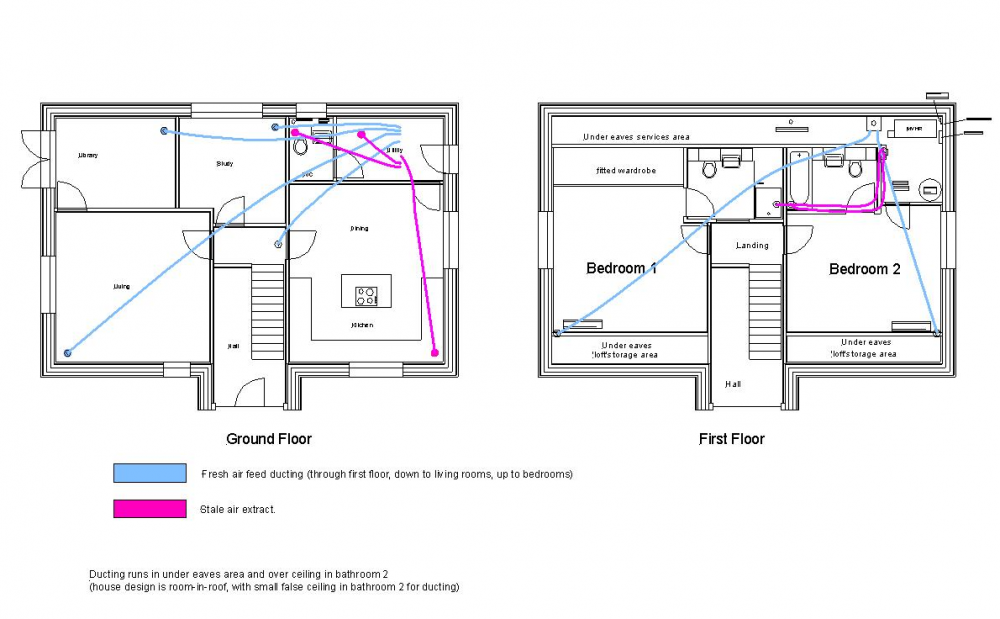
-
Dipping a toe into MVHR
Jeremy Harris replied to Moonshine's topic in Mechanical Ventilation with Heat Recovery (MVHR)
For best performance try to position the terminals so that there are no "dead corners" in any room. The idea is to try to get the air to take the longest path from the point of entry to the point of extract through any room. I made sure that all fresh air terminals were diagonally opposite the extract point from that room, usually the gap under the door. I did the same with the kitchen and downstairs WC extract terminals. In the utility room I fitted the extract terminal directly above where we have a clothes drying rack. In the bathrooms the extracts are over the top of the shower and bath respectively. -
Should I connect to the Grid or is their Alternatives
Jeremy Harris replied to GrantMcscott's topic in Photovoltaics (PV)
To be off-grid with just wind and PV I'm certain you would also need a generator, just for those times when there's neither wind nor sun. You also need to be prepared to tinker and maintain the systems that provide you with power. I suspect that £12k wouldn't buy much of an off-grid system, TBH, unless you were good at DIY this stuff and happy to put a lot of work in to get everything to work. There are some very successful off-gridders, and it can work fine with care and some management of expectations. Worth having a look at this blog, as the author has probably more experience of living off grid than anyone I know: https://lifeattheendoftheroad.wordpress.com/ IIRC, until he got his hydro systems running, he was still reliant on using a generator, despite having a fairly big wind turbine plus PV panels, and living in a location that's reasonably well-endowed with wind (Raasay). -
If it's like my cheapo Brother it may well have a cable label option (there's an icon with "ABC" and a loop) that does this automatically.
-
Just the ends that aren't obvious. No point in labelling a single light switch cable, for example, as it's obvious what it is. Very useful to label the ends of cables where there are lots of them close together.