Jeremy Harris
-
Posts
26430 -
Joined
-
Last visited
-
Days Won
360
Everything posted by Jeremy Harris
-
Just to put the floatation aspect into perspective, we have an 85m² slab, which is EPS that's 300mm deep. If the water level rose to the top of the slab (DPM level) then the upward acting buoyancy of the EPS would be around 242 kN. The mass of concrete and steel in the slab is around 14.5 tonnes, so that exerts a downwards force of around 142 kN. The mass of the house built on top of the slab is around 30 to 40 tonnes, so that exerts a downwards force of between 294 to 392 kN. Summing these forces, using the minimum house mass, we end up with: Downwards forces = 142 kN + 294 kN = 436 kN Upwards force = 242 kN So, even if flooded up to the top edge of the slab, the point where the house would start to get flooded, there is zero risk of the house being displaced upwards by the buoyancy of the EPS, all that would happen is that the force acting on the ground beneath would reduce from around 436 kN to around 194 kN.
-
Sorry, that was a typo, should have read MOT Type 3 - I've corrected it now, thanks for highlighting it.
-
Environmental health weren't the slightest bit interested in testing our supply, and it was only when I pushed them, saying that I wanted to have a chit from them, rather than my unofficial report, that they agreed to test a sample. Even then they refused to accept a sample I'd collected. LA testing is a bit of a scam here, as they are required by law to undertake private supply testing for a set fee, which is less than any of the local labs charge. To get around this they refuse to accept samples and insist on coming out to the premises to take samples themselves, so they can add on a sample collection fee that is way higher than the mandated test fee. I was fortunate in that I had access to an exceptionally good, world renowned, lab... There's a long saga surrounding our borehole, but one major problem is that in this neck of the woods there is an almost total absence of available expertise when it comes to private water supply treatment. I ended up getting a great deal of help from a forum in the USA, where private water supplies are far more common. Oxidation of ferrous iron, manganese etc seems understood here at the commercial water treatment scale, but I only found one company that really knew much about it, and they were up in Lancashire, so could advise over the phone about kit and supply it, but I was left having to design the treatment system and learn from experience. My first degree was in chemistry, but that was over 45 years ago now, and I've forgotten more than I ever learned! With the help of some people in the US I did get a very good treatment system put together, but with what I know now I wouldn't opt for the sand and aquamandix filter, due to it's high backwash requirement. If starting from scratch now I'd opt for the same air dryer, ozone generator and injector system that I ended up building, probably a slightly smaller contact vessel, and a backwashing Turbidex filter. The running cost of this would be a fair bit less, due to the much lower backwash requirement of the Turbidex, plus Turbidex filters down to around 5µ so there would be no requirement for any further fine filtration.
-
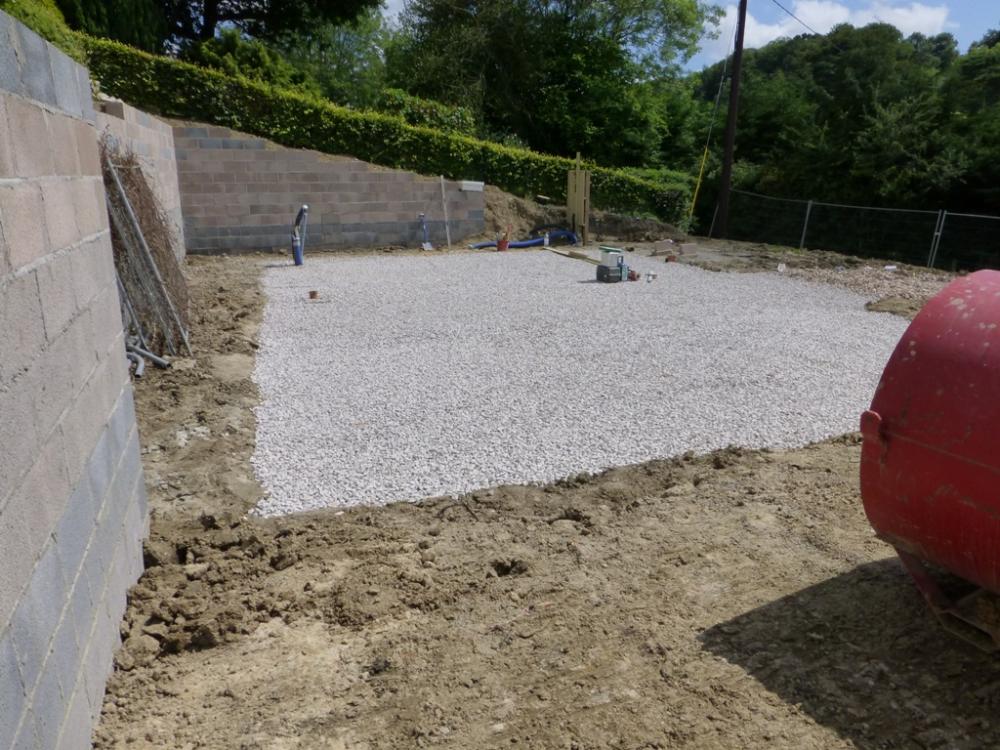
We have a passive slab on dug out ground. Dead easy and quick to install, if done by a team who know what they are doing. Not great for a team who have little experience of laying them. There are photos and a description of ours being laid here: http://www.mayfly.eu/2013/10/part-sixteen-fun-and-games-in-the-mud/ Start to finish the laying of the blinding, insulation, DPM, reinforcement fabric, UFH pipes and pouring and power floating the concrete slab and ring beam took four days. The slab is laid directly on a free-draining 200mm thick layer of MOT Type 3, a bit like clean railway ballast, laid on to geofabric. We have drains around the edges to ensure water flows away. The photo below shows the dug out ground and the layer of compacted Type 1 stone:
-
We have a private water supply that I installed, drawing from a borehole we had drilled. I was surprised that we weren't required to do anything to treat the water at all, as the requirement for treatment and testing only applies to private supplies that feed more than one household. I tested the water a few times before and during the commissioning (which was a bit of a long drawn out saga, related to the way the borehole had been drilled) and found that it had a high ferrous iron content, plus a tiny bit of dissolved H2S and some manganese, so I built and installed an ozone injector, vented oxidising chamber, followed by a backwashing sand filter to remove the ferric iron precipitate. I also added a 5µ filter and UV disinfection unit, just as belt and braces, but may well end up taking the UV unit out, as it costs a bit to run and maintain. The ozone injection is more than sufficient to disinfect the incoming water, as well as very quickly oxidise the ferrous iron, H2S and manganese, and the raw water has been free of coliforms every time it's been tested (we're drawing from an aquifer that's trapped beneath a ~40m thick gault aquitard). The only downside of the ozone injection treatment method is that it doesn't provide residual downstream disinfection, but then neither does UV treatment, the only difference being that the UV unit is closer to the point of use. I did also pay to have the supply tested by the local authority public health people, really just so I had some form of official lab report for building control, if they asked for it (they didn't, weren't interested at all in it). I'll probably test a sample every year or so, for as long as I can still get access to the lab, but I'm not expecting anything to change, as the borehole now has a pretty good sanitary head and a good seal around it to prevent surface water contamination.
-
We used roman-blinds-direct, and they seem pretty good. The blackout lining we opted for in the bedrooms is excellent. They were dead easy to fit, just screw the spring loaded brackets in place then clip the blind directly to it. My only regret is not looking around for blinds with electric motors though, as I find it a bit fiddly to get at the beaded string to wind them up and down.
-
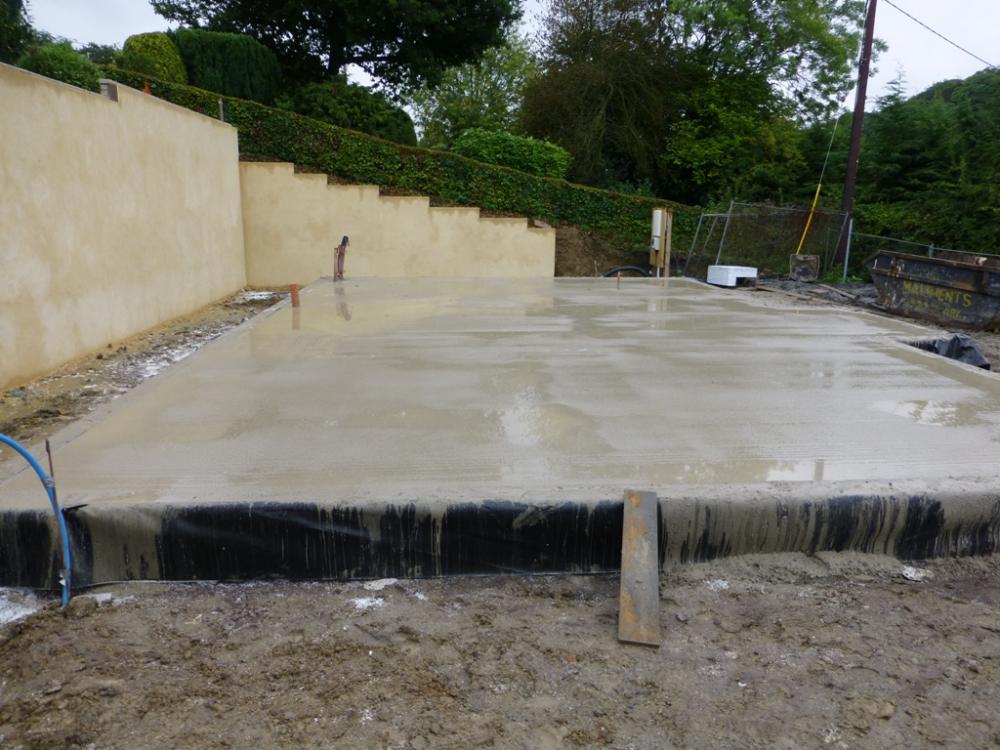
Your SE would be the best one to advise, but I think it may well be important to make sure that water cannot run underneath the house foundations, hence the suggestion that a watertight retaining wall may be needed. We're in a slightly similar position, in that we needed to dig down and build a 2.5m high retaining wall behind our build, and found a couple of springs that had to be dealt with, plus an old clay land drain. Our wall is reinforced concrete, but has a land drain perforated pipe running along behind it, plus a covering of gravel up to just below the backfilled ground level. Any water that builds up just filters down to the land drain and then runs via a length of drain pipe to a big soakaway at the end of the wall, in the corner of our plot. It sounds like you will need a more technical solution, but your retaining wall isn't anywhere near as high as ours, so the design will be a lot simpler and cheaper. Have you already got someone lined up to do the design of the foundation system? If not, I suggest looking for an SE to do the foundation and retaining wall design with experience of working with wet sites and the sort of hydrology you have in that area, as the chances are that your situation isn't that uncommon there and someone with local knowledge may already have a range of solutions that they have used before. As a guide as to cost, I found an SE near to me that knew our area very well, and he designed our big retaining wall (it's around 35m long and up to 2.5m high), provided all the drawings, calculations, specifications for materials, reinforcement, concrete etc for £300 + VAT, so not a big expense in the overall scheme of things, and well worth it both for peace of mind and to keep building control and our insurance company happy. As an idea as to how much bigger our retaining wall is, here's a photo of it together with the recently poured house foundation slab:
-

Roof sarking boards. Treated, untreated.
Jeremy Harris replied to Russell griffiths's topic in Building Materials
Our sarking is 18mm OSB3. As @ProDave says, cheap and solid. We also have counterbattens on top of the sarking, the membrane laid over those, then the battens nailed on top as normal. Makes for a nice solid roof. IMHO. -
That's pretty much what I thought, and I'd just lay the comments from the local authority bloke to one side for now, as he won't be looking to help you, or make your life any easier. Gabions are cost-effective, but far from ideal I think, as you will need to create a retaining structure that's watertight, I'm sure. As well as the established route from the spring(s) there is bound to be water coming down that slope in other places, perhaps just below the surface. Not hard to deal with, but there needs to be a coordinated design undertaken by your structural engineer and someone who understands the local hydrology. Incorporating a diversion for the spring water into the retaining structure shouldn't be too hard, and will ensure that there's minimal risk of water finding its way under your foundations. One advantage you have is that the water flow in that area must be well-understood, as there is an old reservoir marked just below your plot, which I'm guessing may have been fed from these springs at one time.
-
I've had a look at the elevations, and a peek at the plot on Google Earth, and it looks as if the plot is going to be dug out and levelled where the house is going to sit, is that right? If so, then it looks as if there may need to be a retaining wall or structure along the boundary where that watercourse is, and it may well be possible to build some form of deep, open culvert into that. I've also read the observations in the consultation about drainage, where it notes that a 6m wide easement for access to the watercourse will be required. Did that make it into the conditions of your planning consent? When you say that you met the drainage engineer on site, was this someone that you've employed, or was this the person who wrote the objection in the consultation about drainage? There's a very big difference, as someone employed by you should be able to offer you the most pragmatic solution; someone employed by the local authority almost certainly won't!
-
That's good news, as it probably means you could just build a dam and fairly deep collecting chamber where the water enters at your boundary. Should be no problem in running a culvert along your side of the boundary and then down to where it now enters the chamber, I'd have thought. The dam and collecting chamber on your side just needs to have a greater capacity than the existing chamber where the water exits your plot, so there's little risk of it ever over-topping.
-
As above, the critical thing here is the maximum flow rate, together with the elevation. As a gentle sweep has been suggested as the solution, I'm guessing that there may not be a great difference in height from the point where the water course enters your plot to the point where it goes underground. On the face of it a straightforward concrete dam arrangement connected to a culvert might work, but if there isn't much height difference then this may well silt up (I think the risk of silting up may well be why gentle bends have been suggested). Could you build a reasonably tall dam in the space between the house wall and the boundary, all on your side? There are ways to encourage turbulence in order to prevent silting up, but it really depends a lot on how much variation in flow there is through the year, whether there's likely to be any debris in the flow and what the height difference is that you have to play with across the plot.
-
Yes! I had a bundle of joss sticks sat in a drawer and used them to track down smaller leaks. SWMBO was not impressed with the smell of the house when she got home and thought I'd been having a crafty toke while she was out...
-
I reckon the old Bakerlite ones are probably the worst, aren't they? At least with the cast iron ones you can see what you're dealing with before you start, but I pulled one of the black ones years ago and the thing literally fell to pieces as it came out. Luckily we were taking the roof off the house and doing a complete rewire and replumb, plus we still had power from the farm supply, as IIRC it took SWEB a couple of weeks to come out and fix it (them being so slow was the reason my brother and I just pulled the fuse in the first place).
-
You may need to be quick, as I believe that pretty much everyone that offered a zero standing charge tariff has been withdrawing them in response to the regulators price capping proposal.
-
Exactly my thoughts!
-
I suspected this was going to have to happen when the FiT scheme closed, as there used to be an export payment scheme for small energy generators before the FiT came along. The issue is really going to be around metering, I believe, as few (if any) import meters, whether smart or otherwise, are certified for use as export meters. Pretty much any meter manufactured in the last few years can (and probably does already) measure export, but this feature doesn't seem to have been certified on many of them, so can't be used for billing. Fitting an export meter will probably cost around a years worth of export payments for an average size domestic installation, at a guess, plus my guess is that the government will tie any export payment scheme up in so much red tape that the price charged to domestic microgenerators to have an export meter fitted may well be two or three times the price that it should be, but perhaps that's just me being cynical. I will also guess that the only meters that will get approved for export measurement under any new export payment scheme will be "smart" meters, and that will lead to a price hike that will be introduced once "smart" metering is well enough established as to allow wide spread adoption of variable rate billing (which is already being offered - at a significantly higher tariff than something like E7...). As an aside, our E7 meter was fitted yesterday. So far (with no car charging yet) it looks like we use around 60% off peak, 40% peak, after a bit of tweaking of time switches and setting up the timer on the washing machine. A full charge for the car should take around 4 hours and the car can be programmed to only charge during the E7 period (you can set the times for this, either on the car app or sitting in the car). Also interesting that the chap that fitted the new meter carefully got all his PPE out of his van (big gloves and face mask) to pull the company fuse, laid it on the wall by the meter box, where it stayed. He didn't bother to wear it and pulled the fuse holder out with bare hands (safe enough, in theory....).
-
If you want to find the studs after the plasterboard is up, and you haven't marked the floor, then magnets work well. I have some pencils where I fitted neodymium magnets to the end, and these are great for finding plasterboard screws and a lot more accurate than using a stud finder. I also have a dozen or so left over magnets (small ones, around 6mm diameter x 6mm long, IIRC) that I use as markers. They will just stick to the wall wherever there is a plasterboard screw, so I can put several in place to show where all the screws/studs are without marking the paint finish.
-
Holiday let house in top of garage - idea
Jeremy Harris replied to jamiehamy's topic in General Self Build & DIY Discussion
@jamiehamy, We're probably similar to your target market, in that we like to stay in reasonably nice self-catering accommodation from time to time and, as you say, there are some absolutely dire places around, especially in your neck of the woods. We booked a place not far from you a few years ago, arrived late in the evening, took one look at the place and decided to drive off and find a hotel for the night, it was that grim. Your location is good, it looks as if the accommodation and its setting might be ideal for couples, so I would think it should do well. I guess it really comes down to the return on your investment, but if viewed as a pension investment then that probably makes the sums look a bit better. -
My mother in law knows someone who's build was on GD, and she has mixed views about it. They did get some discounts from suppliers, in return for their products being in the show, but they lost at least a day's work every time there was a shoot during the build, so overall her view is that it wasn't worth it, financially. She also mentioned that in the final session a lot of her stuff was moved out, so the GD team from Boundless could "dress" the house to make it look better on TV. Her view now is that she'd not do it again, as on balance, the hassle was more than any possible saving they may have made from discounts. Someone else here reported that either their builder or their architect wanted to increase their fee if the build was going to be on TV, on the basis that they would lose time/have to give free time for filming sessions. I've done some non-building related TV work, and in general it doesn't pay well, if at all. An episode of Scrapheap, for example, pays "staff" (rather than team members, who don't get paid anything other than expenses) around the minimum wage - IIRC they paid me around £300 for around 40 hours work, including one 15 hour non-stop day.
-
Remote internet control of TV and such.
Jeremy Harris replied to MikeSharp01's topic in Boffin's Corner
@MikeSharp01, what about a simple learning remote, like this one: https://www.ebay.co.uk/p/Geemarc-Easy-TV-5-Big-Button-Remote-Control-Replacement-for-Elderly-Simple-Aid/1154541249?iid=221956532218 -
Not sure if they are more flammable than the stuff they are replacing, though, bitumen coated felt. I've never tested it, but I suspect that the old bitumen coated stuff probably burns pretty well, and may well drip burning drops of bitumen as it does so.
-
Ampatop Aero Plus, the stuff that has built-in self- adhesive tape at both edges.
-
Interestingly, when clearing up our site before doing the landscaping, I found an offcut of our roofing membrane. It had delaminated quite badly, with the film layer partially separated from the Tyvek-like fabric layer. It seems likely that this may have been frost damage, as the bit of membrane was underneath a pallet, so out of the direct sun, but probably wet for a fair bit of the time.
-
Can you solvent weld onto orange underground pipe
Jeremy Harris replied to Pete's topic in General Plumbing
I'm pretty sure we have had this discussion here before, as I remember looking up the material specs for all types of soil pipe. It's all either ABS or PVC, and both can be joined with ordinary solvent cement OK. The usual caveats apply, in that solvent weld soil pipe joints shouldn't be used underground, as the push fit joints are intended to be able to tolerate movement due to settlement, whereas solvent weld joints won't have any give at all. If in doubt as to whether any pipe will work with solvent weld, then it's easy enough to test a bit by just brushing a bit of adhesive on and seeing if it softens the pipe and dissolves it slightly. IIRC, the solvent in the adhesive is usually a mix of dichloromethane and either acetone or MEK, and the cleaner used on the pipe and fittings before solvent welding is just acetone or MEK (MEK is a bit kinder to your hands than acetone).