Jeremy Harris
-
Posts
26430 -
Joined
-
Last visited
-
Days Won
360
Everything posted by Jeremy Harris
-
 Just about a month of being on E7 now, and it looks like the split is 59% off-peak, 41% peak, which is slightly better than I'd estimated. This ratio will change, I'm sure, but probably not by much, as with the longer days our peak rate usage will drop a lot, because of the PV generation. The off-peak will drop a lot too, and just be the house baseload, at least until I get the battery system installed. When that's up and running I suspect that I'll be able to virtually stop using peak rate electricity all year around.
 -
Fabric vs bling
Jeremy Harris replied to Ed Davies's topic in Energy Efficient & Sustainable Design Concepts
Rainwater harvesting is an interesting subject. I looked at doing it initially, and quickly discovered it's not as easy to do properly as I thought. The need to remain compliant with the water regs, together with making the system both affordable and reliable, with a minimal need for ongoing maintenance, poses a few challenges. None insurmountable, but it was definitely something best designed in to a new build, rather than added as an afterthought. In the end I dropped the idea because it was pointless, once we'd decided to have a borehole. There seemed to be no merit in trying to capture rainfall before it hit the ground, when we were pulling (old) rainwater out of the ground for our main water supply. -
Looks like the price for the Shoebox hasn't changed much in recent years. I found Kensa to be extremely helpful, back when I was looking into the feasibility of installing a GSHP using a standing column collector. They were also the only manufacturer I found who were able to supply a small unit that met our needs. The only reason we switched to using an ASHP was cost. The total installed cost for the GSHP option came to close to £8k, and the improvement in COP over an ASHP wasn't enough over the expected life of the heat pump to ever recover the installed price difference - £6k buys a LOT of electricity. Our ASHP cost around £2k installed, which made the decision a bit of a no-brainer.
-
ASHP- struggling to warm house in the cold weather
Jeremy Harris replied to Jude1234's topic in Air Source Heat Pumps (ASHP)
All I can say is that I've been running ours on a timer so that it only comes on during the E7 period to "charge" our passive slab with heat overnight (much like a storage heater) and it works extremely well, even in the recent very cold spell. Having the ASHP only running on either E7 during the winter, or from excess PV generation when in cooling mode in very hot weather, significantly reduces the running cost (just about halves it). As for sizing the heat pump I didn't find that at all challenging. I had the heating requirement for the house from thermal modelling, so knew the worst-case heating power needed in worst-case weather, and it was pretty simple to just match that to a range of heat pump performance figures in order to get the sizing right. As it turned out, it wasn't very critical, and any of the smaller (4 kW to 8 kW) units would have met our requirement easily. What I have found is that the factory settings that were programmed into our re-badged Carrier ASHP were way off being optimised for the climate in the South of the UK. The "manufacturer" (who just re-badged a heat pump from the OEM) turned out not to understand how some of the settings impacted on performance in cool, damp, weather (which I found by experiment to be the least efficient operating region). I ended up going back to first principles to determine what the settings should be, and have had an installation that consistently runs with a COP of between 3.5 and 4 all year around (including when used for summer cooling). I've also found that weather compensation just doesn't work at all well, and just tended to reduce COP and increase the frequency of defrost cycling. Having now had the ASHP running with a flat flow temp vs. outside temp curve for more than three years, and having improved the overall mean COP by around 0.3 by doing so, I know beyond doubt that changing the flow temperature with outside air temperature actually decreases efficiency and increases running cost. I should add that weather compensation had no impact at all on the heating performance; that remained the same whatever curve was tried (not surprising given that the flow is mixed down to about 26°C at the UFH manifold). -
The site levelling was a part of the ground works contract, as we needed to excavate down to about 2.5m below the highest point to get the site level. The ground works contract also included laying the 150mm sub-base of MOT 3, although this wasn't that costly as it was a part of a very much bigger job. Looking at the QS breakdown, the sub-base for the passive slab cost just over £1k.
-
New walk in shower area
Jeremy Harris replied to Nelliekins's topic in Bathrooms, Ensuites & Wetrooms
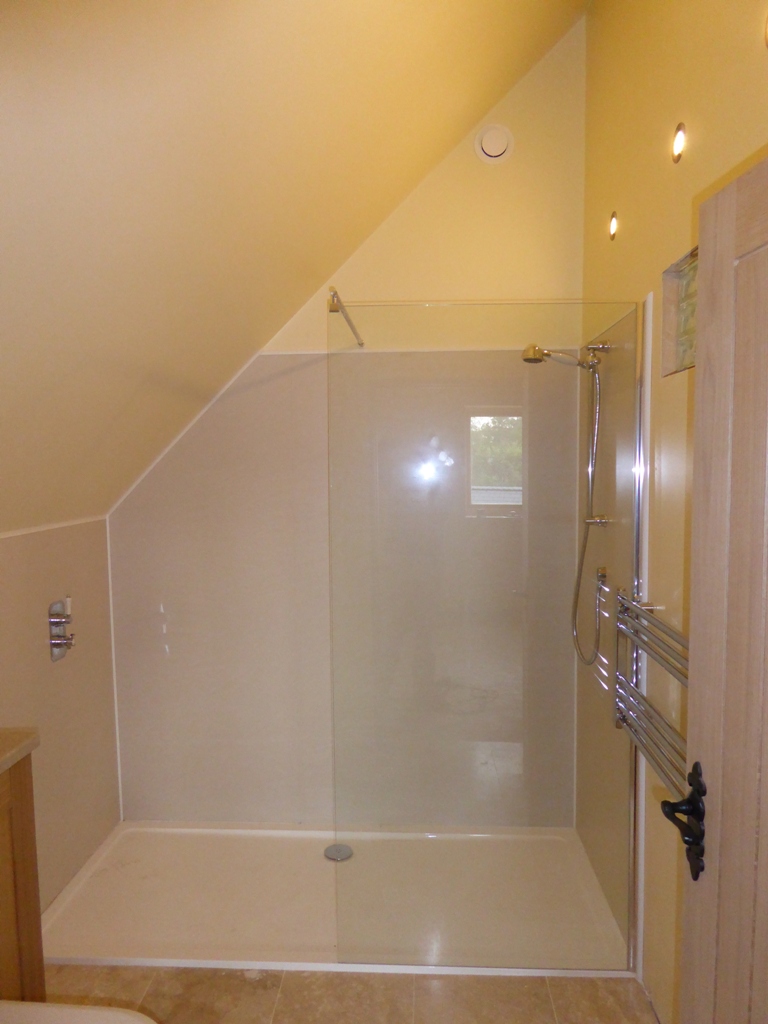
I had to cut a slot in the plasterboard to fit our shower tray, as I made a slight misjudgement when setting the finished room width at 2m, the same width as the tray. It wasn't a problem, as I just fitted a bit of thin ply in the slot and then tanked the floor and up over the ply, then up the rest of the wall behind the wall boards. Once fitted, the gap around the tray and the wall was filled with Sikaflex, then the wall boards were fitted, with more sealant along the join with the top of the tray. -
We had quotes that, when adjusted to the same spec (a couple didn't include labour, one didn't include steel reinforcement, two didn't include the concrete), came out at around £10k to £13k, for a 85m² slab, including UFH pipes, so about £140/m². This was over 5 years ago now though, so I'd expect the prices to have risen a bit and I'd think around £150 to £180 per m² would be closer to current prices.
-
2.5m wide garage door, a decent default size?
Jeremy Harris replied to epsilonGreedy's topic in Garages & Workshops
I had an old fence post staked in at the end of the drive at the last house, lined up so the front tyres of the car ran up against it, which allowed me to get as close as possible to the wall (to allow room behind) without actually touching it. It worked very well, as it's damned hard to accidentally drive over a 4" post. Previously I'd made up a bit of plywood with a batten on it that just sat on the drive with the edge of the ply against the wall, and that worked just as well until the plywood rotted. Inside a garage the plywood would work OK, and would make it easier to adjust the distance when changing to another car. It also doesn't need any holes drilling in the garage floor. -
New walk in shower area
Jeremy Harris replied to Nelliekins's topic in Bathrooms, Ensuites & Wetrooms
We've also used Multipanel boards. I first used them when refurbishing the bathroom/shower in our old house, well over 10 years ago now. We were so impressed with them that we've used them in both bathrooms in the new house. The bottom junction with the shower/bath is best done by ignoring the bloody awful trim/seal (which doesn't) that they recommend, as it works like a gutter to trap moisture at the bottom of the panel. Instead I packed the panels up above the shower with bits of 4mm to 5mm ply, then removed these packers once the panels were bonded tight to the wall. It was pretty easy to just run sealant in the gap to seal the lower edge properly. I chose to bond on (with sealant) a PVC trim at the bottom edge, just because I don't like cleaning sealant that goes mouldy. This covers up all the sealant and gives a wipe-clean surface, just like the panels themselves.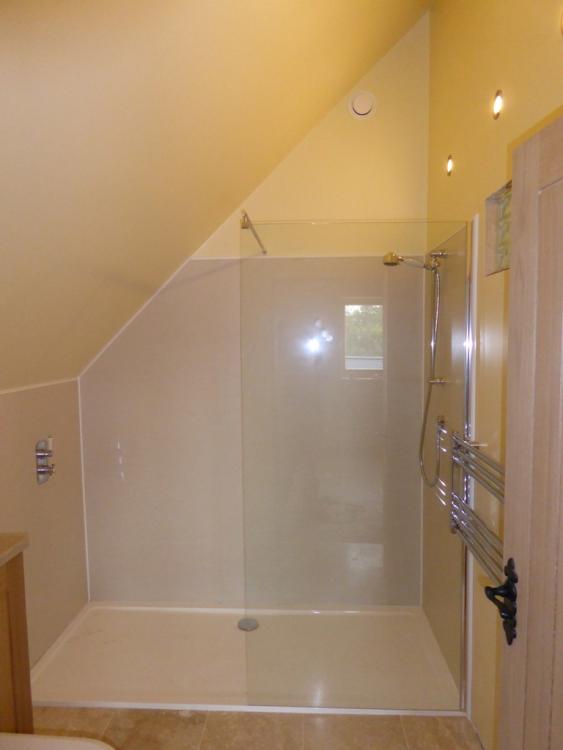
-
Another vote for the Ecology. They were really easy to deal with, with very good customer service, plus they were pretty quick to get everything arranged. Buildstore were a complete and utter shambles, slow, very expensive and seemed to delight in finding inventive ways to both delay things and extract more money. The worst decision I ever made was to get involved with Buildstore, bar none. The final straw was getting tangled up in the (expensive) self-build insurance they offer. When we went over the time we'd allowed, not only did Buildstore charge a great deal more to extend the policy, but they also have a scam running with other insurers, so that when you try to get insurance elsewhere you get turned down because you're already flagged as being a Buildstore customer. I managed to escape this trap in the end, but only after being caught in it the first time we tried to renew our policy.
-
ASHP- struggling to warm house in the cold weather
Jeremy Harris replied to Jude1234's topic in Air Source Heat Pumps (ASHP)
The blower test must be performed with the external ducts for the MVHR closed off and sealed. Failure to do this will result in an incorrect set of measurements, that will be pretty massively in error. The blower fan will pressurise and depressurise the house to 50 Pa, which is a heck of a lot higher pressure than the fans in the MVHR could produce, so they would just be overwhelmed and both external MVHR ducts would leak air in or out dependent on the blower fan direction. -
The high speed films of shells vs armour I saw was during time spent at Eskmeals in the mid 1990's, looking at their proofing capability. We were looking at rationalisation (weren't we always?) and Eskmeals was being looked at with regard to closure. Needless to say we got a very good demonstration as to why the facility should be retained, despite Chisholm's pressure on us to try and find a reason to either close the place or hive it off back to the centre (which is what happened in the end, I think).
-
I used a mix of two wall thicknesses, really as much to do with the practicality of installing it as anything else. I tried to use the thicker, 19mm wall stuff as much as possible, but there were some tight places where I could only fit the thinner 13mm wall stuff. If I've read the regs correctly, then I think that it's only the 19mm wall thickness stuff that complies.
-
It was the GAU-8 30mm cannon that I was once familiar with. Very effective against lighter armoured vehicles, but not quite as good against heavy armour. Not sure about how well it did against reactive armour, as I don't remember seeing the results of any trials against it. I remember looking at high speed footage of HESH rounds against conventional heavy armour and being impressed with the amount of material blown off the internal face. Made me thankful I'd opted for a career in science, rather than as a tankie, a view that was reinforced when I spent a day on Salisbury Plain with 1 RTR, sitting in a Challenger 2 going full pelt during an exercise. Quite why anyone ever wants to be a loader is beyond me, it looked like a hell of a job. In fact I don't think any of the crew positions in an MBT looked that appealing, with the possible exception of the driver.
-
Yes, it has been. Helps to keep Nr up during both the immediate transition to autorotation and when flaring during an autorotation landing.
-
Yes, it is sort of "self-sharpening". What happens is that when a round hits armour, the outside tends to get peeled back, making the impact point cross-section smaller, increasing the force per unit area in the central impact area. The round may well not fully penetrate the armour, but it tends to deliver enough energy to cause chunks of it to spall off inside, usually at a high temperature, creating a sort of shrapnel fireball inside an armoured vehicle.
-
I came across depleted uranium a lot in one place I worked. It was used for non-explosive armour piercing shells, because of its high density, as it significantly increases the available kinetic energy at the target for a given size of round. The stuff isn't a problem in terms of radioactivity (it's barely radioactive at all) but like all heavy metals it's pretty toxic. All the precautions we took when handling DU were with regard to its toxicity. Apart from being used in shells, DU has also been used in other applications where high density is an advantage, like counterbalance weights in the tails of aircraft (including a fair few civil types) and racing yacht keels. As @Ed Davies mentions, the really big issue with nuclear waste is the high volume of material that's been made radioactive as a consequence of neutron bombardment. Pretty much everything inside a reactor core, including all the removable parts, like fuel rod cases and handling gear, will become pretty radioactive. Much of it has a fairly short half-life, so just storing it for a time reduces the problem, but there is still a lot of highly active waste that has to be dealt with. Having said that, it's worth putting the hazards associated with nuclear power into perspective with those associated with other forms of energy generation. Oil, gas and coal all take their toll on human life, both in extracting the stuff and with respect to the toxic effects of combustion. One bit of trivia worth noting is that coal fired power stations release far more radioactive material into the atmosphere than nuclear power stations.
-
I'd also suggest that lagging cold pipes inside the heated envelope is wise. I didn't bother to lag the cold water pipes in our services room (which is inside the house) and had problems with condensation dripping from them in the summer. They are all now insulated with armaflex. Armaflex isn't cheap, but I've found that it's both easier to use and more effective than the rigid plastic foam stuff.
-
ASHP- struggling to warm house in the cold weather
Jeremy Harris replied to Jude1234's topic in Air Source Heat Pumps (ASHP)
I agree about reducing U values below the Passivhaus fabric standard, it doesn't give much benefit at all in our climate. In terms of cost, then if designed to be thermally efficient a house needn't cost any more if built to PH fabric standards, either. Our build illustrates this, as a local architect who was interested in what we'd done asked if he could see our cost breakdown. He later told me that the basic build cost (insulated and airtight structure) was slightly less than the average cost to build a just-meets-building-regs house, so better insulation and airtightness doesn't need to add anything to the cost. Our house ended up with roof and floor U values of about 0.1 W/m².K, and walls that are around 0.12 W/m².K. There's no real benefit in our location to reduce these any further, TBH, as our heat loss is already dominated by that from the doors, windows and ventilation losses. The main problem is that a lot of builders are looking to just bodge build methods they've used for years in order to improve performance, and then that does add cost. Take cavity wall construction as an example. We don't need cavity walls at all now, they are an anachronism that only came about as a way to limit damp ingress through walls, back when walls were leaky solid brick. There's no good reason for sticking with two masonry skins now. A single skin wall can easily be made rain and damp proof, and can be made so that it's inherently more airtight and better insulated. -
ASHP- struggling to warm house in the cold weather
Jeremy Harris replied to Jude1234's topic in Air Source Heat Pumps (ASHP)
If comparing different insulation types purely on the basis of R value (which determines the thickness needed for any given U value) then here's a list of approximate R values for different insulation types, together with the thickness needed to meet the Passivhaus minimum fabric standard U value for a wall (0.15 W/m².K). This list ignores all the other components in the structure and the surface resistance, it's just for comparing the relative effectiveness of different insulation materials: Silica carbon Aerogel ~0.0135 W/m.K , thickness for 0.15 W/m².K ~90mm Silica Aerogel ~0.017 W/m.K , thickness for 0.15 W/m².K ~113mm PIR/PUR foam insulation ~0.022 to 0.025 W/m.K , thickness for 0.15 W/m².K ~150mm EPS/XPS foam insulation ~0.033 to 0.037 W/m.K , thickness for 0.15 W/m².K ~240mm Rockwool ~0.037 W/m.K , thickness for 0.15 W/m².K ~246mm Wood fibre ~0.038 W/m.K , thickness for 0.15 W/m².K ~253mm Worth noting that none of these materials need to be more than around 250mm thick to give a U value (just for the insulation) that meets the Passivhaus spec. When the other elements of the construction are taken into account, along with the surface resistance, then the actual thickness of insulation needed to give a U value of 0.15 W/m².K will be slightly less than the thicknesses given above. -
A Willis is a better option than an electric boiler for this application. Electric boilers have controls and interlocks that will make them a PITA to run inline with a UFH system, as they are not designed to do this. Electric boilers are fine for what they were designed to do, which is provide high grade heat in a similar way to a gas or oil system boiler. That's not what's needed for UFH though, all that's needed is a simple heating element together with a pump and thermostat, as the flow temp probably doesn't need to be higher than about 30°C to 35°C.
-
ASHP- struggling to warm house in the cold weather
Jeremy Harris replied to Jude1234's topic in Air Source Heat Pumps (ASHP)
Just a quick observation about the idea of building a house that needs no heating. This is not a good idea at all, because if you were to build a house that needed no heating system, and just relied on the heat given off by the occupants and appliances to keep it warm in winter, then it would probably be unbearably hot in summer. A heating system can be controlled, turned up and down to regulate the house temperature in winter. The heat output from occupants and appliances can't really be controlled at all, so the heat input to the house will be much the same on the hottest day of the year as it is on the coldest day of the year. Take a typical winter day, with an outside air temperature of around 6°C. If a house needs no heating in order to stay at 21°C, then that implies that the heat from the occupants and appliances is enough to raise the house temperature by about 15°C. Now take a typical summer day, with an outside temperature of 20°C. The heat from the occupants and appliances will still increase the house temperature by about 15°C *, so now the house will be at around 35°C *. So, what's needed is a specification for a house where the insulation and airtightness is good enough to reduce the heating requirement to the point where the house is comfortable all year around, with a minimal amount of heating in winter and little or no active cooling in summer. The Passivhaus requirements are just about spot on in hitting that sweet spot, so arguably there is little or no merit in trying to build a house that exceeds them by much, unless you live in a much colder all year around region, perhaps. * Actually it won't quite do this, as the heating output of the occupants will probably reduce a bit as the indoor temperature increases relative to their temperature, but this rough approximation does just illustrate the point. -
I will do as soon as I have some more info, and ideally some hands-on experience.
-
Yes it was, but I think there is now a better value/more capable inverter charger that works well with the Pylontech battery packs. The Tesla PW2 is a nicely made bit of kit, and it's available for a reasonably good price. My concerns are over the continued glitches that are being reported by owners, together with the fact that it seems to need to be connected to the internet both to function properly and so that the firmware can be updated. My personal preference is for a simpler set up that doesn't rely on internet connectivity, phone apps etc in order to work.
-
ASHP- struggling to warm house in the cold weather
Jeremy Harris replied to Jude1234's topic in Air Source Heat Pumps (ASHP)
The Passivhaus standard isn't for a house that needs no heating at all, although some do tend to make the mistake in assuming that's what it is. A house that needs minimal, or modest, amount of heat in the heating season probably best describes it. We could heat our house using the heat pump in the MVHR coupled with heated towel rails I think (it useful to have this as a backup heating system if we ever need it) but we prefer to heat the ground floor slab, just from a personal preference. We both find the air from the MVHR with the heat pump turned on a bit dry, but I guess that could be resolved with some sort of humidifier easily enough.