


Jeremy Harris
-
Posts
26430 -
Joined
-
Last visited
-
Days Won
360
Everything posted by Jeremy Harris
-
If using electricity for heating, then why bother with heat storage at all? If the idea is to be able to use off-peak electricity during the day for heating, then you can make this work just by having an ASHP and UFH set into the slab (which is what we do) . That way we only use about 1/3rd of the amount of electricity, so it's even cheaper. As an ASHP is around the same price as a Sunamp, it seems a bit of a no-brainer to go down this route.
-
Far more fun to get some one around with a bit of bang to split it up for you. I've not retained my explosive licence, but I could probably find someone nearby, as I used to be a member of South Wales Caving Club, and quite a few of us had explosives licences, for "cave exploration and rescue"...
-
https://en.wikipedia.org/wiki/Tap_changer
-
They are very definitely snake oil, in my view, too. For a fair few resistive loads, like boiling a kettle, more energy will be used if the voltage is dropped, as every second longer that a kettle takes to boil, because of the reduced supply voltage, means another second of heat loss from the kettle. The same applies to any other appliance that takes time to get to working temperature.
-
As long as it can get a mobile data signal it will work OK. All the meter does is transmit usage data back to Smart DCC and receive data from Smart DCC that can be used to signal tariff changes, or remotely turn the supply off. You can ask for a monitor to be fitted to your connection if you think you're getting voltages above +10% or lower than -6% of the nominal 230 VAC. We often get long periods with the supply at the upper limit, 253 VAC, in summer, and never get lower than about 242 VAC, even when demand is high, so I suspect that the DNO could take the local transformer down one tap and bring our supply back within a better range. I'm not sure why we have such a high local voltage, but suspect that it may be down to us having relatively new supply cables, of a larger section than required for our leg from the transformer (two, relatively new, fairly low energy, houses fed from a three phase 95mm² Wavecon that runs ~200m to the transformer, with no other loads). Persuading the DNO to reduce a tap on the transformer isn't easy, though, I've been at them for over a year now with no luck.
-

Oil usage and micro hydro content
Jeremy Harris replied to Lesgrandepotato's topic in General Alternative Energy Issues
Please READ what I've written, then point out exactly where I've "mocked" anything.please. All I've done is state the obvious, that there is a very wide variation between the best and worst house thermal performance in any particular period, so any attempt to determine to one decimal place any relative performance attribute is flawed. If you can produce hard, independent, evidence to show that there is not a wide performance variation between houses built in any particular period, then I'd be more than happy to read it. If you don't believe that every house can be different, then just take a look at EPC bands for existing housing stock. The EPC for existing houses is a pretty crude tool, but even that shows variations of greater than 2:1 in thermal performance between seemingly similar houses. if that's not good enough for you, then go around and ask people how much they spend on heating, and see how wide a variation there is in reality. Even this thread has highlighted differences, with you taking the view that the OP's energy use is low and others taking the view that it's about right. -
You still have the right (at the moment) to refuse to accept a "smart" meter. How long that will continue I don't know, but I had our meter changed to an E7 one in January, and SSE applied pressure for us to have a "smart" meter, but by repeatedly saying no they eventually gave up and fitted a standard E7 meter. When the chap fitted the meter he remarked to me that we wouldn't have been able to have a "smart" meter, anyway, due to the lack of a 'phone signal. I'm equally concerned, as although the network that these are connected to (which is just a standard mobile data connection) is supposedly secure, I've yet to see a truly secure public network. You're right about the possible impact of some sort of hacked attack that causes homes to drop out en masse, I think. The grid is getting to be less stable as we lose spinning reserve and rely more on asynchronous DC interconnects, and one consequence of the loss of spinning reserve is the ability of the grid to tolerate large variations in demand that cause frequency instability.
-
Oil usage and micro hydro content
Jeremy Harris replied to Lesgrandepotato's topic in General Alternative Energy Issues
Please explain to me exactly why I should have included thermal bridging in my simple model (which, as I've already written, was specifically designed for optimising a house without thermal bridging)? If you look at some typical thermal bridging data for a detached 2013 house, built to just meet building regs, then you'll find that the Y value varies from an aggregate for all thermal bridging of around 0.19 W/m².K if the SAP default values are used, to about 0.08 W/m².K if accredited details are used (which may not be that accurate when compared to calculation for the specific details used). It's pretty damned clear that there's more than a 2:1 range for a 2013 house, so what do you think the range would be for a 1975 house? -
Oil usage and micro hydro content
Jeremy Harris replied to Lesgrandepotato's topic in General Alternative Energy Issues
Assuming that a very broad generalisation from a book, derived from averaged data for a wide range of houses, will apply as a definite ration to a house built in 1975 to a house built in 2013, is deeply flawed. It's extrapolating from an averaged data set for a wide range of different houses and assuming that it applies as a general concept to any house built in these two periods. It's very dodgy to assume that even the U values quoted are definitive for houses built in those years, for a host of reasons, not least of which is that many mass housebuilders have been pretty openly flouting building regs requirements for many years now. Lifting an averaged figure from a book, then applying it as if it were a defined value, doesn't stand up to scrutiny. It may well be useful in the very broadest sense, to get a very rough idea of the sort of average performance of houses built in those periods, but will not apply to any specific house with any degree of accuracy, for reasons that are obvious when you look at the distribution of the source data, and in particular, the wide variation between the best and the worst houses for any given period. -
My view is that you need to look at why we are being encouraged to fit "smart" meters, and who stands to benefit most. The primary reason for fitting "smart" meters (which are really pretty dumb; they are only remote reading and control devices) is to allow better utilisation of the grid. Right now, the biggest problem the grid has is the very wide demand range, which goes from there being, in effect, a surfeit of generation at off-peak times (so much so that generators can be paid to not generate, and wholesale spot market prices drop towards zero) to there only being just enough generation and import capacity at peak times. This creates a lot of problems for the grid, for generators and for suppliers. The latter buy electricity on a half hourly spot market, yet sell electricity at pretty fixed retail prices. Suppliers would like to try to reduce the risk they carry, so would very much like to shift to a retail model that allows variable pricing, perhaps down to the same sort of granularity as the half hourly wholesale market they buy from. Clearly, being able to make the retail price track the wholesale price is a really good thing for suppliers, as they can pretty much remove much of their business risk. When the wholesale price changes they can just change the retail price, so that their profit element remains the same. This sounds OK on the face of it, but it presents some potential problems. The major one is that the peak rate price could (at today's rates) be around 30p/kWh, and the off peak price could be down around 3 or 4p/kWh. Anyone who has to use electricity during the peak periods could end up paying more. The real concern I have is that comparing value between suppliers will be even harder than it is now. With retail tariffs tracking the wholesale spot market from hour to hour through the day, how will consumers be able to assess which supplier offers the best deal? The above scenario isn't yet being discussed, and the granularity of the data collected by Smart DCC at this moment doesn't allow half hourly billing for domestic customers, but the capability exists to roll this out, once "smart" meters become widespread. Another concern that I have is over the security and robustness of the communications and control network. "Smart" meters have the ability to disconnect the supply to the house remotely. Right now, the official statement is that this facility won't be used. One has to ask why the capability has been designed and built in to the meters if there is no intention to ever use it. My personal view is that I just don't trust those in control of the system to either only do as they are saying they will do at the moment, or make the system sufficiently robust such that there is no chance of a system problem, or a hacker, being able to just switch off supplies remotely. The track record of the utilities in general doesn't fill me with confidence, neither does the track record of IT projects rolled out by the government.
-
Oil usage and micro hydro content
Jeremy Harris replied to Lesgrandepotato's topic in General Alternative Energy Issues
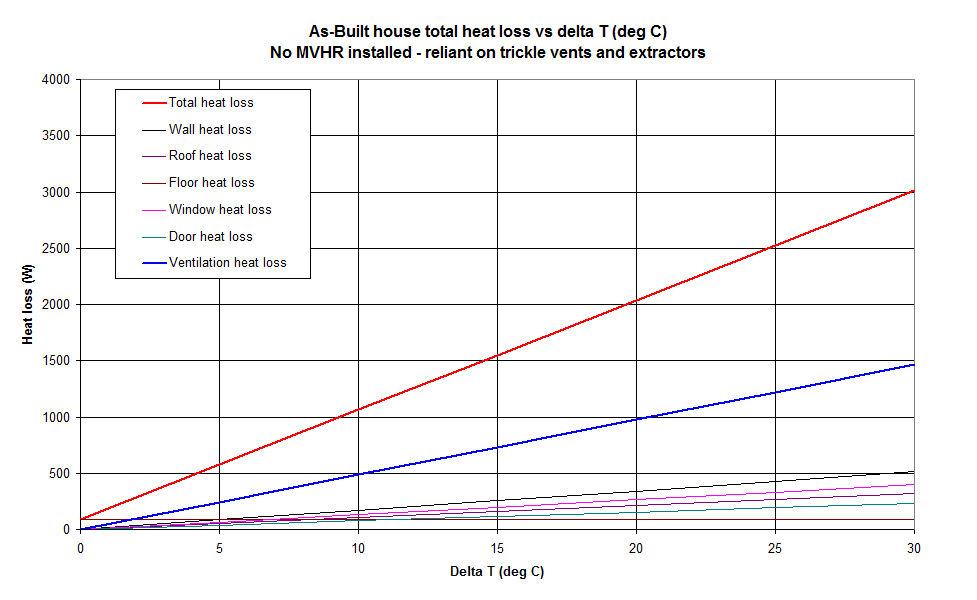
I think that your source is flawed, I'm afraid. The very broad assumptions you've quoted from it leads me to doubt it's accuracy, so any broad statement, like "A 2013 house is 2.7 times more thermally efficient than an unimproved 1975 house" is probably way off the mark, and at best a very broad average across a large number of widely different houses. I gradually improved our last house (a block and brick bungalow built in 1982) and by tripling the thickness of loft insulation, having CWI installed, installing reasonable uPVC double glazing and spending some time going around sealing up air leaks, managed to just about halve the heating requirement. The biggest single improvement was from improving the airtightness, which comes as no surprise, given the high heat losses associated with air movement and ventilation. As an illustration of the proportion of heat loss from ventilation, the plots below are for our current house, with and without MVHR (MVHR recovers around 80 to 85% of the heat that would otherwise be lost from ventilation):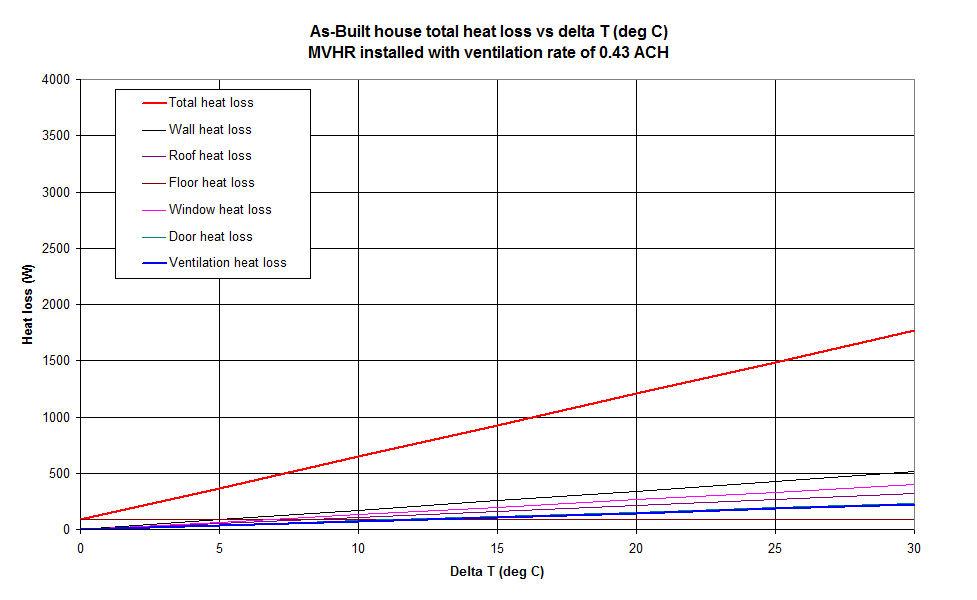
-
Radiator power output, relative to what?
Jeremy Harris replied to epsilonGreedy's topic in Central Heating (Radiators)
If you look at SAP, then you can either put in the assessed value for psi (by calculation of the actual thermal bridges or from advanced details) or you can accept the default value. SAP uses a way of determining the total impact of thermal bridging, by assigning it a value called Y. The Y value has the advantage that it can be compared with the U value for fabric elements, but that's pretty much the only thing it has going for it (IMHO, I'm not a fan of it). The 32% figure you've quoted is a bit extreme, as I believe it most probably comes from the default value in SAP. In reality, any sensibly designed new build will have significantly lower heat loss from thermal bridging, for the simple reason that it can be challenging to get the FEE down without moving away from the default psi values and either using those from the advanced details (bit of a fiddle, IMHO) or doing a proper analysis based on the designed structure (far and away the best method, and not hard to do). FWIW, designing out all thermal bridges, including geometric bridges at angled external wall/roof/floor corners, isn't hard to do. There are standard details for reducing thermal bridging to negligible levels available, anyway, so it's a bit of a mystery as to why they are neither more widely used nor more widely understood, especially as thermal bridging can present a slight condensation risk, especially in a very well insulated house, by creating cold spots. -
Radiator power output, relative to what?
Jeremy Harris replied to epsilonGreedy's topic in Central Heating (Radiators)
I tried to keep the data input down to as little as was needed to get a reasonable estimate, without being overly tedious to fill in. It is just a tool for estimating; I originally put it together to do quick "what if?" checks to see the relative impact of changing things, to allow more accurate trade offs between cost and performance to be done, back when I was designing the house. It doesn't account for thermal bridging, for the simple (and selfish!) reason that I knew from the outset that our house was going to have thermal bridges designed out, no matter what build method we chose. For a more detailed model, that allows for incidental heat gain and thermal bridging, then SAP is sort of OK (not great for a very low energy house, though, IMHO), and PHPP is very good, but also very complex. -
Oil usage and micro hydro content
Jeremy Harris replied to Lesgrandepotato's topic in General Alternative Energy Issues
There's no way that you can just make an assumption that a house of a given date and size will have any particular energy usage; the whole concept of trying to use just those two parameters alone is deeply flawed, for several reasons. Heat loss doesn't vary linearly with house size, as there there is a surface area to volume ratio effect that creates non-linearity (the elephant versus mouse effect). One of the most significant causes of heat loss in houses is airtightness, or lack of. A house with open fireplaces and sash windows will lose a lot more heat than the same size house with no fireplaces and casement windows, for example. Shape and number of storeys has a significant impact on heat loss. Long, thin houses lose more heat than square houses. Single storey houses lose more heat than multiple storey houses. Detached houses tend to lose more heat than semi-detached or terraced houses. Window size dominates fabric heat loss, so a house with large areas of glazing may lose many times more heat than the same size of house with smaller areas of glazing. There are many other variables, too, but the above alone will cause very large errors if only trying to use age and floor area to predict heat loss. -
Radiator power output, relative to what?
Jeremy Harris replied to epsilonGreedy's topic in Central Heating (Radiators)
Why not model your actual house? The simple heat loss spreadsheet I've uploaded here for others to use seems to be reasonably accurate as far as defining the heating requirement, even though it doesn't include incidental heat gain. Others here have used it and reported back that it seems to be reasonably OK, and lots of people have now used it and reported back on how it's performed. In case you've missed it, here it is: Heat loss calculator - Master.xls We have heated towel rails in the bathrooms, run on a time switch circuit so they are only on for an hour or so morning and evening. They do a reasonably good job, in that the towels are always warm and dry, and the bathrooms are never chilly, but it would be nice if the floor was warmed slightly in the bathrooms, just for comfort in bare feet. -
Radiator power output, relative to what?
Jeremy Harris replied to epsilonGreedy's topic in Central Heating (Radiators)
How much heating does your house require? A single 1.5 kW output radiator would be enough to heat our whole 130m² house in very cold weather. Like others, we've found that we definitely don't need heating upstairs, if anything we could do with a bit more cooling up there. -
My personal view is that the case for using a low temperature Sunamp as a UFH buffer, charged by an ASHP, is probably a bit marginal in many cases. There are circumstances where it will work fine, and be a good solution, but I would guess that most people fitting an ASHP and UFH would be better off just running the UFH directly from the ASHP. Using a high temperature Sunamp as a hot water heating system definitely has some useful advantages, with the heat losses being lower and the unit being physically smaller than an equivalent hot water tank. Being a low water capacity thermal store also means that it doesn't require a Part G3 sign off on installation, or ongoing inspections, which is useful.
-
I was thinking the same. We had a pole moved, and a ~200m stretch of overhead cable, crossing a stream and small lake replaced, a new underground cable laid around 50m long, a cable laid under the lane to replace an overhead supply to our neighbours house, and an existing underground cable relocated and re-terminated for £3,533.40. The 6m underground cable run from the base of the new pole, including the underground pot joint, to our temporary supply meter box, plus the installation of the head cost £265.34, but I had the trench dug so all they had to do was lay the cable and make the connections either end.
-
The price was supply and fit, but with no sealing (I opted to do that, only because I felt I'd spend more time getting it right). All the windows were standard 3G casements (8 off)), except for the front glazed gable, with angled fixed upper sections, fitted on a stacking cill over the fully glazed front door and lower side glazed panels. The back door is a standard half glazed unit, plus we have a pair of fairly standard 3G French windows leading to the garden. All the windows and doors came with fitted aluminium cills (deep ones, so the windows could be set back within the insulation layer). I'd have to say that the initial service from the supplier wasn't great; they were a PITA when I was trying to place the order, but the fitters were pretty good, and after sales service has been good. We had a 3G unit crack after about a year, from a fault within the St Gobain sealed unit, and it was replaced inside a week. The big snag is that the company aren't set up to deal with self-builders at all, and do 99% of their business with developers. They've supplied glazing to several of the large developments around Salisbury over the past two or three years, so presumably they are offering keen prices (probably better than the price I got!).
-
Seems to be, we had a section of fencing fall over in the village last week (a Local Authority problem, but I'm a Parish Councillor, and we're the ones that get it in the ear...): Illustrates pretty well that it's the region at around ground level that tends to rot. Luckily another Parish Councillor was able to go and fix it before someone tripped over it (waiting for the Unitary Authority to get around to repairing it would have been pointless, as it takes months, or years, for them to do anything).

-
Anyone used an electric stair climber?
Jeremy Harris replied to Jeremy Harris's topic in Tools & Equipment
Long story, without a clear ending, as yet... As soon as I have some clarity as to what's going to happen I'll say, but right now I'm trying to solve a problem that may, or may not arise, (and it's a possible problem that results from generosity, not something going awry). -
Anyone used an electric stair climber?
Jeremy Harris replied to Jeremy Harris's topic in Tools & Equipment
Just found this video showing a Stanley stair climber, looks pretty straightforward to use: -
Me too. I found that glazing prices varied massively, even for systems with pretty much the same spec and performance. I had quotes ranging from £8.5k to over £24k for virtually the same spec (aluminium clad timber, triple glazed, guaranteed airtightness). Our total door and window area is 25.33m² and the average Uw value for the glazing we ended up fitting is 0.7 W/m².K for the windows and 1.2 W/m².K for the doors. 6.63m² of the glazing is in our front gable, which is around 5m high. In total, our doors and windows came in at about £335/m²
-
What about cooling ?
Jeremy Harris replied to Tim Alsop's topic in Mechanical Ventilation with Heat Recovery (MVHR)
If using a hydronic duct heater as a cooler then it will have to have a condensation catchment tray fitted and a condensate drain, as duct heaters don't have this. It will also need to be made of corrosion resistant materials, as it will be damp whenever it's cooling. I've been working on converting a hydronic duct heater into a cooler, to add to our system, but have run into a couple of snags with getting a condensate catchment and drain system to work OK. Not insurmountable, but it has meant making a completely new housing, as there was no easy way to adapt the duct heater housing that I could see (mainly because if I'd tried to it would have presented corrosion problems). I only tried to adapt a hydronic duct heater because they are half the price of duct coolers... -
Is that the "Jakcure" treatment, Peter? I've wondered about this, as, whereas all our fencing and posts came from the local sawmill, the 8" square "gate" posts either side of our drive came from Jacksons, and I've been a bit concerned about the possibility of rot, as they have their feet only inches above the water table here. They came with a 25 year guarantee, which may well see me out, anyway!

