
Nickfromwales
-
Posts
30306 -
Joined
-
Last visited
-
Days Won
295
Everything posted by Nickfromwales
-
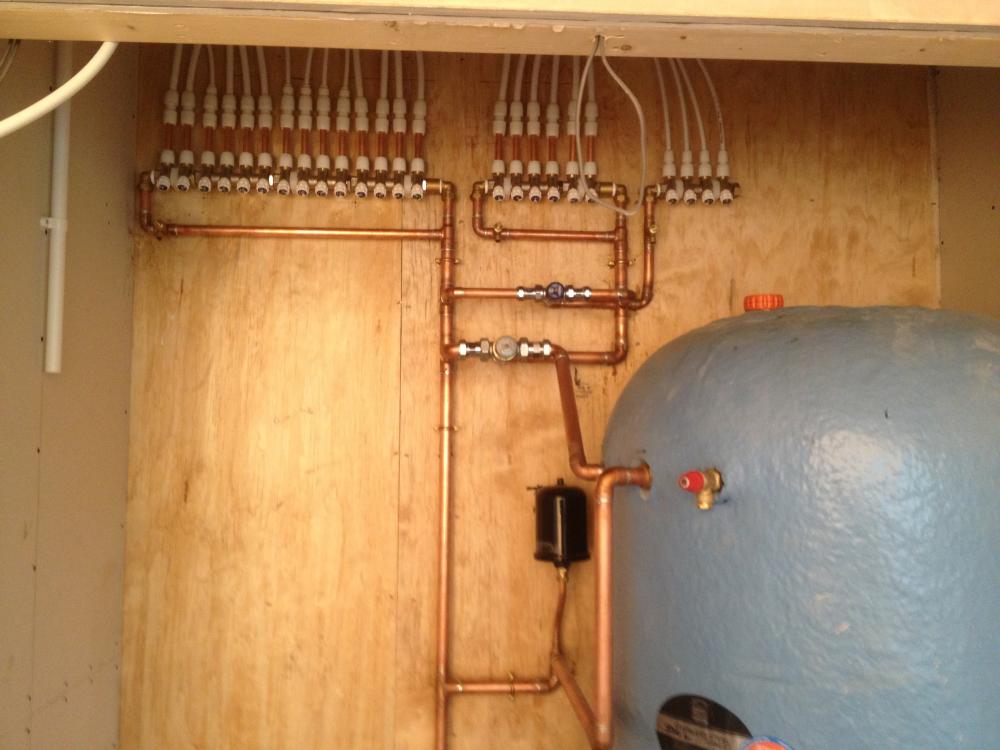
PS, the manifolds are male - female ended so one screws directly into the next to daisy-chain them together.
-
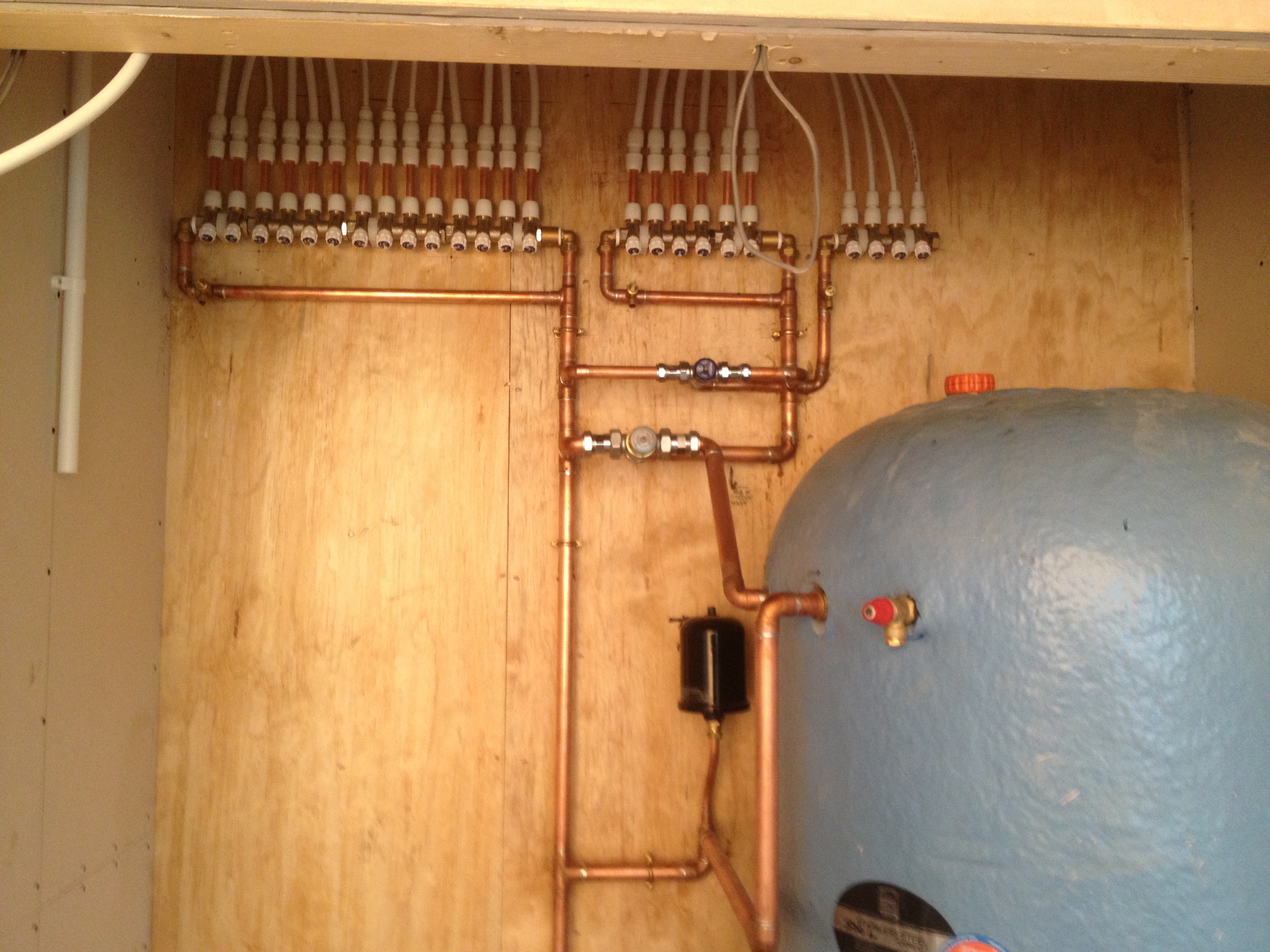
This is the best 'zoom-able' pic I can find. The rails are supported by the pipe work which is held in place with brass Munson rings. Copper to irons on each end, and as a belt n braces job I created a ring so the manifolds got fed from both ends. I did that as the cold manifold was very long and could have suffered loss of flow and I just then carried that across to the hot manifold to as it was easy enough to do. The remit on that job was to be able to use all the showers at the same time and still have some useable flow / pressure elsewhere so went to town on this one. If you zoom in you'll see opaque / white plastic spacers in between the manifolds ( 3 to the long run ). These iirc were 28mm Talon pipe clips which held the rails with near spot on results. Another way to do this, if only feeding from just one end, would be a clip on the input pipe work and then a stub of pipe made off and cap ended ( or a DOC ) the other side, with enough pipe to get a second clip on.
-

MVHR for 148m2 house
Nickfromwales replied to Moira Niedzwiecka's topic in Mechanical Ventilation with Heat Recovery (MVHR)
I meant more about excessive use eg baths more than quick showers etc. PH would allow you to ascertain expected dhw consumption, but it's best to stress that if dhw use rises then the stated / expected efficiency would drop considerably. Thats the tipping point where it may be beneficial to go to a different arrangement for heating and hot water. -
Enlarging holes in brick
Nickfromwales replied to Temp's topic in General Self Build & DIY Discussion
TCT may damage the face before cutting in. I'd only consider diamond for this job tbh. -
Air bricks - Clay or Plastic
Nickfromwales replied to daiking's topic in Bricklaying, Blockwork & Mortar
And no nibble problems either Plastic does seem a strange option for down low, but I recall asking @JSHarris about his uPVC skirts covering his eps up stands and he stated that there was no issue whatsoever. If it's in brickwork then I think I'd go clay tbh, just for 'continuity'. -
MVHR for 148m2 house
Nickfromwales replied to Moira Niedzwiecka's topic in Mechanical Ventilation with Heat Recovery (MVHR)
Would the CoP be hugely affected if the dhw demand was above average though? -
Enlarging holes in brick
Nickfromwales replied to Temp's topic in General Self Build & DIY Discussion
May the sideways force be with you. -
House fire - how to control mvhr
Nickfromwales replied to warby's topic in Mechanical Ventilation with Heat Recovery (MVHR)
I brought this up many moons ago on Ebuild. Click here and see if the content helps out -
Final few questions before window install
Nickfromwales replied to Crofter's topic in Windows & Glazing
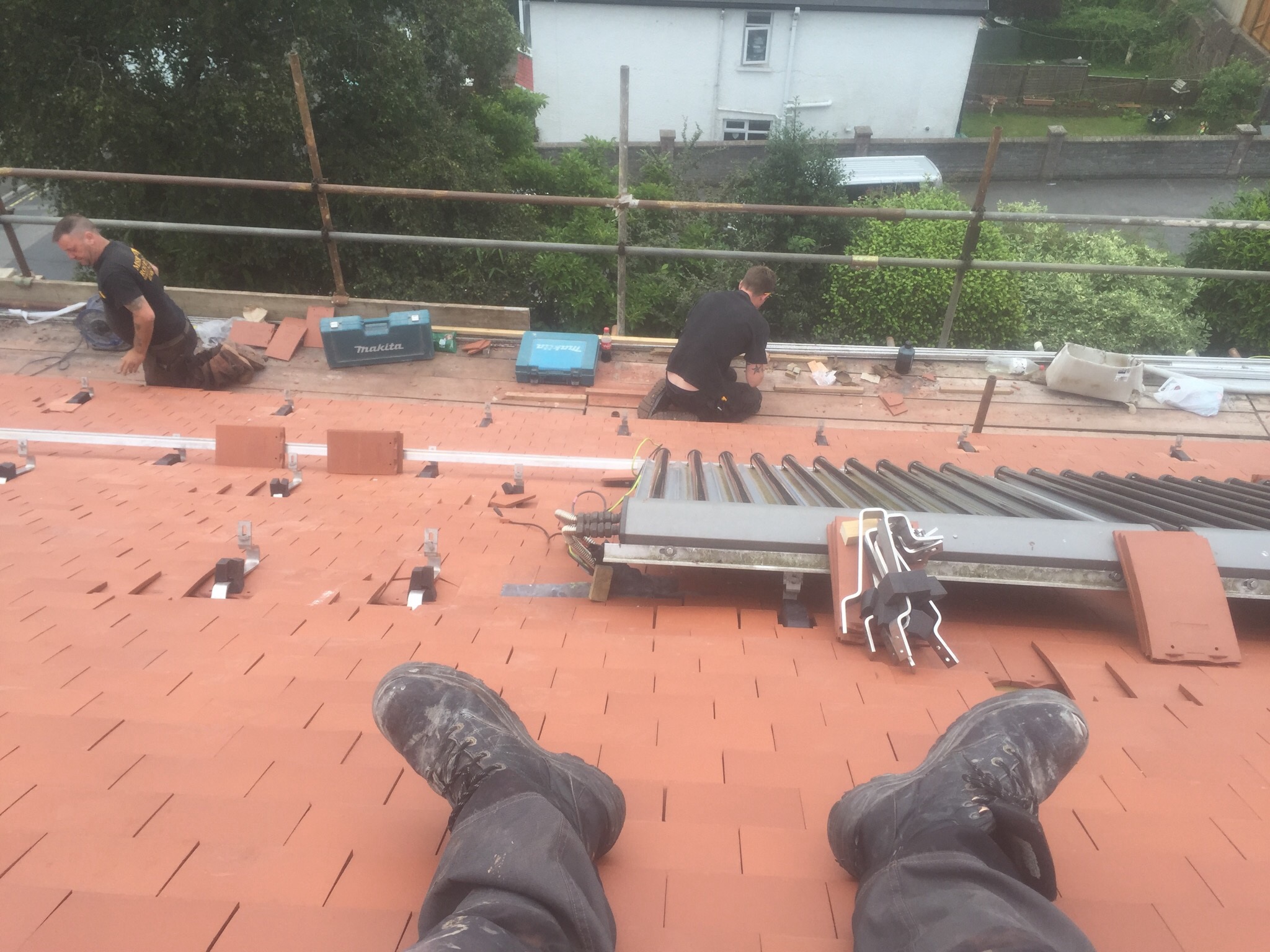
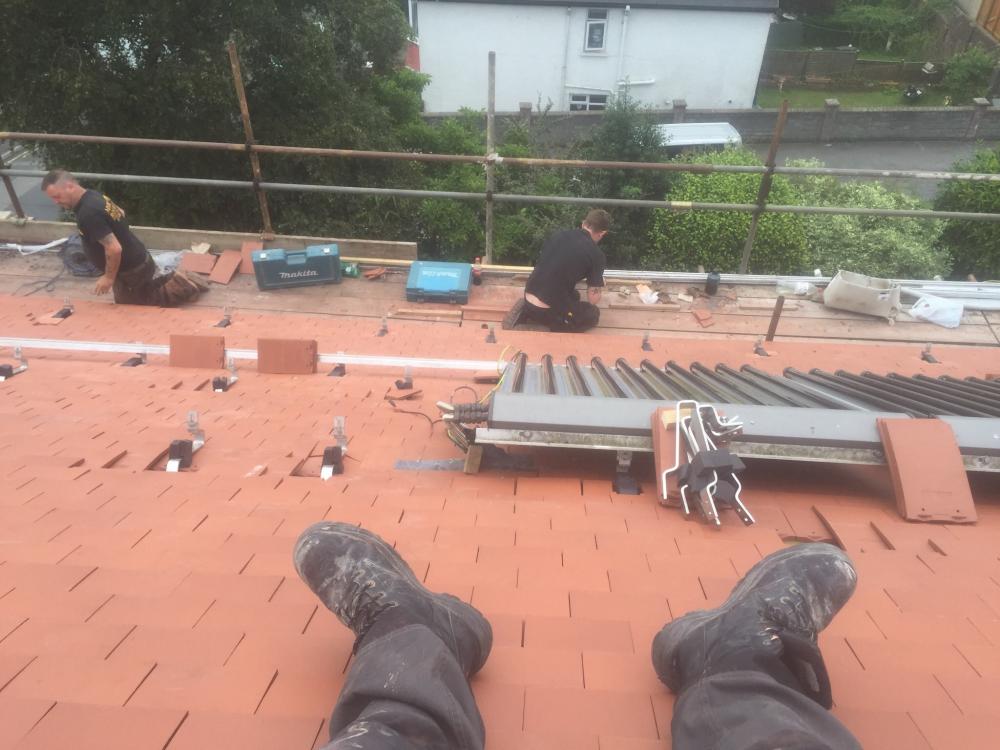
I was called a fat Billy Elliot as if you zoom in, you'll see I broke 4 tiles getting up there -
Final few questions before window install
Nickfromwales replied to Crofter's topic in Windows & Glazing
The one on the left is called Grindy, the one on the right is Choppy. ?? -
Final few questions before window install
Nickfromwales replied to Crofter's topic in Windows & Glazing
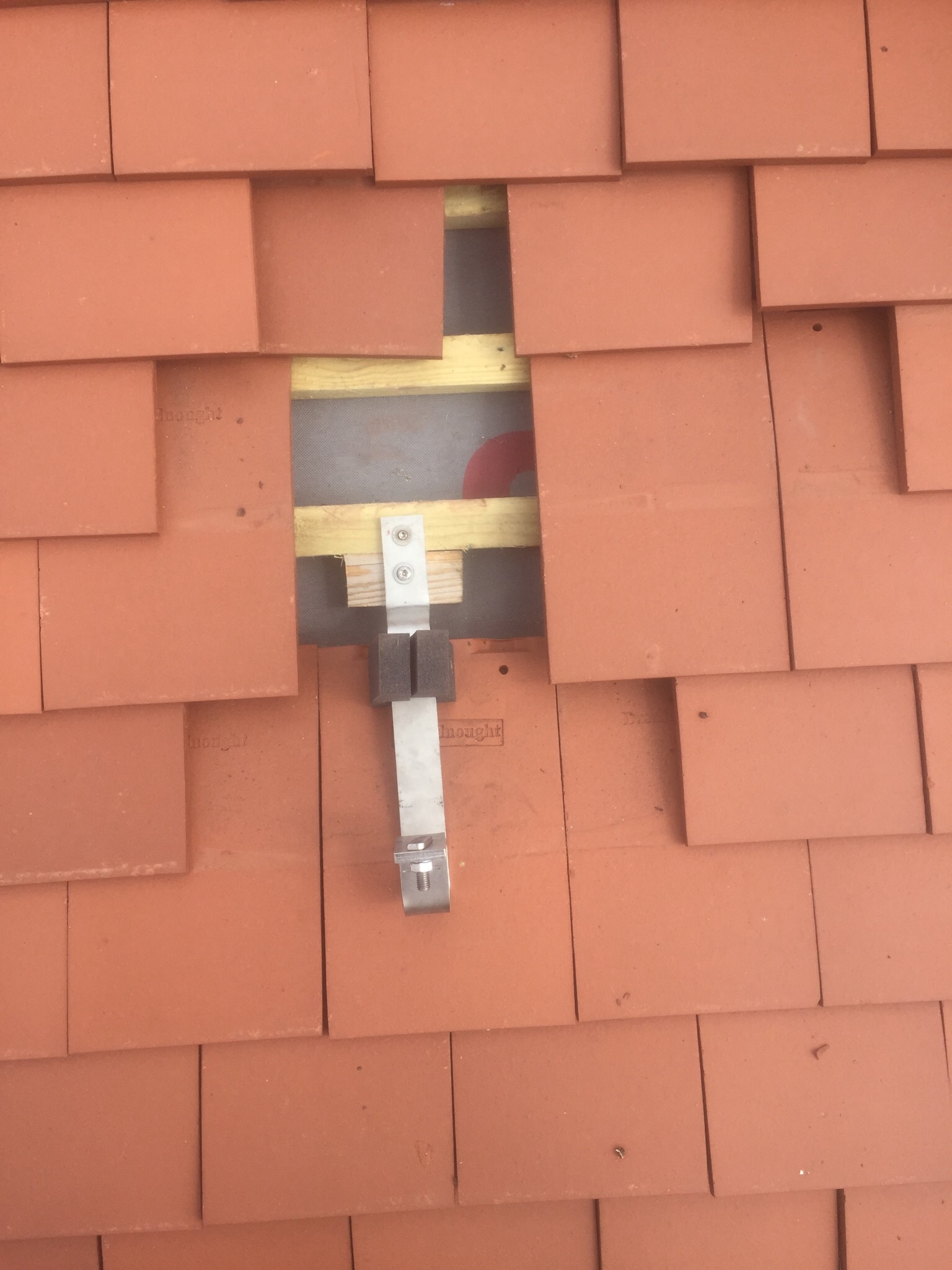
I've just fitted a Pv array on a roof and used A2 stainless fixings. They're rock solid with zero shear, snapping etc and I'd not consider anything else for that particular task. Stainless can be soft as butter but these ones I used were concrete solid. tough at the top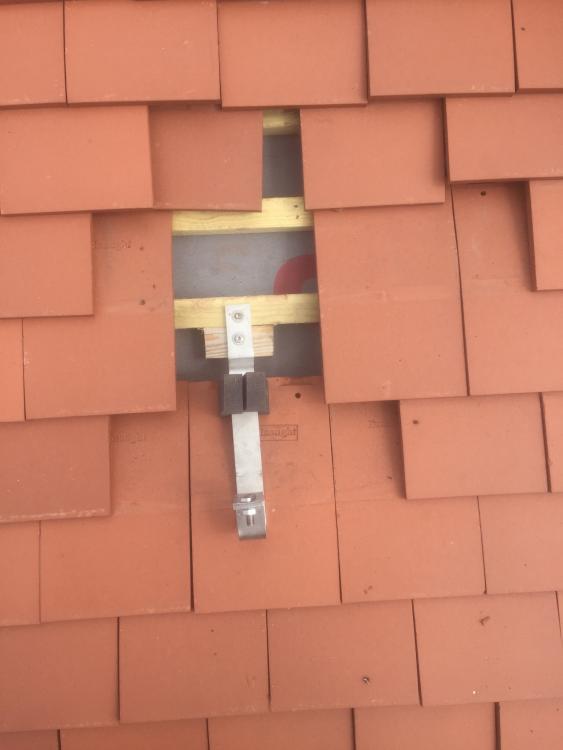
-
Enlarging holes in brick
Nickfromwales replied to Temp's topic in General Self Build & DIY Discussion
Can you get hold of a smaller diamond core drill ( beg / borrow ) and use it side on to ream the hole accordingly. ? -
House fire - how to control mvhr
Nickfromwales replied to warby's topic in Mechanical Ventilation with Heat Recovery (MVHR)
For deaf people an entirely different discipline is adopted including strategically positioned strobe lights. -
House fire - how to control mvhr
Nickfromwales replied to warby's topic in Mechanical Ventilation with Heat Recovery (MVHR)
If you shut the inlets, in an airtight house, then you stop the flow of air. No air in = no extract air out ( smoke removal ) other than the value of the ventilation loss as ascertained by the blower test. -
Enlarging holes in brick
Nickfromwales replied to Temp's topic in General Self Build & DIY Discussion
How deep do you need to ream them? -
House fire - how to control mvhr
Nickfromwales replied to warby's topic in Mechanical Ventilation with Heat Recovery (MVHR)
Whatever the mvhr extracts has to be replaced by incoming fresh air. That fresh air is worse than the stagnant air in the property so you'd be effectively 'fanning the flames' if you boosted the mvhr during a fire. The only correct thing to do when there is a fire is get out of the building, simple. Setting the extract to operate and stopping fresh air being subsequently drawn in will be a very difficult task in an airtight house, so my opinion is to have as early a warning as possible and evacuate accordingly. Smoke detectors in every room and connecting hallways etc, smoke / heat detection in the mvhr exhaust ducting, and additional sounders wherever deemed advantageous. You should aim at stooping a fire at the smoulder / smoke stages, rather than discover it when it's already involved ( flames ). -
MVHR for 148m2 house
Nickfromwales replied to Moira Niedzwiecka's topic in Mechanical Ventilation with Heat Recovery (MVHR)
One with some good points / pros & cons. Genvex Combi 185 Ls Ec Like This 21 Oct 2015 Our designer proposes one of these as being the only heating & ventilation necessary in our new-build. As I understand it, this is an ASHP and a MVHR in one unit. Is my understanding right? Does it also heat & circulate the UFH liquid? The house is small (about 90sq m) and well insulated (can't quote the figures), and the designer is properly qualified and experienced in passive house building, and a registered / accredited for SAP / EPC work. Like This jsharris21 Oct 2015 We have the Genvex Premium 1L, which also has an air to air heat pump. Ours is, in theory, perfectly capable of heating our passive house, with a heat output of up to about 1.5 kW. However, there is no way that I would use it as the only heat source, for a few reasons. The first is the air quality. When it is heating it blows warm, dry air through the fresh air vents and my personal view is that this is a bit too dry and doesn't feel that comfortable. It's perfectly effective, but tends to result in the air being warmer than surfaces like the floor, so subjectively it isn't as nice feeling as under floor heating. The second is noise. When heating (or cooling) the ventilation rate increases to boost speed, and this makes significantly more noise than the normal background ventilation speed. For cooling this is fine, as that's required during the day and the slight noise isn't at all noticeable over the higher background noise level in the house at that time. I definitely wouldn't want it on at night, though, as I think the noise on boost speed would be intrusive, especially as passive houses tend to be very quiet internally. Finally, the 185 isn't wonderful when heating hot water, as the heat output is limited and if reasonably hot water is needed the efficiency drops a lot. It also relies on extracting heat from the house to heat hot water, which tends to result in high ventilation rates as it boosts in order to get enough air through the heat pump to heat the water up. Again, I'd not want it boosting at night to do this ready for morning showers, but that's really just my own feelings about noise and I'll admit to liking things to be quieter than most. On the plus side, Genvex build quality and general performance is very high, we are very impressed with our Premium 1L active MVHR (which is similar to the 185 but without the hot water capability). For the price, the Genvex is pretty good, especially the cooling capability, which is very useful indeed in summer. The 185 is about the same price as the Premium 1L, roughly £4200 inc VAT, plus carriage (I've just checked!) so seems to be better value, but I think I'd be concerned about the factors mentioned above and the hot water capacity (it's got a 185 litre cylinder inside it). A couple of showers are going to quickly use that much warm water (and it will be warm, rather than hot, unless the boost capability is used, which is, essentially, an immersion heater). We use under floor heating as a heating system, and never use the Genvex air heating for the first two reasons above. Very little heating is needed, but our very low temperature (typically 22 to 23 deg C) UFH does provide high comfort levels. My wife has been oiling doors today in bare feet on stone floors and reckons it feels perfectly comfortable. This may well just be a personal thing, as people in North America have been using warm air heating systems for decades and they don't seem to have a problem with the principle. For reference, our house is a fairly big two bedroom passive house, 130m², with a higher than average volume because of the high vaulted ceilings on the first floor. I've found that the hot water system has caused me a significant amount of work to get right, as has the very minimal heating system to a lesser extent. It isn't at all easy to get these systems to work effectively and efficiently in a smaller passive house, especially if also looking for systems that aren't that expensive to install. In many ways, direct electric underfloor heating is probably the cheapest way of heating the house, and the running costs wouldn't be high. The running costs would also be paid for for the first few years just from the saving in installation cost! However, I couldn't bring myself to use electricity like this, so fitted wet underfloor heating in the ground floor passive slab and provide a tiny bit of heat every now and again from the smallest ASHP I could buy. The capital cost of this system was high, around £3,000 at a guess, so it will never, ever pay for itself in terms of energy saving before it needs replacing, but it did salve my conscience a bit (and got a much better SAP EER). I'm about to start a short series of blog posts on my build blog here on this forum, detailing how I've finally tackled the hot water needs. With luck I should have the first instalment up later this evening, and it may help you work through the issues with trying to be energy efficient, yet not spend a fortune on stuff to achieve it! Edited by jsharris, 21 October 2015 - 05:44 PM. Reason for edit:: typos Like This 21 Oct 2015 JSH What would we do without you? Thanks for taking the trouble to clarify things. Effectively, then, you could justify the Genvex just on it's MVHR performance - is that right? If we went for ASHP - driven UFH, would we be able to save money on the MVHR side by using a lower-spec unit than the Genvex? Thanks again Max Like This jsharris21 Oct 2015 Thanks for the kind words. My view is that the Genvex (or one of the other MVHR units that has an air-to-air reversible heat pump) is extremely useful, but primarily for it's cooling capability. We've found it very beneficial to have the ability to blow cool air into the house when it gets a bit warm. Personally, I'd justify fitting the basic Genvex (or similar) active MVHR just to get the cooling capability, but I do accept that it's a high premium to pay over a basic MVHR (our Premium 1L cost a bit over £4,000, including delivery, after the VAT reclaim). It would have been cheaper, with hindsight to fit a normal passive MVHR and add a couple of cheap split air cooling units at around £500 - £600 each. We could have built these in to the house, had we realised the significance of cooling. My view (and I'd stress this is just my view, based on our experience) is that wet UFH is worth it's weight in gold, not just because it's a nice heat source (which it is), but because it allows the heat to be evened out around the house, by moving heat from the warm areas to the cooler areas, which is a tremendous benefit. We have our UFH pump (only about 20 watts) running all day, every day, even with no heat input. It just pumps water around the pipes, moving heat around and maintaining an even temperature. This is remarkably effective, as yesterday and the day before were warm and sunny, which heated the house up, and today was cold and wet, yet the floor was a nice, even 20.4 deg C, all through the house, even in the rooms on the North side that never see any sun. We do have a small ASHP to heat (or cool) the UFH in the floor slab, but it's questionable as to whether this is cost effective for heating. It cost me £1700 (which is cheap, as I bought it as surplus stock) and it saves maybe £150 to £200 a year on electricity, so will take a long time to pay for itself, maybe longer than the life of the unit. It does get a much better SAP EPC, though, and is probably a reasonable choice on environmental grounds. We also use the ASHP to pre-heat the hot water, and that is a useful benefit, one that's maybe worth another £50 to £100 a year in electricity cost at a guess. Additionally, we can use the ASHP to cool the floor slab a bit in very hot weather, and this is very effective, if a bit of a luxury, so overall I'd say it's worth having. The alternative to the ASHP, would be a simple (and cheap) electric water heater to run the UFH. This would work well for the small amount of heating needed, and the heat distribution using pumped water around the UFH would still work as well, but the cooling capability would be lost and the SAP EPC would suffer. All these things are compromises, unfortunately, and there's no clear and obvious answer as to which is best. What is best for me, may not be best for someone else, as I place a value on some of the long-term environmental aspects, and am prepared to pay a bit more in order to use less resources, in my case from the grid. Edited by jsharris, 21 October 2015 - 09:03 PM. -
Sourcing our plumbing equipment for first fix
Nickfromwales replied to JanetE's topic in General Plumbing
It's quite flexible in comparison to JG SpeedFit, as I used some the other day ( JG 22mm ) and it's was truly horrible stuff. I was running 28mm Hepworth barrier alongside it and was finding the 28mm hep twice as easy to manage then the 22mm JG -
Sourcing our plumbing equipment for first fix
Nickfromwales replied to JanetE's topic in General Plumbing
I'd just get barrier tbh. Working out differences and quantities would drive me to drink. Oops, too late ??
-
Sourcing our plumbing equipment for first fix
Nickfromwales replied to JanetE's topic in General Plumbing
Which make of pipe? -
I just buy the rolls and then you can use it for hand or tool sanding. Cutting to size takes no time at all, so more cost effective IMHO.
-
I am bitterly jealous. Ignore the hecklers, they're jealous too
-
Rest and relaxation - escaping from the build
Nickfromwales replied to Stones's topic in General Self Build & DIY Discussion
yup. -
Rest and relaxation - escaping from the build
Nickfromwales replied to Stones's topic in General Self Build & DIY Discussion
Have you got a pic of the old girl ? -
What do you need to know re wiring the fan? It's quite straightforward and we can talk you through it safely. ?