
Nickfromwales
-
Posts
31377 -
Joined
-
Last visited
-
Days Won
345
Everything posted by Nickfromwales
-

Bath Surround / Boxing In, and concealed pipework
Nickfromwales replied to Onoff's topic in Bathrooms, Ensuites & Wetrooms
"Don't trust this man"? -
Agreed. Anorher way to cheat around a cheaper unit is to fit an aftermarket TMV on the outlet to cap the max temp .
-
Dual Hobs in Worktop, design vs structural engineering
Nickfromwales replied to TerryE's topic in Kitchen Units & Worktops
There are over 6 million shades of beige.....what's not to like Exactamundo! My point was about not getting end panels and other such non-interchangeable items done in "baboons arse" purple, or the skin of 101 Dalmatians . @recoveringacademic may not thank me for that idea being planted . I choose to die of natural causes thanks v much . -
Probably best to first define which heater is best suited to what application / why etc. Some of the smaller instants are 'over sink' which means they cannot be connected to a tap or other outlet, then there are under sink instants, and then both variations with varied volumes of stored water, commonly referred to as water heaters ( not instants ). That would all depend on whether or not you wanted to see it or not I suppose. And, more importantly, if it needed to be connected to a tap or if you'd be happy with the rather crappy swivel spout / arm outlet. For basins in particular, anti-scald measures are more of a concern than flow rates imo
-
I think there is a big jump between thermostatic and fully modulating. The former still is quite crude, with the latter near flawless in its delivery characteristics.
-
Probably as good a place as any to impress upon folk the need to strip and clean these filters / strainers directly after commissioning, and again after about a month or two of normal service ( use ). Any crap in the incoming supply (new MDPE etc.), or solder, flux, PTFE tape and jointing compounds can get to / and sit on the valve seat and cause it to malfunction. The effect of that failure is for mains pressure to get past the non-sealed seat and damage upstream equipment.
-
1) Reliance 2) Caleffi 3) Ariston
-
In @TerryE's instance, the stainless steel gauze filter in the PRedV should be all the filtration required TBH. If, post PRedV, the fill point is drawn for the heating / HP etc then that primary measure should suffice.
-
Diaphragm, filter, spring and adjustment screw for the pressure setting.
-
Do you have sufficient volume and head to not require a secondary pump for the rainwater? Do you have filtration on the primary and secondary sides?
-
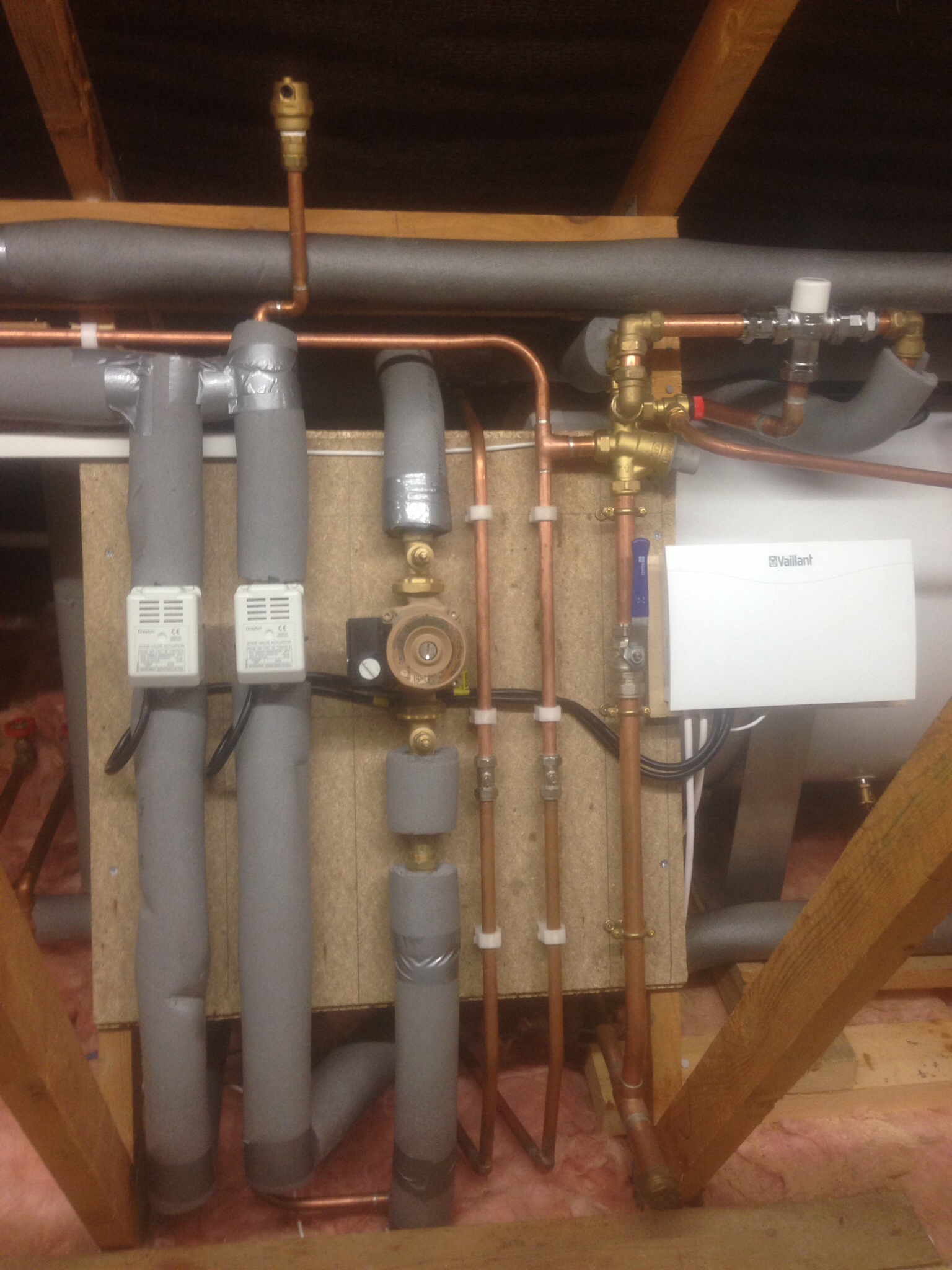
It's one I did 1st bank cold 2nd bank hot @ 51oC 3rd bank hot @ 46oC ( basins) 4th 2-port out of view was 2 x hard water. One to kitchen sink & O/S tap ( back to back ) and the other to utility cold and boiler fill loop ( back to back ). 2 x TMV's for each temp zone Black thing is a 2 Ltr hot water expansion vessel. Blue cylinder is a 500 Ltr Telford TS with a 46kw 28mm DHW heat exchanger ( coil ). ?
-
-
With no dependants / infirm in the house there really wouldn't be any need for the second drop down, other than for comfort / convenience. I prefer the latter, so I have one in my house. The joy of just flicking the tap on at the full hot position and having comfortably hot ( user definable of course as TMV's are fully adjustable with a simple turn of an Allen-key ) is what I like. No flicking the tap between hot and cold to get the right temp, then the pipe work temp stabilises and you have to readjust it, then someone flushes a loo elsewhere and you have to adjust it again........why do this to yourself for change of £40? @TerryE, your old farmhouse would have had a large bore ( 22mm or bigger ) DHW pipe work setup with full bore taps and no restrictive valves such as a TMV. The flow rate therefore would have been good or very good. When you introduce 15mm pipe work though a PHE, then take it through a TMV, you have to start adding the various resistances together and summise from there. As that TMV is 1" body by default, then I'd use a piece of 28mm pipe coming out, going into a 22x22x28mm compression tee, ( Demountable for servicing ). Then 22mm to each manifold.
-
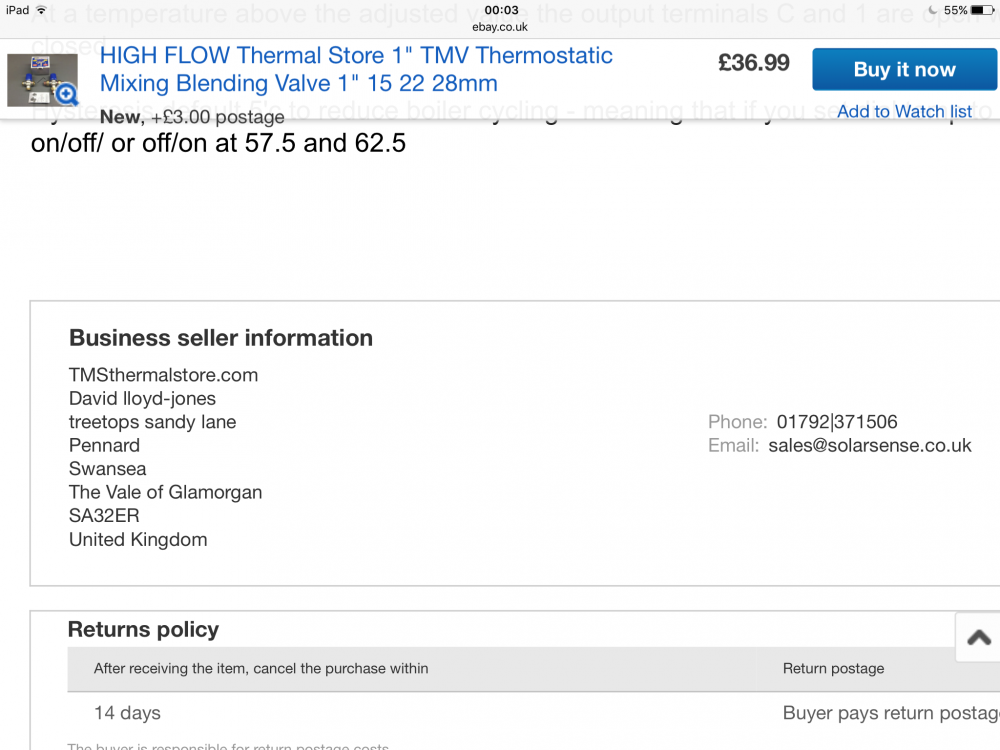
Evening squire As you've got 2x 15mm outlets on the SPV's which are combined to give flow from both units simultaneously ( in parallel ) then there is merit to go to the 28mm TMV for reduced flow restriction and increased litres per min at the set temp. The questions are :- Do you ever see that many hot water outlets being used simultaneously to warrant such a decision? Will the incoming cold mains be man enough to allow this max velocity to be a realistic consideration? The flow through a 22mm TMV is really quite high tbh, and to give one example I previously fitted a 450ltr TS for a customer which had 22mm TMV set to 51oC. I ran both the showers simultaneously and the kitchen sink and they all ran more than adequately. There was a 300ltr cold mains accumulator to reinforce the cold main so it could maintain these rates, but the hot side certainly didn't seem to struggle at all. It may have if a bath was in the picture but running the bath whilst 2 showers are being drawn is a bit extreme. Anyhoo, a fortune? Check this TMV out. And, drum roll please........... Wales delivers once again
-
Dual Hobs in Worktop, design vs structural engineering
Nickfromwales replied to TerryE's topic in Kitchen Units & Worktops
Agreed. Bold colours on anything other than ( interchangeable ) doors isn't a good idea IMO. I've talked some people out of crazy tiles, and after choosing again they've thanked me. Some people have told me to FO, and stuck with their first choice. One the other day walked in, looked at the tiles, squinted and said "oooo, they look a lot different when they're up, what do you think?". I smile and say they look lovely. That, plus the fact the adhesive has gone off and it's too late to pull them off and bin them -
Save your pennies for a new floor :-)
Nickfromwales replied to Nickfromwales's topic in General Flooring
Words are like weapons.....they wound sometimes. But not this time Stare at that damn penny floor until you love it. -
Save your pennies for a new floor :-)
Nickfromwales replied to Nickfromwales's topic in General Flooring
Oh, and thanks for keeping my bizarre flooring thread on point -
Save your pennies for a new floor :-)
Nickfromwales replied to Nickfromwales's topic in General Flooring
I couldn't understand why someone would want a donkey jacket, then I saw your ( soon to be uploaded ) avatar picture......
-
Save your pennies for a new floor :-)
Nickfromwales replied to Nickfromwales's topic in General Flooring
So are my going out clothes. ? -
Save your pennies for a new floor :-)
Nickfromwales replied to Nickfromwales's topic in General Flooring
My missus just showed me the LED splashback video. The coffee tables look the dogs bollocks. . Sorry, light cubes or whatever http://allthingsled.ca/2016/12/16/dec-16-16-demo/ -
Check this out for a flooring that'll save you a few pennies, or not
-
Delicate, annoying opportunism. Advice needed
Nickfromwales replied to ToughButterCup's topic in Planning Permission
Photographs taken with the daily paper in the shot are bombproof . -
This should offer some light relief.
-
Bath Surround / Boxing In, and concealed pipework
Nickfromwales replied to Onoff's topic in Bathrooms, Ensuites & Wetrooms
Set it up for now with the bath being the only thing that uses tank fed cold if possible. ? If that's ok I'll continue to add to this accordingly. ? -
Single and Double Pole RCBOs
Nickfromwales replied to Ferdinand's topic in Consumer Units, RCDs, MCBOs
Was it frozen?