
Nickfromwales
-
Posts
31377 -
Joined
-
Last visited
-
Days Won
345
Everything posted by Nickfromwales
-

Recommend a DHW tank ( unvented)
Nickfromwales replied to joe90's topic in Boilers & Hot Water Tanks
With a wet coil and an ASHP, and a 300ltr UVC, I seriously doubt if there is any need whatsoever for the instant water heater. Id just mount the cylinder stat lower and have the ashp kick in sooner to deal with higher DHW consumption. 2 or more showers isn't going to deplete that imo, but as your storing at lower temp I'd be tempted to go slightly bigger to give better redundancy, IF you ever see yourself having guests frequently. Forgive my poor brain, but are you having PV? -
Ok, I'm still lost. Inside the SunAmpPV's you have a recirculating loop which heats the primary side of a PHE, yes? The EV inside the SAPV is therefore not going to lend itself to the DHW circuit in your property. If I'm right in my assumption above then the previous is incorrect. Or I'm wrong and the primary is sealed and copes on its own with the EV being on the secondary side of the PHE, in which case I'll shut my mouth ? @JSHarris can you clarify, unless @TerryE is in a position to do so?
-
A picture speaks ( or in this case, saves ) a thousand words. .
-
Electric shower vs. instant water heater
Nickfromwales replied to Crofter's topic in Bathrooms, Ensuites & Wetrooms
Ah, just re-read this and you mean an ALL DC solar arrangement including a DC element. It may be worth looking at a higher kw AC ( primary ) immersion if going that route. Sounds like more complication TBH, so maybe just go AC solar and use the excess to power the fridge freezer or take @SteamyTea's advice and just pay for the electric on demand. -
Electric shower vs. instant water heater
Nickfromwales replied to Crofter's topic in Bathrooms, Ensuites & Wetrooms
Only problem with the dc route is you'd have to have one or both immersions on a changeover relay so you could 'mains boost' when hot water is being used en-mass. The relay ( contactor ) can be used to switch from dc solar to ac mains accordingly, remembering that solar will be of little or no use for the morning bathing, literally just offsetting the losses would be a good option though. Also remembr that you'll need a legionella purge cycle too so it'll need a time clock on the boost element to do a 1-2 hour heat cycle weekly. Edit : one or both immersions instead of both immersions -
Thought so. @TerryE, why do you think you need additional expansion? You'll have a lot of hot pipework for that.
-
The SAPV EV is for the primary side of their PHE is it not?
-
Beware of some glues and sprays as not all are for upvc . Some go horribly yellow after being sprayed with the activator so chose well for the finishing / makeup work.
-
Electric shower vs. instant water heater
Nickfromwales replied to Crofter's topic in Bathrooms, Ensuites & Wetrooms
Yup. You could chip a spud through one of those without missing a beat. . -
Crossed with J. Maintenance is an issue, "fleas with the dog" and that.
-
I'd only recommend one to offset the effect of a loo flushing or white goods filling. With your pressure and flow rates I'd leave space for one, and pipework provisioned accordingly, and have a live run for 3 months or so to gauge if you actually need one. Youll need a PRedV anyhoo which should smooth out the spikes ( flush valve closing and 1/4 turn taps being closed abruptly ) but even a small accumulator will significantly improve the delivery characteristics of such a healthy supply, ( and would facilitate having a higher set pressure at the reducer ). Having 30-50 litres of 'buffer' would be a good medium imo, so basically two showers running simultaneously and no noticeable drop in pressure when the aforementioned get used elsewhere in the property. The zimlet ones from PumpsUkLtd are robust and reasonably priced. My gut feeling is you will live without it.
-
Electric shower vs. instant water heater
Nickfromwales replied to Crofter's topic in Bathrooms, Ensuites & Wetrooms
They're a big name in pumps. Very good bits of kit. . Hudson Reed are another. -
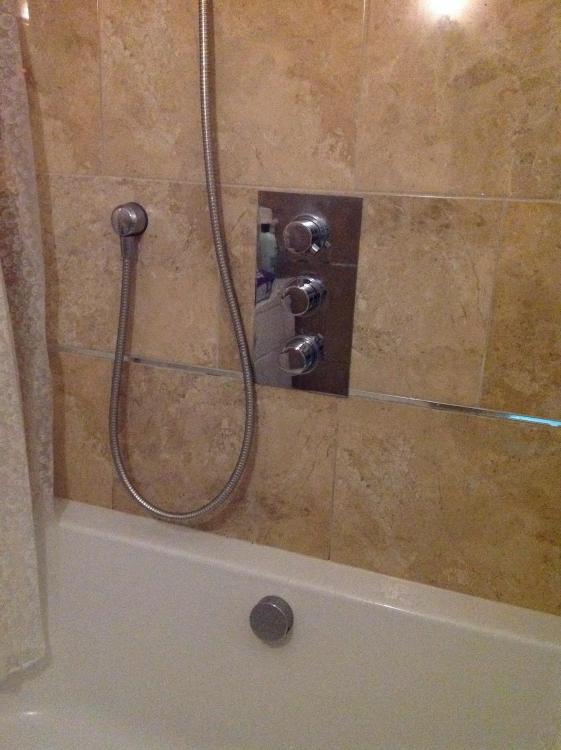
Just chop into the hot and cold in the attic space. You already have joints under the bath, so you could chop it in under there TBH, but personally I despise the thought of not filling a bath thermostatically as I hate to see a bath overfilled with scalding hot water and then cold water being poured over it to cook it back down ?. I also have heard about little ones accidental getting into the bath before the cold has been added and then getting scalded or even dying from the injuries ?. As I have 4 dependants, I have done what @PeterW is proposing, e.g. a thermostatic 3-way diverted and no taps. The only thing I wil say @Onoff is you'll have better flow rates through your tap and the separate TMV than I have through my mixer, but I absolutely didn't want taps on my bath.
-
Electric shower vs. instant water heater
Nickfromwales replied to Crofter's topic in Bathrooms, Ensuites & Wetrooms
Not just nice to have, but a requirement when your renting to 3rd party . You cant have non thermostatic devices fed from an instant water heater, electric OR combi. You have to cap the upper temp limit somehow with an UVC too, either by setting the temp on the cyl stat to 55/60oC or by fitting a TMV ( set at 50oC ). A secondary TMV ( 46oC ) just for the washbasin is a nice touch, giving excellent comfort, and you'll need to go down the TMV route here imo so you can set a higher storage temp ( to get away with having a smaller cylinder ). Dual or triple immersions are available so you can run one for storage and set the other to come on when the occupants are bathing ( boost ) to speed up recovery when it's needed most. -
Electric shower vs. instant water heater
Nickfromwales replied to Crofter's topic in Bathrooms, Ensuites & Wetrooms
? -
Electric shower vs. instant water heater
Nickfromwales replied to Crofter's topic in Bathrooms, Ensuites & Wetrooms
Do you have the link for the Ebay one? Edit : or just the size / spec / number of immersions etc? -
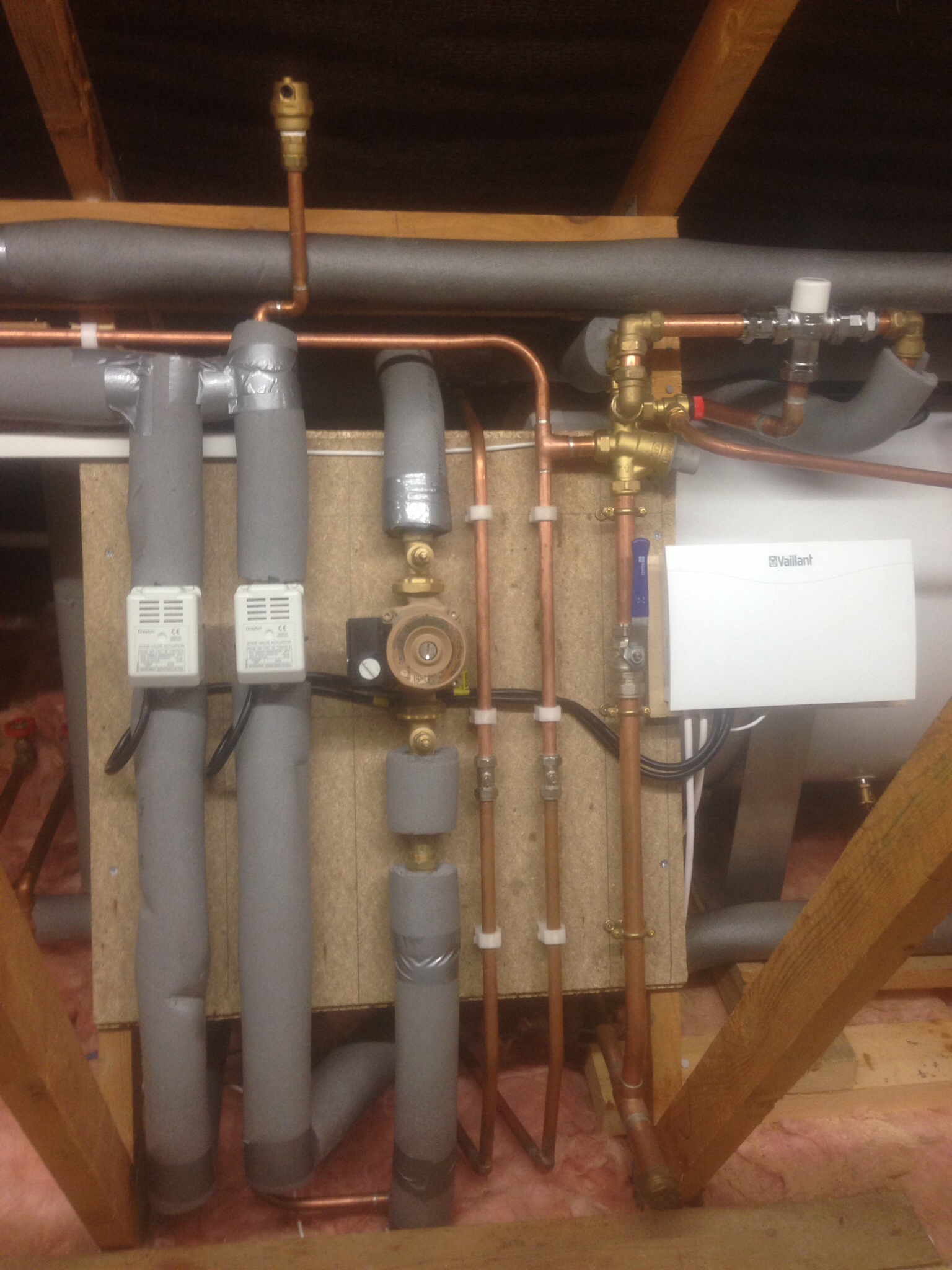
Well, I'm happy to say, you've got the job You can start Monday. Looks neat and tidy to me, and the manifolds are a great solution for negating end-of-line isolation ( and access to more so ). Soldering 28mm is almost a skill in itself. The heat at the front of the fitting doesn't always get all the way around the pipe, so most get a dry patch at the rear of the joint, unless the heat has been applied evenly around the whole fitting. Having a dented pipe is a bitch, so you can't lose brownie points ( remember those ) for the duff joint . 9.5 out of 10. I can't give you 10 sorry, as that may steal my thunder.
-
Electric shower vs. instant water heater
Nickfromwales replied to Crofter's topic in Bathrooms, Ensuites & Wetrooms
The expansion vessel goes with / alongside the uvc. Some are integrated into the physical cylinder size eg there is a false top to them with the EV inside. You can even get bubble top cylinders which trap a pocket of air in the top for expansion to negate the EV. A sealed system is far less likely to give you grief IMO, but your stats are undeniably attractive . Maybe best to consider the use for this situation, as its a renter, and I'm allowing for one shower after the other, up to 4 showers in succession, at any one time. If they're ramblers, then the same of an evening. That's a chunk of DHW and they won't want to be disappointed. -
Electric shower vs. instant water heater
Nickfromwales replied to Crofter's topic in Bathrooms, Ensuites & Wetrooms
You wouldn't spend all that money on an uvc and then strap it into the Delorian and take it back to the 60's by venting it and adding an open tank . If the decision is to go vented, then you buy a copper cylinder for a few hundred and a placky CWS and off you go. Reasons why not to? Cost. Complexity. Increased heat losses. Risk from having tanks in the attic, leaks etc. Incompatibility from mixed pressures to devices such as mixer taps and mixer showers. ( imbalanced hot and cold ). Needing to buy, fit, and maintain a pump for decent pressure. ( Certainly useful if your cold mains is crap ), but as @Crofter has stated his is good, so why would you steer away from good pressure, fit an open gravity system and THEN go and buy a pump to get good pressure ? Oh, and my favourite........My personal dislike of bathing in water that comes from an open tank, born, I guess, from me taking out so many with feathers, fur, and skeletons of its victims still at the bottom . Yuk. I did think about you getting a bit of uplift from fitting a huge CWS in the heated loft space and using that to 'assist' with water sitting at a bit above ambient, but the reality is it would just about nip at the problem. Plus, you'd have to store enough to get you through the mornings ablutions, and fit a solenoid on the fill valve to stop cold water entering during the morning, thus killing off any stored warmth by pouring cold water over it. Its an UVC for me here. Simple, reliable, and if sized correctly and fitted with multiple immersion or one big 6 or 9 kW one, you'll have no major issues with running out of hot water. You'll then still have ample headroom in the electric supply to have a decent induction hob. Remember that an instant and a decent hob will want upward of 80amps if running simultaneously. Might have to turn the telly off to have a shower, If power cuts are a problem, and it's a rental, dual fuel is a real consideration that shouldn't be discounted so quickly. Fitted a dual fuel LPG range in the last rental that was out in the sticks. -
One of the reasons I haven't been kicked off here yet, I'm the fall guy Maybe I can bribe @SteamyTea with an 80 pack of Tetley to actually calculate how likely I am to be hit by said comet. INCOMING!!!!!
-
Leaded solder is certainly duller, and dullens quite quickly, after soldering and cleaning the joint initially. Anyone who wanted to establish the use of leaded solder wouldn't struggle tbh, but I doubt if the question would ever be raised, ( or that the BCO would actually give a shit ). If you TOLD them that you've used it that's a TOTALLY different thing, so keep quiet, lie, or use lead free. Simples. TBH, I now prefer soldering with lead free, but hated the stuff when it was first made mandatory. As Jeremy has said its a pita to adjust, but with me soldering literally thousands of joints I've soon forgotten about the differences. As terry said, forget trying to sweat ( solder ) a copper tail to a lead cold mains with lead free solder. You must use leaded for that and then you realise that leaded solder is far easier to form a 'shoulder' with, often referred to as a 'wiped' joint. If you REALLY want to split the atom here, you could happily use leaded for everything other than the drinking water eg all the heating and Ufh / ashp etc as the lead will be 'contained' to the sealed systems separately and away from human consumption. You've got more chance of being hit by a comet than dying of lead poisoning from soldered joints in a domastic install. What a load of bollocks. .
-
Electric shower vs. instant water heater
Nickfromwales replied to Crofter's topic in Bathrooms, Ensuites & Wetrooms
Ok. A LOT of options and info here from many different perspectives . With the quality of your build Rob, it's clearly possible to heat electrically. ( edited to add : so basically ruling out the need for an LPG boiler / combi ). Just how much electricity do you have available? Instants of any decent size eat through electric and drawing 50-60A is typical. Soon starts adding up . I can't recall what your doing for cooking. I assume you'd prefer to go all electric, but hopefully you've decided on an LPG hob at least? I'd recommend that option in a heartbeat as not only does it free up some juice, it also gives you means of cooking / boiling a kettle in a power cut. I think this is all getting over complicated, just to avoid a quick annual G3 inspection, which is a step in the wrong direction imo. This install screams UVC to me, and it's a no-brainer. Balanced high pressure hot and colds throughout, mixer taps and thermostatic shower mixer and shut the door. Simples. Have the UVC anywhere you like as you e got warm roof space, iirc, but I'd put it in the habitable area to create a warm airing cupboard if possible. I've fitted a 210 Ltr ones in a standard 600mm kitchen larder unit, ( in a hairdressers ), so they can be integrated with a bit of forethought. Similarly they can go into a fitted wardrobe space / similar too . Better to have the bit of heat loss used advantageously if poss so in the airing cupboard would be the No.1 choice here afaic. You can have an UVC made bespoke with 2 or theee x 3kw immersions. This would give you options of a smaller cylinder but faster recovery / re-heat times. You'd have to store at around 70oC for that option and blend the output at ~50-55oC to maximise delivery vs size. A basic, robust thermostatic shower valve will come in change of £100 and you've got a high pressure / high flow shower that will knock the occupants socks off. With your good cold mains pressure, there will still be enough headroom for someone to run hot or cold water from the kitchen sink / washing machine filling. Regarding the shower as an aside, let's not forget about tank fed electric showers ( like the Triton T80Si 'pumped' ) which has an integral impeller pump and gives the same electric shower performance ( better actually ) and convenience as a regular cold mains fed electric. -
The secret is :- 1) Clean pipe. 2) Mild NOT self cleaning flux ( dont use Laco / Powerflux etc ) I use Telux. 3a) Not too much heat. When the flux fizzes and starts to evaporate away, that's when your near to overheating the copper. Also, I use a flux brush to coat the internal of the joint but also to lightly coat the solder so the fitting gets re-fluxed as your soldering. Makes for clean sound joints. Remember to allow the joint to cool naturally after soldering is complete. Leaded solder is more forgiving but lead free isn't at all, and if shocked during the early stages of cooling, it will fracture like honeycomb. 3b) In support of 3a, buy a good torch with a 'volume' control so you can get the flame size according to what your doing. Oh, and as said, ask three times, measure twice, cut once
-
Wanted: 92.5 degree double branch adaptor (110mm)
Nickfromwales replied to ProDave's topic in General Plumbing
Yup. I strongly dislike those. Solvent or nowt under the boards / boxed / tiled in. -
A good time to add that Hepworth pipe is a LOT more flexible and 'user friendly' than JG SpeedFit and such others . Doing as @JSHarris said with the latter would be nigh on impossible.