

Nickfromwales
-
Posts
30336 -
Joined
-
Last visited
-
Days Won
297
Everything posted by Nickfromwales
-

Brickwork damp patch after prolonged heavy rain
Nickfromwales replied to readiescards's topic in General Construction Issues
Obviously there's a reservoir there filled with rainwater. That should be a relatively quick fix. To advise any further we would really need to be up some scaffolding poking around . -
Draw string. Too many days pulling cables in too many different places lol. sorry
-
Insulated foundation ( passive slab )
Nickfromwales replied to Russell griffiths's topic in Building Materials
? 2 sheets of of 100mm EPS can be carried by one man. That negates over half a m3 of concrete ! Why on earth would you actively remove insulation from under your heated slab? 200mm of eps isn't exactly poor, but not as good as 300mm. Also, the additional weight of flooding to the full ring beam depth may push your groundworks and S/E costs up so I think this option is a ? ? Ask yourself one simple question...."Should I be buying more concrete unnecessarily, or fitting more insulation that will serve me better over my time in the property". Fwiw, I'm constantly arguing with customers 'builders' over slab construction, and specifications of, when I'm fitting UFH and screed after they have left. For some reason they prefer to pour ridiculous amounts of concrete into sunroom / conservatory / extension slabs instead of using more insulation. I can only imagine it's because that's how their great gran-pappy used to do it "during the war" and he didn't get any complaints. That and the fact that they won't be contributing to the additinal energy consumption that the poor floor type will cause . -
Good luck with that, sir Get some cheap drain rods and use those to send a new fish rope through. Oh, and tie a new fish rope onto the Swa when you pull it for Justin ?
-
Floor bounce - PosiJoist Floor Vibration checks
Nickfromwales replied to readiescards's topic in Floor Structures
I would expect to see, and would have fitted without being asked / instructed, full depth noggins at the joist ends just before the hangers. Even better would have been a full depth timber wall plate. Agree with @JSHarris a photo with more detail would have been beneficial but it doesn't look from the photos that the joists penetrate the wall ( for end restraint ) ? I know what my reply to that would have been..... -
Floor bounce - PosiJoist Floor Vibration checks
Nickfromwales replied to readiescards's topic in Floor Structures
Simple. Pass it to the person you paid money to. -
What are you waiting for?
-
Floor bounce - PosiJoist Floor Vibration checks
Nickfromwales replied to readiescards's topic in Floor Structures
You can only survey this with a laser and the floor exposed ( carpets up ). Also, you can't measure where the boards meet as they'll likely have cupped slightly, or a lot, with weather / exposure. -
Simple physics. If the slab gets to say 35oC surface temperature ( so becomes an emitter of heat ) and the watts per m2 it's chucking out is greater than the heat loss ( fabric AND ventilation ) of the house then the house will warm up. The flow temp, as set on the manifold TMV, is selected according to how the slab absorbs and dissipates heat, so no two jobs will be identical. How much insulation is under your 75mm heated slab?
-
You at the cider again ?
-
Bath Surround / Boxing In, and concealed pipework
Nickfromwales replied to Onoff's topic in Bathrooms, Ensuites & Wetrooms
Put the receiver under the bath -
Bath Surround / Boxing In, and concealed pipework
Nickfromwales replied to Onoff's topic in Bathrooms, Ensuites & Wetrooms
Roberts ya muvvas bruvva -
Bath Surround / Boxing In, and concealed pipework
Nickfromwales replied to Onoff's topic in Bathrooms, Ensuites & Wetrooms
I've just literally quoted a job ( well JUST before my poxy arm injury ) in a brand new static caravan. I saw these in my local TLC and thought they'd save a lot of trunking. Deffo will be featuring in bathroom jobs of the future. The ones I DO love are the sensor / proximity ones that @PeterW linked, where you put the sensor behind a tile / other, and simply swipe your hand past it to bring a light / other On or off. That's the dogs bollocks, but for a lesser budget these Kinetic ones are superb. ? -
Bath Surround / Boxing In, and concealed pipework
Nickfromwales replied to Onoff's topic in Bathrooms, Ensuites & Wetrooms
Nice lights. . -
Rain noise on steel sheet roofing
Nickfromwales replied to albert's topic in Roofing, Tiling & Slating
I'd spray on a Shultz tote coating, the stone chip stuff that typically gets put onto car lower panels, sills prior to spray painting them, commonly referred to as stone chip. That's should help a lot, and be easy ( but messy ) to apply, but ideally would have to be applied after the roof is up. The dense rubber mats, available in 8'x4' x 1/4" - 1/2" thick as an underlay may also help out if you don't have the means to go for the much deeper cellulose filled cavity. Layering will need some thought to avoid it sweating. -
A long long time ago...
Nickfromwales commented on curlewhouse's blog entry in Sips and stones may break my bones...
A worthwhile trudge, none the less. . Pics are a quick n easy way of updating . -
The tray and overflow pipe is just so much easier and requires no thought. Run the discharge pipe over a door or window so you can see it's leaking reasonably quickly. Dont forget a simple easily accessible means of local isolation, like a 1/4 turn lever valve.
-
Floor bounce - PosiJoist Floor Vibration checks
Nickfromwales replied to readiescards's topic in Floor Structures
Agreed. @readiescards, do you have pics of the floor you can upload ? One option here, as a retrofit fix, could be dropping the ceiling underneath and inserting some engineered, full depth noggins at say the 1/3, 1/2, and 2/3rds points along the length of the span. These can be made like a horse shoe to allow existing services to remain in place, so basically a pair of U-shape 25mm plywood baffles, one inserted with the mouth down, and the other overlaid with the mouth up. These then get glued and screwed together, then a pair of 50x75mm noggins get affixed to those and then to the top and bottom chords, again glued and screwed as well as practicable. Sash-clamping these so the glue is able to form a void free bond will be key to success, but a foaming PU GLUE will help a lot. Another belt and braces ( again retro solution ) measure will be to affix 18mm plywood to the underside of the joists before fitting the new plasterboard. That'll stop any remaining bottom chord movement, and hopefully that would stop the issues your having in the room above. -
Floor bounce - PosiJoist Floor Vibration checks
Nickfromwales replied to readiescards's topic in Floor Structures
Checking to see if there is already a static, negative deflection may be somewhere to start ? -
Floor bounce - PosiJoist Floor Vibration checks
Nickfromwales replied to readiescards's topic in Floor Structures
600 and 400 are chalk and cheese. I did a job for a customer where the TF company specified 600mm centres. 1 runs of strong-back, 22mm p5 deck, glued and gas nailed, and still the dynamic deflection was horrendous. Fitted wardrobe doors seen moving etc. The deflection for static loading and dynamic loading are what you need to translate, as obviously it's the walking around / other activity aka dynamic that's causing issue. Can the company that specified them answer your questions ? -
I went to one leaking copper cylinder when young and keen ? and grabbed the cold feed pipe to show how bad the corrosion was, and that it was there that it was leaking from. As I put my hand on the pipe it pushes into the cylinder and the entire contents ( 115l or so ) emptied into the room in the wink of an eye. It presently disappeared into the floor void and all I could hear is the kid downstairs saying "mummy, the tellys gone off". Every drop went down the back of the telly, dvd, sky box etc. Another top day at work. They went through their own insurance after I took a photo of the knackered Union as I pointed to the hole in the living room ceiling where it was evident it had been leaking for years before I got there. Still got the old pulse racing though. ?
-
So many 'plumbers' don't bother with doing that, but most sinks have a terrible cast where the tap sits, and cheap taps have a terrible nasty rubber o-ring and nowt else. That usually covers less than 2/3 of the hole. It's fatal with a shower over a bath but also not helped along by the fact most people inadvertently buy a standard bath instead of a dedicated shower bath, the latter has flatter sides and slowed decks to guide the splashing water to the drain. They have a much better finish and mate the taps far better.
-
The fibre washer will suffice on its own, and do not use PTFE . The number one thing is getting a bit of emery cloth and cleaning the boss immaculately before fitting the new one. Remnants of the old washer is the number one cause of leaks. Whilst full and in use, connect a hose and open the drain off, as that'll be your biggest nemesis. Once you open it and prove it, that's one thing less to piss on your chips. With the immersion, get hold of the obligatory box spanner, but do all you can to get hold of a 3' stillys as that'll make cracking the immersion just so much more controlled. A bit of patience and effort there will pay dividends. There's no real advice other than to make sure your turning it, rather than pulling it off centre. It's quite hard to keep an eye on that as your perspective changes as you stand up. It'll either turn or it won't. If your tank is in any half decent shape then I'd go for @ProDave's method of keeping the cylinder full so it's counter weighted ( with the cold header tank empty first of course which will happen just by turning off the mains and opening a hot tap ). If you fear it'll fail then empty it slightly so the water level is below the boss. Iirc you have a shower pump. Remember to isolate the pump as this process will disturb all the sediment. Open them 24 hrs later when it's all settled Enjoy.
-
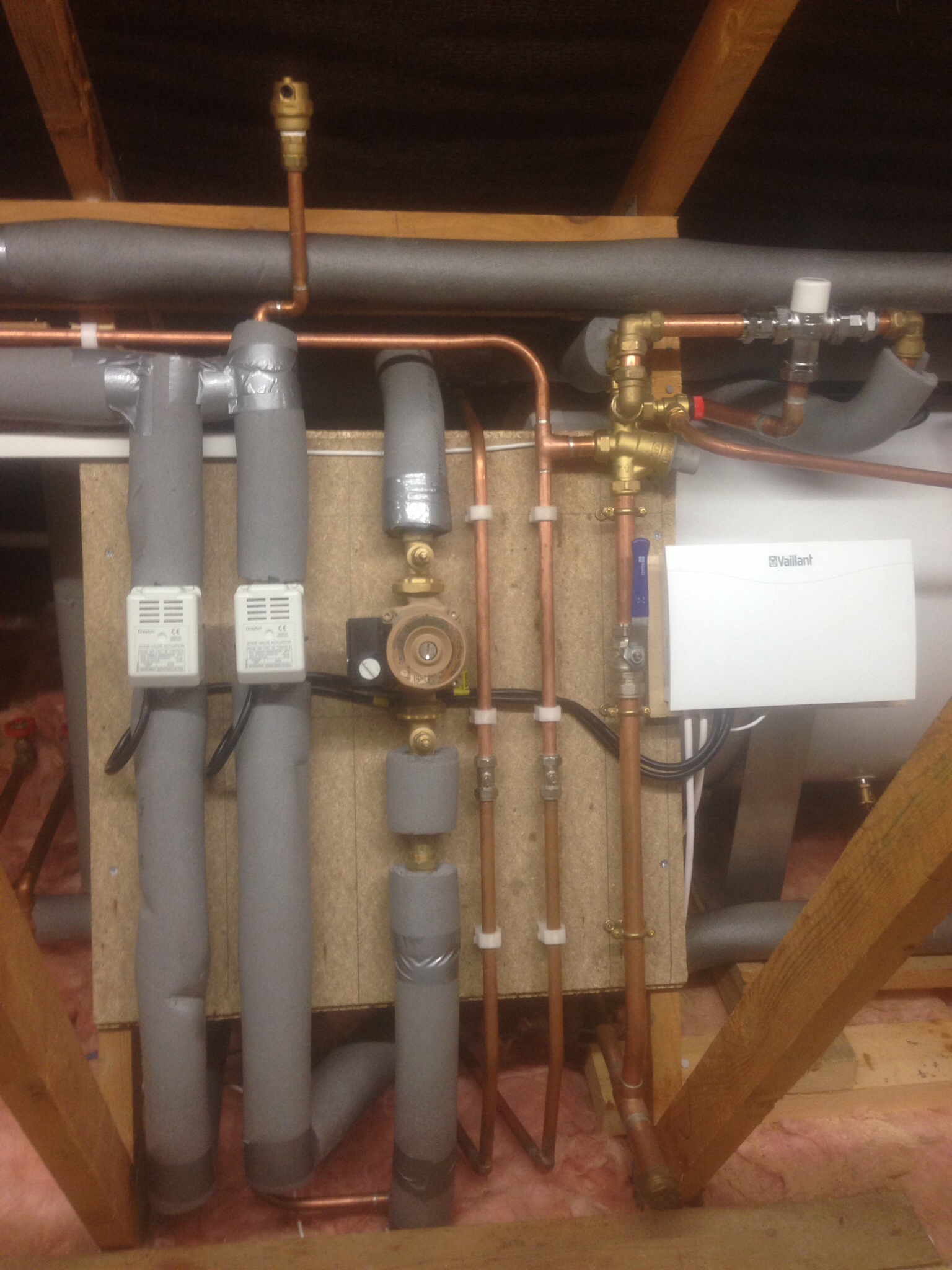
Basically that's what I would do. I've stuck a lot of stuff in attics over the years, then I spoke to a very helpful chap iirc from Pumpsukltd and he mentioned making a large glass fibre drip tray with up stands for all the equipment to sit on / in. From there a Hepworth trap and an overflow run in 32mm waste pipe, so basically a big shower tray.
-
Bath Surround / Boxing In, and concealed pipework
Nickfromwales replied to Onoff's topic in Bathrooms, Ensuites & Wetrooms
Just squinted at that revision after coffee #2, and I think the pockets should go up one course. Apart from that, pure perfection. Slightly wider mosaic strips to get the cut tile out of the way? How many other vertical strips are there, and would them being widened to match cause issue?


