

Nickfromwales
-
Posts
31388 -
Joined
-
Last visited
-
Days Won
346
Everything posted by Nickfromwales
-

Vaillant high(er) temperature ASHP?
Nickfromwales replied to Nick1c's topic in Air Source Heat Pumps (ASHP)
Check your building insurance as not having this in a block of flats left a L/L with a bill of over £30k to pay out of their own pockets. 1. Heating your tank will cost less than a quid, if you do it midday. I'll give you the quid ok 2. Up to you. 3. That will not satisfy G3. End of. The pressurised cylinder categorically must have a stat on it that arrests the input of heat. 4. Your'e not qualified to do it. 5. See 4. It's the wrath of your wife that'll see you 6' under if you have a failure and the insurance doesn't stump up After all the money you saved building your own home, had you not factored just paying for the things you have to pay for...........? Disclaimer; I'm not actually going to give you the quid as I know you'll take it ! Ha ha. -
Vaillant high(er) temperature ASHP?
Nickfromwales replied to Nick1c's topic in Air Source Heat Pumps (ASHP)
Significantly higher when you heat the HWC via the immersion ( from excess PV ) where the cylinder will spend most of the summer at >70oC Fear not! I have ? an F-Gas qualified fitter coming on board full-time in the next few months if all goes well ( and we can work together, e.g. he can deal with my OCD ). I'd be VERY interested as to how those figures were arrived at......I'd bet my arse, no further comment required from @Barney12, that it was not in a real-life install with all the connected pipework in the equation. You won't keep the losses lower than a Sunamp! Temp range vs losses are relative, so if you reduce the temp that the SA stored at you'd have even lower losses stated from that. Apples with apples please!! Have you factored in G3 annual service / maintenance / inspection? Over the first decade you are set to invest a minimum of £1k in paying someone to come out and say "that's nice, whadduzitdo?" FYI, A PROPER annual G3 inspection comprises of; Run off all of the stored hot water until the cylinder is cold. Turn the heating controls on and stand there whilst it heats back up again. Witness the temperature that the cylinder gets to / that the cylinder stat tells the heat source that the cylinder is satisfied and shuts off demand and that the zone valves etc are functioning correctly. Test all the pressure reducing / pressure relief valves ( which usually starts the PRV prematurely leaking after a few years e.g. so nobody ever does it!! ). Shut off and drain down the pressure in the cold water side and then check the pre-charge level in the expansion vessel. Not doing that is the #1 cause of early pressurised cylinder failure. See you the same time next year to do that all over again.......... Item 5 above is the only thing you have to do with the SA unit, and its easy to do that DIY ( e.g. you don't need to be G3 qualified ). In 20 years the SA will have paid for itself, and in 20 years the pressurised cylinder will have cost you 3x what it costs to buy. ? -
Vaillant high(er) temperature ASHP?
Nickfromwales replied to Nick1c's topic in Air Source Heat Pumps (ASHP)
50 dollar? -
Vaillant high(er) temperature ASHP?
Nickfromwales replied to Nick1c's topic in Air Source Heat Pumps (ASHP)
I’m chewing through some “inside information” atm, and I’ll update accordingly ? -
Vaillant high(er) temperature ASHP?
Nickfromwales replied to Nick1c's topic in Air Source Heat Pumps (ASHP)
Yup. -
Vaillant high(er) temperature ASHP?
Nickfromwales replied to Nick1c's topic in Air Source Heat Pumps (ASHP)
I'm currently in talks with a few people to try and reinvigorate awareness of the possibilities for such devices in the domestic sector, and to get the CO2 ASHP's into the stock piles of the various manufactures / suppliers. Slow take-up at the moment as it's considered uber-niche. Good to hear Vaillant are on board. I am trying to find some stray units in the UK to go into current, ongoing projects, where they would "do just nicely". -
Strong, like bull..... If only the beer hadn't run out, we'd have stayed and lagged it all. Tight-arse.
-
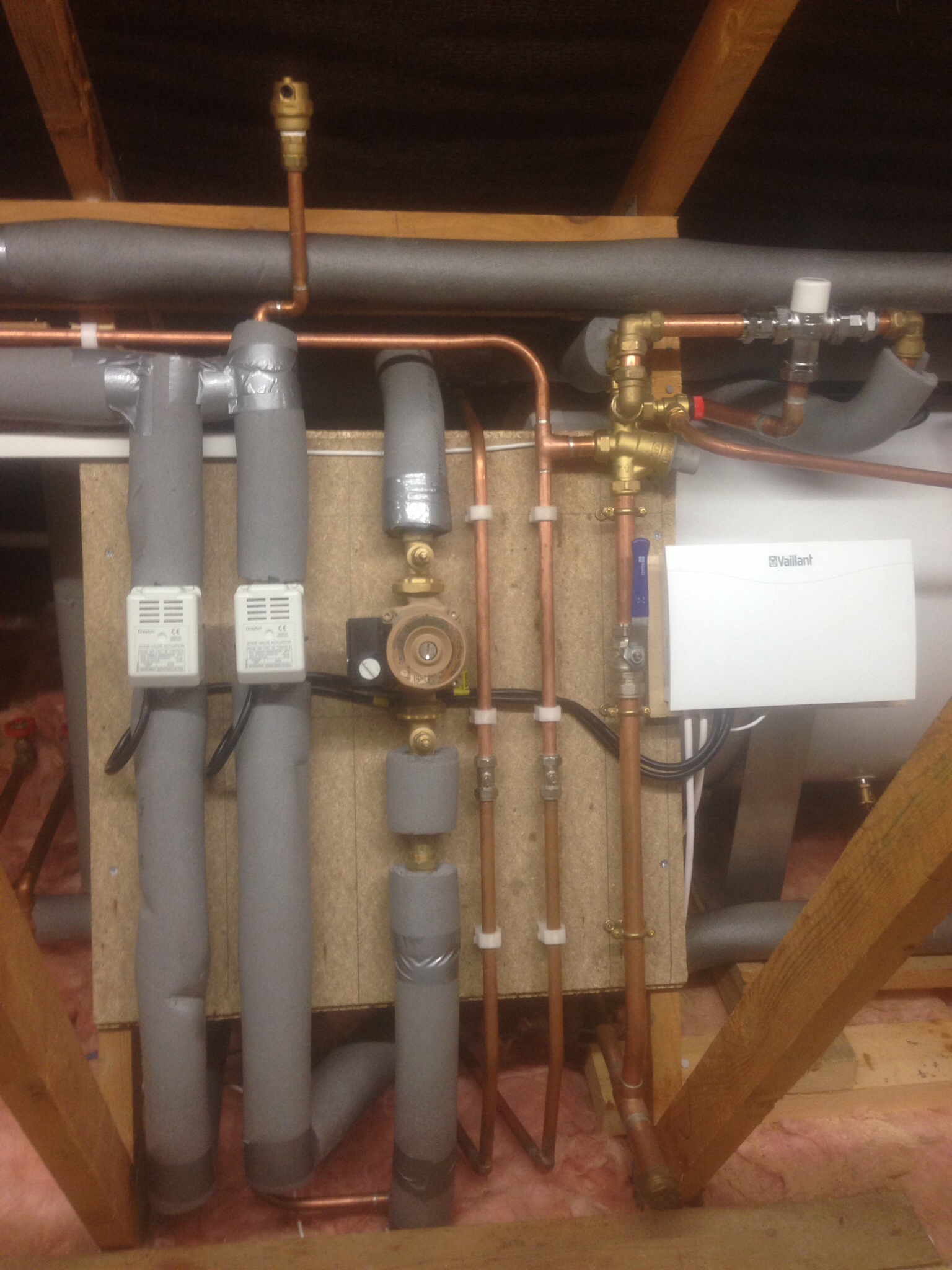
@Benjseb @dpmiller This is a bit confusion here about what actuators go where. @Benjseb you need to bin the TMV you have as it is “a bit shit” as you say at these low flow / temps. I fit Ivar blending sets which work reliably down to 20 degrees at full flow potential. Utterly seem-less in operation and accurate as hell. You can fit the Salus heads onto each individual port and the open the flow regulator ( the bit that shows L/P/M flow rate ) fully as the Salus gave two flying leads ( thermo capillary ) which tell the actuator to open 100% ( until return is coming back hot ) and then to self regulate the L/P/M flow rate to that individual loop. That means short loops cannot bypass and cause issues with bigger loops being starved. You can then, if required, fit a single Salus actuator onto the blending valve instead of the supplied manual one. Clear as mud?
-
The body of the unit will get warm to the touch by comparison after first running stone cold water through it. Just being able to feel the bits you have exposed should suffice. One will stay chilly the other won’t.
-
Yup. Put some pipe jointing compound on every face that meets another. Don't leave any excess inside the bore. Don't over-tighten, same force as the standard compression stuff.
-
Good point. That's what I did before to diagnose a duff NRV in a shower after we fitted a new combi and the customer was trying to blame us. That was the first time I came across this problem. A bugger to find on your own doing process of elimination ( cutting ad capping all over the place !!! ). Every day is a school day.
-
Showers should fly after that is gone.
-
Take the 28mm pipe out of the 1/4 turn lever valve and renew from there. Put a 28x22mm internal reducing set into the nut instead of the olive and thatll get you back onto 22mm pipe from the valve. Keep the top brass nut and fit your straight connector into there. Fit the tee to the horizontal pipe, should fit on the same nut, and just fill in the gaps with 22mm pipe.
-
?
-
-Use compression fittings -No. Chop the MB out and try the bathrooms first. -If it all goes wrong, we never spoke OK.
-
Honest answer, No. You'd need to get a copy of the certification from the manufacturer, even more so if you deliver water to 3rd parties.
-
Not actually seen it done, so another physics lesson for me then Just thought it may have alleviated the issue around the pipe. Bigger pump and suck it up there. No worries, I'll just sneak in later under the cover of darkness and delete my ramblings.....
-
Absolutely. That's the reason I am saying that you should cap the redundant one that will be left open ended after you remove the MB. Otherwise if the TS ones open and discharge the water will squirt out of that then open end. Comprendez vous?
-
Yup. Make sure you put a cap end on the discharge pipe so you don't get ant back-flow / draughts through it. OK. Just a bit OTT that's all. The lot should just fill of the one boiler loop? It's all one unified body of water
-
That's a LOT of 22mm pipework for that many radial runs too. Probably contributes to a lot of extra delay getting hot water out of the basins. ? Looks neat with him though Why 3 x filling loops?!?
-
3 Bar max is the cylinder rating NOT the coil rating You 100% do not need it, and it's strangling your flow rate which is why the shower is a bit crappy. Lose the MB, link through and give it a test run.
-
Why limited? I'm on about from a tank, not direct off the mains.
-
What about sucking the water up to the midway break tank instead of pumping up to it? And then pump up directly to the dwellings into 500L accumulators to buffer out your max demand. You can add as many of those as you like afterwards, which minimises capital expenditure and gives a full start to finish solution that's future proof. If umping its good to remember that you'll be into fitting accumulator of some capacity to smooth the delivery of pressurised water to the domestic outlets within the dwelling. I stay in a hotel where one of his drinking buddies fitted a pump direct to the hotel hot and cold network. Nothing.......nothing......tidal wave. Great. Suck water up with 2 double check NRV's in line to stop back flow, and that should deal with the pressure issues pumping from the ground. Depends how big a tank you can fit at the bottom of the run though, because if its big enough you will only need the treatment midway and you then pump in much smaller volumes from there to offset whats been drawn from the accumulators. Circular MDPE should be good against vacuum deficit / collapse so ok for suction ( AFAIK ).
-
Then you should NOT have that multi-block in there at all !! That was supplied by your plumber then, because Trevor doesn't send multi-blocks out with a TS as its not a HWC but an instantaneous hot water heater with a coil volume of less than 15L. The coil in the TS is good for north of 7 bar ( nominal ), and rated at 10 bar ( max ). Get rid of that and watch what happens to your flow rate to the shower Are you 100% sure the cold feeds to the same bathroom come from the balanced cold outlet of that control group ( multi-block ) ?
-
Do you have a TS or an UVC?

