
Nickfromwales
-
Posts
31388 -
Joined
-
Last visited
-
Days Won
346
Everything posted by Nickfromwales
-
? You could introduce it at the manifold if you are happy to fit an inline coupler. Would be experimental though as it would be pre pipe resistance.
-
Noise. Ball valves sheer the flow of water and create a horrible 'rushing' noise, whereas fitting one of these at the outlet connection is near silent by comparison 2 different definitions; Flow regulator / attenuator Isolation valve ( rotary / screw / lever )
-
Nope. On or off, isolators NOT attenuators Flow restriction always at the outlet.
-
They become quite noisy if you do that. If you're going to strangle the flow then fit a restrictor in the outlet. Beware reducing the flow to WC's as they'll take forever to fill and get on your nerves when you flush the loo at night. edit : restrictor ( not reducer )
-
Permission granted......
-
A thing of beauty. How come the outside tap is coming off that? The O/S tap should come off either directly after, or even better, before the stopcock to the house. Tee-ing off there would be a huge drain on flow for the showers, but if it's not used much don't panic.
-
Zoot, you don’t fully contradict yourself, but what you say in one post does not marry up to what you state in another. A builder you cannot speak to, or instruct, for fear of them packing up and walking off site is an asshole. Simple. You sugar coat the situation, even though I’m not sure you realise you’re doing so, ( and that’s not picking fault btw I’m genuinely concerned for you here ), and the relationship is hugely unhealthy from my simple interpretation. To be clear, there is no pack mentality here, just individual members posting their thoughts / observations You started this thread to get help / feedback / relief / confidence etc and therefore you must accept what had been written as CONSTRUCTIVE, as that’s exactly what it is ok ? Fyi if I spoke to / behaved around my customers like these bullies do then I’d be out of work and rightly so. They’re not the best builders at all, and I think you’d get better builders with ease. You’re clearly a little intimidated and apprehensive to cause ripples, but you haven’t got out of the ground yet and you’ve had your third litter of kittens already! Fantastic / amazing builders wouldn’t have f.ucked up the foundation level, end of. You're being given no opportunities to discuss / interject / guide and that is fatal. Were here to help so stop biting, also the advice you’re being given is free and impartial, so take a deep breath and look at this glass as half full not half empty please. Right now this feels like taking a horse to water but no drinky-drinky. Explain that you will NOT be paying anything for the founds to be made up to the height that you indicated before work commenced. Simple, and end of ? Their fcuk up, their problem to sort. If they walk off when you state that, good bloody riddance and hello new day and new builders. Either what you’re saying isn’t the full story, or you simply cannot see you’re being bullied. Have that chat, stem the anxiety of speaking with them, and set a standard for how things are to roll forward. Have a cup of tea and a digestive biscuit before replying. ?
-
Just cruel..... Funny, but cruel.....
-
Wise words. Well, except the "Erk" bit lol. It was more the principal than the actual unit So pan on the end wall ( facing the door ) and basin on the shower wall? Have you drawn this on graph paper to see what circulation space you have left?
-
Something like This?
-
Put the sink indirectly opposite the WC ? At 1200mm it won’t be usable as a wet shower eg open ended. Just won’t happen.
-
With respect, most of what you have written here does not reflect such a rosey situation. It may be how it's portrayed / worded by you, but there is some writing that's on the wall here I'm afraid. Next time there is a kettle brewed maybe ask #2 to sit alone with you, away from the crowd, and discuss 'next steps' to your OWN satisfaction. You need to slow the pace between client & contractor here, and ensure you retain a voice. A loud, polite but firm voice. It sounds as if there is more momentum than clarity here. I thought you were going to have a heart attack over your concrete pour!!!!!! That wasn't in ANY humour.
-
B = min 1000mm A = Moot, as it isn't stopping all of the water. 300mm fixed panel would stop water getting at the corner of the floor / tray junction. In honesty, this is too small a tray to be open. Minimum tray size for 'open ended' is 1600mm AFAIC, but 1800-2000mm better. Plus then you wont need the A panel.
-
Just sack the prick if he says that to you. Are you under some disillusion that they're the only building team in Wales? I would stop work now and meet up with #1. If you carry on as their pet, instead of their customer, FCUK knows how the rest of the build is going to go, or more importantly what it will do to your health. As you stated, you haven't paid anything yet so a quick reminder of that wouldn't go amiss here I think. It's quite nauseating to hear how you are being talked to / treated here if I'm honest. You SERIOUSLY need to hit the reset button here and cut off the problem AT SOURCE. That means a meeting with #1 before any more work is carried out on site. If you don't stand up for yourself now then you will be almost at fault for allowing this to become business as normal. Get a handle on this now, as it will grow horns and you'll regret a lot of the decisions made, after paying for them of course. I wont say exactly what I would do to the (expletive deleted)wits who have caused you such other grief, but the dog shit would have been packed into the holes in a dozen engineering bricks...... one for each window. The one thing I cannot tolerate from anyone is them being obstinate or just plain rude. Those types soon realise what happens when an unstoppable force meets an immovable object
-
Remember in very adverse conditions, heavy clay being one, I would recommend fitting more than one run of french drain. Cheap enough to buy, and a very good place to have such redundancy ( bearing in mind that you have already dug a trench, so why not double up anyway ). Builder may scoff at that idea, but I would persevere and just tell them to do it as it is your wish. Make sure the pipe is covered with Terram / other ( weed membrane ) to arrest the influx of silt / other unwanted spoil.
-

A charity with self-build track record
Nickfromwales replied to tonybythesea's topic in Introduce Yourself
Hi Tony, and welcome to BH. You can post that here, but please feel free to peruse the sub-forum headings for any differing enquiries -
One piece is always best, and there are some nice ones out there nowadays with plenty of colours / finishes etc to choose from. Fiora was the make of the last one I fitted.
-
Shower tray at floor level
Nickfromwales replied to Pocster's topic in Bathrooms, Ensuites & Wetrooms
Not asking for trouble just looks a bit nasty imo. Looks like the floors been over-laid during the last make over kinda thing. To try and seal a flat floor to the flat surface of a tray is just horrible. It’ll never look nice. Do as I normally do, and as @JSHarris did and just leave 15mm or so above the finished floor level ( FFL ) and don’t bother with the up-stand. FYI I only recommend up-stand trays for rentals / student digs as they’re bombproof. Just a horrible gap to keep clean but easily done quarterly by the landlord ??. 1000x760 is a cracking sized shower so don’t moan about that, just be sure to not put any clutter on the sides so you can throw some shower shapes in there ? -
Shower tray at floor level
Nickfromwales replied to Pocster's topic in Bathrooms, Ensuites & Wetrooms
Bastard of a detail to seal and maintain. Are you referring to a regular tray with an upstand? -
How far into the room is the supply air valve?
-
You'll need to cover the splines on the spindle then, or the arbour will file the splines off Then you'll be up shit creek, minus the paddle.
-
Why go to a showroom with a view to spending money? I go to them to steal ideas and make money Geberit WC frame on the 'net ~£200....in the showroom £300 +. You rich or summat?
-
Vaillant high(er) temperature ASHP?
Nickfromwales replied to Nick1c's topic in Air Source Heat Pumps (ASHP)
I did have a chat with an elderly couple at the Kent Build It event and had to politely tell them they'd need to live another 25 years to break even. I think 5 would have been pushing it lol. They very politely thanked me for my diligence, and explained that they wanted to preserve their kids and grand-kids futures in a property that was to stay in the family for the next few generations. Very lovely couple they were too. -
Vaillant high(er) temperature ASHP?
Nickfromwales replied to Nick1c's topic in Air Source Heat Pumps (ASHP)
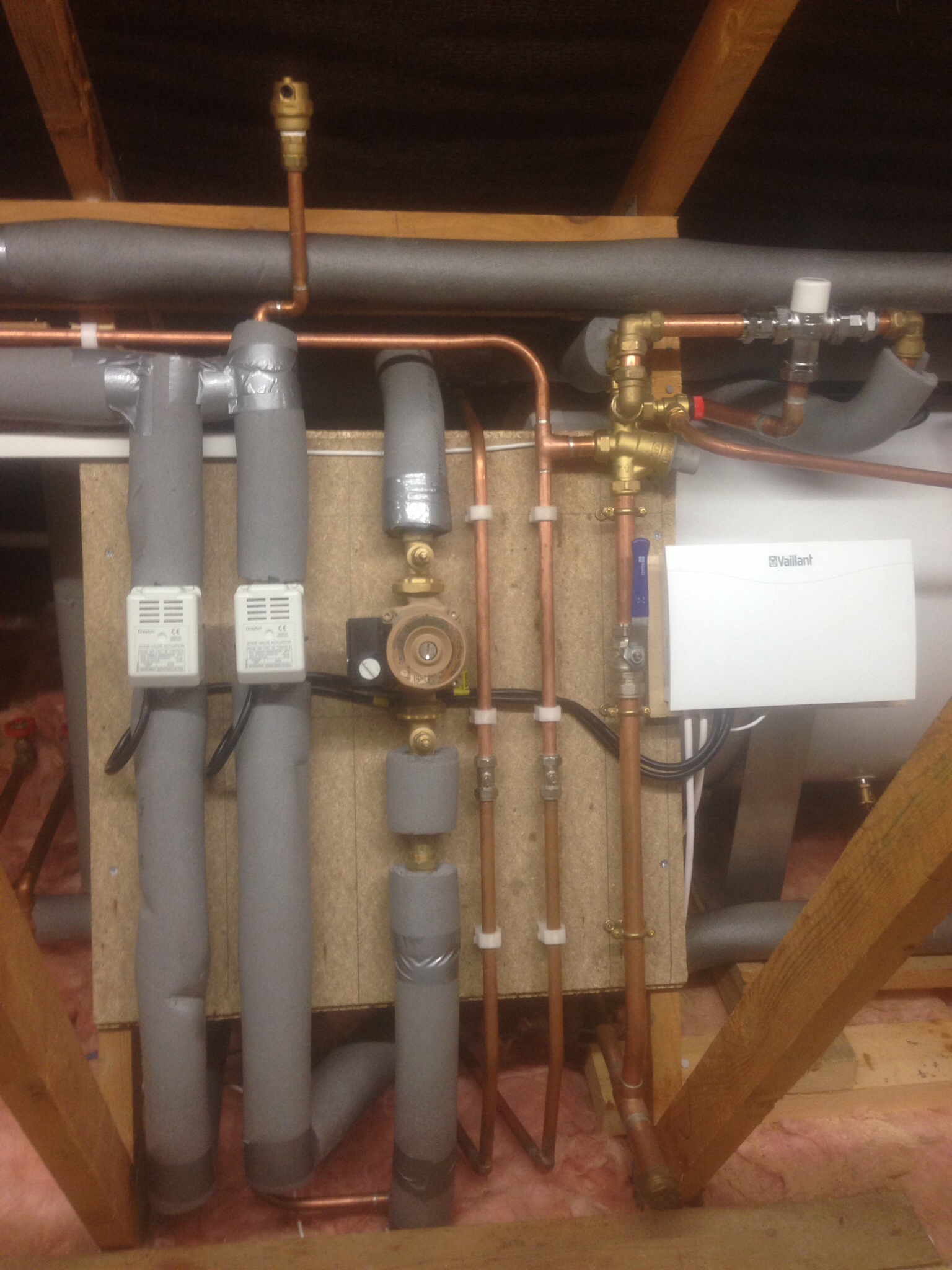
That lot = compliant. The only non-compliant part of that installation now is........................................................ You!! -
Low flow rate in mains pressure system
Nickfromwales replied to Randomiser's topic in Other Heating Systems
I'd say you have far bigger problems than slow showers I fear. If this was a retro-fit then a few things that would have needed doing, so lets see where you are with these before adding anything.... All mixer taps ( every single last one of them ) should be installed ( or retrospectively connected to ) in a manner that prevents back-flow to the UVC. That means, the cold feed to EVERY mixer tap should originate from the multi-block ( MB ) balanced cold outlet. One of these should already have been fitted within 500mm of the UVC and the cold feeds should be connected to that, and NOT to the generic cold pipework that traverses the property. If that has not been done, then a G3 installation requires that a non return valve ( NRV ) is fitted in the supply line to / at EACH and EVERY hot outlet. The idea is, if a mixer tap is open, 4 bar pressure cannot creep back up the hot pipe and back-pressurise the UVC ( sat at 1 bar lower so cannot 'fight back' ) beyond its 3 / 3.5 bar stated working pressure capacity ( and it goes pop, which I've seen happen and isn't pretty ). Or, to save all that grief ...... A whole of house pressure reducing valve ( PRedV ) like this should have been fitted to the one single stopcock that supplies cold mains water to the house. Hopefully the house is still served by the one stopcock? A 22mm NRV can be fitted to the hot outlet of the UVC, IMMEDIATELY off the UVC, which will negate all the satellite NRV's needing fitting. Quick and cheap / simple, plus G3 compliant If those have not been done ( some pics would help ) then you do not have a G3 compliant install and it's on borrowed time. If they have been done, you found a top installer and I'll shut me mouth ( doesn't happen very often ). Is it only the hot that is suffering?