

Nickfromwales
-
Posts
31390 -
Joined
-
Last visited
-
Days Won
346
Everything posted by Nickfromwales
-
Are the current actuators 2 wire or 4 wire?
-
Liquid damp proof membranes can work really well. It’s just about getting them installed correctly, and then overlaid immediately to protect them from damage.
-
Note : only if it was a 2-storey house
-
By the time you fill the house with ‘stuff’ you’ll struggle to quantify the difference imo. Comparing empty house > empty house is where it would be notable I think but in real life I doubt there’s much in it at all. With a heated slab, the thermal time constant is just so good it’s already above and beyond the requisite to spend out further improving it. UNLESS you’re staying there for the remainder of your days I’d spend the extra cash on something else.
-
That is good, and is probably where I’d spend my money in a TF house.
-
Great point, forgot to mention that one.
-
Don’t waste your money putting plywood / OSB everywhere !!!! Anything significant ( noggins / timber panels for ) can be decided at the outset, and there are some very robust plasterboard ( retro-fit ) fixings our there now so the point is moot afaic. Deffo line the kitchen with plywood, 12/15mm, and the bathrooms too, for utensil / accessory fixings both now and later down, as that IMO has value. Boarding 100’s of m2 for nothing is just good money after bad. As far as acoustics are concerned, I’d say plywood would be a worse choice than double boarding with PB. If you’re really worried about noise / sound, then just double acoustic board the plant / study wall ( both sides ) and full-fill that stud void with acoustic rated Insulaton, likewise with any other problematic locations. Double boarding is twice the cost, simples, so use ones own noggin and just fit a single, thicker PB once . 15mm on the ceilings and room-dividing walls will be as good as 2 layers of 12mm, if you change from regular insulation to acoustic rated at noise specific junctions, so don’t spend out where you don’t have to. Outside / exterior walls can be regular ( cheap ) white 12.5mm board, as you have the blown cellulose TF, so no need for further expense there whatsoever.
-

Infrared Heating Panels: Radiator alternative?
Nickfromwales replied to Raks's topic in Other Heating Systems
IR heaters ‘heat what they hit’ so if you can’t see the heater you’ll get very little comfort heat from it. Conversely if you’re directly in front of it, you’ll be toasted. Not a fan of IR at all tbh. Standing a piece of furniture <100mm off a wall isn’t a big sacrifice in even the smallest of spaces, so probably good to keep some perspective here. I certainly wouldn’t want IR panels up at eye level ? -
We’ve just done similar for a large job but have simply run 3c+E to each regular switch. That allows you to break the switches live and / or send 230v to the lamp from a central home automation hub. With that discipline you can overlay HA onto the existing generic wiring at any location, and also revert back to the normal switch if the HA falls over. Requires a lot of flood wiring, some of which will be known redundant until converted / upgraded to HA, but very future proof. Running MAINS ( 230v ) GRADE Cat6 / HA specific cables you each light switch would be a good idea for ultimate future proofing. That can daisy-chain switch to switch like a ring main, starting and stopping at the HA hub, and doesn’t need to be lots of radial runs. Yuk. I only do radials now for anything that isn’t a kitchen / utility. Why would you want to lose an entire floor of sockets for a duff mobile charger? Bedrooms / living / dining / hall-stairs-landing / plant etc all on radials if I’m doing the job ?.
- 25 replies
-
- 1
-

-
- automation
- wiring
- (and 2 more)
-
?
-
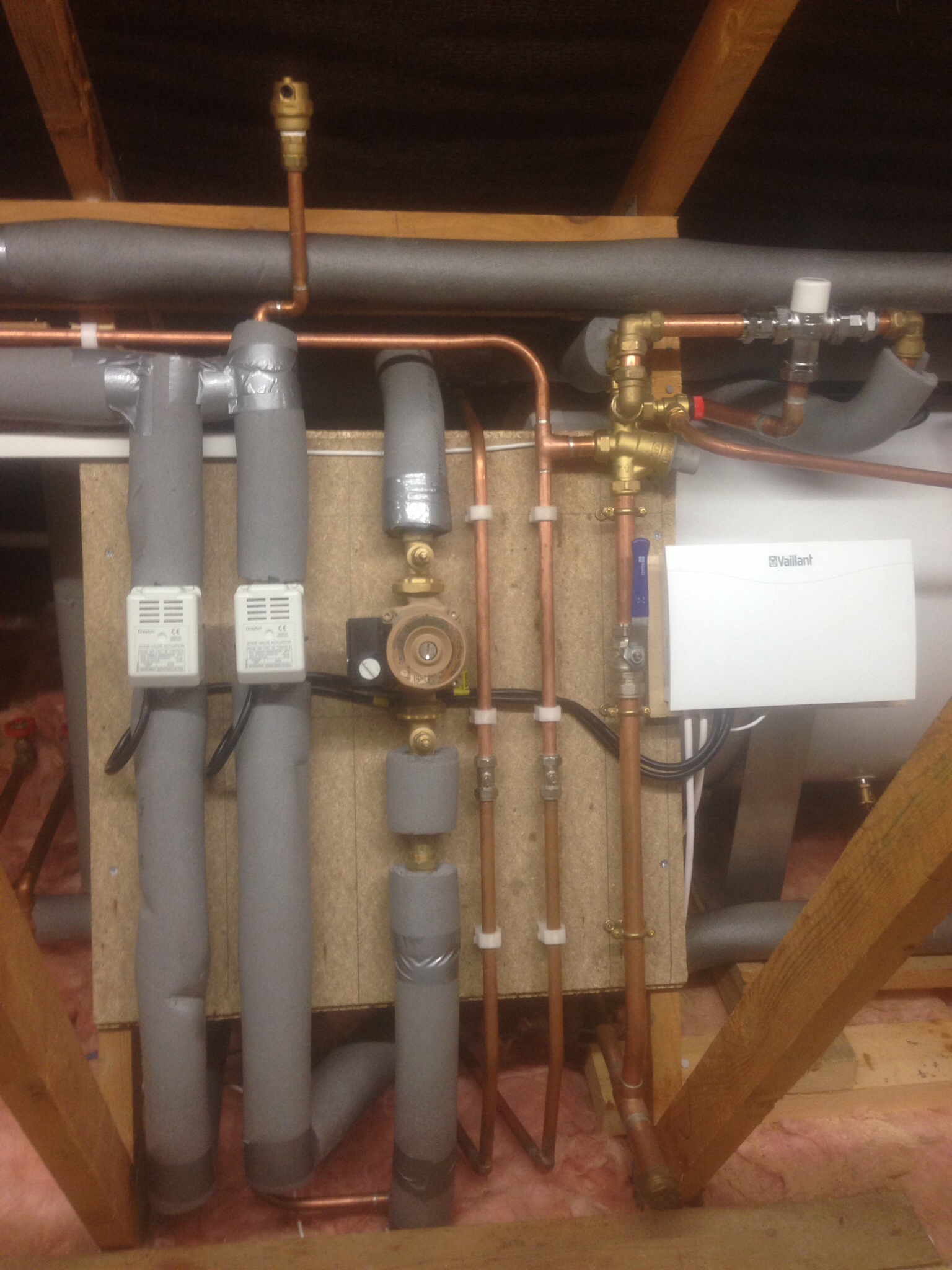
Hey-up 'lad. Just realised this is only mocked up atm. Ditch that for two 45's and a straight, short flexi.
-
Plinth heater Wet and electric are available, but the wet version should work ok even at the lower flow temps. Example only Yes, as they will heat up at different times to each other. Tha can result in an UFH circuit running a lot on its own resulting in short-cycling. Would ideally need a decent ( 100L + ) buffer tank to feed everything from in order to hydraulically separate the two mediums.
-
Just done one exactly like that. No probs at all with that arrangement ?
-
https://www.wundatrade.co.uk/shop/home/quick-shop/wundatherm-quick-shop/controls-quickshop/actuator-auto-balancing/ They're the dogs danglies. I can tell you that the flow meters are OK and reasonably accurate, but always restrict even when you may not want them to ( eg when a large circuit wants more / full bore heat to satisfy the relative stat when other smaller circuits / zones are up to they're required temps already ), but these will give full flow to all circuits until the return temps come back warm, and then they start to strangle back the flow on the circuits that recirculated quickest, eg ones which would otherwise cause potential bypass issues for the larger circuits. I fit these routinely now where actuators are required, and they are super fast acting too. 10/10 from me.
-
Sunamp UniQ HW+i experience? Charge via ASHP?
Nickfromwales replied to oranjeboom's topic in Energy Storage
It would come into it's own if being used in conjunction with high temp space heating + DHW, with SA being used as a heat bank for load-shifting off E7 / 10 / other, but yes, it's a difficultt sale at the price ticket that results in trying to combine the two. I'm much more of an advocate of SA = DHW, and then space heating gets met as and how best practicable. Let's not forget, however, that these types of installations are off-set by RHI payments, which does change things in anything less than a well-performing dwelling / poor EPC rating as that equals higher payments to go towards off-setting the capital expenditure. -
WiFi Speakers Not Wired for Sound
Nickfromwales replied to Ferdinand's topic in General Self Build & DIY Discussion
Sonos all the way. Idiot proof, and child’s play, with one of the most robust platforms I’ve come across so far. Or, cheaper but coarser, something like a Lithe Bluetooth speaker, multiples of, but I’m not sure if these will network with one another. @Barney12’s, largely Sonos, system will exfoliate you. Tres bien -
You can go one better as they are able to insist that a representative from the DNO actually attends site to carry out a witness of such export limitation. The DNO charge sometimes ( incontestable ) but often don’t. @willbish are you putting DC batteries in with the PV at the outset? You may never get permission to put them on the AC side, now or retrospectively, if they’re already so particular over this. Export limitation should suffice here so I don’t see you having a big problem. 3kWp on each roof sounds a good amount and would generate a good spread of Pv through the day, without the midday ‘peak’ that can knock the inverter off when the local voltage rises to 253v.
-
Electric Boilers: Reliable and cost effective?
Nickfromwales replied to Raks's topic in Boilers & Hot Water Tanks
Sunamp no longer deal with the public directly, so their products are only available now via re-sellers. Sizing the unit size and type are quite specific requirements, so this would need to be surveyed by a SA accredited supplier. Installation price is "how long is a piece of string" as no two jobs are the same I'm afraid. -
Electric Boilers: Reliable and cost effective?
Nickfromwales replied to Raks's topic in Boilers & Hot Water Tanks
The 6 will suffice if it's given access to electricity on demand. I would go to a 9 if only if you have a bath. I fitted a 6 in Somerset and it's happily servicing a bathroom, kitchen sink, and utility sink in a household of 3 occupants. Great! No problem with adding an induction hob then ? -
Electric Boilers: Reliable and cost effective?
Nickfromwales replied to Raks's topic in Boilers & Hot Water Tanks
So as for an electrical design, you're already at ~20kW before sockets / lighting / kitchen etc Is this on it's own electricity supply? -
Electric Boilers: Reliable and cost effective?
Nickfromwales replied to Raks's topic in Boilers & Hot Water Tanks
My replies relate to the OP No gas. A gas combi is deliciously simple and quick, and I'd still recommend one today if I thought it were the CORRECT decision. Cost / economy / running costs and practicality will be all the things the person PAYING for it will be asking about. Design of retrofit is easy, and often free, just the design will need the property garnished with additional floor insulation / wall insulation / roof or attic insulation, and possibly upgrades to the windows and doors to meet the lower heat output per m2 that UFH can provide. It is not a good choice for retrofit AFAIC, unless it is highly insulated and "energy efficient" in it's current state. -
Electric Boilers: Reliable and cost effective?
Nickfromwales replied to Raks's topic in Boilers & Hot Water Tanks
Putting convection heating into a retro fit is in no way whatsoever a bodge my old china mug If the occupants are in a tiny 2 bed terrace, there's a bloody good reason for it! UFH and an ASHP really need to be designed in at the outset. Lipstick on a pig and all that eh? -
Electric Boilers: Reliable and cost effective?
Nickfromwales replied to Raks's topic in Boilers & Hot Water Tanks
Fortunately I spent about 13 years fitting new heating systems into exactly these types of properties We had to get very inventive of how to get heat into these and often the only way to get sufficient heat output was to fit two smaller radiators in the same room wherever there was room to do so. UFH in a retro fit is bloody hard to get right, even harder to insulate against the losses from, and are utterly impractical in small rooms with lots of furniture. The capital cost and impact to living pattern vs heating use is also a huge PITA. Horses for courses -
Electric Boilers: Reliable and cost effective?
Nickfromwales replied to Raks's topic in Boilers & Hot Water Tanks
They can go behind furniture without issue. They heat by convection rather than radiation, so no problem not 'seeing' them . Fit multiple smaller ones to get the required heat and fill any available 'gaps' to suit the room layout. Number one rule; DON'T put them on outside walls wherever possible. -
Electric Boilers: Reliable and cost effective?
Nickfromwales replied to Raks's topic in Boilers & Hot Water Tanks
Why make it so complicated? Willis heaters go in, paralleled up in qty to match max heat demand + 50%, on a recirculating loop ( or through a small low loss header for a very small dwelling ), and just let the dwelling suckle heat from that loop as it wants. Call for heat kicks in the heaters, and they go off or into 'satisfied state' until the recirculated water temperature drop low enough for the willis stat to kick back in. Done a few like this recently where there was no gas, no room ( or desire ) for an ASHP, and low / infrequent demand. Works really well. Keep it simple here Heating; Electric panel radiators are cheap as chips, and will heat the place almost instantly / on demand, and are very well suited if infrequent use is typical. Something as small as ~2kW units ( x2 for even spread of heat if more of a spread of heat is necessary ) which will kick in / out thermostatically as required. I'd buy the ones that have separate wall mounted wifi room stats / timers for ease of control & to prevent overheating the space aka economic running. These can run off 13a plugs with no special needs for a big electricity supply. Forget UFH unless you go for an ASHP, but that would seriously have to be justified by the usage of the dwelling mandating such a complex and costly setup? What is it's intended long-term use? Hot water; Fit a size 6 Uniq ( Sunamp ) and you'll only need a 3kW electric supply to get high pressure DHW on a 22mm supply That will tee off to do basin / sink / shower from one source and no need for a discharge pipe and G3 annual inspection. Note: the Sunamp isn't a hot water tank it's an instant water heater / thermal store, so no actual 'stored water' to speak of. Next to no losses in comparison to an UVC, and a far, far more simplified installation with prob half the space or less taken up. It'll go into a kitchen unit as its only ~580mm deep x ~370mm wide x ~650mm high. Near zero maintenance too, as its only requires a single tiny expansion vessel that can be checked in minutes ( by anyone who's competent to do so ). Electric boilers, and even worse electric combi's are very electricity hungry. If you had an electric boiler and a big electric shower you'd need a big electricity supply to match. Fit a big electric shower and it'll also be massively dependant on cold mains pressure / flow rate. It will suffer to a point that it's useless if anything is running off the same cold mains supply ( in the main building ) at the same time, and you'll end up running it on it's lowest setting most of the time just to get a decent stable temperature out of it. God help you if someone goes to use the kitchen sink whilst you're in the shower!!! The only way to combat that issue is with a 100-200L cold mains accumulator, which is a BIG vessel to try and integrate into somewhere where space is already tight.
