
Nickfromwales
-
Posts
30353 -
Joined
-
Last visited
-
Days Won
297
Everything posted by Nickfromwales
-
No. Any external heat source capable of generating 62oC or above is fine. Plus you can opt for an ‘e’ prefix unit which then features a 3kW immersion heater for back up. ‘Duals‘ have 2x heat exchangers in each SA unit. One for potable DHW, and the other to be dedicated to importing heat to recharge the SA. The immersion will be nigh on useless for your situation, if you’re thinking electric only, but if burning gas then you’d be fine. You do not want to fit accumulators in the attic, only CWS ( cold water storage ) tanks ( open / gravity ). I’ve done an HMO with 14 en-suites for which we just used a few big CWS tanks, gravity hot water to basins / sinks / baths, and took feeds out of the same CWS’s to tank fed electric showers ( Triton T80Si pumped ) which worked brilliantly. Needs 3 phase electric to run that lot though Sonos a big wiring job / upgrade. Also you will need to run separate potable water supplies from the cold mains to sinks / basins / kitchen & utility, as the stored water CWS based system can only be for bathing as it will be unfit for human consumption. You could take a feed from attic CWS to a pump and pair of 500L accumulators on the ground floor and get a sealed and pressurised system working ( so you could use thermostatic mixer showers ), which would still need potable segregation, but better still would be an outbuilding where you could fit 3 or 4 x 500L ACC’s and just go mains pressurised with no pumps / CWS / tank fed showers etc. Uber low maintenance option too. Just hook up a gas boiler to 3x size 12 SA’s and you’re rocking and rolling. If you have room for UVC’s then they’d work too, but would take up probably 2-3 times the space the SA’s would need, plus you’ll need G3 annual service / inspection on top of the gas cert. Over 10 years the SA’s would break even in cost, but you COULD, possibly, get away with a single 500L UVC just would be down to usage patterns and estimating peak demand eg if students then lots of evening showers at the same time etc. It’s a big system that’ll need a proper design, rather than back of a fag packet, so measure twice cut once ?
-
Ok thanks. You’ll be on the model with cold start and also possibly a victim of the ( then not very reliable ) overheat stat nuisance tripping. I fitted quite a few where the stat would trip a number of times before I could get them to come on ( and stay on ). Often meant extended stays to babysit them through the initial heat up. They’d weirdly work ok after a number of resets ( 4+ resets in some instances ) but I believe the stats then fitted have been superseded by a new / different part to make the current iteration very reliable. Deffo. Yours struggled on 2x 9’s and got bumped up to 12’s. IIRC you’re still having an issue with one of the stats nuisance tripping? The Achilles heel with the SA is the 3kW immersion heater. That’s why if there is any sign of duress I’ll fit 2x units ( or 3 ) to get the necessary increase in kWh of input energy. If the dwelling has peak heat requirement of say 4kWh, and you have 2 units so 6kW of immersion, then you’ll have 2kWh of energy available to sustain heat capacity / offset hot water consumption which is meagre on a good day. Having been advised to fit a single size9 eDual for this dwelling is a non-starter. You need a LOT of capacity to mix the two services into one unit. I only fit duals now if there is an external high power heat source ( gas / electric etc ) boiler etc. Was the intention to load shift off economy rate electricity and fortify with PV? Would be ok in the summer when the heat demand dies off, but for the depths of winter you will seriously struggle here with one unit and only 3kWh to inject at any given time.
-
If the UFH is calling for heat then the SA will NEVER heat up as it’s likely the demand is equal to, or greater than, the energy input ( output ) that the 3kW immersion can provide. Turn off the UFH and hit the boost for 2 hours. Run a hot tap and see if you get heat. Do that and reply here please. Also, how old is the unit? When was it delivered? Also when did you get the Eddi? They now have a ‘Sunamp’ setting which ignores the chunked energy consumption during cold start and therefore does not prematurely show as ‘max temp reached’ The issues may be multi-fold here, as differing periods of manufacture will have dictated which iterations you have to ‘problem solve’. Also, IIRC, the latest SA does not do cold start now as they’ve determined that putting the immersion on flat out from cold doesn’t damage the local PCM as they first feared. More info required, most importantly which SA unit you have and do you have the latest logic on the Eddi.
-

Temporary heat source for UFH: Willis heaters
Nickfromwales commented on oranjeboom's blog entry in Kentish RenoExtension
Thanks Jeremy. The review board will reside over this today Which supplier did you use? The one I used, not only were there no MI’s but the pipe does indeed slide all the way in and hit the element. Had to mark depth on the pipes to check they’re well clear as that would be disastrous for the element of a DIY warrior were to assume the element was a depth stop. -
Temporary heat source for UFH: Willis heaters
Nickfromwales commented on oranjeboom's blog entry in Kentish RenoExtension
Horizontal being discussed now...... Eventually.....
-
Temporary heat source for UFH: Willis heaters
Nickfromwales commented on oranjeboom's blog entry in Kentish RenoExtension
Which is where rethinking was introduced. Huge differences in flow rates / turbulence inside the heater body. No decades of feedback in honesty, but two seasons heating a 300m2 build with the stats set to ~40oC without even a single sniff of bother is evidence enough to ‘argue’ the toss afaic. Discussing this now with my electrician, over a pint or 3, and even he said it’s counter-intuitive to have the electrified head under the heater. I’ve seen enough immersions leaking through the seals to be cautious. Over cautious maybe, but I’ve deliberated and forged ahead from my own findings. So far, so good. -
Temporary heat source for UFH: Willis heaters
Nickfromwales commented on oranjeboom's blog entry in Kentish RenoExtension
Nothing, upon review. ?. Im still unconvinced there is any real detriment, unless someone has an instance to recall, to them being as I fitted them. Probably / maybe isn’t argument enough when I see them in and working and if they were airlocked at the top you’d be able to hear it. The ones I have in currently are running perfectly well and silently ( bar the noise of the adjacent pump ). -
Temporary heat source for UFH: Willis heaters
Nickfromwales commented on oranjeboom's blog entry in Kentish RenoExtension
After purging these out I've seen no argument strong enough to make me put these in the other way around TBH. The prospect of a leak getting down into the electrics is far more of a factor for me than a few mm of air sitting at the head of the heater jacket. The thermostats push in too, so want to drop down / out when the other way around. With faultless operation to date to reflect upon, over multiple instances, I remain sufficiently happy that water leaking down onto electrics vs the air pocket 'issue' ( yet to be shown how much of a real world issue that actually would ever be !?! ) is argument enough for little 'ol me to carry on on my own judgement. I could be convinced to put them horizontally maybe, so I'll reflect and see if there's sufficient merit to do so. I did look at google images of other installations and decided upon what I thought was the lesser of the two evils. -
Temporary heat source for UFH: Willis heaters
Nickfromwales commented on oranjeboom's blog entry in Kentish RenoExtension
Yup and yup. On our permanent installs they’re exactly as you say. Contractor fed so cannot be run dry. On the temp setups I’m happy to just explain the 1,2,3,4 process. Off = 1,2,3,4 eg turn the heaters off before shutting down the pumps and vice versa. KISS at its finest. -
Temporary heat source for UFH: Willis heaters
Nickfromwales commented on oranjeboom's blog entry in Kentish RenoExtension
Above is a sealed and pressurised kit ( expansion vessel / PRV / fill loop / pressure gauge etc ). -
Temporary heat source for UFH: Willis heaters
Nickfromwales commented on oranjeboom's blog entry in Kentish RenoExtension
This is how we set up temporary Willis heaters. The 22mm into 22mm tees with 22x15mm reducing sets giving 15mm copper tails to connect the heaters off. The 22mm is a constant recirculating loop, with a pump, so the heaters don’t boil or short cycle like crazy. At the bottom is the 22mm ‘return’ which was connected to the manifold return and then the top right 22mm after the pump had another tee which becomes flow to the manifold. Don’t connect them directly to the manifold as the flow will be proportional and cause headaches. Works a treat and we have 2 jobs running on these at the moment, toasty warm.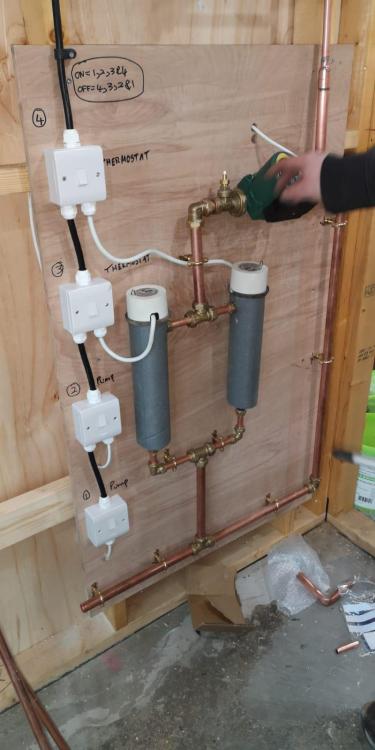
-
Manifold system air lock likelihood?
Nickfromwales replied to Oz07's topic in Central Heating (Radiators)
If it’s sealed and pressurised then it would be periodic rather than frequent, but the risk of it being more problematic would be real. If you purge each loop one at a time it may push through, but that would be down to trial and error. If you’re putting an automatic bypass in ( so all rads can have TRV’s ) then fortify that with a gate valve so you can close that off 100% for future purging. You’ll need 100% of the pump flow to do the purge effectively, so you deffo don’t want the bypass operating whilst doing so. Closing the bypass / using it as isolation should be avoided. -
Manifold system air lock likelihood?
Nickfromwales replied to Oz07's topic in Central Heating (Radiators)
My pleasure lol. -
Manifold system air lock likelihood?
Nickfromwales replied to Oz07's topic in Central Heating (Radiators)
Dependant upon where your airtight layer is of course Pipe work shouldn’t be outside that really, even more so for heating primary’s. -
Manifold system air lock likelihood?
Nickfromwales replied to Oz07's topic in Central Heating (Radiators)
No. You’ll just have AAV’s up high to deal with that. Do you still have to do a flat roof? Or will you have an attic / other accessible void above? -
Manifold system air lock likelihood?
Nickfromwales replied to Oz07's topic in Central Heating (Radiators)
If the manifold has to go low then no, but if it can go much higher up the wall then yes. Honest answer is.... why not just drill holes through the wall? Or do the pipes run through attic / ceiling space and then down? This will work with a purge at the commissioning stage, but recurring air locks will be an issue over time. -
Segregate potable ( drinking quality ) water system and bathing water systems from the get go and then go for a pressurised artificial cold mains created by 3x 500L cold mains accumulator vessels. Hot water cylinders or Sunamps can provide all the hot water you’ll need, and you want to aim for around 600L of stored hot water. That would be 2x 300L UVC’s or 3x size 9 Sunamps. UVC’s need annual G3 inspection but Sunamps do not. Cost is roughly x2 to go for Sunamps but the form factor is also beneficial as it’s a factor of about 3 compared to UVC’s ( Sunamps being smaller / compact / less complex ) so less space needed for the same capacity. Its down to how much space you have? What plant space is available? You can also go for gas instants, one per floor, for instant hot water, with something like a Rennai 50kW instant gas multipoint. Cold mains will be the killer here as no cold in = no hot water out, regardless of what provides hot water Whos paying the gas / electric bills?
-
Manifold system air lock likelihood?
Nickfromwales replied to Oz07's topic in Central Heating (Radiators)
You can purge each run, one at a time, with cold mains to get rid of all the air, but even with inhibitor air ( gas given off by the rads slowly corroding ) will collect at the high point and eventually cause another airlock. Putting AAV’s at the high point is an option, or T’s with drop pipes and manual vent caps will also work ( if you cannot go any higher than the high point ). The CH pump on / prior to the manifold will not push the air through if it’s a full floor height of head up and back down again. ? -
Wetroom - Forget it Pal. Damn and blast it
Nickfromwales replied to ToughButterCup's topic in Bathrooms, Ensuites & Wetrooms
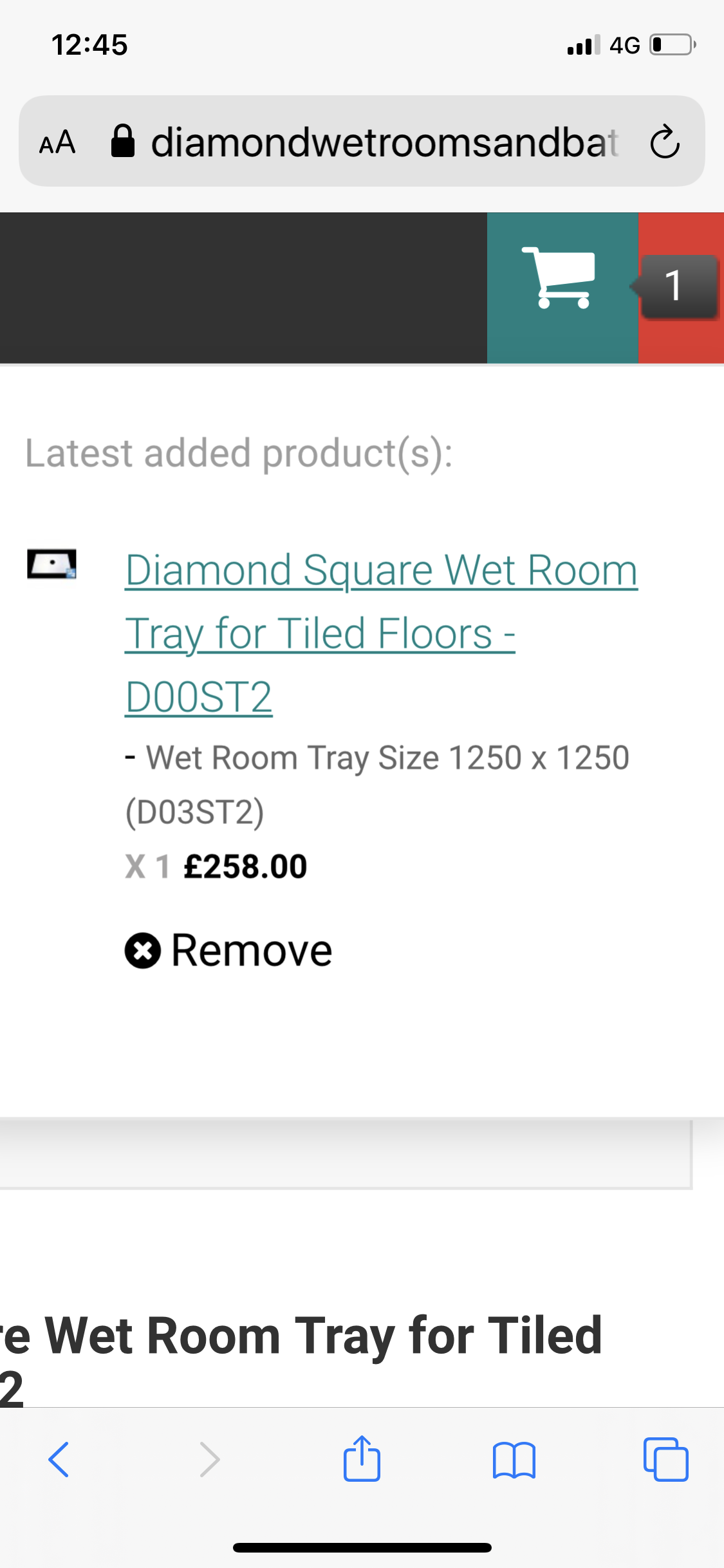
@AnonymousBosch I see 900mm as one dimension, what size wet area are you allowing? 900x900 is a very small area if you aren’t intending on fitting a screen / cubicle of any sort. As far as your other woes, I don’t really see this being much of an issue unless there’s something I’m missing..... Diamond Wetrooms do a reasonably priced 900x900 wetroom former which is cheap enough, and GRP so no issue with mosaic ( Wedi products can compress when applying point pressure on small mosaic ) and require little in the way of accuracy of the underlying works as you can bond them down into wet adhesive to set them level prior to fixing down firmly with mechanical fixings. I’d recommend a 1200mm or 1500mm area if you’re going to all this effort. £258 for that 1250 square. Hire a concrete grinder to remove 30mm of existing floor area to accept the perimeter of the tray and happy days. “You can do it, Deeds” ?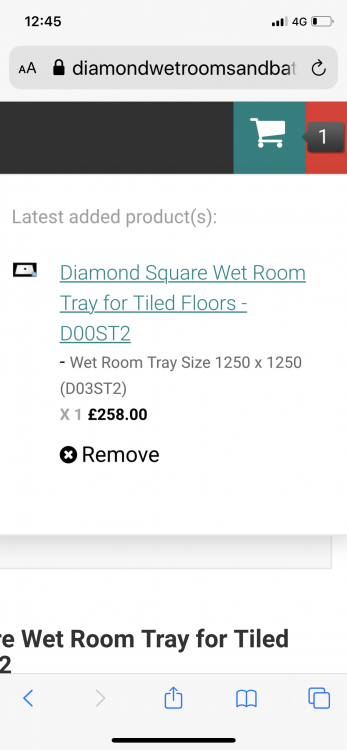
-
Structural Steelwork Support On Passive Slab
Nickfromwales replied to davidc's topic in General Structural Issues
Yes, as long as ring beams are observed at those points. Studs get stacked in multiples where they support a steel, and the timber transfers the load to the slab. Commonplace in TF structures. -
Should also read “visible” as compression on gas is less than preferable.
-
@PeterW Can you skim over FC as is?
-
@Visti @Russdl The router will be your friend. On the downstairs ceilings, when affixing to the underside of the pozijoists, please do yourselves a huge favour and router 3-5 mm squares out of the back of the FC boards where the joists hangers are God ( please select as applicable ) help you if you don’t, as sanding back the jumps / humps / bumps on the ceilings where these rigid unforgiving boards have been used, will be a bitch. Best of British chaps, @Russdl, Chuck those screws in the bin mate FFS !!! If they have no purchase in the resilient bars you’ll end up with cracks and a life of filling and painting ?.
-
Prevent leaks from wetroom?
Nickfromwales replied to sendu's topic in Bathrooms, Ensuites & Wetrooms
He does come from a rough area.....? -
Skirting tiles.