

Nickfromwales
-
Posts
31390 -
Joined
-
Last visited
-
Days Won
346
Everything posted by Nickfromwales
-

Pressurized system not filling after draining
Nickfromwales replied to Bemak's topic in General Plumbing
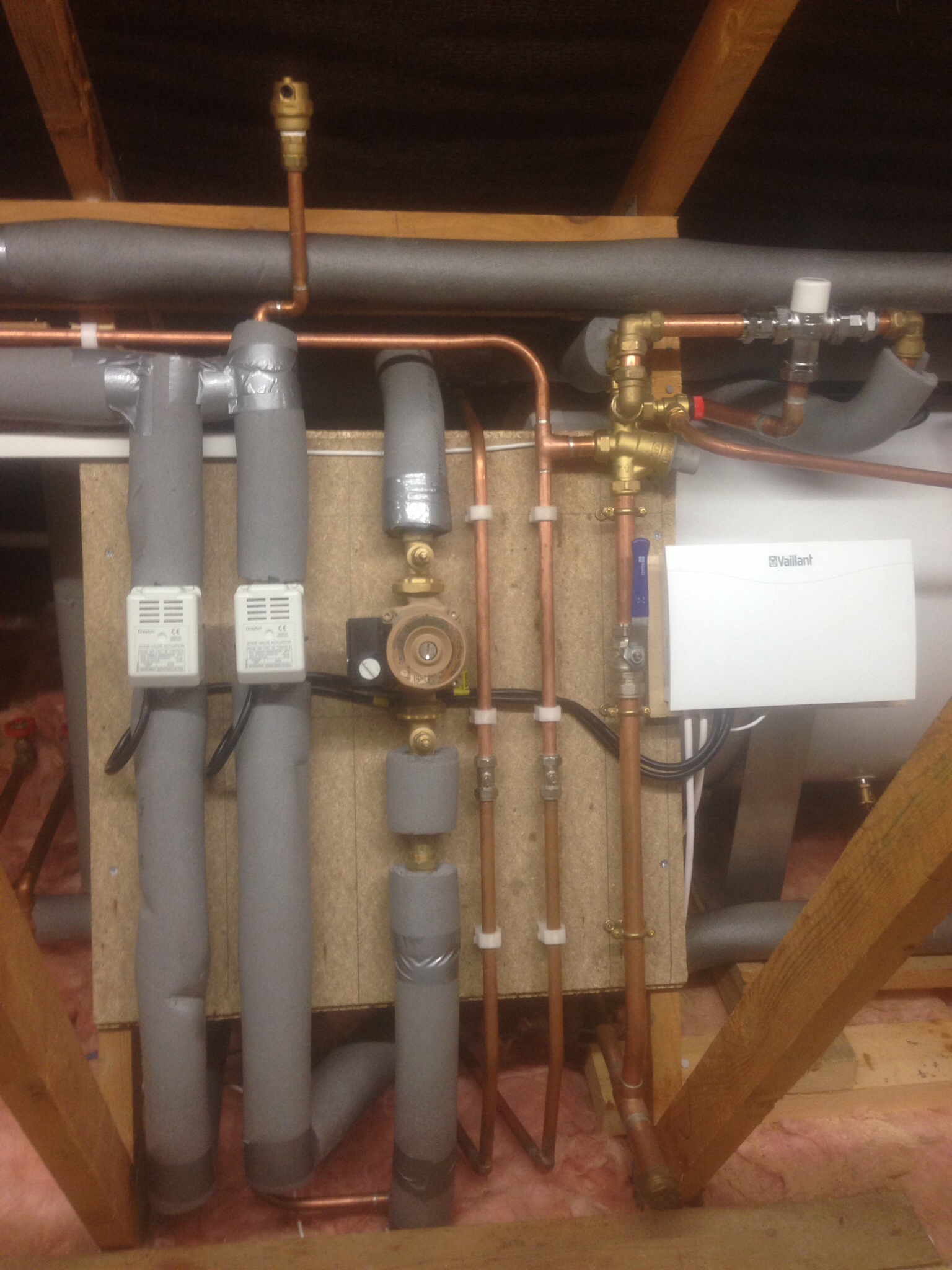
Crikey. Ok. It looks like the bit you’re “topping up” with is a pressure reducing valve. The purpose of this valve will be to prevent you from over-pressurising the system by inadvertently not fully closing the fill valve back shut 100%. The fog is lifting. What boiler is this please? Make / model? -
Pressurized system not filling after draining
Nickfromwales replied to Bemak's topic in General Plumbing
What are you doing to introduce water into the system to gain pressure? -
Pressurized system not filling after draining
Nickfromwales replied to Bemak's topic in General Plumbing
Pressure? Are you seeing this on a gauge or guessing that you have pressure? -
Pressurized system not filling after draining
Nickfromwales replied to Bemak's topic in General Plumbing
It would back ‘leak’ through the grouped return, so isolating the hot water aka coil loop shouldn’t be making any difference? If this achieves pressure filling the heating only, what is being closed to isolate the hot water cylinder so as to get pressure on the heating system? -
Pressurized system not filling after draining
Nickfromwales replied to Bemak's topic in General Plumbing
Like this. Link -
Pressurized system not filling after draining
Nickfromwales replied to Bemak's topic in General Plumbing
2 modes Heating & Hot water. So, is this an S-plan or Y-plan? Basically do you have 2x motorised valves or one. The motorised valves are usually the valves with a metal or plastic box head with a wire going to it. -
Pressurized system not filling after draining
Nickfromwales replied to Bemak's topic in General Plumbing
What is the “coil loop”? -
Needed- Low temperature blending valve 20-45c
Nickfromwales replied to gravelrash's topic in Underfloor Heating
Same functionality as the Ivar. I have seen these for sale, eBay iirc. -
Doesn’t appear to have any valves https://www.ebay.co.uk/itm/lITRON-AQUADIS-Everblu-Cyble-enhanced-V2-1-WATER-METER-LITHIUM-14MA009285-/254757026625?mkcid=16&mkevt=1&_trksid=p2349624.m46890.l6249&mkrid=710-127635-2958-0
-
Unless it’s a shared connection. Speak to the neighbour and turn off whatever feed you can find at the steer, then work back on a process of elimination.
-
HRC = Hot Return Circuit UVC = Unvented Cylinder. You could put a flow switch on the hot pipe feeds to the kitchen / utility sinks which would trigger the HRC pump when hot water is drawn.
-
Fitting a stone resin shower tray on plywood
Nickfromwales replied to George 3G's topic in General Plumbing
Nope, all good. For under the tray or for the remainder of the bathroom flooring? If the latter, green P5, for the former as per @Temp’s reply. -
Isn’t that only if it runs through the gen / export meter? I’ve a friend who has added panels and battery storage to a FiT’s install, but that element is 100% unaffected by the addition of batteries as the charge is captured and sent into a 3rd party BMS and goes around the existing and into its own MCB, thus only ‘preventing’ import. Yup. Spot on. You can change failed equipment but needs to be like for like, eg you can’t have a failed 250w module replaced with a 365w etc. You can add a BMS and put the batteries onto the DC side, and put 48kWh without issue. The BMS can be dialled down to zero export, and you can G100 and declare, with the DNO often either then asking for equipment details and usually a witness visit to observe the zero export in operation.
-
Stiebel Eltron are the Bentley of the HP world, and are Uber-fussy with the installation criteria, ask me how I know!! Not a bad thing, but they are very focussed on correct and immaculate execution wrt to the implementation of their products. A simple and acceptable ‘adaptation’ would meet their criteria; eg the employment of a much larger UVC for one, plus some manipulation of the flow temps of the HRC vs the stored temps of DHW ( and flow temps to it ). The HRC can then be made “invisible” to the HP so as to not upset SE. All in a days work lol. Not exactly If the HRC has no demand and managed losses then there would be no heat energy lost, ergo nothing to then keep triggering as demand aka call for heat, at least no more than acceptable latent losses attributed to the system and its components. A HP is there to provide heat energy, end of. It must do its job, simples. How the install is designed and executed will dictate the efficiencies of the system as a whole. I think it is very narrow-minded of SE to state the above, but that’s if it is designed for a domestic installation. If it is not, and you apply it to an adverse scenario, then expect the fleas to come with the dog.
-
A man after my own heart. Pulsing the hot return in this scenario would be an epic fail, and using a pipe stat to decide when to pulse would still not yield an acceptable result afaic. Just insulate this run(s) very well and switch on and off via a dusk to dawn sensor for ‘daytime’ use, and then fall back to occupancy switching for nighttime use ( where someone moving at night would trigger a recirc event ). Make sure the hot return pipe is the same size as the delivery pipe, or evacuation times for the delivery ( aka flow ) leg will be hindered by the return pipe size.
-
Erm, just buy a different pan? There are plenty to choose from!!
-
I always drill through at a much later stage for the various projects I undertake, PH dwellings and airtight ones alike. It is of absolutely zero detriment to do so if done carefully, and sympathetically. Conduits get fitted through correctly sized holes, executed and sealed according to the dwelling type, plus running slightly downhill to the outside to stave off ingress of moisture ( in the event of my thorough sealing-up ever failing ). Getting from the ground up to the cavity would be an issue, with conduits needing to be surface mounted / exposed or set in place prior to the external 'skirting' arrangements being fitted. The location of your ducts would then command where the electrical device could go, eg where the cable could then rise in said safety zone. Install all of these later, and spend the interim deciding what exactly to put where, exactly.
-
Fitting a stone resin shower tray on plywood
Nickfromwales replied to George 3G's topic in General Plumbing
The product I refer to there is that "no more leaks shower seal" item. Yup. So all of that gets done as one wet application. You'd butter the Wedi with CT1 immediately before dropping the tray in, then apply an excessive amount around the 3 sides, and then you'd tool that into place as per that thread to create the up-stand. My second favourite currency lol. -
If you are a growing household then you may eventually struggle with a combi, but there's me ( showers ), the missus ( 1800x800 bath to fill ), and 4 kids ( mix of 2 showers + 1-2 baths ) at ours and I have a combi and am happy with a few cons for the pro of not having to have a cylinder. We're happy to observe a "nowt else running whilst someone's in the shower" policy, and that works just fine for us tbh. I will change that this year, hopefully, by adding a type of thermal store to the cold feed that supplies the combi, eg so it receives a stable input of pre-heated 'cold' water, which will remove my one major niggle with the combi. That is the fluctuation in hot water delivery ( associated with any type of instantaneous water heater, not just a combi ) when the hot or cold does get used elsewhere during a shower. That will be further offset by the installation of a cold mains accumulator ( just a 100L one to cover the <30L of draw-off from the mains from other use eg WC#2 being flushed + hand-wash or the washing machine / dishwasher filling etc ) which will be more than suffice for us then in terms of demand, reliability and stability. If you need a hot return circuit to get instant hot water to outlets reasonably far away from the hot water source, then a cylinder would be preferable as you cannot ( sensibly ) achieve a HRC with a combi. If you have or are having solar PV, then a cylinder is a no-brainer to get as much FOC DHW as you can each summer by feeding excess generation into an immersion. What boiler do you currently have, that your plumber has said can be converted to 'sealed and pressurised'? Is it a modern, condensing boiler? There is, essentially, no need to convert the boiler, unless you want to get rid of both the F&E and the CWS ( small and large ) plastic storage tanks in the attic(?) You do 'need' to change the cylinder to an UVC to get the DHW coming out at cold mains potential, which would then remove the CWS tank to boot. If you do ever want to convert the attic, now would be a good time to get rid of both tanks. How much area of UFH will you install, and will it need to run independently? Will you still have rads upstairs? Gas boilers do not like to run UFH directly, as when the floors are warmed up, the heat load is then quite small to keep them there, so the boiler can short cycle. Type that into the search bar here for LOTS of discussion on that
-
Hi and welcome. This forum is definitely a great place to get help, advice and support by the bucketful. A very worthy project, and we'll all be glad to help wherever we can. I think the best advice I can give at this time would be to consider a turnkey foundation and frame supplier, with guarantees for quality and standards incorporated in the price. This would take you straight to a weathertight shell, and put you in a position where you may feel more comfortable as PM's with a very fast turnaround time. All depends if you're looking at the journey or the destination
-
I'll PM you the details.
-
Fitting a stone resin shower tray on plywood
Nickfromwales replied to George 3G's topic in General Plumbing
Following my advice / techniques in the thread I linked by creating a bond / up-stand in one would be ample. No need for that product afaic, but if you’re happier ( feel more confident ) to apply that then there’s no reason not to use it. You can ‘paste’ the 3 sides round of the Wedi with clear CT1 immediately prior to dropping the tray in, and then mask up and top coat with more so as to have a wet-on-wet bead of CT1 all the way around. Don’t worry about getting it a bit mucky, as cheap baby wipes will clean it all off perfectly well. Use loads of them, one or two wipes with each before discarding into a carrier bag as you go. Masking the tray before you start the installation would help. I use 2” PVC electrical tape. Stick the tape just shy of where the tiles will stand out from the walls. Peel off the masking the second you finish applying the top seal of CT1 and have done the clean up with wipes. -
Do you have a pic of the item please? Would make life easier offering advice if we could see it
-
Any runs which are long, almost always get jumped up to a double run with my installations. Particularly habitable / quiet rooms where bathrooms which provoke a boost session are away from, eg so they are not made ‘noisy’ by the boost velocity ( whereas with 1x duct they may well have otherwise become ). Needs fully justifying if that means a lot of rooms which then “require” 2x ducts if that means lots of extra hold through steels / beams etc. Well worth the additional effort and cost I’m bedrooms / snugs / studies etc, plus living rooms. MVHR unit = bigger the better….. ……deffo observing the minimum duty is a good point indeed, but with Brink the knee-jerk 4 speed setting can all be user defined to x percentage per increment, so not had any issues oversizing with Brink tbh.
-
Fitting a stone resin shower tray on plywood
Nickfromwales replied to George 3G's topic in General Plumbing

