-
Posts
30353 -
Joined
-
Last visited
-
Days Won
297
Everything posted by Nickfromwales
-
Hi. Yes, as long as the coils are 230VAC rated then you’re propel is sound. Just be sure to have good segregation of the cables at the relays, so you cannot ever get 230VAC going down the zero volt side.
-
I was once tempted away from Uniquity WAP’s by a HA company, as they were adamant that Ruckus were a far better device ( at roughly £2x ) but with all of the Ubiquity stuff I’ve installed for clients ( who do not / will not tolerate poor performance / unreliability etc ) has performed way above my expectations. I particularly liked one version of their wall mounted AP which has a data throughput socket at the base of the unit. That allowed the 1x Cat6 cable to support the AP but also give an additional data outlet to connect a hard-wired bit of kit to, gleaned off that AP. If you have for eg a PC in situ now, plugged into a Cat6 outlet, you could buy this AP and connect the PC back to it whilst creating a WAP point in that location. If it’s not a PoE point now, just use the supplied PoE injector to get the power source for the AP and you’re up and running. I’m very happy with ubiquity to date, and just bought a couple of the long range ( not Lite ) AP’s for my own place. Buckets of WiFi off them.
-
What fittings do I need to connect to my shower mixer and heads?
Nickfromwales replied to Conor's topic in General Plumbing
I never put push of it into compression, as it’s a plastic pipe which a metal olive then bites down into. Insert just makes the plastic pipe stay rigid, and does nothing to prevent the olive sinking into the plastic. Never ever done this on a plumbing job, unless it was a temporary setup like a filling loop etc that I needed to cobble together in a rush which I then babysat whilst in use. I would never do this as a permanent job, and recommend the use of a push fit fitting into copper pipe for every single instance where you need to transition from compression to push fit. -
What fittings do I need to connect to my shower mixer and heads?
Nickfromwales replied to Conor's topic in General Plumbing
I use those a lot. Very robust and reliable, and a perfect partner with Hep2o ( Wavin - Hepworth ) pipework. -
GSHP for heat AND hot water
Nickfromwales replied to Alister84's topic in Ground Source Heat Pumps (GSHP)
Was referring to the OP not your build. ICF as above. 5kw will suffice regardless of DHW consumption, as you’d just size the UVC a lot bigger and accept longer recovery times. No ASHP can replenish DHW linear to it being consumed, so the point is academic to be fair. But it would work, just slowly. It would only be 1kw behind a direct UVC with 2x 3kW immersions. -
Help me to understand GSHP performance
Nickfromwales replied to Benguela's topic in Ground Source Heat Pumps (GSHP)
Be interesting to hear what the installed cost is for a typical GSHP with a borehole, fitted and finished…. -
And put a couple of small desk fans in there, running 24/7 and oscillating, to keep the air from stagnating under the units.
-
GSHP for heat AND hot water
Nickfromwales replied to Alister84's topic in Ground Source Heat Pumps (GSHP)
A little 5kw ASHP would suffice, if a big enough hot water tank was fitted, and the heating load was equal to or lesser than, it would simply take much longer to recover after depletion. Why a GSHP? Seems a massive ball-ache and no support from RHI = big capital costs and a far longer break-even period. ASHP seems far more practical and attractive for a number of reasons. Forget solar thermal, go for more solar PV as ST is a PITA to own and maintain, has significant losses, and is a one-trick pony. PV can be converted to heat with an immersion, and when the tank is satisfied the excess electricity can go towards the house base loads. ST just heats and heats, and then carries on doing that all summer which is of little or no use if you're not there to keep drawing off DHW. Needing bags of DHW is not necessarily managed by the heat source, more the hot water device, so the position of the horse and the cart may need a bit of adjusting here -
BRegs give stated max lengths for ‘small bore’ waste runs, iirc max length 3m before upsizing to next pipe diameter etc. For showers I never run anything less than 50mm, as the air break in that size pipe allows free flow from the bubbles / foam creating an air lock, which happens in 40mm. The difference is quite significant tbh, where the water etc travels in the lower half of the pipe and air is free to travel over the top keeping things flowing very well. Its an odd phenomenon but it makes a big difference in my experience. Smaller pipes do slowly clog up from the soap etc coating the inside of the pipe, layer by layer, over many years of use. 32mm waste pipes from basins and 40mm waste pipes from kitchen sinks are the ones that suffer most, with pipes eventually blocking completely. What is found in the cut out sections of pipe are evidence of this. Quite unbelievable how bad they get. If you are burying / boxing any of this then upside by 1 in every instance. 40mm replaces 32mm - 50mm replaces 40mm etc. For wash basins I run 40mm up vertically and fit a 40mm bend with a 40x32mm reducer in it to come horizontally into 32mm pipe and then to the trap of the basin. Makes a huge difference in discharging water away from the basin.
-
The coffin tanks are quite quiet tbh, as the full valve usually do no more than 4 lpm flow rate. That plus the water drops down inside a plastic sock so there’s no sound of water splashing into the part empty tank. If boxed in a bedroom and wrapped in 100mm acoustic insulation they are perfectly tolerable in fairness.
-
You're fine, other than the obvious lack of hands on electrical skills.... Touching neutral or live to earth with the RCD on and the MCB off will inevitably ( nuisance ) trip the RCD. That's normal / expected, so nothing to worry about there. Yes, isolate the live, neutral and earth wires from the rose to the pull-cord and that's you done in terms of electrical isolation / making the pull-cord and fan safe for removal. FYI you should not be testing continuity with cables connected, as that can yield misleading results.
-
Have you a garage or an outbuilding / lean-to? You'll need somewhere to install a cold mains accumulator which will be the size of a typical UVC. You'll need to convert one or both showers to electric, or upgrade the combi to a heat-store combi. You'll not be getting off the hook easily here I'm afraid, as you cannot run 2 showers in an HMO whilst guaranteeing that a 3rd person won't go and wash the dishes or put the washing on etc which would then kill the showers on the spot. A bit of upheaval is unavoidable, if you wish to go HMO.
-
Not without the MCS, as I said, read my way = no payment for export so net metering is out of the OP’s equation…..unless I’m missing something?
-
@joth
-
Err, if a single phase inverter feeds into one of there phases, how would the PV generation get to ph-2 and ph-3 without that methodology?
-
It’s obvious from the first few posts that the OP is being sent in that direction. Any mention of a 3-ph inverter would obviously require a 3-ph CU.
-
It needs to be insulated ( rock wool down into the 110mm pipe will suffice ) plus pipe insulation over the pipe, if it’s less than 750mm ( iirc ) inboard from an outside wall.
-
Low flow what do i need to increase
Nickfromwales replied to Ahmiccc's topic in Boilers & Hot Water Tanks
On reflection, the hot water pipe from the combo to the low use outlet can be in 10mm pipe. That will have lower dead leg characteristics and deliver hot water quite a lot quicker to that outlet. I do this a lot, works very well with plenty of flow rate. Answered in my previous, tee off before the control group. No. You’ll have cold and hot water blended, so if they’re not both from a softener then you’ll still have issues with limescale / furring up of outlets. Softener at the stopcock and everything from that. Softener needs to be before the control group so there is no practical way of sensibly integrating it between / across the balanced and unbalanced ( pre and post control group ) supplies afaic. Adds unnecessary complication and will not protect your appliances / outlets as it is intended to do. Why buy and install a softener to do half a job? So no Get in touch with Trevor@cylinders2go and mention my username and the forum and he will give you a discount on the UVC. It would be a Telford stainless unit, and you can have one or more immersion heaters, with a lifetime warranty. Plenty of members on here have purchased via him. With your stats, you’ll probably get 130-150L useful average storage from a 300L acc. I buy Zimlet units from Anchor Pumps. -
Then a 3-ph inverter is a no-brainer. Have you sat down yet with a bit of paper, and drawn out your CU with the 3 phases and actually worked out how you are going to practically and safely ( and economically ) divide / allocate the loads of the dwelling over the 3 phases? What will go on which etc? All of the issues with ‘economical’ go away in an instant with a 3-ph inverter, so why would you not get one? Fronius is what we’ve just specified and installed ( my bonafide PV associates and I ( to save any of the previously received pedantic comments )) to alleviate such issues. This has left me much more flexibility to allocate phases throughout the domestic dwelling to maximise safety, practicality and above all safety for the clients. 3 story residence, so power and lighting most likely going on a phase per floor, kitchen ring on the same phase as the sockets in the open plan dining / living space ( as it’s immediately off the kitchen ), but appliances on fixed wiring will be ok to go over the other 2 phases. I’ve designed the electrical system to maximise divisibility / balance of the power available from each phase of the inverter, for best utilisation of the PV productivity + the output of the DC battery system, eg so the clients will not have to remain constantly mindful of how / when / which way to optimise this discipline ‘manually’ on a daily basis. The other downside of the single phase inverter is the max throughput. Even if your max PV generation doesn’t get close to the stated throughput threshold of the 3-ph inverter, you’ll still be guaranteed to be using every ounce of the PV you produce on a bright sunny day. Question here is of economics; 11 panel / ~4kWp array could be manageable by such ‘manual’ intervention, particularly if fortified with a diversion controller to scoff up any excess linear to it being produced, so it’s down to some maths to estimate the possible savings and how that overlays on the ROI eg when will it offset the uplift in capital expenditure. Next point would be, why go 3-ph CU at this time? Who’s idea was that? Why not go 2-ph, with the main domestic CU ( DB1 ) on ph-1 and then the remaining ph-2 ( DB2 in a garage for eg ) made off strategically to adopt an EV charger or 2 later down the line? You won’t have that much excess to harvest in an EV IMO, certainly not enough to warrant going 3-ph throughout with associated costs, 3-ph inverter so time for a reality check on the proposed 3-ph install IMO. Even with a 3-ph head + meter and initially just using the 2-ph setup, you can still retrospectively add a 3-ph compact CU for a 3-ph EV charger if you ever needed one. There would need to be a very good reason to go 3-ph in the house in this particular instance, and I’m not hearing one yet? Is there something significant you intend running off electricity that were not aware of atm?
-
Low flow what do i need to increase
Nickfromwales replied to Ahmiccc's topic in Boilers & Hot Water Tanks
A model T Ford will get me from Lands end to John-o-scrote, eventually, but I would rather drive it in its modern day equivalent ( particularly if the modern choice was about the same price with cheaper running costs, less things to go wrong, and a lifetime warranty when bought in stainless ). -
Low flow what do i need to increase
Nickfromwales replied to Ahmiccc's topic in Boilers & Hot Water Tanks
It’s very important to most, hence it’s frequently discussed here. Why would you put pumps in and large CWS storage tank(s) when you could have a quieter, more efficient system? Plus the hot tank needs a certain amount of head for gravity then for all the other outlets that cannot be fed from the pump. No thanks ? CWS for a pumped gravity arrangement in this particular instance would need to be 75gal minimum. -
Low flow what do i need to increase
Nickfromwales replied to Ahmiccc's topic in Boilers & Hot Water Tanks
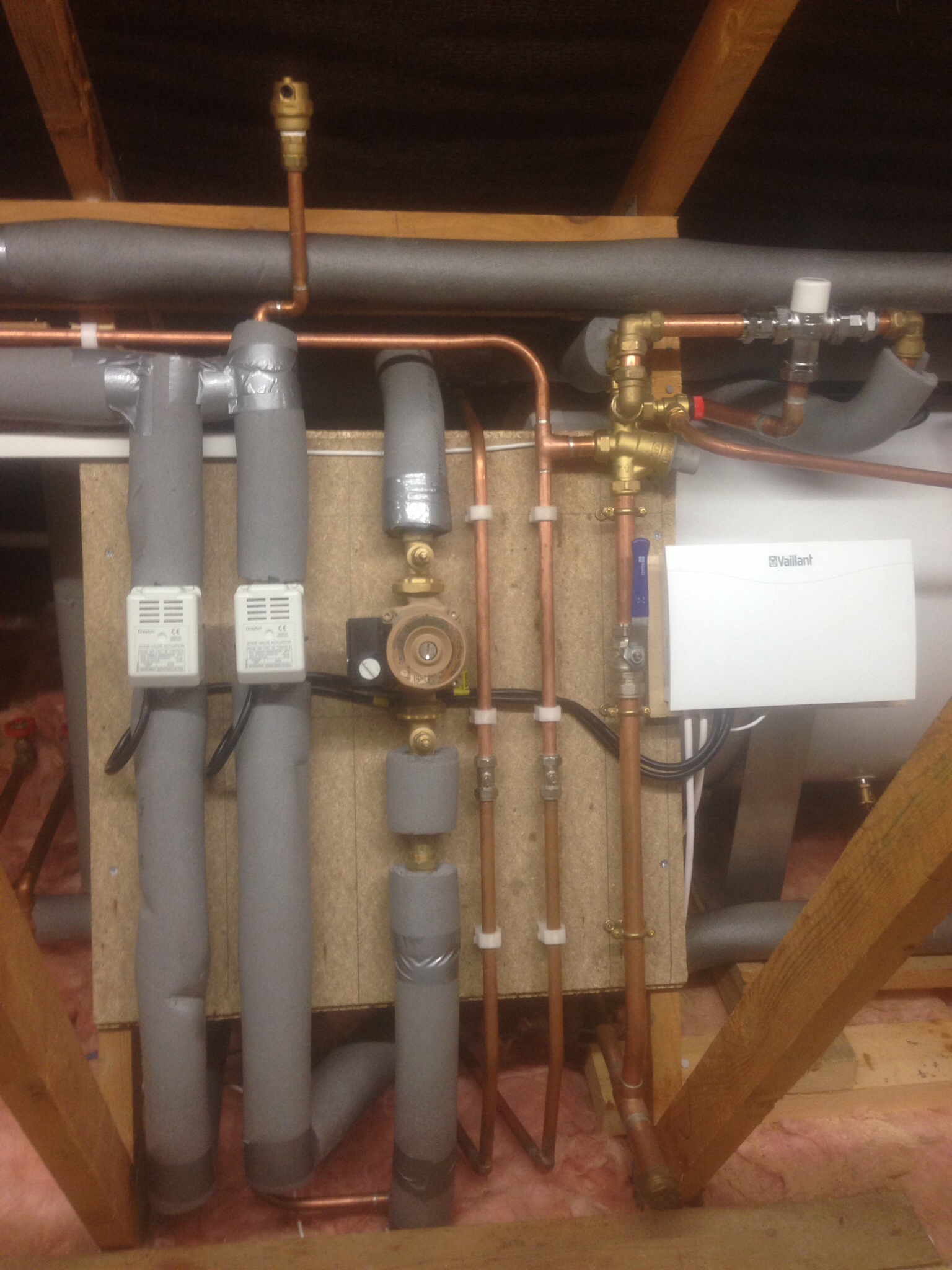
The combi will have a cold mains feed, teed off in 15mm before the control group. The hot outlet of that will be 15mm pipe to the low use outlet and that alone. One pipe one outlet. DHW will come from the UVC for everything else. As above re flow of mains through combi. As long as the rising main gives the UVC what is called “cold mains priority”, eg the 22mm feed from stopcock to control group uninterrupted, then you’ll be as well off as you’re going to get. To maximise the preservation of the flow rates the outside tap should come from the rising cold mains BEFORE the first ( aforementioned ) stopcock. The cold fed domestic appliances and the WC’s should all then be fed from the softener cold outlet, with the softener being the very first thing off the stopcock. Stockcock > double check non return valve > drain off cock > 22mm tee. Off that tee comes the 22mm feed to the softener, and the 22mm cold feed to the UVC control group. Some may call this a bit OTT, but with a promise of no more than 2.1 bar and expected struggles with max flow rates, do this and max out your situation is my advice and what I would 100% do if this was one of my client’s full M&E projects. Soften everything other than the kitchen sink cold, American fridge cold feed, possibly the utility cold, or any other cold outlet routinely used for human consumption. Combi-mate conditioners can be used for treating the raw ( hard ) cold feed before these outlets / appliances ( like a boiling / chilled water faucet ) for max results. As always, follow the specific MI’s ( manufacturers instructions / installation advice ) for the items you wish to purchase, so knowing right now what is going in is paramount for this design to be right first time. MI’s can be downloaded for most common devices. Running 2 showers simultaneously will need a household discipline of no other significant outlets being used in parallel during shower times. Both combi boilers and UVC’s are cold mains dependant so ultimately use that cold mains potential and nothing else to push the hot water to the outlets. Starving them obviously had a detrimental effect, however with the static body of pre-heated DHW in the UVC, you will benefit from ‘same temp’ showers which just speed up or slow down, whereas with a combi they would just go cool / cold. Good quality thermostatic shower mixers for balanced pressure cold / hot systems is vital. Do not cheap out there. 28mm is OTT imho, as the above splits the 22mm main at the stopcock already. I would say allow space to add a 200 or 300L cold mains accumulator if there is room in a garage / ground floor space, and have that in the pipe run between the 22mm priority run and the control group so it’s only ever fortifying bathing / showering / mixer taps. Consider that as a parachute option for the eventuality of when the new mains becomes live and you have the system finished, you’re not happy with the max flow rates for the 2 showers together. -
You do in every instance where there is existing foul / waste pipework that you cannot confirm the type / specifications of. If in doubt, pipe goes out. As @PeterW says, the boiler PRV is a normally closed valve so no through draft can occur, and if you're that worried about this rather insignificant cold bridge, just cut the pipe off inside, drill back through at 25mm diameter and push a 21.5mm pvc overflow pipe into the wall as a sleeve. Seal that both ends with a suitable sealant. Re-fit the 15mm copper pipe through the sleeve, and fill the gap around the copper pipe with expanding foam at both ends. Problem ( if one actually exists ) solved.
- 12 replies
-
- copper pipe
- thermal bridge
-
(and 2 more)
Tagged with:
-
Low flow what do i need to increase
Nickfromwales replied to Ahmiccc's topic in Boilers & Hot Water Tanks
Hi. OK, you seem to be all over the place with the replies here, so let me clear a path for you. Incorrect. The heating circuit can easily support an UVC / TS etc, simply by adding 2-port zone valves to split the heating flow and then running that to the heating coil of the storage tank. The downside is that the combi then, ideally, wouldn't be used as the return path for the hot water a) due to the restrictions through the combi plate heat exchanger, and b) because the combi does one job or the other, eg DHW or heating out, not both together. This means that all the time DHW flows through the combi, it will ignore the heating circuit completely thus not maintaining the temp of the UVC. To get 2 showers running simultaneously, and with good flow, you will definitely need to store hot water in an UVC. I would not recommend the pump as with the new cold mains in place you should find things 'sufficient' as is. You'll lose the inherent restrictions, in-built into the DHW gubbings of a combi, by going mains > UVC > outlets, plus the hot and cold feeds to all the mixer outlets will also be balanced by the control group supplied with the UVC. That gives a 22mm outlet to the UVC and a 22mm outlet to cold mixer feeds, both at the same potential. For this setup you will need to plumb the house correctly, with all monoblock taps / mixers etc all piped back to the same place at the UVC. Cold feed appliances, WC's, and DEFFO the outside tap need to be tee'd off the cold mains the second it comes into the house. Ideally the outside tap should come off the rising cold mains before the first domestic stopcock within the property. The combi can be run to the most infrequently used hot tap in the house, and the one open for as little a time period as possible ( probably the cloakroom wash basin ) so the DHW priority when it's in DHW mode is not dominated by that outlet eg it stops servicing heating output to rads / UVC. Ignore the dynamic pressure readings as they are academic, because you can get great performance from a shower with little to zero dynamic pressure. It's flow rate l/p/m that matters here. Plumb the house to have a rising dedicated 22mm cold feed that services the UVC only to maximise performance.