
Nickfromwales
-
Posts
30353 -
Joined
-
Last visited
-
Days Won
297
Everything posted by Nickfromwales
-
Usually, but not always
-
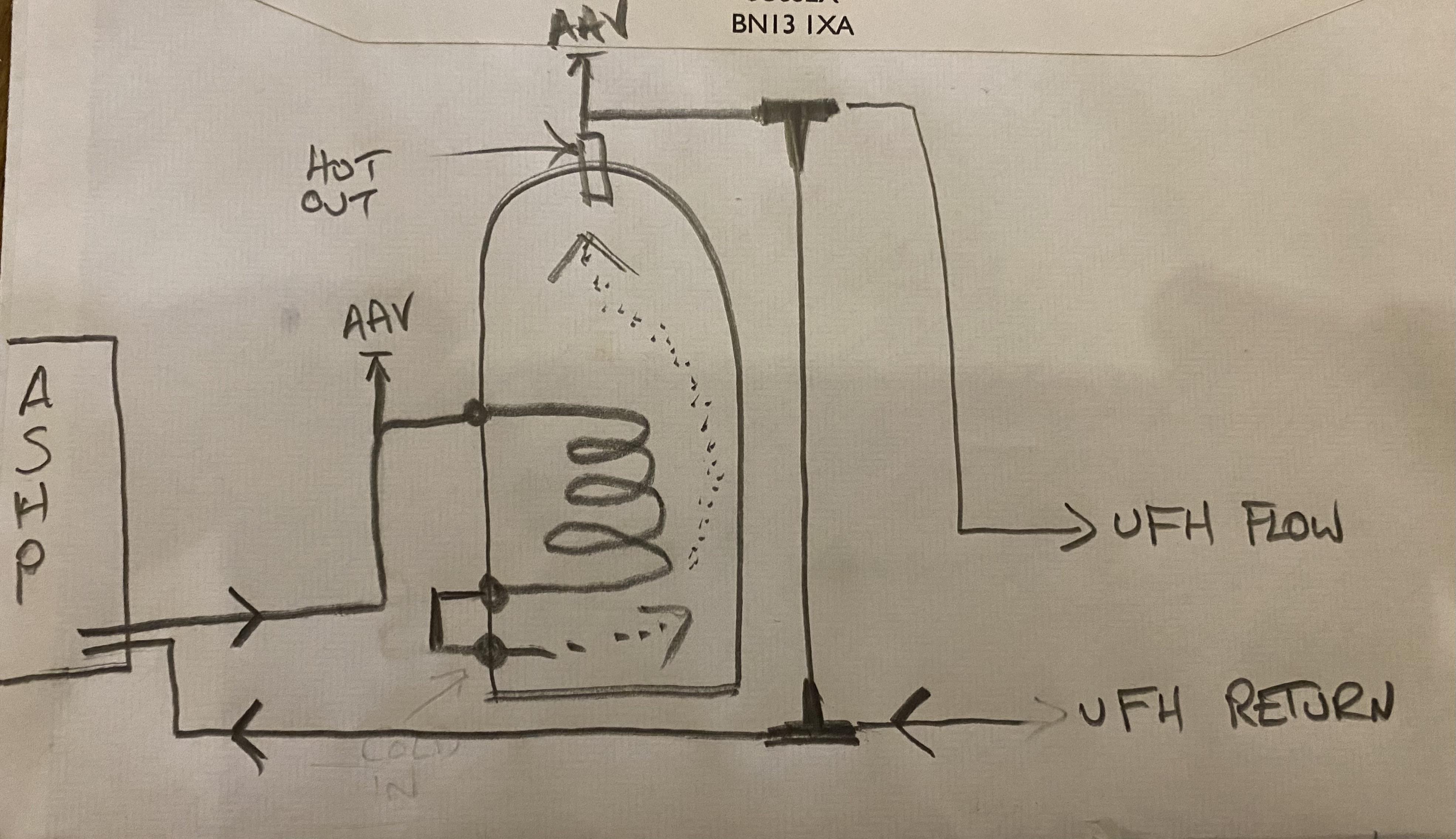
Hi. Yes, I re read this a couple of times before dipping my toe here. The transfer rate of heated water from the coil ( note : 5kw ASHP ) to the surrounding body of water in the vessel is insufficient in linear ( attempts to be linear ) output. Therefore we are advising here that the buffer ( a small UVC in this instance ) becomes part of the whole single system. In my pic there will be both hydraulic separation, initially, and then energy buffering second eg when the house comes up to temp.
-
If it’s a stainless coil then fine, but copper coils should never be left open to atmosphere as the insides get condensation and corrode badly over time, hence my seemingly unnecessary inclusion of it in my drawing. Fwiw, I would still include the coil in the pathway, even if it’s just teed in one side ( highest connection ) and capped off at the lower so it stays ‘wet’. The way it’s drawn by you @joe90 is an energy buffer arrangement, and will do as you suggest eg allow heat to the path of least resistance, so when hearing from ‘cold’ the lions share of heat energy will go almost directly to the UFH ( with any residual head diverting / bypassing through the buffer and back to the HP ). Only pitfall is heat has to creep all the way down the buffer to the very bottom to escape as return to the HP. Have the expansion vessel teed into the return down low so it’s on the coolest pipework possible ( or you get a wasteful heat bomb ).
-
 Yup. One TV at a time will each receive undiluted signal.
 -
What does your home cinema look like?
Nickfromwales replied to Adsibob's topic in Networks, AV, Security & Automation
In respect of Hollyoaks, no. The grizzlier the death the better. -
What does your home cinema look like?
Nickfromwales replied to Adsibob's topic in Networks, AV, Security & Automation
Dead man walking lol. But, yes. -
What does your home cinema look like?
Nickfromwales replied to Adsibob's topic in Networks, AV, Security & Automation
It would need to be vetted, to separate out victims who are watching such utter garbage but are not yet completely dependant on it, where then they would qualify for a longer term correctional program of rehabilitation. However, I must add a caveat; that if they also watch Hollyoaks then they go straight to for the aforementioned execution without any form of reconsideration. For those, there is absolutely zero hope. ”Nick for president!!!!” Moving swiftly on……. -
Deffo NOT motorised. The motorised Salus ones open in a few seconds these open slowly as the 230VAC goes into a heating element which melts a wax in a sack. That resultant energy turns into force which slowly pushes the pin hammer outwards to open the valve. Can you tell us what the flow temp is when the system is operating? The water temp getting to the 22mm pipes at the manifold please.
-
I would not do this. Conversely I am in regular contact with Trevor of Cylinders2go and he has had to petition Telford to start producing small buffer tanks ( sub 100L ) as there are lots of enquiries for these to be retrospectively installed in ASHP installs where they should have gone on on day 1. You already have it, it’s bought and paid for, so my advice would be to plumb it in as I show above and keep the ASHP as happy as possible. No 2 instances are really the same, so this is general advice, but I’ll put money on it that removing it would be a bad choice. Measuring its success as is is not a fair representation of how it ‘could’ perform, so as it’s there anyway, plumb it as above and see how you get on. Around £150 of antifreeze will need introducing to keep the concentration levels as required.
-
If you feed the ASHP into a coil there is bugger all primary volume, and a far reduced medium for transferring heat energy from one ‘side’ to the other. This is being demonstrated here. Buffers can he volumetric or energy devices, so can be plumbed in in 2 different ways to do 2 different things.
-
LAN C can go into a powered router / splitter and then feed C + a second LAN cable off it. The second cable can go down and behind the skirting and along through the wall to B. Coax at C can be split TBH, if you do not see both TV's using the coax at the same time routinely? If you can hide it at location A, a 5ghz AV sender could be used to get TV signal from A to B.
-
What does your home cinema look like?
Nickfromwales replied to Adsibob's topic in Networks, AV, Security & Automation
All of the soaps nowadays have sod their souls to the devil and "storylines" are in the gutter. People who watch and perpetuate them should be publicly executed without trial. -
Are TV aerials becoming obsolete?
Nickfromwales replied to dnb's topic in Networks, AV, Security & Automation
Maybe just a little swearing, but certainly politics do pop up..........rarely goes well. -
What does your home cinema look like?
Nickfromwales replied to Adsibob's topic in Networks, AV, Security & Automation
The real question is; how loud you can turn this up before pissing off the neighbours......? You can get some very big sound from some very small enclosures, but will you ever get to appreciate it is my issue. I've moved to a semi where I am mindful of the neighbour, and strategize when I give my now modest system some welly, but I could not ever dream of cranking my ol' faithful Yamaha DSP A2 up via my ( since sold ) Kef setup or there would have been murders. I used to run 2x Kef ref 104.2's, 2x Kef Q65's 2x Kef Q55's and a 95c with an active Velodyne subwoofer ( all bought second hand for sub £5k from someone who shed this stuff as soon as the latest replacement arrived at Quinns or A.E. ) and the SPL was just staggeringly good, if you like that sort of thing. I now have gone for audibility second and clarity first, ( with just a bit of subsonic ), achieved by a good ( large ) Samsung sound bar plus an accompanying matched subwoofer, with the sub being hidden away in the corner out of sight where it still rocks the room well enough. Not even close to a whiff of my what my old setup was capable of, but certainly a 'good enough' and compact / discreet enough setup to suit me ( and the neighbour ). I would definitely consider a much bigger and therefore 'visually obtrusive' system later down the line, if |I can ever get into a detached home that is. These days, my sound pollution is contained to my Sprinter, where it does not offend. 3x 12" subs sit directly behind my drivers seat and rattle my ribcage nicely. Kevin and Perry go extra large in there -
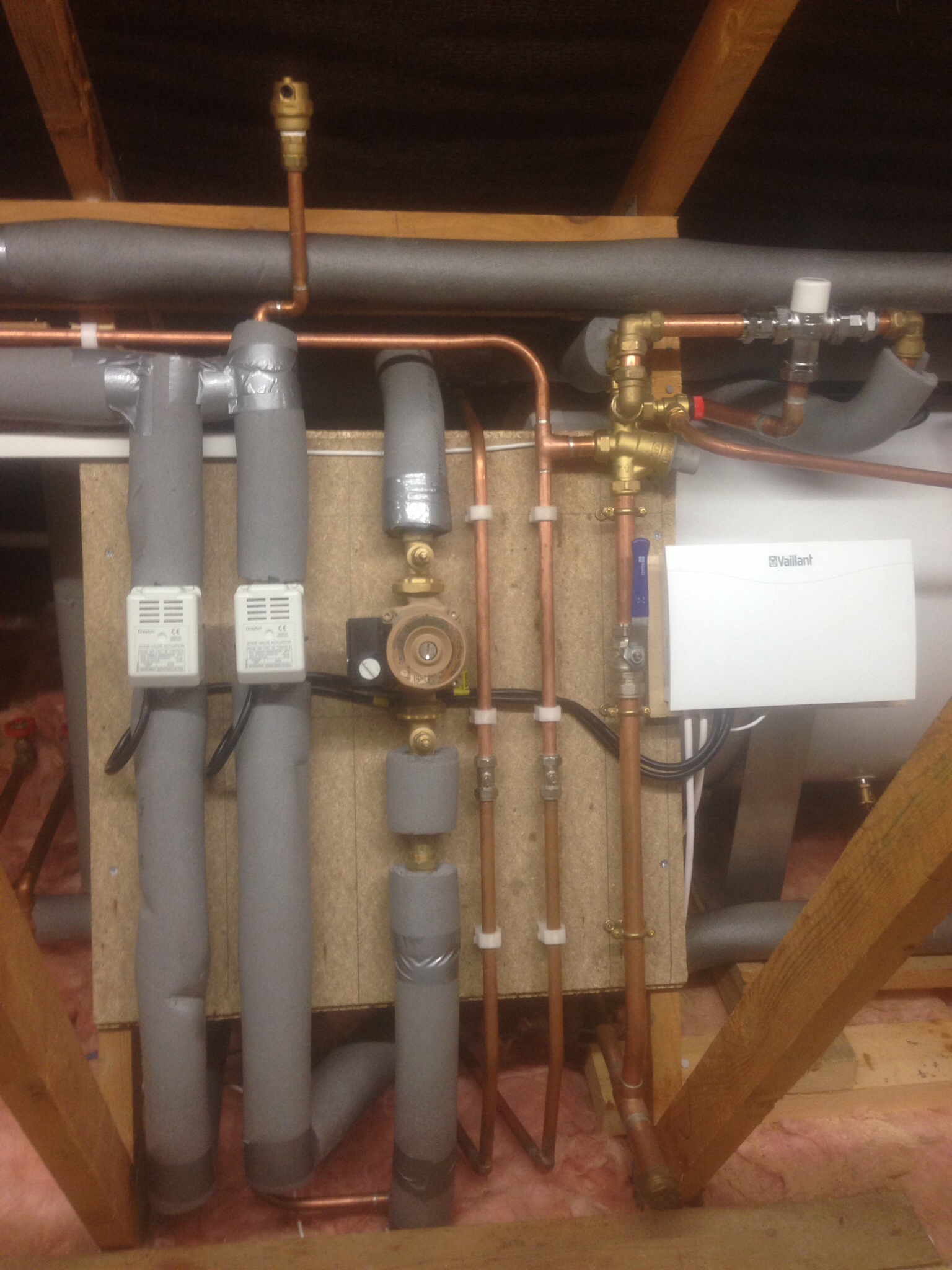
There should be a pump sending water to these 2 manifolds, sucking heated water through a remote TMV? ( @PeterW, the same as was at @newhome's when we got there, eg the red Reliance TMV's which governed the flow temps to the floors ). Agree it's likely to be weak / dying actuators, OR worst case the flow and return the wrong way around on that one problematic manifold causing the actuators to 'jump' whilst opening. @steve1986 these wax actuators start to open around 30-60 seconds after they get fed with 230v ( and the wax in the head slowly starts to get melted ) so the elapsed time, where you are hearing this issue, is relative to the actuators going from partially to nearly fully opened. This is deffo being caused by the actuator(s). If you wish to fault find before buying new actuators, simply swap the 4 there over to the other manifold, as a process of elimination, and see if the issue migrates or not.
-
@joe90 are you heating the 'buffer tank' via the coil, or are you using the coil to extract heat? The whole idea of a buffer is to add volume to the primary side so going via a coil will not achieve that. In honesty, I do remember sorting the deal out on price, but I'm pretty sure I did not spec the cylinder you bought to use as a buffer..... IIRC you followed @PeterW's install that he was on at the time where he used the same UVC as a buffer? Been a while of course. Agree that it's a simple fix to reconfigure, but with the caveat that the system volume will increase, thus, requiring an additional volume of antifreeze when you mix ( combine ) the 2 bodies of water. You have 2 filling loops atm? One for the ASHP primary and a second for the internal heating system? Internal UFH on inhibitor only and antifreeze in just the external primary's? Run the ASHP flow through to the buffer coil inlet, and come out of the coil output and feed that into the bottom ( cold in ). Then take the flow from the 'hot out' back to the ASHP as the buffer return. You then need a tee immediately off the top connection of the buffer ( the 'hot out' ) where you will pick up the flow to the manifold, and then a tee lower down the same pipe run to pick up a return for the manifold.
-
Looking for internal dimensions of Wago wiring center (L32 L60)
Nickfromwales replied to joth's topic in Electrics - Other
??? -
So, the “NRV” is a bypass valve and not an NRV in this instance? Removing this or allowing flow through it can only take away from the pump energy pushing water around the loops, so a bit lost as to how this will promote flow ( even if it has ! ). Most bypass valves are user-adjustable so they can be ‘slackened off’ to allow them to operate at a lower resistance. Was this one not adjustable?
-
CT1 on the deck is plenty, as long as a proper and robust metal wall profile has been used. Do NOT ever dream of doing away with the wall profile ?. 8mm at that length of screen would benefit from a top stay bar, 10mm probably good without it. That’s said…..( here comes the caveat )……. if it’s a regular domestic setting. You have to include the much higher likelihood of someone using this and taking a tumble, plus that likelihood increasing over time / use, so you should factor that in now for maximum safety. That assumed, I would say to fit a top stay bar now, perpendicular to the glass at the 2/3rds point to be safe.
-
The tank stat option will likely be too crude as a control, due no linear hysteresis, and result in under / over-shoot IMO.
-
You just re-fit the LS>LR link to use bus only.
-
Does it not have a regular stat connection as well as the bus connection? Have you checked the Mi’s?
-
Nudura all the way. Woodcrete systems are porous so moisture ( rainwater ) infiltration is a huge problem all they way up to the external rain screen ( render / other ) being installed, plus soffits - facias - gutters being on and functional. Having had 3 M&E projects run simultaneously, with 3 different types of ICF, I would say hands down that an EPS ( inherently water resistant / non-hygroscopic ) based block would be my first choice. @Russell griffiths recent AT score of 0.28 with a DIY Nudura build speaks volumes. That was with an untreated internal surface, just the raw blocks and concrete core plus perimeter / junctions / openings sealed with various tapes & mastics and foam etc, but most importantly bone dry from the moment the roof was on, including driving rain etc for over a year going directly onto the external EPS facades. That allows the inside to be bone dry and pushed on through the worst parts of the year unhindered. A huge bonus. Plus very little to nothing to be done internally to get airtight, which cannot be said of the 3 big names in woodcrete ICF. Agenda and budget plus your skill set will be big influencers in which product you end up going with.
-
Question regarding underfloor heating layers
Nickfromwales replied to Nanda's topic in Underfloor Heating
Get a new builder immediately!!!!!! 50mm of insulation is not even building regs, so this chap is WAYYYYYYY behind the times and not up to the task. If you put anything less than 140-150mm of insulation under a HEATED floor, you're going to have very poor results with the heat output, plus the running costs will be very high. I would also have a guess that the other aspects of the building are leaky and poorly insulated, so the space heating demand will be adversely high. That is not well suited to UFH as it runs at very low temps and cannot be turned up beyond 27oC floor surface temp without the home becoming uncomfortable. This sounds like a disaster unfolding, sorry, but good you have registered here and are asking the right questions Stop this work now, before it's too late to change it.