
Nickfromwales
-
Posts
30329 -
Joined
-
Last visited
-
Days Won
297
Everything posted by Nickfromwales
-
 There’s a consideration for both parts, but “over glazed” often raises red flags for overheating for peak summer spells.
 -
It's in respect Part O mostly, combatting solar gain, and not wasting electricity mitigating against such issues.
-
Contact a local pvc installer and ask them to supply and fit a suitable, replacement hinge for you. Likelihood is, that it will need to be adjusted when fitted to get the door to open and close / lock / seal properly, so needs a bit of attention tbh.
-
Check dimensions to see if this is suitable.

-
Long shower waste run - can I avoid a stub stack?
Nickfromwales replied to maznaz's topic in General Plumbing
5m in 50mm pipe will be fine. To appease the BCO you just need to demonstrate it working afterwards, they shouldn’t really be too bothered about anything after the 110mm pipework / vents etc. No need for an AAV unless the pipework drops vertically a good distance before meeting the stack. -
https://www.buyinsulationonline.co.uk/product/novia-a1f-building-paper?gad_source=4&gad_campaignid=22149925402&gbraid=0AAAAAolHs116snL13ZrLXATGXtAl0ng5L&gclid=Cj0KCQjwoZbBBhDCARIsAOqMEZUWvJ23gaPqHoGM1WgXfutk1-neASiKkpZE0KoCZTsh0mwEStg5KcIaAsLCEALw_wcB
-
Can the DNO cutout be located inside?
Nickfromwales replied to WisteriaMews's topic in Consumer Units, RCDs, MCBOs
Indeed. You don’t need much room unless you’re splitting off for other things, which would then need extra kit in there such as switch-fuses and isolators etc. -
Can the DNO cutout be located inside?
Nickfromwales replied to WisteriaMews's topic in Consumer Units, RCDs, MCBOs
It’s an odd world, considering one of these will suffice….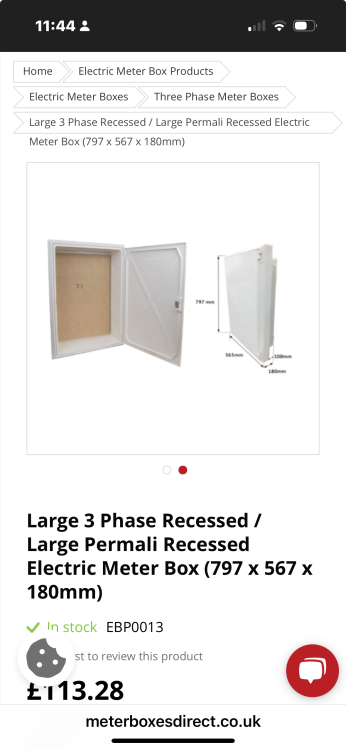
-
Not so sure that's practicable? Ventilation and rainwater runoff, moisture behind cladding needs to be able to drip, dissipate etc so I don't see how the cladding can finish flush with the lower course. Pretty much anything is 'doable' with time, imagination, and budget, but I think you need to look at sectional examples first to decide if the flush finish from one discipline to the next is actually going to work in real life.
-
Can the DNO cutout be located inside?
Nickfromwales replied to WisteriaMews's topic in Consumer Units, RCDs, MCBOs
They're not airtight, so don't really need any ventilation as such, also they don't get 'hot' so to speak. This kind of thing. Random grab. https://www.ebay.co.uk/itm/192527358041?chn=ps&_ul=GB&mkevt=1&mkcid=28&google_free_listing_action=view_item -
Not needing a crane will be one saving. I'm not a fan of a SIPS roof, particularly with a metal rain screen, due to the noise / acoustic transparency of the PIR vs say blown in cellulose or other similar higher performing material. SIPS will need manufacturing, cut roof will be DIY / builder and more flexible / forgiving for you to work with.
-
You need to cut small notches into the timber so the boards are not laying on the cables. DO NOT put weight on these as the cables will get damaged quite quickly.
-
Codswallop..... It weighs the same, either chuffing way !! The better job would be to increase the footprint of the timber at the point where the load is transferred to the masonry. Complete nonsense afaic, sorry. so different fixings change the weight of the load do they? Not what I was taught, in the few physics lessons I attended. This suggested methodology, of cutting a section of a brick out, shows that this person has zero practical skills or has ever tried this in person, as it simply cannot be done. You take out an excess amount of masonry, clean the hole and set a mix of compo in, then use an offcut of timber to create the pad out of compo (sand and cement) and allow to dry. I use a piece of synthetic slate on top of the compo to create a nice clean shelf for the timber to sit on. Once the timber is in place you fill in around the timber with more strong (3:1) compo and job done. Trying to get the timbers into this wonderfully neat little pocket you are going to attempt to make would be wholly impractical and cause you no end of logistical aggravation during the install, and the suggestion of you disturbing say 100mm of masonry would compromise the strength of the wall is just make believe, sorry again. Is this guy a 1st year apprentice or something?
-
Underlay is for impact / noise more than anything, so just use whichever you want. Some have a foil for an vapour barrier, and some insulate, etc. If it’s over a suspended, cold ventilated sub floor then you’ll need to control vapour, so look for one that offers that functionality.
-
Ah, ok. Just make sure you mop and clean the floors aggressively, I use a janitors mop. Soak the floors (and I mean soak) with 75% water 25% primer (not PVA) and repeat a couple of times. This will rid the surface of dust / contaminants, and size it prior to levelling. The self leveller will need fibres ideally, so go for the Mapei builders screed (20kg bags) and mix to the exact detail on the package. 2 person job so ones pouring a bucketload out whilst the others mixing the next, this isn’t a job where you can break off for a cup of tea as this needs to be laid wet on wet so it flows and levels. Use the same mop and prime the floors immediately prior to laying, repeating as you go. Don’t worry about standing pools / puddles just avoid as best you can, but you can’t have this too wet imo and it makes a huge difference to how the leveller will settle and blend. After mixing as instructed, you then put 1/2 pint of extra water in and give it one final good whisk, and literally get it onto the floor whilst it’s still spinning. The extra bit of water will further promote it levelling out and flowing very well, plus it extends the ‘open’ time between bucketloads going down to guarantee that wet on wet application. You’ll need a spiked roller too. Have you levelled before? If not, do one room at a time, and choose the easiest one first for a practice run.
-
Advice needed on French drain
Nickfromwales replied to Omnibuswoman's topic in Landscaping, Decking & Patios
Were you having issues with storm / rainwater runaway? -
What is the purpose of using the self leveller exactly? Joists (and therefore flooring) a bit out of whack? Whats going over this as the finished flooring?
-
Advice needed on French drain
Nickfromwales replied to Omnibuswoman's topic in Landscaping, Decking & Patios
Simple question. What were you charged for, and what was delivered? Please state what was ‘in writing’ to help us help you. 😉 -
Can the DNO cutout be located inside?
Nickfromwales replied to WisteriaMews's topic in Consumer Units, RCDs, MCBOs
But not necessarily in a domestic setting…. I recently tried to buy some tray and cable management, but @tuftythesquirrel had, apparently, bought the lot. 😌😜😜😜 -
Going for self build no 2!
Nickfromwales replied to Crofter's topic in New House & Self Build Design
Hello stranger. 🙂 -
Not penetrating the internal leaf of the B&B structure, multiples of times, and then not having to be pre-disposed to correcting each of these penetrations, is a no brainer . Pick your battles! Life’s short.
-
You can get images to download from www.buffwelshplumbers.com
-
Surge protection would only be installed in the new CU in the house no need for a secondary one in the remote CU.
-
30m should be fine to export the supplied earth, and I’d defo go with the 16mm2 to stave off voltage drop and give some headroom, but you could probably get away with 10mm2. Catenary is fine, just remember to get duct grade CAT6 (I don’t use CAT5 anymore). That SWA can be protected by a 50a breaker, and should allow use of most things even when the EV charger is in use. I’d only recommend a rod and isolating the earths if this was a metal clad building.
-
Agreed. Thanks for the added option / clarity 😎👍