StructuralEngineer
-
Posts
57 -
Joined
-
Last visited
Everything posted by StructuralEngineer
-
Brick Shed Coversion - Advice needed please
StructuralEngineer replied to Pjbrandon's topic in Garages & Workshops
I'd use cheap roofing batten screwed straight to the inside walls of whatever you've got at 400 or 600 centres. (it's treated against damp). Sheets of OSB screwed to that. Do same with floor. This allows some air circulation for any moisture to come away. -
Yours truly is very annoyed.
StructuralEngineer replied to MikeSharp01's topic in Building Regulations
I usually reply to BCO points with inline answers in red, and I see their numbered list as an easy way to clear all outstanding questions in one go. In other words, if they send this kind of list, it means they're doing me a big favour and making it easy to respond without having to re-issue all my drawings. I'd be interested in your thoughts on it. Indicative answers : 1. Please provide details of the fire resistance to external walls within 1.0m of the boundary. This should be in terms of its minutes of fire resistance from inside and outside. 30 mins inside (1 layer plasterboard). No resistance outside - that ship lap is gonna go up like a bonfire. 2. Please provide design specification for the proposed MVHR ventilation system. We have a layout but need the design details. See attached PDF for the spec of the Zehnder ComfoAir 160 (A+ class). 3. Please confirm the provision of network access to the new dwellings. Wi-fi booster from study in original dwelling. 4. Please provide design details for the proposed staircase, and guarding to low level glazing. Standard Keyclamp handrail at 900mm high, brushed red oxide finish (see updated section attached). 5. As an extra item I picked up, please can you confirm that Bedroom 3 will have an escape window as it is an inner room. Room will only house teddybears, nevertheless see updated roof plan showing velux.- 30 replies
-
- 1
-

-
- building control
- part f
- (and 3 more)
-
House with full planning/ thinking of buying
StructuralEngineer replied to Dyfed's topic in New House & Self Build Design
It's a very nice house - congrats! (and your architect really knows how to use Revit.) Could the garage roof can't be same ridge height as the rest, increasing the size of the upper room? Turning garage into a bedroom could be problematic -- access through utility doesn't feel very nice. How about making the garage ground floor a study, with loft bedroom above accessed via a spiral stair? Lots of storage in the eaves, so can knock out storage in bed 3, move the staircase over, and still have en-suite in bed 1. -
Glulams: cutting and drilling them
StructuralEngineer replied to ToughButterCup's topic in Roofing, Tiling & Slating
Thanks @MikeSharp01 for the link. These look like they can take about 12kN safe working load for 4 holes and 120mm long 12dia steel dowels. Is that round about the load you have? @recoveringacademic -
There's a free PDF document of the HSE's guidance to clients, designers, contractors -- maybe you were thinking of this one?: http://bit.ly/CDM2015_guidance The one I tend to send to new contractors or clients is the easier to digest "A short guide for clients on the Construction (Design and Management) Regulations 2015": http://bit.ly/CDM_short_guide @laurenco I would be careful to check what roles you are expected to carry out, as you might find yourself responsible as Client, Principal Contractor, and Principal Designer all in one!
-
Glulams: cutting and drilling them
StructuralEngineer replied to ToughButterCup's topic in Roofing, Tiling & Slating
I'm sure it'll be fine. You could always go along the route of "you're right about that top bolt spacing -- perhaps we can go with a plate under it to be sure?". He/she is probably as worried about it as you are. Looks like the document is freely available: http://www.structuraltimber.co.uk/assets/InformationCentre/eb9.pdf -
Interesting one. Planning doesn't have this kind of authority, so if you use something that looks like Welsh slate that should be fine. If they pull you up on it, I'd wager you could easily win if you challenge it.
-
Glulams: cutting and drilling them
StructuralEngineer replied to ToughButterCup's topic in Roofing, Tiling & Slating
The detail (from Structural Timber Association) is suggesting a single row of bolts is bad practice as it can cause splitting, and that they prefer to see a bearing plate under the glulam beam. For example like this: Typically also glulam connections will have multiple bolt rows, any number of which can be seen here: https://www.pinterest.com/pin/294493263104077506/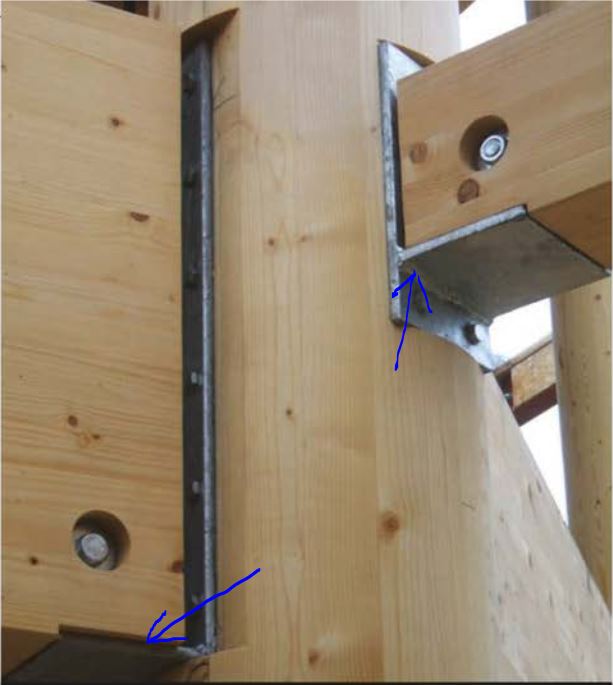
-
Glulams: cutting and drilling them
StructuralEngineer replied to ToughButterCup's topic in Roofing, Tiling & Slating
My gut said that connection didn't look right. I just did a quick search and found this: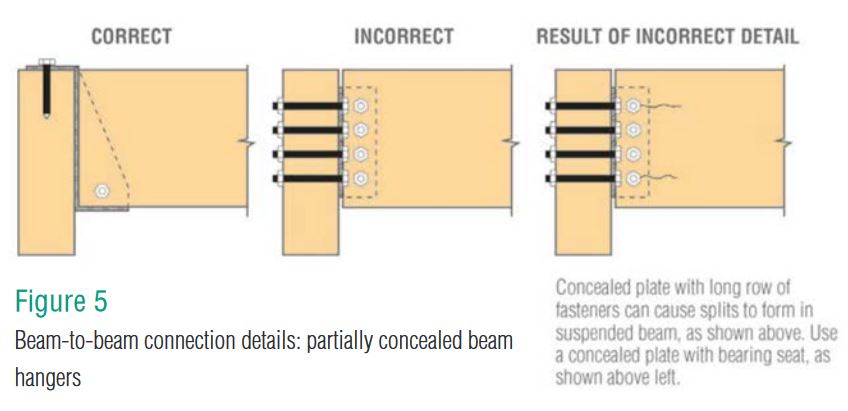
-
Glulams: cutting and drilling them
StructuralEngineer replied to ToughButterCup's topic in Roofing, Tiling & Slating
The weld looks poor but will hold. The glulam connection on the other hand, with just one row of bolts... has this been checked by anyone? I mean that sincerely. -
It's superb to see such a clear WIP photo. It worries me slightly that this is supported off timber stud though. 10m is very long for a steel in a domestic situation.
-
Holes in the web of an RSJ
StructuralEngineer replied to Triassic's topic in RSJs, Lintels & Steelwork
If you're taking out a large part of the web (the upright bit) it would be an engineer re-design. First thing would be to see if you could make the hole toward the centre of the span, so if it's a 4m long beam, 2m from the end. At this point there will be the greatest moment but the least shear stress, so the web is doing less. Conversely, near the supports (the ends of the beam) there is going to be the most stress in the web. However, if the beam is already working at maximum capacity any holes in it are going to reduce its strength. For a "rule of thumb", if you keep your opening within the middle third of the depth of the beam, on the centre-line, within the middle half of the span of the beam, ensure there are no point loads on the beam, and click "like" on all my posts from now on, you should be fine. -
Looking at a plot with PP but scary soil survey!
StructuralEngineer replied to Dreadnaught's topic in Foundations
If you increase the depth of concrete and add additional reinforcement this should work well as a raft over less competent ground too. -
Looking at a plot with PP but scary soil survey!
StructuralEngineer replied to Dreadnaught's topic in Foundations
Yes, I was thinking, since you said there was reasonably competent granular strata overlying the clay, you could potentially go with scraping the topsoil away, import stone bed and compact, cast RC raft over the top. NHBC allows for that over desiccated clays (see CH4.2 p9) as long as your building is rectangular on plan and the raft is designed (or signed off) by a chartered engineer. I tend to prefer rafts for the simple reason that you have cost certainty, pretty much whatever you find on site and whatever the BCO says, and you can do a final design and get quotes even if the building hasn't been designed yet.- 20 replies
-
- 1
-

-
- soil survey
- piles
- (and 1 more)
-
Looking at a plot with PP but scary soil survey!
StructuralEngineer replied to Dreadnaught's topic in Foundations
Interesting site -- and almost precisely the same ground conditions as the question in my mock IStructE exam Weight of a house: Masonry clad timber frame, say 10-15kN per m2 according to the structural engineer's pocket book. So for a 100m2 footprint, 1500kN. Piles: Forget about CFA piling or getting a large rig onto the site. Yours is a very small scale project. Noise and vibration could be a bit of a non-issue. If you use bottom driven steel mini-piles, you could perhaps get 50-100 kN per pile, thats 15-30 piles, and the team could quite happily complete the job in two days. All it needs is a compressor and the vibrating "mole" does about 85 decibels. Google "Grundomat" and you'll be amazed. I'm not sure off the top of my head if water table would be an issue for these piles though. Raft If it were me, I'd consider creating a reinforced concrete raft. It would be relatively tolerant to roots. I second what others are saying -- it would be valuable to get the vendor to supply access to services and welfare during the build if it's a reduced access site.- 20 replies
-
- 3
-

-
-
- soil survey
- piles
- (and 1 more)
-
Just not happy about the concept of joist hangers.
StructuralEngineer replied to epsilonGreedy's topic in Floor Structures
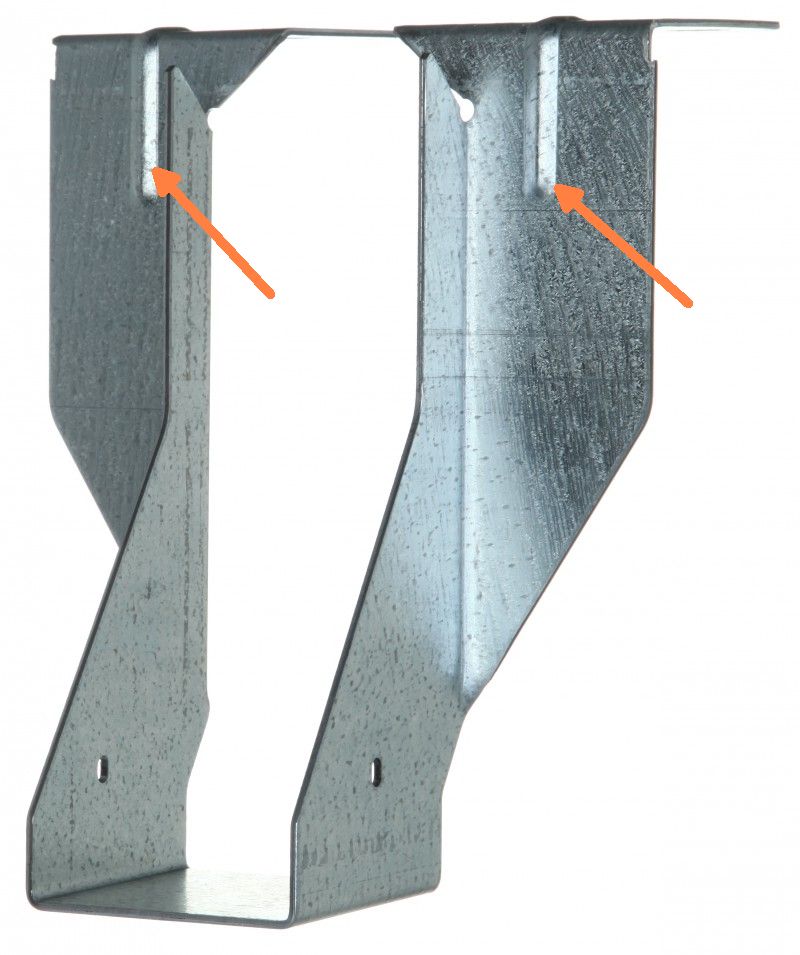
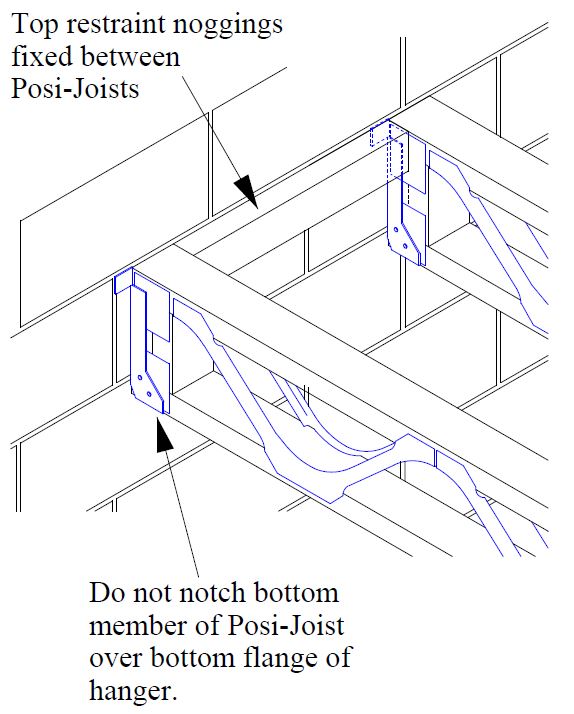
I think Simpson Strongtie have a great technical department whom I've used several times in the past, and they have always been able to fully justify why they're recommending any of their product range. The problem comes when copycats produce almost the same product, but forget to see the small but vitally important little folds or webs in the metal. Take for example the raised area on the fold of the following hanger: It stiffens the folded sheet metal, and if it's missing, the metal may unfold under the weight of the floor. It's exactly like a steel tape measure -- consider how easy it is to bend one way and difficult the other way. Regarding joist hangers for I-section joists, really this is the domain of the joist suppliers, since they're the ones that warranty the system, and the hangers are a vital part of the system. Again the issue here is that Posi-joist are highly technically astute and provide the following detail, but copycats may forget to include one vital part of the system (can you spot it @recoveringacademic?).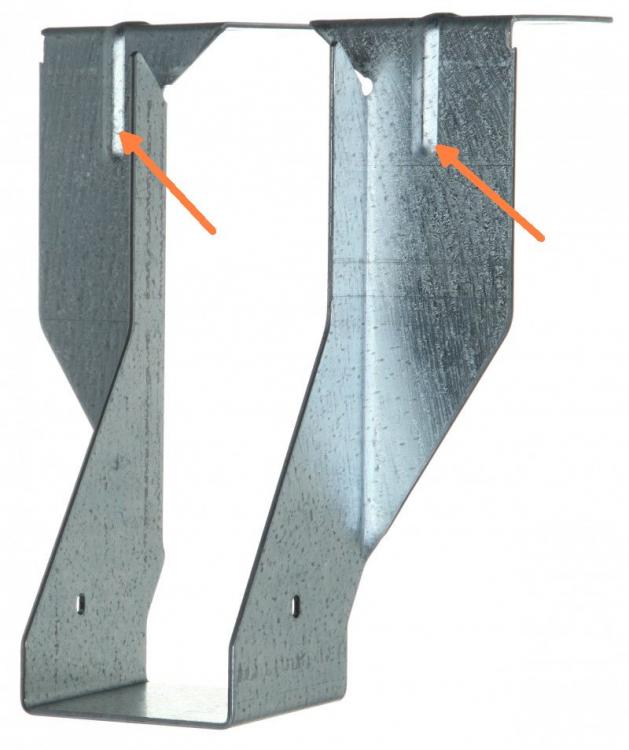
-
Just not happy about the concept of joist hangers.
StructuralEngineer replied to epsilonGreedy's topic in Floor Structures
The timber to masonry hangers in this list all have a ledge which sits in the bed joint: http://www.strongtie.co.uk/products/gamme/timber-to-masonry-hangers/129/liste -
If the concrete floor is designed "suspended" it sits on the blockwork over the strip footings, and does not need to touch the ground (although you have to shutter the underside with something). So to clarify, either you go with a groundbearing slab (compacted stone base, RC slab), or a suspended slab (shuttering, RC slab). The screed is immaterial to the strength of the slab and is only there to cover over the heating and to level the floor.
-
3D printed house anyone?
StructuralEngineer replied to newhome's topic in General Self Build & DIY Discussion
Thanks for the link @newhome. This looks like a more sensible "test case" for 3D printing concrete than I have seen in the past -- i.e. with several human interventions such as lintels over windows -- and sticking to vertical walls only. I wonder whether this is any use though? If the lack of strength in concrete without reinforcement means you can only print vertical walls, it takes the whole point out of 3D printing, which is that you can print forms you wouldn't usually be able to create easily. Speed of construction is slow - you have to wait for each layer to set, and the footprint is small because it's confined to the size of the print bed. -
Hi, and I'm glad you posted this up here. Your Architect appears to be competent going by the drawing and notes, though he/she is using standard notes for the foundations and floor slab. In other words, these may or may not work for your site. As you have discovered you could be paying several thousands of pounds extra because a structural engineer hasn't been consulted (I assume). Some observations. Yes, a 150mm concrete slab with a single layer of mesh is the standard way to build a ground-bearing slab. The 150mm hardcore is also a standard requirement. The screed is because the architect has specified underfloor heating and insulation over the slab. It's quite common to build slabs without screed otherwise. The foundation top right of your garage should be joined, not left untied like this. Is there a reason for the 140mm blockwork? How many stories is your property? Any reason for the additional blockwork skin to the inside of the walls at the bottom of the plans? Here are some ways you could reduce cost: You can have insulation below your slab and do away with the need for screed entirely (see https://www.quinn-buildingproducts.com/resources/insulation-solutions/solid-ground-floor-insulated-below-ground-bearing-slab/ ) but you may need to forego the underfloor heating in that case. Your strip footings seem to be wider than normal. For a standard 2 storey home, 450mm - 600mm wide would be more common. A structural engineer could advise and potentially save you money. You might need a trial pit to be dug. Try using a suspended ground floor instead. This negates the need for compacted hardcore/stone, for sand blinding, and can be done either with cast-insitu RC, beam and block, or timber. A timber floor might be ideal as you have the insulation below it (see https://www.nu-heat.co.uk/resources/floor-constructions-library/joisted/ ). Don't forget, as well as the inefficiencies highlighted above, your floor is also very deep, so to construct it your builder might need to dig down and remove spoil from site, which costs something. Hope this helps!
-
SmartRoof by Keystone
StructuralEngineer replied to StructuralEngineer's topic in Roofing, Tiling & Slating
Thanks everyone for the comments. @PeterW thanks for rectifying the youtube link! Does this forum have any markup I can use to do that? Regrading the insulation, I think any room-in-the-roof today needs insulation both between the joists and under (see for example Kingspan or Celotex standard details), so that's probably a wash in my book. However I agree it would be better if this came already installed. Did you manage to get a design from them for your dormer -- I believe the system is specifically for dormer roofs? -
I wondered if any of you have come across or used Smartroof, and what your thoughts are on it? It's a dormer roof system, constructed off site, then dropped into place. https://www.youtube.com/rqRx9yTAhZY
-
Hello and yes, it's a renovation blog.
StructuralEngineer replied to AdamSee's topic in Introduce Yourself
Hi @AdamSee and welcome to the forum! Is the external skin brickwork supported on the UPV window frame? It looks like you have a cast concrete lintel for the inner leaf of blockwork, then a cavity, then just the window frame. -
DIY Insulated Foundations
StructuralEngineer replied to Triassic's topic in General Construction Issues
Did you forget the basement retaining wall? -
Great minds think alike . This is precisely what I've been working on for the last few years. I've developed a simple modular system that can be built in your garage or shipping container, using just a battery powered hand drill, using materials from DIY stores, fits in your standard family car, and complies with all UK building regs and planning. The beauty of it is that, given the UK weather, components can be manufactured on an evening in your shed or garage, then driven to site in your car at the weekend. It's modular and you can put up a single watertight module (2.5m cube) on site in a day. At the "entry level", if you rent some land or a bit of forest, you can put one module up as a shed/office/cabin, then expand on that as time goes on. Since it's demountable and transportable, even if you end up finding a better location elsewhere, there's no money wasted. So far I've done all the structural calculations, 3D models and have built some prototypes -- though the project is ongoing and I have yet to build something in earnest with it. It's fully Open Source, which means anyone can take the design, use it, expand on it, create derivative designs... even take it and make money out of it.