StructuralEngineer
-
Posts
57 -
Joined
-
Last visited
Everything posted by StructuralEngineer
-
@SteamyTea I'm not with you. My point about masculinity doesn't make any reference to anyone's femininity. For me and many men, building a home with our own hands is part of our masculinity, from the dictionary "possession of the qualities traditionally associated with men." I'm happy to discuss if you feel I'm wrong.
-
Thanks everyone for such a warm and encouraging welcome! If you're trying to win me over you're going the right way about it (the other way I can be won over is good coffee). @Dreadnaught Likewise, and I hope we can benefit from one-another's expertise and experience. @MikeSharp01 Certainly it looks like there are reasons other than engineering/construction/cost that tend to dictate the situation, and as an engineer I find that as frustrating as the next man. There are green shoots though. For example, staying single storey, financing without mortgage, building on flood plains, or under "other" jurisdictions(e.g. waterways, Scottish "hutting", mobile or park homes). I'd be interested on your and other's views on this. @jack Indeed! I'd say it was a mix of structural mechanics and historical precedent, and while the former can be straightforward the latter is hard to come to terms with as a "science" professional, especially when your peers sometimes trump science with precedent. This problem is greatly compounded by the fact that there is little or no feedback loop -- so if a surgeon operates on 5 patients and they all suffer complications, they can look at what the underlying issue is with their method. If a SE designs 5 buildings, they never get to see any of them again. This is partly why I'm here -- to get realtime feedback! @billt Try telling that to any self-builder who never worked on the tools. Just using a measuring tape can be a real challenge for some, and I say that sincerely. I personally think anyone should be enabled to build their own house, and that it's an essential part of masculinity that is denied to men today. @SteamyTea Foundations - see also the above paragraph - are the worst to get data about, in that they're buried and hardly ever see the light of day again. 99.9% of the time if there are problems another Engineer will be dealing with it, maybe 20 years in the future. However, the source of the "over engineered" perception is probably because of NHBC and building control, who often specify enormously deep trenches, and inexperienced/insecure/browbeaten SE's who blindly follow. It's vexing because most SE's I know see it as their utmost duty to save the client money. BTW. I'm more of a coffee man, but each to their own! @JSHarris Thanks for the case study. Conservatism is probably a good thing when it comes to foundations, since a bit more concrete amounts to £85 or so per m3. Like you I've noted the tendency for trench-fill being over the top (see comment above) and have for years been advocating for a pad and beam approach or using mesh reinforced rafts. Also you may be right about the London Clay effect -- where loss adjusters have picked up on "clay heave" and apply it where it doesn't apply. Only last week I was shocked to see another SE who had specified 3m deep trench-fill with clay-master to two sides as underpinning... 1.5m away from a mature broad-leaf...
-
I'm extremely glad to discover that this forum has been set up since e-build closed down. I'm a Structural Engineer by trade, with a personal interest in self build and off site construction, and you can find me answering structural engineering and publishing questions at Quora.
-
The beams on beam-and-block are cast in the factory, and should therefore be quality controlled. The reinforcement bars they put into the beams are pre-tensioned, which means that they are pulled at each end before the concrete is cast around them. Once the concrete has set, the tensioners are released and the bars cut off flush with the ends of the beams. What this does is compresses the concrete because the bars are trying to regain their original (shorter) length. So the short answer is that you absolutely shouldn't have any cracks in the beams, and if you have, something's gone wrong in the factory. Also the driver's explanation doesn't stack up, since the concrete used is extremely strong.
-
If you have 15mm OSB you should be fine -- and you can always close up the spacing between the nails and also ensure a nail on each batten goes into the "wall" at the edge of each SIP. Think about the logic for a minute -- a batten is only 19mm x 38mm. If you put a nail through the middle, you only have 19mm of timber (if that!) acting against the nail in each direction. So the batten itself is probably as weak or weaker than the OSB anyway.
-
Thanks, and agreed. I might have something to say about an 82mm recess in a 100mm block-work wall though...
-
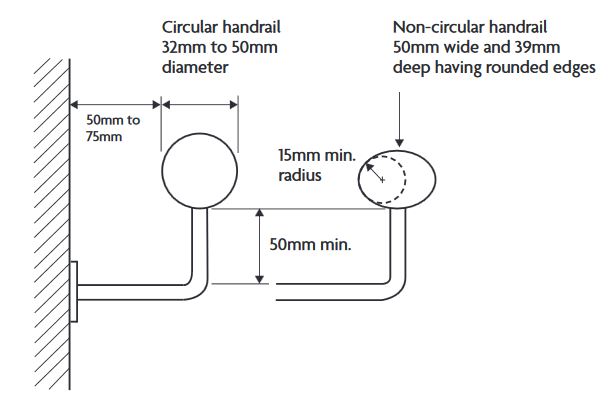
As far as I know the thickness requirement for handrails comes more from their need to be strong enough to hold someone up when they lean on it or trip and grab hold of it. The accepted deflection limit is 25mm, and the codes say that for a domestic stair the rail should be capable of taking 0.36kN per metre, which is 36kg. You could take a 36kg weight and hang it at mid-span between two supports, and see how much movement you get. These regs only apply when the handrail is stopping you falling down a drop of 600mm or more ("protection from falling"). In practice, the real limiting factor is whether you can get your hand comfortably around to grip onto it, and for this reason the Part K document states a minimum of 50mm gap to the wall and minimum 32mm diameter rail -- see the excerpt below from Part K page 16, diagram 1.13. I'd never noticed before that this seems to relate only to non-dwellings, so you may be right that this doesn't apply either.