Temp
-
Posts
10641 -
Joined
-
Last visited
-
Days Won
43
Everything posted by Temp
-
The certificate of lawfulness route should work as long as the caravan isn't capable of being "separately occupied". It must be seen as an annex to the main house. If you are doing the application yourself make sure to point out you are all one family and don't go showing bathrooms and kitchens or it may be declined. An extra bedrooms that you can later convert (with planning permission obviously ? is the way to ensure adequate space.
-
If your builder is VAT registered and can build you a caravan that meets sections 2.1 and 2.2 then I believe he can zero rate it to you (so you have no VAT to reclaim)... https://www.gov.uk/guidance/vat-treatment-of-caravans-and-houseboats-notice-70120#section2 Aside: You may want better standards than required to meet the VAT rules. Some places that sell caravans to BS 3632:2015 also offer caravans upgraded to higher standards that also meet building regulations for insulation etc.
-
Certain caravans are 5% and others 0% (eg if they meet BS 3632:2015) but that's when sold by a VAT registered company. The VAT Self build reclaim scheme is something else. Id be surprised if they are eligible. On what grounds? See my reply to your other thread..
-
Welcome to the forum. Interesting project. Hope this won't scare you off but better the devil you know.. Where are you with planning permission? You don't need planning permission to park a caravan or genuinely mobile home in a garden but you do to live in it separately/independently to the main house. So the planners may take an interest if it has everything you need to live there such as a kitchen and bathroom. If its missing one of those (so you have to use the one in the house) you might get away without needing planning permission. I've also got a feeling North Devon has introduced the Community Infra Structure Levy (CIL). Mobile homes are normally exempt from the CIL but I wonder if a sewerage treatment plant would be considered too much of an "attachment to the land" for a mobile home? See this case. https://assets.publishing.service.gov.uk/government/uploads/system/uploads/attachment_data/file/733411/2018-07-18_Redacted_report.pdf The owner won his appeal but the drainage was mentioned as a potential factor. Perhaps make it look part of the "site" rather than part of your home? Self builders are also normally exempt from this but only if they apply for the exemption and get the paperwork done before starting work on the site.
-
Topographic survey - mandatory or nice to have
Temp replied to Internet Know How's topic in Surveyors & Architects
You could probably do one yourself. Here is part of ours. Basically its a site plan with a 10m grid of height markers and two reference points noted at the bottom. This version was done for the planning application so it also shows our proposed house (mostly off the top of the scan). I assume the surveyor sent an electronic copy to the Architect so yours might be expecting it in some electronic format he can import into his CAD. PS We had one done because the site slopes.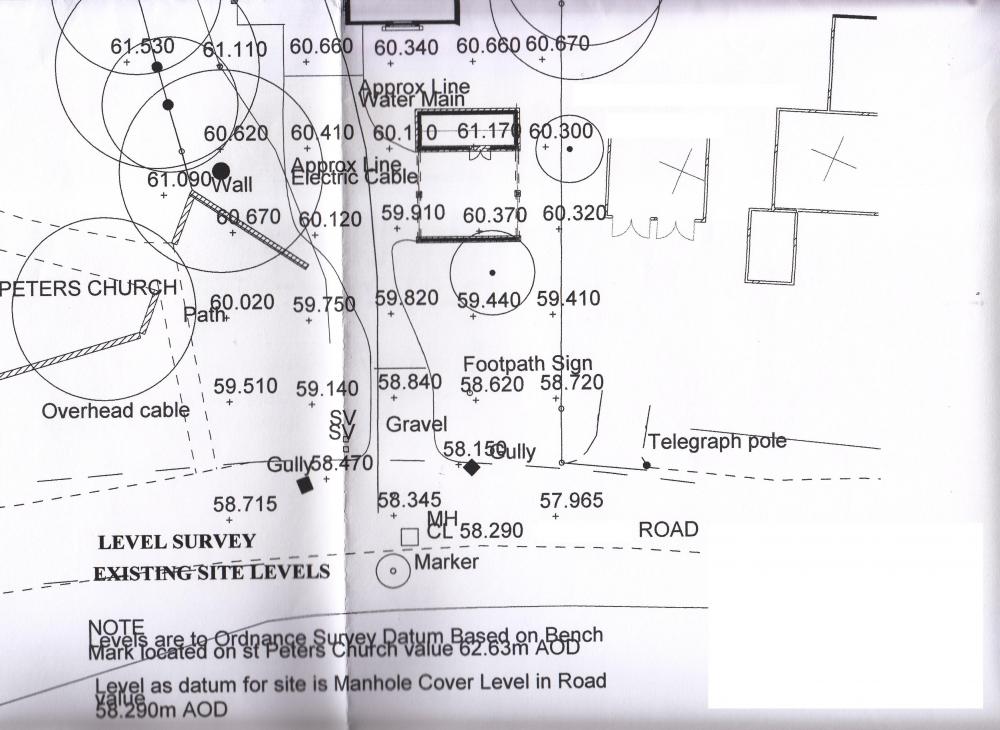
-
VAT on new build
Temp replied to Jimbo37's topic in Self Build VAT, Community Infrastructure Levy (CIL), S106 & Tax
The main issue/risk it that HMRC might refuse the reclaim for the house because not all buildings on the site (eg the garage) were knocked down. You can try asking HMRC but in recent years HMRC have stopped providing opinions "in advance" on virtually anything. If they reply at all they will probably refer you to the guidance that says you need to demolish all buildings on the site. You can try an accountant but it would need to be one very familiar with this area of VAT law and case law. My guess is your average local accountant would probably just hedge his bets and point out the risk you already know. The only way to know for sure is to see what HMRC say afterwards. In order to minimise the chances of HMRC looking at the reclaim too carefully I think I would show the garage on the new Planning Application but not claim for anything with invoices dated before PP is granted (eg only claim for things purchased after PP is granted). That way it looks pretty much like a normal run of the mill self build reclaim. Other things to think about.. VAT on landscaping, trees and plants etc can only be reclaimed if there is a landscaping plan included with the planning grant. So you might care to include one in the planning application even if the planners are unlikely to make one mandatory. For a new build a contractor doing "supply and fit" must zero rate BOTH materials and labour to you. You only reclaim VAT for materials you actually purchase yourself. Don't pay VAT in error on supply and fit as you can't reclaim it from HMRC. If necessary get contractors to requote at 0% VAT before they start. Has the CIL been introduced in your area? Starting work on site (as you have done with the garage) before you have done ALL of the paperwork for the self build exemption can mean you loose the exemption. That may of may not matter depending on how big the replacement house is. Sorry a lot of this is in other parts of the forum. -
What has your BI insisted on re: disabled access/ramps
Temp replied to gwebstech's topic in Brick & Block
We love our level entry. With some imagination its possible to have steps with a ramp/path wrapped around them. Ramps don't have to look industrial. -
We have a lot of exterior oak and in my experience... a) If you want it to go silver after 5 years of black, blotchy and perhaps even slimy then do nothing. I let a field gate do this. b) If you want to maintain a honey colour with low maintenance then something like 1 coat of Sadolins classic and 3 of Sadolin Extra clear brushed on very thin. I mean thin or it will look like treakle. Thin and it looks great. Our front door has this. c) If you don't mind some maintenance... 1 coat of Danish and 3 of Osmo UV Phrotection Oil. Put a new coat of Osmo on every 3 years. We have lots of external oak beams with this. d) If you actually like maintenance and dont mind the oak going darker brown...then go for Danish oil on its own. However you may need to recoat it every year, perhaps even twice a year if very exposed or it will go black and blotchy on its way to a). Our external beams started with this then I sanded it all off a few years later to switch to c). Try your choice on some scrap oak first.
-
VAT on new build
Temp replied to Jimbo37's topic in Self Build VAT, Community Infrastructure Levy (CIL), S106 & Tax
This might be nearer to your case... https://www.gov.uk/hmrc-internal-manuals/vat-construction/vconst02370 But note it says buiiding not dwelling. -
VAT on new build
Temp replied to Jimbo37's topic in Self Build VAT, Community Infrastructure Levy (CIL), S106 & Tax
Not very clear but.. https://www.gov.uk/hmrc-internal-manuals/vat-construction/vconst02250 -
VAT on new build
Temp replied to Jimbo37's topic in Self Build VAT, Community Infrastructure Levy (CIL), S106 & Tax
See 3.2.1 and the linked paragraphs. https://www.gov.uk/guidance/buildings-and-construction-vat-notice-708#para3-2 -
VAT on new build
Temp replied to Jimbo37's topic in Self Build VAT, Community Infrastructure Levy (CIL), S106 & Tax
The main problem I see will be your invoices for the garage being dated before your planning permission. That's been a problem in the past. -
Smoked Shower Glass - Anyone?
Temp replied to canalsiderenovation's topic in Bathrooms, Ensuites & Wetrooms
Would it show up white limescale more? -
Permitted Development Question - rear/side extension
Temp replied to tp1's topic in House Extensions & Conservatories
I believe if built before 1948 the front of the outbuilding would also be considered the front of the original house. See top of page 15 in the technical guide. and the definition of original... So if built prior to 1948 it doesn't matter if the outbuilding was an extension its considered part of the original building. -
Perhaps try.. https://www.utilitysearch.com
-
Some numbers here for gas and electric but I not sure if they cover the final mile or just the distribution grid. https://www.energynetworks.org/news/public-information/dial-before-you-dig.html https://www.dnvgl.com/software/software-services/maps-viewer-uk-gas-network-operators.html
-
Try asking a solicitor who they contact when doing searches for conveyancing.
-
Permitted Development Question - rear/side extension
Temp replied to tp1's topic in House Extensions & Conservatories
I think a lot depends on if they consider the outbuilding to be part of the original house. Was the outbuioding constructed before 1948?. The original building is defined as... If before 1948 then option 3 might need planning because you are extending forward of the original front elevation. Eg the outbuilding is not an outbuilding and you are extending it forwards. -
Typically you either need a vapour permeable membrane or a 50mm ventilated void below a non permeable membrane. The latter causes issues with the depth of insulation between rafters. You may need more insulation below the rafters. An alternative might be to switch to a warm roof which puts insulation above the rafters but raises roof height. That doesn't need ventilation but it's important to get an interstitial condensation risk assessment done for the proposed design. Don't let the builder just wing it.
-
Are there other houses set back from the road? In some cases the planners are wary about such "backland" development.
-
RSJ/UB are better especially if you are in a semi or terrace and other side has or will remove their side as well. PS I dont think they make RSJ beams any more, have been replaced by Universal Beams (UB) but the old name is still used by some people. They are essentially the same thing. Just mention that in case you get a quote that refers to a UB.
-
I was going to use slate but was told it scratches easily. Went for some black granite found at a local stone masons yard that I think was left over kitchen worktop. Got him to hone off the glossy surface to give a silk finish.
-
What has your BI insisted on re: disabled access/ramps
Temp replied to gwebstech's topic in Brick & Block
Raise the whole garden except for a narrow bit near the house to avoid bridging the DPC. -
My understanding is that the raised area (I've not heard it called the visual warning area either) is raised to discourage rugs from being placed too close.
-
Approved Document Part J has the dimensions/rules but they are confusing until you realise that they are different for appliances that can and can't heat the hearth to over 100C, and decide which you are building for. If it can (eg open fire basket) you need diagrams 24-26 on pages 37 and 38. If it can't (eg stove on legs) you can use diagram 26 and 27 on pages 38 and 39. https://www.planningportal.co.uk/info/200135/approved_documents/72/part_j_-_combustion_appliances_and_fuel_storage_systems