


MJNewton
-
Posts
1354 -
Joined
-
Last visited
-
Days Won
1
Everything posted by MJNewton
-
Just do it! It might not give you the answer directly, but it might help us work out what might be happening. Zoot, if you're asking for help the least you can do is do what's asked of you - even if you're not sure why? Mrs Miggins never gives us all this trouble...
-
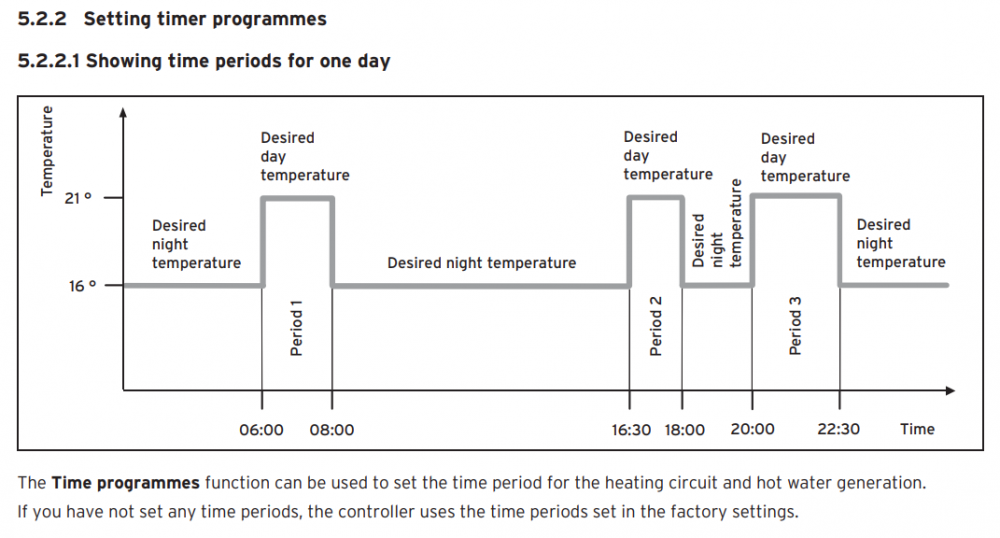
The low output could be the weather compensation in action - recognising that the outside temperature is relatively high (is it?) it limits the heat output. In the middle of winter it'd crank it up to max.
-
...and the diagram on page 25 may help illustrate this as it can get a bit confusing just written down if you're not familiar with this method of control:
-
From some of the clues you've mentioned, is this your controller? (Vaillant VRT350F, with the instruction manual here)
-
 You could do that, but bear in mind that the longer the sample period the bigger the jump is expected to be and so it makes it easier to detect and easier to avoid false positives. If your window is small the threshold would likely have to reduce and you may find it triggers when it shouldn't. As @SteamyTeasaid trial and error will guide it well, and to be honest I only went with 5 minutes because that's how regularly the script wakes up to take temperature measurements for plotting so I just piggybacked on the back that. That said, I do find a shower gives a 5-10% rise in that timeframe and so it stands out from the noise (natural variations) quite well.
 -
20% RH is pretty exceptional but, granted, I suppose it can happen. With it being seasonal however it shouldn't affect rate-of-rise detection, or was/is the issue that you've only got absolute RH detection available?
-
I think there's been a misunderstanding along the way somewhere. A new pump (or radiator, or any other invasive bit of work) could indeed result in pressure loss for a period whilst you bleed out any air that was inevitably introduced (from the work itself and the fresh water added afterwards). However, a new pump would *not* cause the PRV to pass water. That is, or represents the existence of, a fault and so I would be getting the installers (of the system) to come and take a look at that.
-
I wouldn't be surpised if RH in a conservatory tracked external RH to an extent, hence 80% wouldn't be at all unreasonable. But 20% RH? That just seems *way* too low.
-
It's usually due to a bit of crud on the valve face or it not seating quite right having passed. A blast through from a fully open valve (eg turning the valve beyond it opening fully and allowing the spring to slam the valve back in place) should usually restore order.
-
Do you mean it varies that much within a short time period (say, minutes)? Or just with the seasons? That said, 20% sounds awfully low - error value territory perhaps? I thought I'd have to get really clever detecting humidity rises but as you can see from charts (and BristolBuild2020's) 'shower incidents' really seem to stand out. I started off with an arbitrary threshold of 5% rise in a five minute period and have found that picks every shower without fail and has never knowingly false-alarmed so I've just left it be. Incidentally, I did think about running the boost until the humidity value had reduced to some figure (say the pre-rise value) but took the easy way out and just boost for a fixed 30 minutes which seems to be sufficient.
-
Sounds great! I'd love to hear how you did this. My unit has Ebm-Papst EC motors which accept a 0-10v speed input (and conveniently provide a 10v output for this) and so I was going to use a digipot to create a potential divider driven by the Pi. Speaking of which, what device are you doing your controlling from?
-
Is it practical to descale them, in-situ if need be for extra complications? We've got a UVC and are in a very hard water area and always wondered if one day I might need to descale it. I figured I could drain it, remove the immersion, hoover out anything loose with a wet-and-dry then put some descaler in before rinsing and repeating? Would obviously be easier for the OP to do on a unit that's not yet installed, and I suspect scaling could be a common reason why these are removed and sold on, particularly if it's the inlet diffuser that's blocked causing issues with flow.
-
Thanks everyone. Once again BuildHub comes up trumps with no-nonsense advice. ?
-
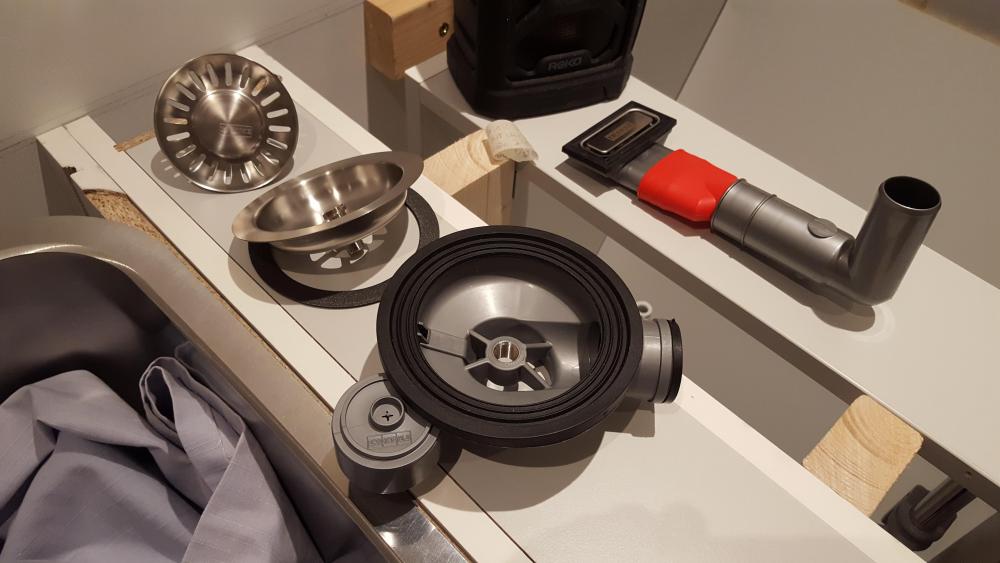
I should've uploaded a picture really as thinking about this it has dawned on me that not all sink wastes are the same. Here's what I've got: With the above-sink parts consisting only of a pressed plate (i.e. there's no threaded column that protrudes through the sink hole) it's clear that the watertight seal is actually a function of the rubber washer underneath the sink. If I was going to be putting silicone/PM anywhere *that's* where I'd be needing to put it but given the ridges on the washer I don't think it'll be required.
-
Just been back to the wastes to examine in more detail what washers/seals are provided. There's a formed rubber one for underneath that mates well with the underneath bits, and a thin foam one for on top. The foam washer doesn't make the plug hole sit proud as there's a fair recess in the sink, and without it it doesn't self-centre quite as well. What I think I'll do is dry-fit to start off with, or perhaps add silicone to the foam washer for good measure, but I don't think I'll leave it out.
-
Thanks everyone - seems unanimous to use to use silicone for the top seal. I must admit it wasn't a specific doubt about the quality of the kit - it all felt good quality but wondered even so about the benefits of a silicone seal.
-
I've got a new stainless steel Franke sink and waste, which came supplied with sealing washers top and bottom. The instructions make no mention of using any silicone in addition to the washers but should I for belt and braces?
-
Might a stat with 'open window/door detection' help there? I think it just ignores sudden drops in temperature and doesn't attempt to do anything about them.
-
That sounds fair enough, but I would think a huge polythene sheet would suffice whilst still allowing full access/visibility to what's been uncovered. The cynic in me is thinking they might be 'tarting up' the appearance and perhaps even trying to hide some of the issues you've been observing. Pure speculation on my part though.
-
I've got a master-slave 3-way adaptor that does that and find it really useful when using power tools. Don't seem to see them around much for reason.
-
MVHR - list of questions/thoughts
MJNewton replied to mjward's topic in Mechanical Ventilation with Heat Recovery (MVHR)
Reading your questions made me wonder if you were confusing MVHR with ASHPs, but given you've mentioned both I'm not so sure. Suffice to say though; don't mix up MVHR with heating/cooling. MVHR is an approach to providing ventilation and whilst it does so in a way that minimises losses through heat recovery it is no substitute for heating/cooling as the air flow volumes are so low it has very little effect. Don't get me wrong, I think it is great and would definitely recommend it (I retrofitted a system here and so in answer to Q8 I can confirm it is *definitely* DIYable and would be even easier in a new build). -
Plasterboarding and Finishing recommendations
MJNewton replied to revelation's topic in Plastering & Rendering
I've always wondered what happens with butt joints when taping... With tapered edge you've obviously got a valley within which to sink the tape and filler but with butt joints do you always have some amount of 'bump' no matter how careful you are with featheredging to way beyond the join? -
This is great news. I was wondering how you were getting on but didn't dare ask!
-
And the best cure for this is ....
MJNewton replied to ToughButterCup's topic in General Self Build & DIY Discussion
Access ceiling from above, reposition joist, move light back to original hole... -
They'll have likely gone over the top of the upstand slightly thus obscuring it. I think you can see some of it exposed around the pipe in the other picture.




