


MJNewton
-
Posts
1354 -
Joined
-
Last visited
-
Days Won
1
Everything posted by MJNewton
-

Heatmiser Neostat v2 temperature sensor problem
MJNewton replied to Ultima357's topic in Underfloor Heating
That doesn't necessarily rule out powering it via low voltage if the volt-free relay is powered from the low voltage side of the PSU. -
Heatmiser Neostat v2 temperature sensor problem
MJNewton replied to Ultima357's topic in Underfloor Heating
Do I recall you saying the self-heating was suspected being down to the internal PSU? If so, could you remove that and just power it via low voltage from a remote supply? -
Okay; I'll have to defer to others with ASHP knowledege/experience to see if that's normal. If it's going to work like that and never deliver water at 55C even when it is on it won't heat your house. Period.
-
I'll never forget once chatting to my plasterer and him telling me he can spot the 'fussy' customers because all their screw heads are oriented the same way. The look on my face must've indicated I didn't quite get what he was referring given the absurdity so he went over to the lightswitch to show me the types of screws he was talking about. Only when he got up close did he spot mine were perfectly aligned (horizontal of course; none of this vertical nonsense) then he checked the socket just in case it was coincidence. Oh no - I was one of *those* people.
-
Assuming the target set in the 'thermostat room' is high (please tell me you haven't left it at 15C or something) then - unless my ignorance of how ASHPs operate is showing - I would expect it to be running flat out whilst there's still a massive amount of heat required. With rads at 40C you're still only getting 1/3rd of what they would output at 70C. I know you'll never reach 70C with the ASHP but it's likely that's what the radiators have been sized for (if they've been sized at all). If you can get 55C from the ASHP you're only at 2/3rd max output - still below par but twice as much heat as you're currently getting. That'd surely make a difference to the rooms regardless what their construction is like. Personally I'd ignore the rads for a moment. Sit by the ASHP and measure its flow and return every few minutes. See how it behaves. If it's never going above 40C then *that's* your problem; not your house.
-
Okay good! I'd sit by the ASHP measuring its output - you'll see the changes soonest there and discover what it maxes out at. Then wander around the radiators doing their measurements. If the flow temperatures start dropping go back to the ASHP and make sure it's still outputting what it was.
-
Good and bad. Good because this is *exactly* why these measurements needed to be taken - you thought the radiators were hot but they are not. At least we now know you *do* have a problem and now know where to look. Bad because it is no wonder the rooms aren't heating up. Radiator temperatures of ~34C is simply insufficient if heat losses are high and the rads are 'conventionally' sized. You are getting approximately 1/5th of the radiator's output running at that temperature (based on the Delta T being 14C (34C - room temp of 20C) as opposed to 50C). The lockshields are likely too wide open too - too much flow. Don't worry about that just yet though - it's the ASHP that needs the focus. Were you able to measure the flow and return temps at the ASHP?
-
Yes, the pipe is generally best - consistent across all radiators regardless of valve type and easiest to fix to.
-
Let's move on then and just talk doors!
-
Heatmiser Neostat v2 temperature sensor problem
MJNewton replied to Ultima357's topic in Underfloor Heating
Ah yes, understood. Makes it all the more surprising doesn't it that they can do a great job with that bit but somehow bodge the temperature sensing side! -
Nevermind all that. How's the measuring coming on?
-
I can definitely understand the desire to understand why, but to delay even attempting it for several days until you do? It wasn't as if I was asking you to change anything - purely gather a bit of information that's all. I can't help but be reminded of my 3yr old daughter - every time I ask her to put her coat on she asks why? I always explain but it makes no difference. She'll keep asking why, particularly if the sun is shining as to her that means it's hot outside - I haven't been able to explain to her the nuances of the sun in winter. It doesn't matter though - she still needs to put her coat on whether she understands why or not (and whether I am able to adequately explain it or not). If she doesn't put it on she will remain cold. Okay good. And as a token of my appreciation I'll try and answer your questions in the meantime: Regarding flow temps, if some radiators are being starved of sufficient flow (for whatever reason - could be many reasons) then they won't necessarily be getting the same flow temperatures (very slow flow results in a lot of heat loss before even reaching the radiator). More to the point though - we still don't know what the flow temperature is! Sure, you've set the ASHP to 55C but are you getting that? What if you're only getting 35C? Straight away we'd know why your house is cold. Regarding return temps, these will vary depending on how much heat is being transferred to the room. With all else being equal (ie same flow rate) small radiators will have higher returns (there's only so much heat they can extract) whereas large radiators might be dumping loads (more than necessary). The former is particularly bad because that still-hot water is being returned back to the ASHP which may then be forced to throttle down in order to stay at the target temperature. Because without testing the temperatures you're just guessing. Do the test. If they're out of balance you'll see differences in temperature drops across the radiators and this will lead to you failing to get the most from your AHSP and in some cases (particularly where the heating capacity vs requirement is marginal) you may be failing to provide sufficient heat to all rooms. Alignment of heat-up time is one aspect of balancing, but arguably the most basic. Furthermore, I'd see it as a consequence of real balancing which is aimed at producing the same (and specified) temperature drop across all radiators regardless of location, size, etc. I know you've got an issue with the term but that's tough. I think it's perfect. Big deal - let's move on. Okay, that's good to know. When you same 'the same' though that means nothing. All cold? A'l medium? All hot? All super hot? There's a reason temperature scales were invented - let's make use of them. If you/we can conclusively demonstrate that the ASHP is providing sufficient heat (ie meeting the target flow temperature) and all radiators operating to their design specification (average temperature and temperature drop) and yet the house is still cold then we will know that the radiators are insufficient for the rooms they are in. Four solutions: 1) increase the size of the radiators (within the limits of the ASHP at least), 2) reduce the heat loss in the rooms (reduce drafts, increase insulation), 3) supplement the heating locally, or 4) tolerate the situation. The colder they are the better to be honest. As the room temperature rises the heat transfer from the radiator reduces and so it can throw the results. It's a detail not worth worrying about (particularly in this instance of course unfortunately).
-
Zoot, did you miss this? If not, and you just don't want to do it (for whatever reason), let me know and I'll stop asking you to do it.
-
Heatmiser Neostat v2 temperature sensor problem
MJNewton replied to Ultima357's topic in Underfloor Heating
Might there be a cheap(ish) solution to be found by just concentrating on what these stats are really there to do - measure temperature. With so many zones I am assuming you are not using the timer/programmer functionality on each and every one? I am picturing a centralised controller that reads the temperature in the 14 locations and controls each zone as required in accordance with a common schedule. I don't know what off-the-shelf solutions exist for that or whether a roll-you-own approach based on something like Home Assistant would be better (certainly cheaper). Sure, for the latter there'll be a bit of a learning curve but the end result ought to be good. -
Heatmiser Neostat v2 temperature sensor problem
MJNewton replied to Ultima357's topic in Underfloor Heating
Indeed! For such expensive stats it's even more depressing the issues you're having. You might be more willing to accept compromises if they were cheap (even then I think I'd be surprised). -
Now that you've got the pipe thermometers, what are the flow and return temperatures of each radiator when the ASHP is running flat out? (Turn the room stat up to max - you really don't want it cutting out whilst doing this) Also, what's the flow and return temperature at the ASHP?
-
Start with balancing the radiators, not the room temperatures. Only once you've ensured you are getting the maximum heat output from each radiator can you then begin to explore why different rooms are (still) at different temperatures (and it'll likely be down to inappropriate radiator sizes, but let's take one step at a time as we haven't really begun yet because of all the backchat and disputing what you're being told).
-
Heatmiser Neostat v2 temperature sensor problem
MJNewton replied to Ultima357's topic in Underfloor Heating
You can improve things even better than that these days (for many years in fact). Digital stats with 'time proportion and integral' control algorithms don't wait for the temperature to dip above/below thresholds before doing something. Instead, when they are in their 'proportional' band (of, say, 2C either side of the set point), they will either request a proportioned heat demand signal to the heat source if that's available (eg a modulating boiler controllable via opentherm) or if like me you've only got on/off controls available they it'll use pulse-width modulation to synthesize the same effect eg if it calculates that it needs 20% heat input to maintain the set temperature then it'll trigger a demand for 2 minutes in every 10. Simple, reliable (it constantly self-learns) and - most importantly - extremely effective at maintaining comfort. I've had a Honeywell CM927 for 15 years now and once up to temperature I don't think it ever really moves off the set point.- 150 replies
-
- 2
-

-
- neostat
- temperature
- (and 1 more)
-
Be very careful judging glass tinting/colour up against a white background - they will look very different in real life, up against the sky etc. We got samples for the differently-tinted glass for our roof lantern and soon discovered judging them against a white background was meaningless compared to holding them up to the sky or, even better, seeing a real life installation.
-
Pre-heater or no pre-heater....
MJNewton replied to djcdan's topic in Mechanical Ventilation with Heat Recovery (MVHR)
That's a good point, and I think mine does the same. -
Pre-heater or no pre-heater....
MJNewton replied to djcdan's topic in Mechanical Ventilation with Heat Recovery (MVHR)
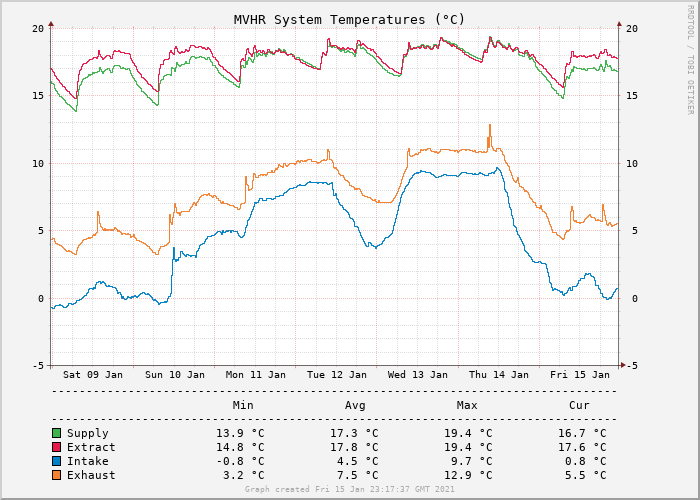
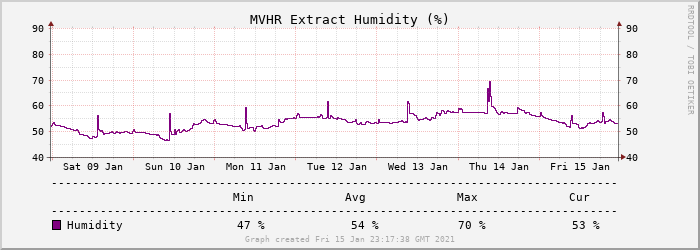
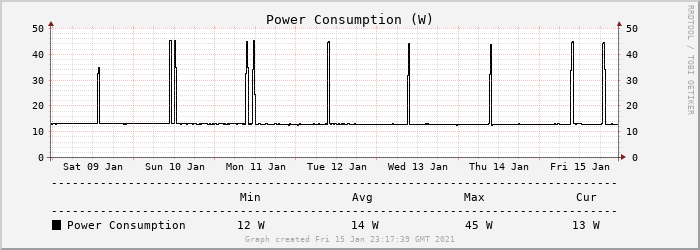
I don't - yet - as I haven't finished the installation (still have a few runs to add) and so haven't done any balancing. All I've done is set the flow and extract to be similar (based on power consumption rather than flow rates) and made sure they're sufficient to convince me it's working. 'Heat transfer' as in efficiency? If so, that seems to be pretty good at an average of between 80% and nearly 100% depending on the two methods described at the Paul Heat Recovery page on the subject: The negative 'blips' appear to align with going into boost as the humidity and power graphs demonstrate, and I guess would make sense as the air is moving faster hence less time for transfer: (I have to laugh: when zoomed in you can even distinguish between my wife taking a shower and I! ) In terms of heat rise between intake and supply temperatures I am therefore seeing pretty much all of what I'm extracting out: We don't tend to have the heating massively high (lounge stat set to 20C but bedroom TRVs tweaked down a little), and this is a retrofit to a 2007-built Persimmon house so far from a perfect environment I'm sure. The pipes are running within the ceilings so whilst they are within the heated envelope of the house I doubt the temperatures there are the same as the rooms and will be being cooled by air leaks here and there. The unit itself, manifolds and termination of all the pipework is in the cold loft so there must be losses there too. Still getting air delivered 17C when it's 0C outside so perfectly acceptable I think - even without a heater as I say, and particularly when compared to what would've been coming through the window trickle vents which I have not foamed up!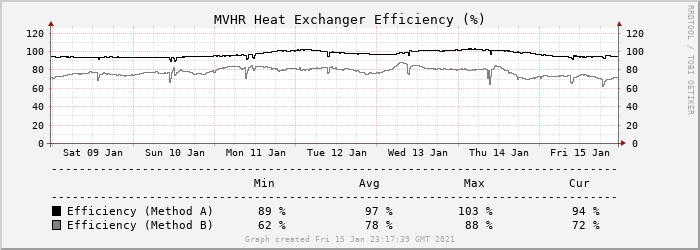
-
Pre-heater or no pre-heater....
MJNewton replied to djcdan's topic in Mechanical Ventilation with Heat Recovery (MVHR)
Yes, we do - intake, exhaust, supply and extract. There's also a humidity sensor in the extract to trigger boost for cooking/showering. Regarding heaters, we don't have one - and I don't think we really need one either. Even if the supplied air is a little cooler than the room temperature I haven't noticed it cooling the room down, perhaps due to the relatively low air volume and limited heat capacity of air. I'm also mindful of the higher cost of electricity compared to the mains gas we've got - perhaps if we were all-electric I'd be more open about using an electric inline heater more as a case of 'why not?'. -
I must admit I've moved on myself a couple of times but have always returned as I'm interested in the subject, can always learn more from others and, more to the point, don't like to think of anyone being persistently cold as that's no fun at all. Very frustrating though.
-
'It' = your ASHP, and the flow temperature you've set it to in particular.
-
No, it really is *balancing* radiators. The aim of the adjustments is to make the temperature drop across each radiator the same. If the radiators are correctly sized then this will *in turn* lead to the rooms being heated at the same rate. There is nothing wrong with the term. Please stop with the arguing as it is not helping get your house warmer (quite the opposite in fact - it is putting people off helping).

