


MJNewton
-
Posts
1354 -
Joined
-
Last visited
-
Days Won
1
Everything posted by MJNewton
-

Blade cutting depth for track/plunge/circular saws?
MJNewton replied to MJNewton's topic in Tools & Equipment
I was surprised how cleanly even the stock 24T blade cut, not least given I'd previously set the blade too deep such that it extended beyond the timbers I had the board supported on... I was wondering why it was so noisy - only afterwards did I discover I'd been cutting a 2mm deep score in the surface of the pristine screed below. I'm sure that didn't do the blade too good! -
Blade cutting depth for track/plunge/circular saws?
MJNewton replied to MJNewton's topic in Tools & Equipment
Ah okay, that's interesting. Will try some practice cuts as you suggest. I've only used my track saw for cutting up OSB sheets so haven't paid too much attention to the quality. Probably not the most representative of materials either. -
Living with mvhr
MJNewton replied to jpinthehouse's topic in Mechanical Ventilation with Heat Recovery (MVHR)
Do remember that the airflow is relatively low - compared to, say, a kitchen extractor - and so even when you're not there it is likely still clearing contaminants from when you were. Note also that the background power rate is relatively low - whilst I haven't fully finished mine (in terms of balancing mine and still got two or three runs to add) I've got nine runs so far and it consumes a constant 7W in background mode and so costs ~£10/yr to run. Boost is higher (39W) but that only runs when we're in and doing things to cause it to. -
Been a funny ol day
MJNewton replied to Russell griffiths's topic in General Self Build & DIY Discussion
Could of been worse - you might've found a previously-bought-but-as-yet-unfitted loft ladder up there! This, incidentally, is how you find lost tools. Buy another and then go and put it away in a 'safe place' such that it won't be lost again. That's where you'll find the old tool. Note that this trick tends only to work when there's something stopping you from returning the new one for a refund... It's why things are blister packaged as retailers known this phenomenon of nature too. -
Blade cutting depth for track/plunge/circular saws?
MJNewton replied to MJNewton's topic in Tools & Equipment
Thanks for your thoughts; it does sound like an as shallow depth as possible is what's called for if I want to maximise neatness of cut. Thinking back I think it could well have been one of Peter's videos where I saw the suggestion about having just an ever-so-slight protrusion of the blade beyond the bottom of the workpiece. As you say he seems to know what he's talking about so I'll go with that. -
Never mind self-build; it's self-help I think I need! This is a topic that's probably better suited to lighthearted discussion in a pub, but actually I think this forum might well house kindred spirits that may well understand where I'm coming from, and perhaps offer some insight as to dealing with it. The goal of perfection. For some reason I'm always aiming for it, or rather I'm really dissatisfied with imperfection. I mean *really* dissatisfied - disappointed, anxious, sleep disrupting etc. For example, this evening there are a couple of additions to my mental 'unhappy with' list - some roller marks where I've painted the new large open plan room and a couple of plasterboard join lines where the skimming hasn't been perfect and is just about visible in certain unforgiving lighting conditions etc. The rest of the house has had these sorts of things for years and they've never bothered me but this new room should be perfect right, because it's new! Not only have such blemishes in the existing house not bothered me previously, I haven't even spotted the vast majority despite living here for 10 years - it's only now I'm walking around looking for them to compare against my own handy work that they are making themselves known. Perhaps that's the secret to the way out of having such an easily-discomforted mind - these things probably won't matter in time. I hope they don't anyway. Something that is possibly also very telling is that these imperfections are often bigger in my mind than reality - next time I seem them they're not quite as bad as I remembered. Bad enough though. The way I feel is the main reason I don't like employing tradesmen as invariably I feel disappointed with some aspect of their work. I don't mention it (unless it's really bad such that even a 'normal' person would say it needs fixing) but I am often left with a feeling of some regret that either I picked the wrong guy or should've done it myself. Does this sound familiar to anyone? If so, how do you deal with it? I keep reminding myself that these are 1st world problems, and that actually if the things I'm worried most about invariably fall into the category of 'aesthetics' rather than, say, 'health' or 'finances' then really I'm probably luckier than 99.9% of the rest of the population and should be grateful for it. Such positivity only lasts so long through; I'll be staring on my DIY blemishes again in the morning when having my cereals with the same sick feeling brewing in my stomach. Tell me I'm not alone...?! ?
-
I'm about to embark on a mammoth cutting session trimming down end panels, plinths etc for the new kitchen. I've bought a new 40T blade for my Titan track/plunge saw (it came with a 24T) but was wondering what blade depth I should be using for the best cuts? I'm sure I saw a video one time suggesting the blade depth should be such that the teeth only come halfway through the bottom of the work piece, whereas another article I've just read (on circular saws - I am assuming its the same consideration) says to have the blade coming 5-10mm through. Most other discussions about track/circular saw use don't seem to mention it. Any advice?
-
There's every chance I wouldn't ever need to - it was more question if curiosity really as I'd never given it much of a second thought on laminate.
-
That's what I've got in the back of my mind, but will approach him a but more open in the first instance asking for advice. To be honest I'd be surprised if he didn't offer to sort it.
-
Interesting thanks. Will see what the plasterer says / can do but good to know there might be backup options if a 'conventional' fix doesn't work out.
-
Better than the worktop though. £3.5k! ? (It was said a bit tongue in cheek, same with the slippers although I do often find myself up ladders with slippers on wondering what on earth I'm up to!)
-
Kitchen layout options - an island too far?
MJNewton replied to Moonshine's topic in New House & Self Build Design
I often hear 1000mm as a commonly quoted minimum acceptable distance (with the likes of online planners that warn of issues configured this way too), but then I guess you're not call Big Jimbo for nothing! ? -
Okay, thanks all. Hopefully I won't have cause to climb up but as you say if needs must then will go carefully! I'm thinking duvet, cardboard, plywood, slippers etc. Or perhaps some sort of cantilever setup with the rest of the family perched on the other end. I must admit the cost took me by surprise... I designed a kitchen layout and got a price... £3.5k. Sounded good I thought. Added on a worktop and it jumped to £7k. Eh? Did I double up on all my quantities? I've only ever bought one worktop before and I think that was £150, if that. I naively didn't realise quartz and other stone worktops were *so* expensive compared to laminate. Of course, it was too late by then - my wife's 'wants' mechanism has an irreversible ratchet so there was no turning back.
-
I don't mean from scratches and dents, but standing on it... There must've been a couple of occasions in the past where I've had to stand on my chipboard laminate worktop, whether that be to reach something or - most likely - perform some aspect of DIY. For our new kitchen, however, we've opted for a quartz worktop (30mm thick) and wondered whether this sort of practice would be out of the question? It also got me thinking about related questions such as whether there is any flex in it at all, how strong the joins are etc. Can anyone that has some knowledge of them shed some light?
-
Thanks both. I'll give the plasterer a call and have a chat before starting anything myself.
-
I think I might get the plasterer to do it.. I'm not confident I'd be ae to get a flat/flush enough finish, particularly given the unforgiving nature of this room as I mentioned.
-
Thanks Nod. I did think (fear) it might be a case of having to make it worse before it can get better! How deep do I need to be making the V? Through to the plaster? Tape? Board? I suppose if one of the latter two I'd discover whether there's any tape or not). Is the V so that there's enough body and surface area for the filler to attach? Any particular filler you'd recommend? I did think of calling the plasterer, for advice rather than blame/remedy. He was a nice bloke so he might even pop round to take a look.. and maybe even sort it (I'd be more than happy to pay if need be). Incidentally, it's a really unforgiving ceiling for blemishes - full width sliding doors at one end and quite large room with the entrance at the other. I swear even dust would cast a shadow...
-
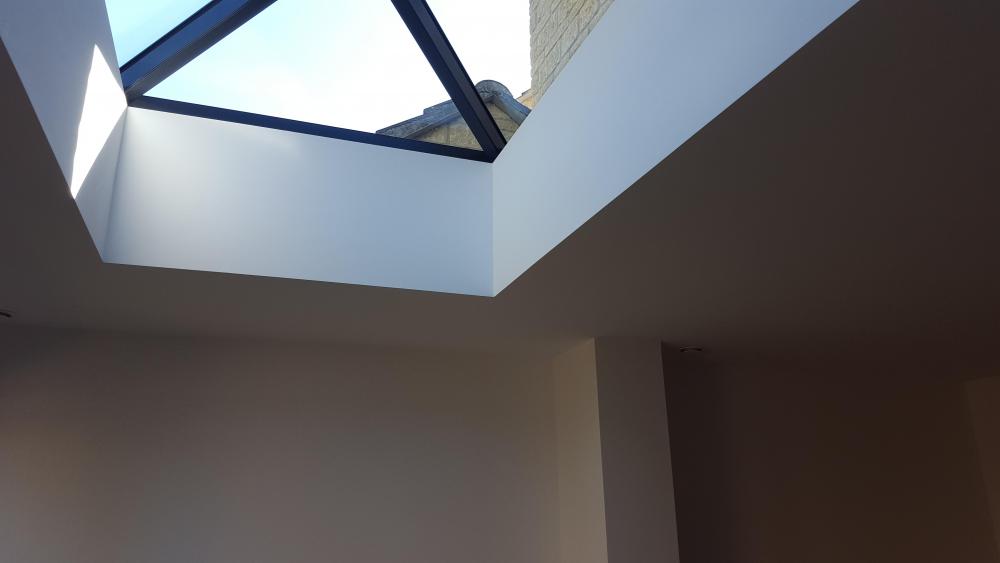
A few months back I had our new open plan extension skimmed and following the mist coat noticed some slight cracking along a couple of joints in the ceiling. I didn't think too much of them at the time and just filled them prior to the final top coats of paint. Today I noticed they're back, here's one (well, two - there's a less visible small one coming from the corner): The cracks have come back *exactly* as they were when first spotted and the main one happens to be on a joint line which I am assuming is the issue. In particular, I carried the resilient bars through to the extension from the main room and I did notice that board joints aren't nearly as well supported when butted up over a resilient bar as they are on a joist. I wish I'd put some timber behind these particular joints to keep them firmly anchored together but that ship has sailed. I am pretty sure the plasterer taped all the joins - I saw it in loads of other places and surely if he'd missed one out he'd spot it when going around? For context of zoomed out location showing its location: As you can probably make out the extension roof is mostly lantern opening and so there's likely not all that much rigidity in the whole structure and I am assuming this leads to ever so slight movement. I do hear the odd creak every so often e.g. when the sun is blazing and warming things up, and I am assuming this is normally. The crack is only really visible from one part of the room... this being where the sofa's going to be going for watching TV... Grrr. Any ideas how to deal with this? The movement will presumably continue (the extension was built around 18 months ago so if it's still moving around now it surely always will) and so I'm thinking something flexible is required? I don't need to necessarily get rid of the crack entirely - I just want it less of a blot on what is otherwise a perfectly pristine white room. I'm gutted really, and whilst I recognise I'm learning as I go along this extension is probably going to be my last so I'll be stuck with it for a while! I've Googled for advice and found loads - too much really. I'm hoping someone here might be able to say 'X will sort that no problem'...

-
Sub-distribution boxes?
MJNewton replied to tanneja's topic in Mechanical Ventilation with Heat Recovery (MVHR)
For what's it worth, try and remember you are installing MVHR for its practical benefits not aesthetics and so if some evidence of its existence can't be hidden away then so be it. A bit like radiators. (Of course I don't practice what I preach. I had many a sleepless night trying to work out how to retrofit our MVHR with minimum visibility. We had a simpler layout to deal with though (although did have 2.5 floors) and I was lucky with some built-in wardrobes, joist directions and the fact they were I-Joists so could have large holes drilled through them if necessary. Still difficult and I look back now with some pride - and surprise - at what I achieved! ) -
Sub-distribution boxes?
MJNewton replied to tanneja's topic in Mechanical Ventilation with Heat Recovery (MVHR)
I think that could bit could be an issue as you'd be trying to push (or pull) four 75mm pipe's worth of air through one. The increased volume of air through that pipe would likely result in noise not only from air speed but back pressure also. I stand to be corrected but I would imagine it'd only really work with a large diameter pipe to feed the downstairs distribution box, just as would be the case in a conventional setup. -
...which in case you were still wondering 'so what?' means that it therefore stores energy (when compressed) which can be dangerous if something suddenly gives. Shouldn't be an issue with low pressure plumbing testing though I wouldn't have thought. (I have visions now of an AAV blowing a hole in the roof and landing in next door's garden...)
-
GRP (God-awful Rubbish Period)
MJNewton commented on canalsiderenovation's blog entry in Canalside Bungalow Renovation
I would expect it to be snooker table flat. On second thoughts... -
GRP (God-awful Rubbish Period)
MJNewton commented on canalsiderenovation's blog entry in Canalside Bungalow Renovation
Something to add: If adding on a new roof on top, would there be edge detailing challenges? (Or would they be ripped off to give a simpler base on which to lay the boards and new edging?) -
GRP (God-awful Rubbish Period)
MJNewton commented on canalsiderenovation's blog entry in Canalside Bungalow Renovation
Taking a step back, and reflecting on my own very similar experience, is your main concern the (lack of) fall or the quality of finish? I am a but more relaxed about less-than-perfect falls with modern materials, not least given that when I started doing loads of research about the issues - not from forum discussions but in standards documents, manufacturers literature etc - it really was more about the consequences of the extra loading of standing water, freezing causing safety issues etc thus not particularly significant for most domestic situations. As some one (in here I think) told me; a roof with a hole in it will leak whether there's a fall or not. If it's the quality issue then that can surely be resolved without replacing or building over the roof from what I've read from others on here that know about GRP. For what it's worth our building inspector's opinion was not to rip the roof off and start again. I don't think we discussed building over though unfortunately. Just wanted to chuck that in given what I went through as the situations are uncannily similar. (Same roofer perhaps?! ) Do also be mindful that when you post up 'shoddy' work on the Internet it really gets ripped apart and you end up feeling like you've got the world's worst house and are the world's worst customer for letting it happen. Reality is there are probably thousands of these 'shoddy' roofs around that have simply never been offered up for critique. Remember: I see them all the time on the TV and soon so will you... -
My trick - which admittedly is yet to be proven to work as it's my first time with downlighters - is that I put some thinnish (~10mm thick) pieces of wood up inside the hole for the downlighter spring wings to sit on. My thinking was that when it comes to pulling any lights down/out the stress will be on those pieces of wood (and distributed across the board) rather than the delicate edges of the hole. I secured them in place with a couple of small blobs of silicone just to stop them moving around in the process whilst not preventing removal should the need arise. Should work I think?



