AliG
-
Posts
3211 -
Joined
-
Last visited
-
Days Won
11
Everything posted by AliG
-
Every time I have taken tiles off a wall it has destroyed the plasterboard, but maybe it can be done more carefully. I am not sure what will happen on the block wall, depends on if it was plastered first which you won't know until you take off the tiles. I would assume that you would want the shower head to be on the end of the shower opposite the small window. A lot depends on the kind of shower valve you use. With a surface mounted valve you could just have the head on a rail which can be taken off. This is the simplest installation which plenty of people are happy with but I personally don't like. If you use a valve sunk into the wall then the valve and heads can be in different places which means you can turn it on without getting wet. The problem with this is that it won't be easy to sink it into the block wall, the valves are usually about 70mm deep, so you would either have to frame out that wall and lose some space or put it in the exterior wall below the window which is also not ideal. Even then you would need to get the pipes from the valve to the head at the other end which means either chasing them into the block wall or framing it out again. I would probably put whatever valve you want where the door is being blocked up and just accept the getting wet which isn't the end of the world. I have some showers where this happens and some where it doesn't it really isn't that big a problem. Most showers are installed this way. That wall will presumably be a nice new stud wall where it is easy to route the pipes.
-
I second this and recommend using disposable latex gloves and not the cheap ones included with cans of foam. Never wear clothing you don't mind being destroyed when using it either. If you do get it somewhere you don't want it, immediate application of the gun cleaner will clean it, but usually the best idea is to let it dry and then scrape it off. Trying to wipe it off whilst wet is a disaster.
-
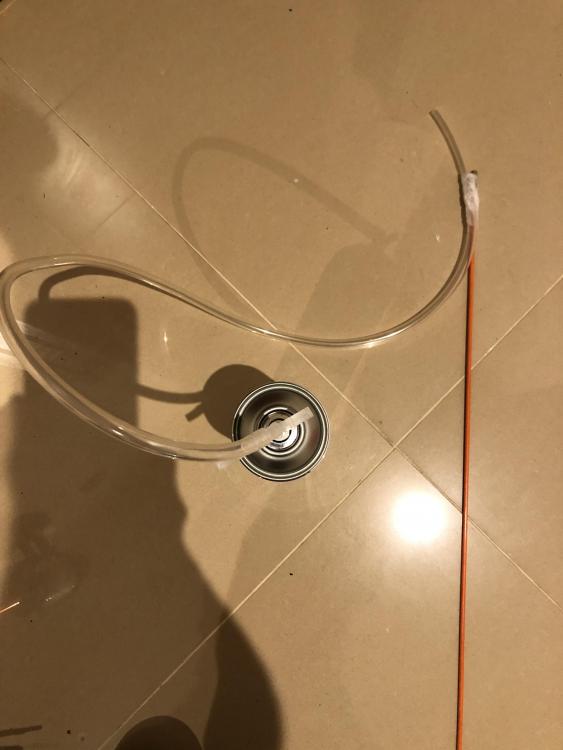
I have been using quite a bit of this myself recently. Having had a couple of guns cleaned out and then seize up my conclusion, supported by reading up on the internet, is that you are better to leave the foam cannister attached and close the gun so that it is airtight. Also unless you are using a lot of the foam it might just be easier to use single use cans and not bother with the faff of cleaning guns. I also find the combination of gun plus 750ml can is often very hard to get into the spaces where I want to use foam. i had to knock this up to get foam into hard to reach spots.
-
Stamp Duty
AliG replied to nod's topic in Self Build VAT, Community Infrastructure Levy (CIL), S106 & Tax
The Scottish stamp duty holiday was a lot less generous than in England, my mate is buying a place and I was surprised how little difference it made. TBH the property market has been very strong and does not need artificial boosting. -
Meter Readings Panic and Electricity Costs
AliG replied to canalsiderenovation's topic in Electrics - Other
You need 7.3 kWh to heat 150L of water from 6C to 48C. I think the original forecast was based on about 10kWh a day when the ASHP was installed. This will account for standing losses in the tank and pipework also which might be 1-2kWh a day. So I would divide 10 by the COP to get the electricity usage on a daily basis. Probably 5kWh per person in the house is a good estimate. 4.2kWh a day would raise the temperature of a 300L tank to 60C from 48C. But it wouldn't cool back to 48C every day, so it would probably be 2-3kWh a day for the immersion. -
Meter Readings Panic and Electricity Costs
AliG replied to canalsiderenovation's topic in Electrics - Other
The heat loss should be the same other than slightly lower standing losses due to a lower average tank temperature. It may be that heating the water in the afternoon you are doing it at the warmest point in the day which would slightly improve the COP, but I wouldn't have thought the difference would be enormous. -
Meter Readings Panic and Electricity Costs
AliG replied to canalsiderenovation's topic in Electrics - Other
This is the correct strategy. If you can only heat water during the low price period then this eliminates a lot of the cost premium. On Octopus Go the off peak price is around 1/3 of the peak price. For this reason it might be better to have a larger tank than you otherwise would have with an ASHP. An immersion has a COP of 1, so it would still be better to heat the water up to say 55 with the ASHP if you want it that hot. Better would be to find a way to have your water less hot. Do any ASHPs heat the water first to 55C for the legionella cycle before the immersion kicks in? I don't think the generally can get above 55C. Maybe it is considered less hassle to have one water temp for normal times and just use the immersion for legionella. Using the ASHP would seem to be cheaper, especially in summer if you want to have a legionella cycle. -
Meter Readings Panic and Electricity Costs
AliG replied to canalsiderenovation's topic in Electrics - Other
Due to the higher temperature hurting the COP, ASHP's are less efficient for DHW than they are for heating. This is then exacerbated in cold weather when the COP falls further. In a well insulated house, DHW becomes a higher proportion of energy use which reduces the effective efficiency of an ASHP. If you look at the chart I put up earlier- You can see at 50C and 2C outside the COP isn't much above 2, whereas in the 35-40C range where you might run UFH it is around 3. From these figures an ASHP would cost around 3x as much to heat water as a gas boiler in the coldest days of winter. In summer when the temperature is in the 15-20 range the COP rises to between 4 and 5 and the penalty is much less. I am not sure that this quirk is well understood or advertised. ASHP works far better with low UFH flow temp and if you don't want your hot water to be too hot, 48C seems to be the recommended hot water temperature.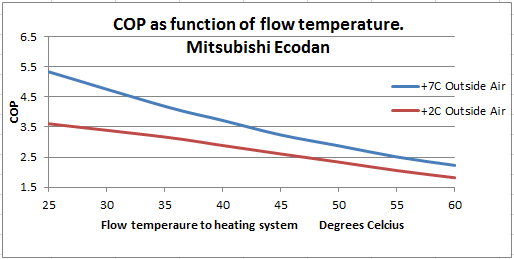
-
A houses' heating energy usage is driven by its heat losses. Whether you replace these losses over 24 hours or 10 hours you will use the same amount of energy. So theoretically whether the heating is on (regulated by thermostat) all the time or some of the time it should not make any difference. It won't be exactly the same but near enough. However, if the house has high heat losses as they traditionally had, then turning the heating off during the night or when you are out allows the temperature to temporarily be below a comfortable temperature which will save some energy. You will still need most of the energy to get back up to the target level but there will have been a period when you were saving some energy as it was colder. The smaller temperature differential will modestly reduce energy losses. The worse insulated a house is, the more it will benefit from this. Most of the houses on here will see such small changes in temperature over a few hours as to eliminate any benefits from this factor. With an ASHP the COP is better the lower the temperature the water is heated to. Thus you want to run the UFH flow at the minimum temperature required to offset the house's heat loss over 24 hours. To run it less than 24 hours would require a higher flow temperature and lower COP. Running it more or less than 24 hours a day will probably not make much difference unless you adjust the flow temperature at the same time.
-
Electricity costs around 6x as much as gas per kWh so you cut CO2 emissions but not costs. However, you do get a big payment from the RHI and save on putting in a gas supply.
-
I don't know about the buffer, I will let an ASHP expert answer that. I think it is what should happen though as the ASHP heats the buffer to stop it short cycling. In my experiments leaving the heating on all the time versus switching off and on has had similar cost. I would imagine in your house which I think is ICF you would have quite low losses and would be as well leaving it on all the time (which could allow you to use cheaper off peak electricity). Until you know if and why it is using more electricity than expected would hold off though, For an ASHP running a lower flow temperature for a longer period of time should be cheaper as it improves the COP. Do you know your flow temp?
-
@bigreadie can you have a look at this thread where we went through a lot of the issues that might be causing high bills on an ASHP, a very similar situation to yours. https://forum.buildhub.org.uk/topic/18532-meter-readings-panic-and-electricity-costs/ In this situation the ASHP had its own usage display on their Consumer unit and on the ASHP, do you have this? It is almost certain that your ASHP is the culprit. It will use a lot of electricity when it is cold though TBF. One easy thing though is to change your electricity supplier. You should be able to get it for less than 15p/kWh so that would help a bit. If you look at the other thread you might expect, very roughly, to use 30kWh a day for heating, 10kWh a day for hot water and 10kWh for general electricity use during the coldest part of winter. That is not far off where you are. The heating would fall considerably in spring and autumn.
-
The max power consumption of your UFH pump appears to be 99W so it cannot be driving up your bill. https://wilo.com/in/en/Products-and-expertise/Series-Finder/Star-RS-25-6_1931.html A few simple questions before we start- 1. I assume the bill is based on meter readings and not an estimate? 2. Do you have a gas boiler or ASHP? 3. Is the immersion on? 4. What rate per kWh are you on? I have a swimming pool and a Tesla and don't use that much electricity so something seems odd.
-
Calling all Charlie Luxton wannabes (or the real deal)
AliG replied to mtnash's topic in New House & Self Build Design
I think you have done really well here. As a few people have said, reversing the stairs and having a double height space at the he front of the upstairs hall would be nice. The plant room at the front of the house is one to watch. The window style you have chosen lends itself to a Georgian style. I would expect some symmetry and this would spoil it on the left hand side. The other thing to be careful of which I have seen on a few houses is putting a utility area like that at the front can lead to having lots of pipes, vents, meters etc on the visible elevation of your house which should be avoided, I would try to make sure they end up round the side. Opening things up though - Can you just clarify is the site 55m long and 22m wide? I think if the front of the plot is south then I would call that north facing just to avoid confusion. People normally refer to the way the main back garden faces. However, in my street the houses on the other side of the street where the plots are like this are often pushed right back in the plot and have their main garden in front of the house, is this something that would work on the plot or you would be interested in? With the space you have, you have a lot of room to play with the orientation of the house, for example making it L-shaped could allow you to have west facing windows for afternoon light. I really don't think having your main living space and windows facing north is the best idea even tough the actual room layout is fine in itself. This is where an architect can really help. -
Will any rooms other than the bathroom benefit from the return loop and how often will the bathroom be used? If the answers are no and not much I would question the value of it. We have one and I run it four times a day as it wastes quite a bit of heat and electricity. We felt we needed one though as the kitchen and master en suite are 30M from the hot tank. When it is running or just running you get instant hot water, when it has been off for a few hours you get instant warm water and a 2 minute wait for hot water (it is a 28mm loop due to the large number of fittings connected). At some point I may try to get a more accurate reading on its energy use to see if I should run it more. In fairness a smaller loop would use a lot less energy. 15m of 15mm pipe holds around two litres of water, so if you are running a shower or filling a bath you should get hot water through in less than 30 seconds. I would probably just go for this.
-
Yes, it seems to me that a 25% longer period at a 10% higher price is a good deal if you are using electricity at that time
-
Meter Readings Panic and Electricity Costs
AliG replied to canalsiderenovation's topic in Electrics - Other
Here is the data I found on power consumption of various devices. People expect to use energy for their fridge and freezer, it is the unexpected ones that add up. For example the PoE switch for our WiFi access points uses more than 3x the electricity of the fridge! One thing not in this table that I looked into is using the short programmes on the dishwasher and washing machine. It feels like they would reduce energy consumption because they are on less, they actually dramatically increase it. Device Consumption.xlsx -
It would seem like the 5 hour 5.5p tariff is the one to go for. I think you are right with 830pm start. This would allow you pretty easily to put on the dishwasher, washing machine etc at that time. This tariff should work well as with an ASHP your heating use will be pretty well spread over the day. If you are the kind of people who like to shower before bed then you could get most of your hot water at the lower price too. I guess if you go to bed early and get up early you could turn off your heating at 9 and back on at 130am and have a shower at 6am. Then that start would be better I think either the earliest or latest start is best I can’t think why someone would want an in between time. Wish I could get it as I could run the pool filter and car charger during the night.
-
Is the rule not internal floor area, so if the internal floor area is kept below 5.4x5.4 you just sneak in below the rules.
-
Meter Readings Panic and Electricity Costs
AliG replied to canalsiderenovation's topic in Electrics - Other
Most devices designed in the last 10 years should have standby power usage of less than 1W. I think this was an EU regulation some time ago. I started a thread where I went round and tested devices by plugging them into a Wi-Fi plug and most were negligible. For example an Amazon Exho which is on all the time used only about 2.5W Older devices are another matter. I think our. Nintendo Wii used about 10W so that is now turned off. Things like PS2s and so on may use similar. The devices I have also heard noted as using a lot of standby power are ovens but I couldn’t plug them in separately to check. The constant load that people are unlikely to think about comes from things like Sky Q boxes, Wi-Fi repeaters, UFH pumps, MVHR etc which all can use modest amounts of power all the time. You could easily have 100W+ of constant draw from things like these. -
Meter Readings Panic and Electricity Costs
AliG replied to canalsiderenovation's topic in Electrics - Other
Dishwasher, tumble dryer and washing machine all probably use around 1-1.5kWh per cycle, so if you used each of them once a day as we do that's 4kWh straight away (I have managed to get the dishwasher to every 1.5 days now that I am at home). If anyone is working from home, a laptop probably runs at about 30-40W (the charger will be sized larger so it can run the laptop and charge it at the same time). On the other hand a desktop and monitor could easily run to 150-200W and a big gaming system like my mate has 400W. So don't use your gaming rig for WFH! -
Meter Readings Panic and Electricity Costs
AliG replied to canalsiderenovation's topic in Electrics - Other
This looks to me around what you should be expecting. You are using a bit less electricity than I would guessed at, with a lower thermostat setting probably offsetting the lack of EWI. I know it seems like a lot if you extrapolate the recent number over a year, but you will use no heating at all for 5 months probably and much less in the spring and autumn. My guess is that you are on track to use around 5000kWh for non ASHP and 5000kWh for the ASHP per year (maybe a bit less with your insulation). This is in line with the heat loss report which you were running ahead of before. The PV might offset 2000kWh of this as you likely won't be able to use it all. Once your EWI is in to be at 21-22C probably won't cost you anything extra and at the moment it might cost you an extra 50p a day or so. No point building yourself a lovely new house then not being comfortable to save a few pounds. -
If you have a lot of tress around I think it would get horribly clogged up with leaves. Some kind of enclosure I think would be better. Expect them to be stupidly expensive
-
For those types of temperatures I suspect a solar cover could get you there, but it is not so easy to implement when there are plants around. You aren't looking for much above air temperature, so my comments below are less relevant. But 100,000 litres of water would require 116kWh of energy to increase the temperature by just 1C. I spent a lot of time looking into pool heating and costs as I didn't want it to be a money pit. Most of the discussions I could find was based on outdoor pools. Around 1/3 of the cost of heating a pool is that warm water evaporates from the top and then has to be replaced with cool tap water/rain. Ours has an automatic PVC cover and then the moisture in the air is dehumidified with the heat generated put back into the pool. Combined these pretty much eliminate that cost of heating, at the expensive of a few hundred pounds a year to run the dehumidifier. If you have heavy rain into your pool you will need to regain a lot of heat. Once this had been eliminated, I treated the pool as it if was just another room of the volume of the pool plus the room above it and used the insulation values for the floor, around the pool, the walls and the windows. This has come out almost exactly at the heat required to heat the pool. The problem when you are outside of course is the only insulation is below ground, thus heating costs would go up exponentially. Our pool has 150mm of EPS below it and 50mm all around the sides, if I remember correctly, but most of the heat loss is the room heat loss not the floor. I think the best analogy might be trying to heat a conservatory. No problem in the sun, a nightmare when it is dark and cold outside. My guess is it would lose 1-2C a day so you are talking 150ish kWh a day in the June-September period. Using it in this period the costs wouldn't be bad, all year round would be astronomical.
-
My pool is 9x3.7 I think. And 1.3m deep. Should have made it 1.35m maybe. It is just heated by the gas boiler and I reckon it costs about £500 a year, around 25000kWh. With an ASHP you’d probably be looking at 7000kWh of electricity so almost £1000. I guess the low temperature will help to keep the COP higher. The larger cost for me is actually the pump and dehumidifier. I think they use around £8-900 a year in electricity. Servicing costs for me are around £500 a year. The big cost really is the space. Pool room plus changing room and plant room are around 85sq metres so call it 150k of space. The pool and all the plant was about 80k and because it is set into the ground there is also extra groundwork and foundation cost. I had considerably bigger quotes for the pool itself and reckon I got a pretty good deal. Think it would be about 100k from the same guy today as it was quoted in 2015.