


SteamyTea
-
Posts
23851 -
Joined
-
Days Won
200
Everything posted by SteamyTea
-
And the processing, I don't think Craig Jones looked the larger picture. One of the problems is that processing wool into insulation is a very small scale business, and anything that is small scale has high fixed overheads.
-

It's not very warm let's light the fire
SteamyTea replied to JohnMo's topic in Stoves, Fires & Fireplaces
Murderers!! -
Swimming in treacle, flying drones and generating electricity
SteamyTea commented on dnb's blog entry in Building in a woodland on the Isle of Wight
Are you PV modules going to get shading from the trees on them? -
Pretty sure it is on one of the higher embodied energy and carbon insulations. ICE used to have the figures.
-
Attempting a straw bale, off-grid passive house in Somerset
SteamyTea replied to Smallholder's topic in Introduce Yourself
Is that when using straw bales as the structure, not just the insulation? Right, I had forgotten that there were higher PH standards. Less than many spend on a kitchen or bathroom. No, my first boss. -
Last winter I think I had ice on the screen. Both times it had gone by 8 AM.
-
Should easily heat that on a half decent day, even allowing for Cornish Cloud. Did I tell you that when I moved down it rained every day for 66 days. That record was broken last year I believe.
-
Do you know the size off the ST? What is the ST currently heating?
-
SW is the prevailing wind direction, so is it a case that air is blowing past/through the insulation? Also how large is the window. Real measurements help here, then theoretical heat losses can be worked out.
-
Renovating and extending 1970s house with warm air heating
SteamyTea replied to Gooman's topic in Introduce Yourself
Might be because it distributes the air more evenly. Radiators, which are really convection heaters, allow much of the air to raise to ceiling level, which will be hotter than you want, while the floor will be colder. This causes the mean room temperature to be higher than it needs to be. -
Could you use the 'spare' hot water on a recirculating DHW system. That can also act as a cooling circuit. I wish I had spare energy, maybe I need to run a very large TOR relay at home, then host dark web content, that should pay the bills.
-
Renovating and extending 1970s house with warm air heating
SteamyTea replied to Gooman's topic in Introduce Yourself
Yes, but not from the mains temperature each time, and any heat that escapes into the house, reduces the need for space heating. I will say though, that I am a fan of forced air heating, to me it is the sensible way to heat a building, we live in the air, not the walls, floors, furniture etc. We also like to breath in warm air, this reduces the the amount of body heating as we are filing about a quarter of our volume with something warm, several times a minute. I get hiccups if I go out into the cold. -
Renovating and extending 1970s house with warm air heating
SteamyTea replied to Gooman's topic in Introduce Yourself
You have answered this already. Air takes 1kJ.kg.-1.K-1 Water takes 4.18kJ.kg.-1.K-1 If you work out the mass of air that is heated every day, say 2 tonnes, multiply it by the temperature difference, say 15K, you get 30,000 kJ. Do the same for water say 150 kg and 40 K, you get 25,000 kJ A similar amount (an purely speculative). The difference is that you want hot water quickly, so need a lot of power (kW), the house is heated constantly, so a lot less power is needed to deliver a similar amount of energy. -
Yes, never really taken any notice of them. I think the difference between mathematics and science is that mathematics does not, in itself, describe reality, it is abstract, so falls out of the set of all sciences, to use a mathematics term.
-
Can I divide this thread by zero and get a real answer. Mathematics is just what mathematicians do, there is no consensus as to whether it is science or art. There is no Nobel Prize in Mathematics.
-
Well English Lit ones may be. My Viva wasn't. Was a (expletive deleted) of a lot of standing on shoulders though. So much so that my research became a minor part of the narrative.
-
What you going to do with the excess electricity in the summer? How large is the PV system.
-
So faith healers, homeopathic and reiki practitioners are scientists.
-
Brilliant, thanks.
-
That is very useful information, do you have a reference for it please.
-
OK, then, to be blunt, anyone that has proper scientific training. You can't say that anyone that shows curiosity 'is a scientist', that is just barmy, and you know it, would make everyone in the world a scientist. If you want to reject the whole concept of professionalism, convince the world that we do not need any standards, for anything, an opinion is just as valid as evidence. I have an interesting in art, I even create and sell some, does that make me an artist or a crafter? Depends who you ask, ask a painter and they say craft, ask a sculpturer, and they say art. Science is using the tool, that have been refined for thousands of year to get to the truth. I am quite happy for you to trust who you think is a scientist, but one word of causing, it they tell you that gravity is an illusion, don't step off a high bridge. Then why have we so much rejection of science, and the scientific method?
-
Renovating and extending 1970s house with warm air heating
SteamyTea replied to Gooman's topic in Introduce Yourself
Or just follows the heating curve formula. T = 1-(e-kt)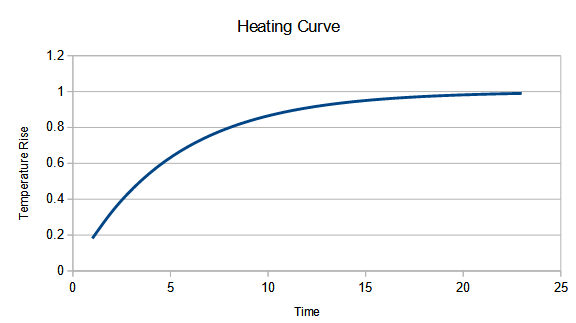
-
It is the language of science, but in itself, not science. The classic question is to describe a number. What is a 2, or a 23, show me 7, or 439? This starts to go into philosophy, and the problems really start to show then. We have Bertrand Russel to thank for all this.
-
I have never liked the 'water' analogy to describe electrical circuits, so why not describe what actually happens. Or attempt to. If you take a piece of conducting material, metals are good one. They are composed of atoms, and the atoms are made, in the simplest model, of the nucleus and orbiting electrons. At normal temperatures, all is fairly stable and everything stays in place. There is a little jiggling of atoms going on, but on average, they cancel each other out. Now if you put a hot flame at one end of the metal, while holding the other end, after a short time, your fingers get hot. The energy from the flame has somehow travelled along the bit of metal. Electricity does exactly the same, and in the same way. What happens in a circuit is that the voltage has enough energy in it to overcome the inherent stability of the material. It does this by pushing an electron to a higher energy state. If there is enough voltage, the electro breaks free from its atom, leaving behind a space, which is called a 'hole'. Atoms hate to be unbalanced, and electron hate to be free. So at the very first opportunity, the hole will get filled by a free electron. Sometimes this is the same electron that it has just left, other times it is another free electron looking for a hole. This movement of electrons is what causes current, measured in amps. The more electrons moved, the greater the current being passed though the metal. The faster you can move those electron from their atoms to other atoms, the more current you have. So it is just down to voltage times amps, which we know is power (W = V x A). The level that the voltage is at, is what sets the speed the electrons 'move' at. The size, and therefore the amount of material, sets the amount of current that can pass for any given speed (or voltage). Basically a thicker wire has more atoms in it, so more electrons can be moved. Now imagine what happens when one set of flowing electrons meets another set, coming in the opposite direction. If the speed and amounts are the same, they will just cancel each other out, The laws of momentum tell us this. Mass times velocity, (M x v) + -(M X v) = 0. Now a PV system, after the inverter, runs an a slightly higher voltage than the incoming mains electricity (it senses this voltage, as well as the phase and resistance constantly). This means that no electricity can flow up the wires and circuits to heat up the PV modules until they emit light. Also when the PV is not generating, that pathway is blocked. When generating, the free electrons, that are looking for empty holes, find another path, the path of least resistance, until they do find those spare holes. Those holes will be on any connected circuit that has a load on it. This is really the definition of a circuit, no load and there is no connection between the negative side and the positive side. So by keeping the PV side at a slightly higher voltage than the incoming supply, electrons are forced to 'look' for those free holes, and if they cannot find any, because the are at a higher energy state, they can physically smash out an electron from the atom it is orbiting. In doing so, it looses energy, and plops into the vacated hole, leaving the displaced electron to do the same to the next electron. This bullying by the higher voltage electron eventually forces enough electrons to go back down the grid wires until they meet a load, which may be your neighbours lights. Now if there are not enough loads on a circuit, and you have two competing sources making free electrons floating about, you eventually get way to many at the elevated energy state. This causes the metal wire to heat up. Eventually the wire will get so hot that it will melt, this breaks the circuit and stops current flowing, even if the voltage is still high. This is why there is a circuit breaker on the PV circuit, it stops wires melting. Summing up, the higher voltage generated by the PV system allows the electrons to flow to the nearest load, if that nearest load happens to be miles down a wire, they will still flow there. But what usually happens on a long circuit is that all the pushing and shoving that the electrons do just heats up the wires, the conservation of energy tell us that. So to use up 'your' electricity, switch on a load, to use your neighbours electricity , or the grid electricity, turn on a load. To stop your neighbours using your electrify, turn on a load, or turn your incoming supply off, though that will also turn all your electricity off as well.
-
Are they emaillable? Could make interesting reading. I am not sure how much difference it makes where you are. I looked at the difference between mean temperatures in Newcastle and Cornwall once, seem to remember it was under 1°C. That does only tell part of the story though. Cornwall tends to have cool spring times as the ocean is cold.

