

reddal
-
Posts
235 -
Joined
-
Last visited
-
Days Won
1
Everything posted by reddal
-
Data Cat5 and other wiring
reddal replied to Auchlossen's topic in Networks, AV, Security & Automation
I agree - put loads of cables in - more than you ever think you will need. It costs very little to embed runs of CAT5e in the walls when building - but is a total pain to retrofit them afterwards. Note - CAT5e has 8 cores internally - and can also be used for most control / sensors etc - ie you can splice into the CAT5e cable for most low voltage applications. A 300m reel of decent quality CAT5e will cost less than £50 - so you can go nuts with it without spending a lot. -
Boreholes aren't cheap - depends on depth etc - but you are talking several £k at a minimum just to create the borehole - and then the real fun starts with extracting the water and making it drinkable. On dowsing - I don't believe there is anything spooky going on - it's just your mind playing tricks on itself along with the ideomotor effect. It can be extremely convincing - but whenever dowsing is tested under proper double blind conditions the results are no better than chance. Here are some links : http://www.smithsonianmag.com/science-nature/debunking-dowsing-5028261/?no-ist http://web.randi.org/uploads/3/7/3/7/37377621/jref13edmod_dowsing_teacher_print.pdf
-
I've always been a bit dubious of this - the idea that ground temperature impacts can persist between seasons. I understand a GSHP can change the ground temp in the short term - but the idea that the change in temperature will hang around for months or even years doesn't make sense to me. We build houses with all kinds of fancy insulation - and even with all that - with no heatsource any temp difference between the inside and outside of the house will equalise within a few days. And yet a temp difference in the ground made of soil and wet mud with no insulation at all will remain for months/years? Surely any temperature impact a GSHP has on the ground will equalise in a few days at most? - reddal p.s. apoligies for the derail...
-
Log burner stove for large open plan room but MVHR
reddal replied to readiescards's topic in Stoves, Fires & Fireplaces
I think that normally means its not burning hot enough. Apart from the cosmetic issue of the glass this can also lead to creosote build up in the chimney which can be dangerous. Can you shut down the air intake a bit less to avoid it? Also check your fuel is properly seasoned (measure it with a cheap meter). -
Log burner stove for large open plan room but MVHR
reddal replied to readiescards's topic in Stoves, Fires & Fireplaces
Wood burning can be tricky. A few tips for anyone trying to run a smaller fire : Make sure the fire gets up to a proper temperature when lighting. Don't limit the airflow until it's burning nice and hot. Get a flue thermometer and an IR gun and obsess over them :). Make sure the flue/chimney has enough draught. You can get a fan installed to help it if not. Make sure the logs are properly seasoned - this means something like 15-20% moisture content. Most of the logs you buy from garages etc are rubbish - I've seen them at 35% moisture which is very hard to burn and will cause all kinds of problems. Its easier to burn 2 or 3 small logs than one bigger log - so if you want to only burn a limited amount of wood it's easier if you split your logs into smaller chunks Dont wait too long before refueling - e.g. don't wait until the fire is nearly out and has cooled down before putting on another log - do it when its still burning hot - so it will keep that temperature up. -
Log burner stove for large open plan room but MVHR
reddal replied to readiescards's topic in Stoves, Fires & Fireplaces
I'm not sure about that. With the firebox rammed full of logs its actually quite difficult to get it all burning at the right temperature - some parts of the stack inevitably don't get enough air and don't burn properly. However when burning a few logs in a big firebox there is lots of room for air to get to each log - and you can choose whether to spread them out or pack them together - which gives you more control on the output. I have a stove thats rated at 8.5kW. I did some tests once to try to estimate what output I was actually producing. I ran the stove for a few hours - only adding 1 or 2 logs when needed - maintaining correct burning temp throughout - and measured the impact on the house temperature. I then repeated the exercise next day but using a 2.5kW electric heater instead. The result was that the stoves output was a bit less than the 2.5kW electric heater. i.e. when using the stove in the way I found easiest to keep it burning properly - the output was only a fraction of the rated output (8.5kW) - probably only about 2kW. I could easily burn less wood that this test - maybe getting output down to 1kW - or more - maybe getting output up to 5kW. However I don't think it would be easy to get up to 8.5kW and keep good burning temp throughout. The output rating of a stove is pretty much entirely determined by how big the firebox is - but you don't have to use it all - in fact I find it easier to get logs to burn properly when only using a fraction of the max capacity. - reddal -
Log burner stove for large open plan room but MVHR
reddal replied to readiescards's topic in Stoves, Fires & Fireplaces
Two seperate issues here : The temperature the stove burns at. I agree running a stove at too low a temp is bad. How much wood you burn at once. Its very possible to burn a lot less than the maximum capacity at the correct high temperature - easier in fact. Once a stove is burning at the correct (high) temperature - you can restock it with just one or two logs - and get low output - or pack in loads of logs and get high output. The size of the stove doesn't make a lot of difference to the minimum output I think. I agree that plenty of people will use a big stove incorrectly - and pack it full of loads of logs - and then close off the airflow to try to reduce the output - leading to low temp burning. However once you know not to do that - its not a problem to run a stove at a fraction of its max output. -
Log burner stove for large open plan room but MVHR
reddal replied to readiescards's topic in Stoves, Fires & Fireplaces
I wouldn't worry about what the rated output of the stove is. A bigger stove can always be run at much lower output by just using less wood. The rated output is a maximum - assuming the stove is somehow completely full and all at optimal burning temperature (hard to achieve). In practice trying to achieve the maximum output is likely to lead to some of the wood burning at too low a temperature - which is bad. Its much easier to get correct burning using less wood. I would guess you are unlikely to ever run a stove at more than half its rated output - and its easy to run it much lower than that. The minimum output of a stove is determined by how small your logs are, and how much control you have over the airflow. I would guess that you could run any stove at 1kW by only using a couple of smallish logs at a time. - reddal -
Hi, I think we used the same stuff for our house. The exact type was K39 I remember if that helps? I wasn't very involved in that part of the build - but what I remember is : we used a LOT more of the stuff than the original estimate (more than three times as much if I remember correctly) it was a bit fiddly to apply. It was a learning experience for the guys doing it - took a while there were all kinds of constraints on the temperature / humidity and how to protect it whilst drying There was some complexity about the build up of metal mesh / cavities etc that were needed (I can try to look up the details of that if its useful) However - its been up a few years now and its worked pretty well - with very little maintenance. The finish does look nicer (to my eyes at least) than some of the alternatives. - reddal
-
My prediction - England gets kicked out of Euro 2016 later this week after further violence - and this leads to a decisive swing towards the Leave side...
-
Supplying air to the MHVR via underground pipes is the scary scenario as pointed out above. Supplying geothermally preheated air to the ASHP would be less controversial - but sounds like more hassle than its worth. I think the key advantage of an ASHP over a GSHP is that an ASHP avoids the whole issue of ground works, pipes etc. If you were going to do that anyway just go the whole way and do a GSHP with liquid filled pipes (using a low freezing point fluid). I have a GSHP - and whilst it does avoid the issues of defrosting etc - it was quite expensive. If doing again I might well go with ASHP instead. - reddal
-
We were in a similar position a few years ago - but decided to get a warranty from NHBC Solo - not because we were forced to - but we were advised it might be a lot more difficult to sell without it because other people would find it harder to get a mortgage. We weren't planning to sell anytime soon - and still aren't - but it seemed prudent to protect the value of the property as a financial asset - just in case we did decide to sell. However we found the process with NHBC very painful - and would not go down that route again. We didn't realise at the time that there was such an overhead to getting this kind of warranty - ie beyond the cost of the premium - the huge pain of having to jump through extra hoops to keep NHBC happy (way above and beyond what building control needed). I like Jeremys solution of buying an indemnity if and when there is a need. I don't know how universally those are accepted - but if in the same position again I would research that carefully.
-
One of : They aren't VAT registered. In which case fair enough - though they should make clear that the price doesn't include VAT. They are VAT registered - and pay the VAT in their VAT return - but they aren't very organised and don't send out invoices. They are VAT registered - but just pocket a lot of VAT on ebay sales and never declare it. I bet a lot of that goes on. They will be in trouble come an audit. I have the same trouble with Amazon purchases all the time. Its not always clear if the price includes VAT - and even if it does you have to hassle them to get an invoice. OMG - you reminded me its quarterly VAT return time again. I hate the whole process... - reddal
-
Hi, I know you don't want to hear this - but it does sound like if you want to sell quickly - it will have to be at a slightly lower price. Property is only worth what someone is willing to pay for it. A valuation is just a guestimate of this - and if you tested the market and noone was willing to pay close to the valuation then the valuation was wrong. Maybe remarket it 10% lower? Also make sure the property is as well presented as you can. People should be able to see through cosmetic details - but they do seem to make a big difference. So tidy up any small decoration issues, clear out as much clutter as possible, etc etc. And get new photos done. A few years ago we were selling a property and I thought we were going a bit overboard with the presentation. We replaced a few carpets, repainted a few rooms, returfed the garden and then moved 90% of our stuff into storage and got a company in to 'stage' the place - with rented furniture. It looked a bit rediculous to my taste - like a show house - and I was thinking we were wasteing a lot of time/effort/money - that is until it finally went onto the market and the first 2 people who viewed in on the first day both offered the asking price on the spot! Hope it all works out for you. - reddal
-
I dont think there is a single right answer - there are many patterns - several give 96, one gives 40, another 201. You could probably construct any answer with a complex enough rule. If the question becomes which pattern is the most elegant? Well its a bit subjective...
-
We bought one of these http://www.scaffold-tower.co.uk/Scaffold_Towers/double_width_2.5m_8x4/platform_height_4_2m.php We originally planned to sell it afterwards - but its been too useful. It gets used for all kinds of maintenance jobs etc.
-
So there are two different tanks - one for DHW and another for heating?
-
I was just doing a very simple simulation - assuming no losses etc. ie for each liter of water calculate how much would be drawn from the tank (given the mixer trying to get eg 45c) and work out how much energy this removes from the tank - and what the remaining temp of the tank would be. And I might have done it wrong... though I can tell you from experience that the reality is something along these lines. Yes I would guess that a thermal store at 60c might struggle to deliver enough hot water if it was also running the heating. e.g. you heat the store up to 60c - then the UFH kicks in and draws heat from the store pulling it down to 50c - and then you will wont have enough hot water for a bath before the store is below 45c. If DHW and UFH are both working off the same store - which is pre-heated by ASHP - but you want the DHW to always be available - then be careful because its easy to end up not using the ASHP at all for the UFH - and essentially just using (expensive) electric heating. i.e. if the ASHP can heat the tank up to 45c - but the immersion heater kicks in before this then the immersion heater will power the UFH. Alternatively the immersion heater can be linked to the ASHP and doesn't come on until the ASHP has been given a chance to contribute (ie tank down the 30c) - but then there will be plenty of times when you effectively don't have DHW available! We struggled with these issues and ended up with a seperate DHW cylinder and thermal store - however its a bit of a compromise. Others here are more expert on this stuff than me and can comment more authoritatively. - reddal
-
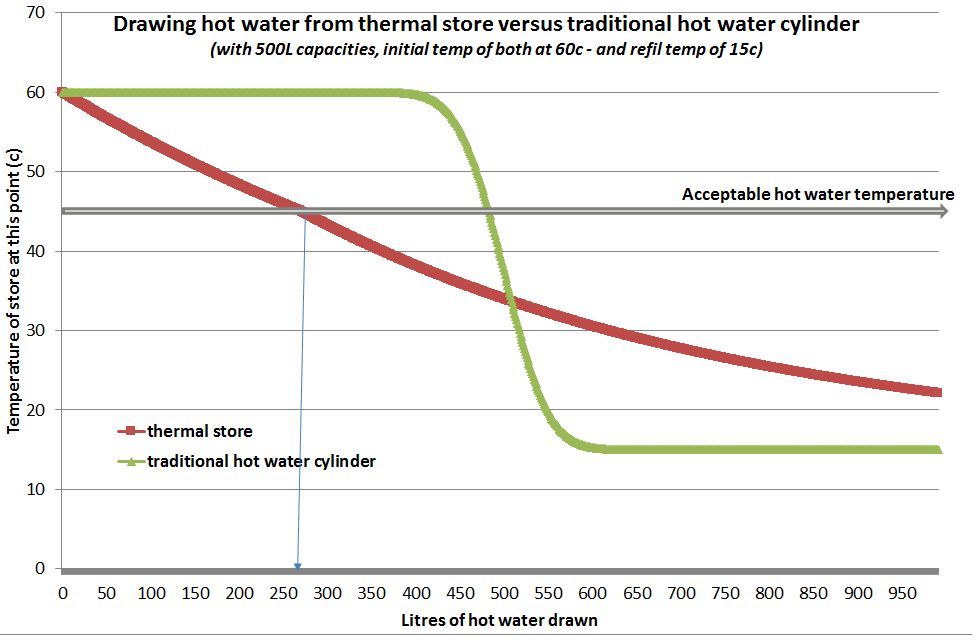
If my calculations are correct (they might not be!) - a 500L thermal store at 60c would deliver about 260L of water with the mixer set to 45c - before the temp started to drop below that level. That sounds ok - enough for a couple of baths/showers at least before the temp starts getting tepid. If you want the output temp to be mid 50's though then you would get less than 100L before it drops below that level. Others can comment with more authority than me on if 500L at 60c gives enough capacity. It sounds to me like it would - but is a little bit tight. A thermal store for DHW would perform a lot better if at a higher temp - like 75c. - reddal ps a graph :
-
As Steamy explains there is a lot you can do with detailed data. If anyone has this kind of data but doesn't feel like they have the data analysis skills to extract the value from it then I will have a go for you if you give me all the raw data. Compared to the giants around here there aren't many topics I can contribute expertise on - but data analysis is something I can at least have a go at! - reddal
-
Hi, What temperature are you planning to keep the thermal store at? I initially had problems because my installer didn't realise that thermal stores aren't good at providing hot water when kept just a bit above the target hot water temp. Some discussion from the old site : The thermal store is 300L. Yes - the thermal store should have been a lot bigger. The original design had just the 300L thermal store. The installers who designed the system thought this would be plenty - and 300L is a lot of hot water - but they didn't understand that a thermal store doesn't work like a traditional hot water cylinder - it starts losing temperature immediately - compared to a cylinder which gives you most of its capacity at its initial temperature - then quickly drops to the input temperature. Here is a simulation I did to illustrate that : Because the GSHP only gives hot water at 50c - the output only has to drop 5c or so before its not really hot enough as domestic hot water. This meant we didn't even get a single full bath of hot water from the system! A thermal store has the same total amount of energy in it as a normal cylinder - it just outputs that energy at a different rate. If the thermal store had been much bigger - or we had a primary heat source that provided much higher temperatures there would have been less of an issue. However it became clear that them specifying a 300L thermal store with a GSHP as primary source was a mistake. ... - reddal
-
How does the datalogging work?
-
I've got an AC system (same kind of technology as ASHP) with the external unit about 200mm from a wall. The guy that serviced it said it was a bit close - but no major issue. His concern was only about being close to the wall it might get clogged up with leaves / debris back there - which would be a problem.
-
Hi, I wish I'd done more of this on my build - there are loads of sensors tied in with the systems (heating, UFH, etc) but they typically aren't very accessible - you can't log the data and put it all together to see what is really going on. If doing it again I would try to find a way to install independent sensors and datalogging of as many of these as practical : temperatures in each zone of UFH room temperatures in several places external temperature internal humidity hot water tank temperature (+thermal store temperature in my case) temperature of inputs to the thermal store (solar and stove in my case) circuit by cicuit electricity usage and probably more! There is some complexity to the datalogging systems that I don't really know anything about - but I'd want to be able to get the detailed raw data onto a computer to analyse it there. If you can find a way to setup a system so that adding additional sensors costs no more than a bit of wire and a few pounds for each sensor - then I would put in loads! - reddal
-
No - surely this is the answer :
