
reddal
-
Posts
235 -
Joined
-
Last visited
-
Days Won
1
Everything posted by reddal
-
No - not sure. The documentation is not helpful on this point. The GSHP guy checked the brine loop side and didn't see a problem - so is assuming it must be on the other side - particularly because he was surprised not to find a filter between the heating and the heat exchanger - and thinks that should be fixed (and system flushed) regardless. If he is right - and this is something that needs to be done as part of routine maintenance every 5 years or so then I guess I have to get it done. Its quite expensive though so I'm tempted to just leave it...
-
Hi, Recently my GSHP has been playing up again - occasionally not heating water and displaying an error "High pressure plant fault". This goes away when you hit escape and it then seems to get on with the job. I asked the contractors that service it to come check it. They looked at the filters but couldn't see anything much. They recommended that the UFH side of the system should be cleaned out and an extra filter should be fitted between the heating system and the heat exchanger. They implied it was probably a good idea to do this regardless as the system is 5 years old now. Their estimate for this work is : Back-flush heat exchanger – 2 men for 6 hrs £498.00 Fit filter and add chemical – 2 men for 2 hrs £241.00 Flush after 2wks and dose – 2 men for a day £664.00 All those figures ex-vat - and only an estimate. I think they want 2 men because one guy knows about the GSHP and the other is a UFH specialist. This company is the only one locally that has anyone that knows anything about GSHP - so I don't get to shop around. Its been working fine the last few days - so I'm wondering if the problem is fixed anyway... A few questions : Is it a good idea to get this done every 5 years anyway? Is it likely to fix my problem (if I still have one)? Is the estimate reasonable? thanks as ever for any advice - reddal
-
Hi and welcome. I would definitely put lots of thought into controlling solar gain. Think about : how to add shading the type of glass - makes a big difference how the angle of the sunlight affects things how the heat capacity of the contents of the house affects the response to gain how ventilation can help - ie windows situated to generate convection how to add cooling Our house has been built a few years now and has lots of south facing glazing. We put a lot of time, energy and money into controlling solar gain - and even so - it occasionally catches us out. e.g. last week there was a fairly sunny day. The sun is a bit lower this time of year, and I switched off the passive cooling recently. The result was the living room was 29c! It probably would have got higher but I opened all the doors/windows to control it. If we hadn't put lots of resources into controlling solar gain during the design (ie if we had followed the advice of all our professional advisors at the time!) then I think the house would have been uninhabitable during summer - with no easy fix. - reddal
-
Mobile signals frustrated by house wall insulation
reddal replied to Auchlossen's topic in Boffin's Corner
I use VOIP for all my outgoing calls from the house. We have a landline - but only use it for broadband. However I still need a mobile signal inside the house. People have my mobile number and not typically my home (voip) number, and send me txt's to my mobile. If the mobile didn't work in the house it would be very inconvenient. Outside my house you typically get a full-bars mobile signal - inside (without the repeater) you get nothing at all. I don't have the specs our insulation anymore - but it was a variant of this system - https://www.oakwrights.co.uk/oakwrights-design-and-build/encapsulation/wright-wall-natural. On top of that there is a build up of metal lath and lime render - and I always suspected the metal lath wasn't helping - acting as a faraday cage. -
Mobile signals frustrated by house wall insulation
reddal replied to Auchlossen's topic in Boffin's Corner
Thats interesting - I had no idea there was a legal issue. The current exemptions seem to be here - https://www.ofcom.org.uk/__data/assets/pdf_file/0028/84970/ir-2030-july-2017.pdf . Loads of glorious techy detail in there - but I can't see anything obviously exempting these mobile repeaters so looks like you are right. So how are people supposed to build houses that have a mobile signal? We all obsess over how to best provide other services into our houses (heating, electricity, hot water etc) - I think mobile signal deserves the same attention. If insulation is causing the problem - is there a type of insulation that doesn't? I know if I'd had the choice of a different insulation material that was a bit more expensive but allowed me to have a mobile signal - I'd have gone for it. -
Mobile signals frustrated by house wall insulation
reddal replied to Auchlossen's topic in Boffin's Corner
Hi, We also found there was initially zero mobile signal inside the house - despite having good signal outside. I always assumed it was as a result of using a metal lath as part of the wall build up (under lime render) - however it could be insulation as others suggested. We bought a mobile repeater from these people - https://www.mobilerepeater.co.uk/ . It has an antennae on the outside of the house which connects to a box inside the house which rebroadcasts the signal. We bought an entry level one - which worked, but didn't give good signal throughout the house - so we then bought a much more powerful version, and its been fine since. It seems like this problem is very common in modern houses. We should either : work out what the real causes are and advise people how to avoid the problem, or accept its inevitable but give new builders clear advice to expect it and how to counter with repeaters. Nowadays having good mobile signal inside your house isnt just a nice-to-have, its considered a basic human right by many :). - reddal -
I've bought a bunch of rope from www.cheaprope.co.uk in the past. 6mm blue polypropylene is 6.99p/m.
-
When I used to live in London we often had scumbags trying to break in. The only solution that seemed to work was fitting a grid of steel bars over any window at accessible height. A bit overkill maybe, but it still allowed windows to be opened, and was effective - if you can live with the aesthetics.
-
As others said - check out 4G coverage for your area. If its not great you can install a high gain directional antenna to boost a weak signal.
-
I just bought loads of that - for £18/ton delivered. They were only coming from about 20 minutes down the road however. The key thing is to find someone nearby.
-
I have a GSHP connected to boreholes that also supply water. However for reasons Jeremy describes - it wasn't simple to use the same borehole for both - so we ended up drilling seperate holes - which was obviously expensive. If you have to drill a borehole to create a water supply - and you are decided on a GSHP, then it might make sense to drill another at the same time given a lot of the cost is in getting the equipment onsite and setup. i.e. the extra cost of another borehole might be something like £6k, which might compare well to the cost of installing a near surface loop, and deliver slightly better performance. If I was doing it all again I would think very carefully about options other than GSHP - it ended up costing a lot. The one thing a borehole based GSHP does probably better than other solutions is passive cooling - which is what persuaded me to go down that route. However the extra cost would have paid for a lot of other cooling options. Good luck! - reddal
-
New diesel and petrol vehicles to be banned from 2040
reddal replied to Triassic's topic in Environmental Building Politics
My guess is people wont park their car by their home at all. You will get out of your car at home - then the car will drive itself to an underground car park nearby, charge itself, and be ready near your house when it predicts you will need it next. In fact the whole idea of everyone owning a vehicle will probably disappear - you will just press a button on your phone and one of millions of shared vehicles will arrive seconds later. On the original subject of this proposed future ban - I support it if the idea is just to signal to people that they should think more seriously about buying electric vehicles. However I hope they don't actually go ahead with the ban. By then IC engined cars will be a niche for enthusiasts only - and why not. I don't like the idea of big brother prohibiting things unless there is a very good justification. -
That can make a fine solution I'm told (several people here have installed ASHP + solar). The devil is in the detail of how it is all specced, setup, controlled etc. You need to either spend a lot of time yourself stressing over these things - or hire the right person to do it for you. Do you have mains gas at your location? If you do I would think seriously about just getting a traditional gas boiler to drive all heating and DHW. It will cost very little to buy/install - it will work fine most of the time - and if anything goes wrong you will have a choice of dozens of qualified professionals to fix it. If you need cooling - put in an AC unit :).
-
Sounds like a problem with the UFH design or control - rather than the GSHP. I guess if they were used to a UFH system that circulated water at 60c then any heat pump is not designed for that - its about slow heating at lower temps. However we also struggled a bit with UFH performance. Because the GSHP setup and control is quite arcane and complex - it was hard for anyone to work out what the issues were. We recently changed some things which hopefully will make it work better going forwards - won't know for sure until this winter.
-
Agreed. People tend to focus on heating - we certainly did. Heating a house with any kind of sensible insulation / airtightness is easy and cheap to run - however you do it. You can spend a fortune on a 'highly efficient' heating system (we certainly did) but you might be better off putting your money and energy into worrying about other aspects - like cooling, or lighting, or security etc. Don't get me wrong - if you want some fancy technology for heating your house because you think it will be a cool toy, or something you are passionate about - then go for it. If its a pure economic argument then the justification is often borderline at best.
-
Hi, We have a GSHP. It works reasonably well - and doesn't use a lot of electricity to provide our heating and most of the DHW. However it was expensive to buy, install and maintain. There have been a couple of problems with it over the last few years - and each time was quite tricky to resolve - given there are very few people around me who know anything about them - and nobody who understands the particular model. If doing it all again I would look at ASHP more closely. In fact I might just look at an old school oil fired boiler! That would cost more to run - but I'll be dead before the GSHP pays for itself through the difference. We have had the GSHP for 5 years now - I guess they don't last forever and in the next few years I may have to replace it. Given I already have the brine loop etc (the tricky underground part) then I will probably be sucked back into getting another GSHP! Not sure how I feel about that :(. - reddal
-
Handy VAT caluculator
reddal replied to Vijay's topic in Self Build VAT, Community Infrastructure Levy (CIL), S106 & Tax
This works - but you don't need an online tool. Just use these : If you want a total with VAT and you have the ex-VAT price then : IncVAT = ExVAT * 6/5 If you want the ex-VAT price and you have the inclusive price then : ExVAT = IncVAT * 5/6 If you want the VAT amount from an exclusive price then : VAT = ExVAT / 5 If you want the VAT amount from an inclusive price then : VAT = IncVAT / 6 The last one is the one that often confuses people :). - reddal -
Recommended Garden Shredders, Please
reddal replied to Ferdinand's topic in Landscaping, Decking & Patios
We had a few acres of land that was completely overgrown with brambles and thick growth of everything else including some small trees - it was a completely impassable jungle. We wanted to get it cleared and asked a contractor what it would take - they said it would take a couple of weeks with plenty of machinery and would cost thousands of pounds (can't remember exact figure - but it was completely prohibitive). Instead, we put proper stock fencing around the area and put a couple of pigs in it to see if they could make any impact. The result was within a couple of months they had cleared everything - brambles, bushes, even small trees! Livestock can be a good way of clearing unwanted vegetation. -
By the way - I would probably setup the IP cameras with static IP addresses - so your security system isn't at the mercy of the router having a problem or some other DHCP issue. Your DVR might even require static IP addresses. If so set the default gateway to be the address of your router if you want the cameras to be able to access the outside world.
-
Yes - the router provides access to the internet and can do this for all parts of your LAN. I would just use it as this - ie the router provides ip addresses via DHCP to the whole network and therefore becomes the default gateway for all devices and any traffic with an address outside your local subnet will go to the router and then to the outside world. You can just have a single connection to the router to provide this - connected to your main LAN switch. Accessing the CCTV from the main network should be fine - its only a fraction of the raw camera traffic and only occational. I wouldn't use the Genexis unit to route traffic between LANs - in fact I wouldn't have different LANs at all - just a single LAN with a single subnet - but a direct route from cameras to DVR. Or maybe you want a seperate LAN so you can control security between them? ie prevent anything from the camera side of the LAN from accessing the rest of the house? If not I wouldn't bother doing anything complicated - and keep the router doing the basic task only.
-
Why would it be a problem to use the modem as a DHCP server? The DHCP server would only be used when each device starts up - it doesn't affect ongoing traffic? The PoE switch won't have routing tables - but it will maintain an internal list of which MAC addresses are accessible via which ports - and push traffic to the correct port accordingly. If that didn't work then the traffic would never get to its target at all. Connecting the 2 switches via the router would work - but I don't see what it adds unless you want to do something extra like setup firewall rules about what traffic can go from one switch to another.
-
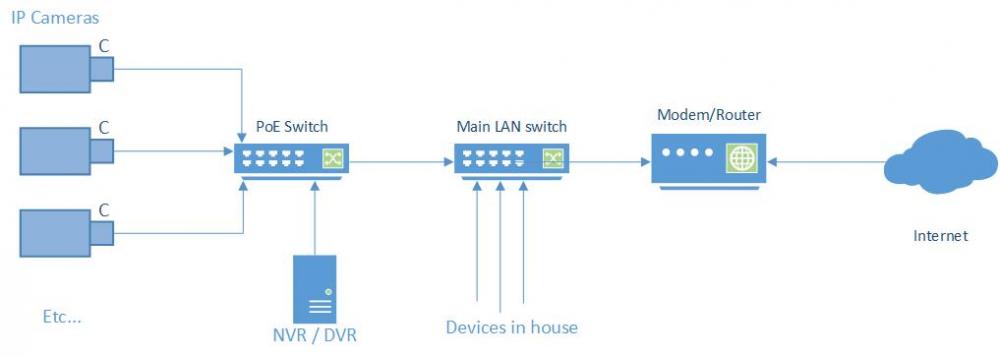
You dont need the two LANs to be completely seperate - you don't even need different subnets - you just need to make sure that the camera traffic doesn't contend with the rest of the house - ie there is no bottleneck that all traffic has to go through. e.g. I'd imagine something like this : Here the main camera traffic will go from the cams to the NVR/DVR without ever bothering the rest of the network - however the PoE switch can still be connected to the rest of the network - but that will only be used if accessing the cameras setup page or accessing NVR over network etc - ie occational and lower bandwidth usage. - reddal
-
The key thing is to make sure that whatever is consuming the camera traffic (an NVR or pc usually) is receiving it via the seperate network. If it all goes into a single central point then that will be the bottleneck. If you have 16 IP cameras they will probably cruise at 30-50 mbps with peaks of 100mbps (depending on the setup). This isn't a problem for a gigabit network - but if there is a bottleneck point then anytime something else high bandwidth is happening (a file transfer say) then the network can be swamped and performance will be bad.
-
I have a friend that has several IP cameras powered by PoE over runs about 80-90m. It seems to work fine - but I think 100m is about the limit for ethernet connections. It probably also depends on how much power the IP cameras use - ie a monster camera with lots of IR will probably have more restrictions on cable length than a tiny one. If you have power local to the cameras it might be better to power them directly - or by a local PoE switch as suggested.
-
OK with 16 cameras I would try to isolate them from the main network. ie dont just connect the IP cameras into the same switch as everything else - have a seperate switch for the cameras. Some NVRs have a built in PoE switch which makes this easy. A different subnet won't really help if you are short of bandwidth - it keeps devices logically seperate but in the end if all the traffic is going over the same cable it doesn't help if they are different subnets. A QoS setup can help prioritise which traffic you think is most important if you are short of bandwidth - but its complicated to setup - and its better to avoid the problem by installing extra cables so you have plenty of bandwidth if you can.