


Marvin
-
Posts
2389 -
Joined
-
Last visited
-
Days Won
3
Everything posted by Marvin
-
the devil is still in the detail
-

can you fit a towel warmer/towel radiator over a bath tub?
Marvin replied to TryC's topic in Bathrooms, Ensuites & Wetrooms
Well I assume this is electric? Check this info: https://www.drench.co.uk/blog/how-to-guides/what-are-bathroom-electrical-zones -
In that case make sure you make it old age compatible! Warm, low maintenance, low running costs, accessible both with regard to level access and facilities. All are easy included alterations during build and not noticeable (except a lift but the space for one can be prepared by avoiding putting services in that area). It all sounds nuts as you live in your beautiful home, until that time when you start struggling and don't want to leave but can't cope. M
-
I think things have changed. I was offered one, I believe in the last 3 years, and all they gave was about 50 days free credit which I didn't need so I declined.
-
Is a floor mounted door stop compatible with UFH
Marvin replied to Adsibob's topic in Bathrooms, Ensuites & Wetrooms
shame the door couldn't open outward -
Yes in my experience good insulation and airtightness is paramount. good floor insulation is also important. Easiest is when the floors are timber suspended...
-
Hi Does anyone have any experience of locating their ASHP on a fairly exposed flat roof? ( this side of the boiler flue. Flue going)
-
Thanks A_L I have 50% over sized radiators installed because I was not sure that the insulation and MVHR would work as well in practice as in theory. It does. ? Who says 2 wrongs don't make a right? ?
-
Do correctly sized radiators work ok when fed cool water using an ASHP? (Obviously with the right controls)
-
Hi seeker. First advice I would give is to start with the end in mind. It is always better to insulate big rather than heat big. Yes up front cost more but end product better - if your intending to stay! Timber floors? Lots of choices regarding heating and some compliment each other and some clash! When I lived in an old solid stone walled building, it was plaster boarded on the inside, however the builders never sealed the walls so the wind blew through!
-
Upper storey internal stud walls - direct onto joists or onto ply floor?
Marvin replied to Hastings's topic in Timber Frame
The stud needs good quality support and nod has said a good way to do it. If you rely only on the strength of the flooring between the joists it will sag over time because of the weight of the wall. I know! Have no idea where it might stipulate this but I have been in plenty of properties where the walls have sagged because the flooring has bowed because of this. In fact the last 3 properties! -
But decide this one soon because the soil pipe will need to be moved!
-
When working as a Project Manager for clients, I would always express caution on stretching the finances before you are even half way through the job! For my clients a perfect house is a house they like and can afford. If you don't have this you have the perfect house that someone else ends up owning. If you gave an architect the role to design your home, specifying a certain square floor area and or certain facilities / rooms and the result is different, then you have a few choices but I would humbly suggest that getting more money is not a good option. It may be good to measure the rooms that are planned and see if you can see where the floor area could be reduced, or see if you could loose a room or two. I'm sure the architect would rather the design is compromised rather than not built at all because you can't afford it. I would look for at least 15% of your budget to be a reserve before you start any work on site. Keep an eye on cost engineering problems that arrive as the project moves along and find a way to solve them. ( very good to understand how cost engineering works and learn to apply it.) Biggest risks of sudden increases of cost in my experience are changing plans after you have started, vague plans and ground works! If one part of the budget goes up remember to find a saving somewhere else when it happens. It's not going to go away! Finally if you do get to the finishes and you kept any of your reserve I bet you could find a use for it! Many others will have sound advice I sure. Good luck. Marvin
-
Proposed garage (car maintenance) in the field opposite my house
Marvin replied to newhome's topic in Planning Permission
Have any trees on or adjacent got TPO's? Is it on a flood plain, is the land sloping towards the existing houses? Any uk protect plant species? Ancient woodland? Do migrating birds regularly use the land? ( I'm begging to clutch at straws here) will existing hedging be effected? Erm... someone help me out! -
Proposed garage (car maintenance) in the field opposite my house
Marvin replied to newhome's topic in Planning Permission
Any otters, dormice, invertebrates, natterjack toads, reptiles, water voles, or white clawed crayfish on or nearby the site? Site of an old mine, tannery, railway sidings? Suggestion of a better local site, Too near a river, watercourses, historic monuments or landmines. If none of these relate then your struggling.... -
Proposed garage (car maintenance) in the field opposite my house
Marvin replied to newhome's topic in Planning Permission
Various topics you may wish to consider: Risk of land contamination: oil leaks, asbestos from brake pads, Noise pollution. Foul drain overload. Hazardous business waste. Access road suitable for fire engine. Wildlife endangerment. Tree removal. Not in keeping. Invasive plant species. Bats. Slow worms, badgers, great crested newts, Check the local council planning core strategy which give the planning policy aims. Check for other commercial planning applications that have come up in your area. -
Wow! That is very poor! Let's hope they have plenty of money: http://www.architectsjournal.co.uk/news/councils-lose-12-million-in-planning-appeal-costs
-
Think sometimes after a certain distance 32mm is recommended to stop siphoning. But also some appliances have anti-siphoning traps. My MVHR has run fine with 22mm 4m across and 3m down to a 40mm waste for the last 4 years but I'm only moving air for 250m3 building Good luck Marvin
-
Looks like a smooth coat of plaster and rough painted white sandtex textured masonry paint on top. That's my guess from the photo. But it could also be some form of artex, or plaster rough finished and painted over. But the best advice I can give is to have a practice on something else until you get the best match. As long as it matches you could use plaster of Paris, lime morta and a garden fork. I have had similar fun fixing holes in artex ceilings... Good luck Marvin
-
Recommendations for powerful canopy extractor
Marvin replied to Coffeepotclaire's topic in Kitchen & Household Appliances
Canopy extractor hood sounds right to me. Fans should state the decibel level so even if you don't understand what it means you can compare the level with others. This may help with basics: https://chefspick.co.uk/cooker-hood-noise-levels/ Better to have a larger outlet one than a smaller outlet one with regard to noise. Bit like a petrol car the faster the speed the louder the noise. Good luck Marvin -
Insulation and heating queries for renovation
Marvin replied to Gladewood's topic in House Extensions & Conservatories
You still looking for info? -
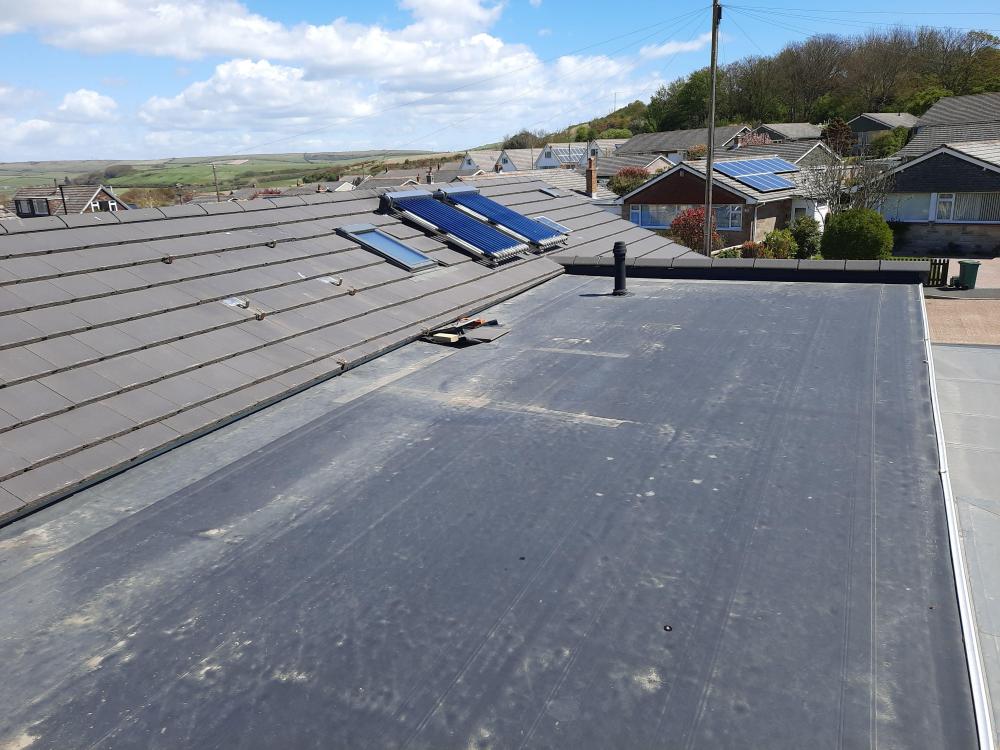
Not sure I can help with your quest but: If you search on Youtube videos for EDPM Roof installations you should see how the black flashings form the side edges to stop the rain water from coming off and the drip edge forms a drop so the rain water can run into the gutter. I can't see how these could be replaced with an aliminium flashing and still do the same job. The only thing I can think of is capping over the edge ones. Personally I wouldn't try the same with the drip edge. Best of luck Marvin
-
I don't know enough but I would suggest you type in this sites search box New Drive Unclassified Road Good luck Marvin
-
I would have said your roof in that area definitely doesn't leak.
-
Having been clearly advised of the stupidity of trying to install a ASHP big enough to "heat the house", in the house, ( did I mention the 800mm diameter ducting it would need?) You will all be glad I have moved on! I have already had some good pointers from Buildhub posters - thank you! - and am now looking at the set-up. Are there any ASHP air to water units that will do cooling? If so anybody have any feedback on how the use of the cooling has gone, for an air to water system? The ASHP would only need to be 1 of the smaller ones. 4kWish. Input. Thanks Marvin


