


Marvin
-
Posts
2389 -
Joined
-
Last visited
-
Days Won
3
Everything posted by Marvin
-
Yes designed so thin that you can't propperly fix to them without risking splitting and or undermining the structural integrity is a non holistic approach.
-
We used to calculate when mixed on site half went in the wall, and half on the floor, not used, or stuck to the mixer, borrowed. Most likely the problem is the difference between theory and what happened to it on the day. It can be as simple as brick frogs up or down or circular holes inside bricks being more or less filled and so on. Sorry I can't be more help. Good luck Marvin
-
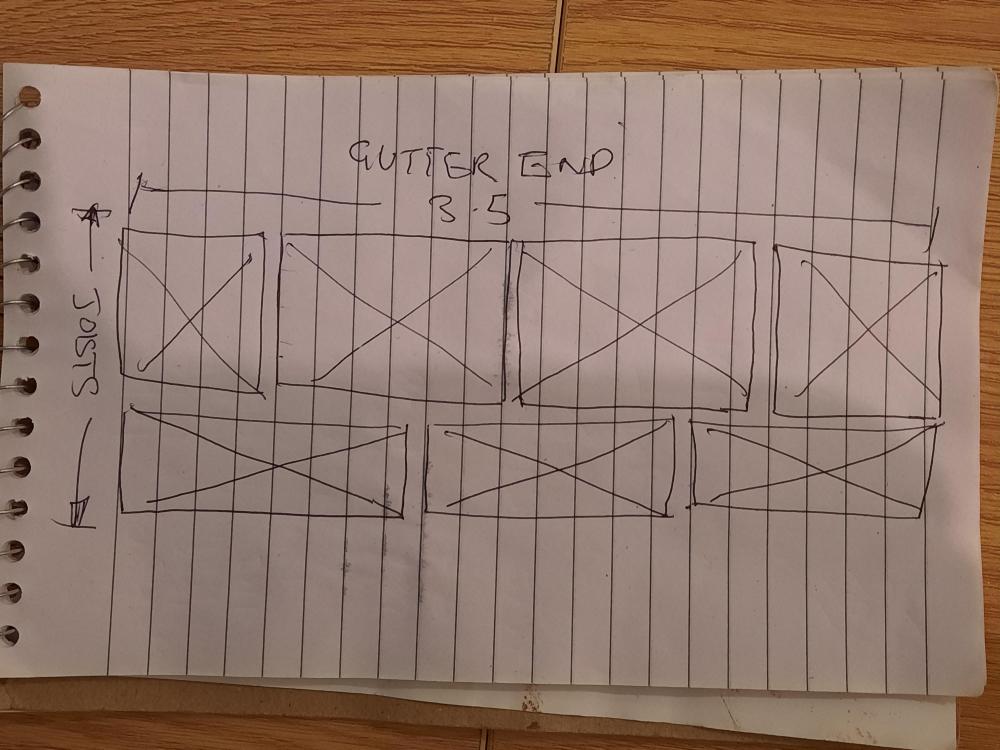
Would this design help to reduce the work? However all edges will need supporting. If I really couldn't make it work I would put 2 layers on and bond them together, but this may cause other problems....
-
I think at this stage it's only about where the duct for the cabling starts at the begining of your land nearest the public highway to where it ends at a box on your building.( This point is referred to as where demarcation happens.) Search for: PAS 2016 for info on ducting requirements in your search engine. So in the future when they want to roll out 10G, sorry, 4G or whatever they can draw a cable along the duct from the pavement to your external wall. Ask the building inspector if they only want a schematic of the duct route to demarcation point at the moment. Probably wanted to give you the heads up that you have to get a duct in. Let me know how you get on. Good luck Marvin.
-
I think the u-value for new build walls is now 0.16. Putting additional insulation is good but only worth it if you are intending to stay put. Of the basic elements: walls, floors, roof, glazing, and airtightness its no use having one excellent if the others are poor. Best value items are usually first draft excluder and pluging up drafty holes espically around where services enter and leave the building including holes through the floor. Secondly a good foot of loft insulation. Then its looking at the rest. Suspended timer floors are well worth insulating. If all these things are already done then an internal coat over the external wall plasterboard and re plasterboard over that or something that someone cleverer has thought of. If you have good air tightness then possibly a mechanical ventilation with heat recovery (MVHR) system or an air source heat pump (ASHP) system might be better money spent. Good luck Marvin
-
The different elements are for different reasons. As AliG pointed out the fibre insulation in not needed to meet good insulation level but more likely sound deadening and yes the fact that no membrane layer is identified is odd. The purpose of the membrane is to stop moisture getting into the plywood sheathing, and using breathable means that moisture can get out. I would check with designer about missing membrane. Surprised there's no vapor barrier on the inside too. I have to coat under my plasterboard with sheet plastic to stop the moisture vapor? Well I'm sure someone will correct me. Good luck Marvin
-
I think the boards, whereever their edges are need to be supported all along.
-
I agree with James about changes. If you don't get the water from the flashing into the gutter even if you seal it it will run down render and stain.
-
Where will the roof rainwater go?
-
What were you going to do with the soil taken out?
-
 I would want to have insulation between the the duct and the concrete, so I would go larger.
 -
Where I live I insulated my approximately 105m2 floor with 2 layers of 100mm PIR board, one in between my floor joists, and one across under my floor joists by using long screws and batten. It was only worth doing that much because the walls and roof have similar insulation. Whilst under the floor has some protection from the cold I save approximately 10kw per hour if I want 23C inside and its 0 degrees outside just from the floor insulation. I have LPG which is supplied in 47kg bottles so I know exactly how much energy I use on hot water and heating, and the last 12 month review meant I used about 6000kW hours for the whole year. Often people talk about what in theory they would use, using this, and that, but I know coz I counted the bottles that woz empty! I have also insulated an existing bungalow floor by lifting up the carpet and making a hole in the floor to slide strips of insulation and batten in. That also had an incredible effect. The rule of thumb for me is if your going to stay in your property (not doing up to sell) then definitely insulate a suspended timber floor if there is enough depth. (and foam any gaps to keep the joists snug). So if I was doing one layer of 100mm at about what £20 per m2? So for the one layer I would by about £1,900 of board for 105m2 floor (don't forget to deduct for the width of the timber joists if its going in between) Batten and screws say £100 so budget 2k. It would take me about 3 weeks to install going under the floor and avoiding cables. For a suspended floor of 100m2 with no insulation ( floorboards and carpet between you and the cold air) when it was a constant 5C outside and a constant 23C inside (this never happens!) I estimate you would be losing about 10.39kW per hour through the floor. For a suspended floor of 100m2 with 100 rigid insulation between joists when it was 5C outside and 23C inside I estimate you would be losing about 0.431kW per hour through the floor. Saving about 240kW a day in these conditions. Well, someone is sure to correct me, but that's what I roughly calculate.
-
Thermally: Celotex is about 0.022 W/mK Wood fibre insulation is about 0.038 W/mk over 60m2 outside temprature -8C, inside temprature about 23C you would use about 35 watts per hour more to keep the inside temperature at 23 using Wood fibre or 0.84 of a kW per day. I think is about the sound.... Acoustically I think these are 2 different types of product with different purposes. I would check the airborne sound properties of each and the impact sound properties of each. I think its unlikely to need much impact sound resistance but if the echo from banging on the neighbours wall crosses the air gap will the rigid insulation absorb it? If it was sound could you double the soundblock? But lots of things to be considered like the dew point calcs.... https://www.greenspec.co.uk/building-design/woodfibre-insulation-intro/ Best of luck Marvin
-
A 2.2kW system on my roof (23 degree slope) where I live would give me about an average 71kW of power in the month of January and a peak of about 324kW in the month of June. Although there is loss of heat through the tank related to the temperature of the water, the insulation and air /room temperature, if we take a simplistic approach and just look at the water usage and temperature of water refilling the tank, we can have a rough idea of how much energy you would use to heat up the replacement water used each day Say the use is 2 good showers a day. Assume each 10 minute long (I do about 4 mins) at about 43 centigrade (hot temp my wife likes not me). Shower flows at the shower head say 10 litres a minute (I love simple maths) That would be 200 litres of 43 degree water used. (at this point there is lots of minute detail about cold water in the tank being heated to 63 (I love simple maths) and then blended down to 43ish degrees therefore using less of the hot stuff but 200 litres at 43 degrees or 136.5 litres at 63 degrees blended with cold needs about the same energy to produce (ish) if its from the same source, so lets stick with it.) Ok the question is how much energy is required to raise 200 litres of (say winter cold) 5 degree C water up to 43C The raise in temperature is 43 - 5 = 38 I believe the Specific heat of water is about 4.19 kJ/kg K (That's every litre of water you want to raise 1 degree C means you use 4.19 killajoules) So the maths is 200 litres raised in temperature by 38 degrees is 7600 units. Times these by the the kJ required for each unit (4.19) gives you 31,844 kJ So we have 31,844 kJ which converts to kilowatt/hours (if I'm right 1kW hour equally 3600 kJ) So divide by 3600 gives you 8.85 kw of energy needed per day or approximately 264kW hours per (winter) month I am hoping that this will be corrected by those who know better and then used by those who want to check their own hot water use. Marvin
-
You may wish to find out how much PV energy (therefore hot water you will get in the winter). I use this to calculate: https://re.jrc.ec.europa.eu/pvg_tools/en/tools.html First choose your exact location on the map. then choose set up (i.e. off grid) tab to the right of the map. Then fill in the figures: panel wattage etc. Then hit the button at the bottom which says visualise results. Depending on your situation you may want to look at a small ASHP. I am not sure. The £ and the reliability need looking at. I always hate wasting the PV power and batteries are expensive... I am working on spliting my mains power and having the MVHR running on PV with battery back up because it only uses about 22watts per hour and the excess power produced in the summer (about 4 times the winter PV generated) to supply my lights, with mains back up. Best of luck Marvin
-
I cannot see that being true, (although I have had almost all my experience with gas) If someone has had that experience I would expect it was the size of the boilers or installation differences that made the difference. If your not having solar hot water then yes I think Conor is right about the combi. If I remember my training, I think you should size the combi to ensure you have enough instant hot water coming out for the shower you want, and this will probably decide the size of the boiler rather than the heating requirement. But I'm sure I will be corrected if I'm wrong. If I had mains gas, electric, or LPG as the only power sources I would always choose mains gas. Make sure that you fill the loft with insulation all over as much as possible to a foot thick: this is the most cost efficient way of improving the property insulation, along with cutting out any unnecessary drafts. I am in a 99m2 bungalow with no mains gas. Good luck Marvin
-
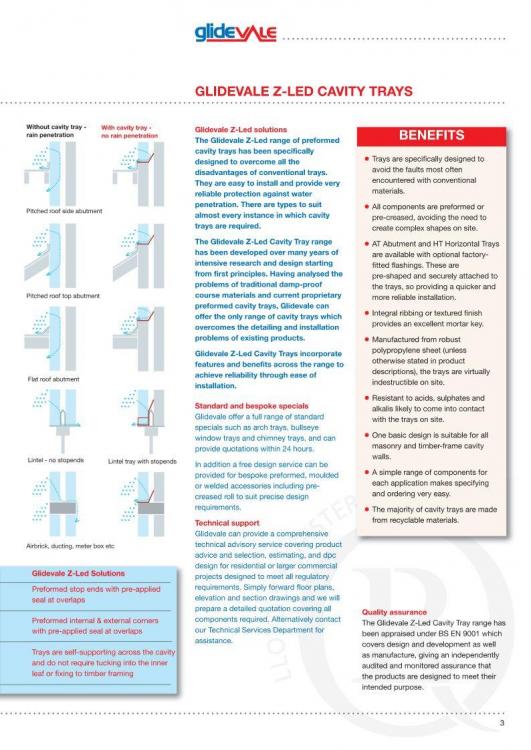
I didn't see if they were high water absorption ("suckie " not in the dictionary how I mean it) soft bricks behind the render or not and I have seen problems in that situation before. But do feel if it was missed, it should be done. Typical info:
-
Oh dear. Sorry about that. At least the wall hasn't been rendered yet. Looks like a few days work and very careful protection of the flat roof!
-
Installing MVHR after renovating
Marvin replied to avajamesbee's topic in Mechanical Ventilation with Heat Recovery (MVHR)
This is our bungalow and the plan shows the layout in my loft so I just cut through the ceiling where necessary. It can be very difficult to run pipes in between upstairs joists because of the services already there. If I had to retro install an MVHR system to a recently sorted house I would run pipes across the loft until they met the corner of an upstairs room and run the pipes down the room corner to the upstairs joists. But I think it could be a hell of a tricky game trying to find a route for the pipes - they are quite large - even as rectangular ones. So to answer your original question I think it would be very disruptive, frustrating when you find routes blocked by pipes and cables, time consuming and I wouldn't even attempt it without an endoscope inspection camera. But boldly go where other people... https://acarchitects.biz/self-build-blog-mvhr-systems/ And finally it depends what causing the build-up of all smells. Consider the following: Double glazed upvc windows don't let the air through and so should have trickle vents in them if there is no MVHR (generally) FENSA requirement All toilets, bathrooms and kitchens should have extractor fans or openable windows. Building Regulations requirement When I had a house without MVHR I used humidity controlled extractor fans with automatic shutters to avoid cold air coming back in even though I had openable windows. I installed them as high as I could (following manufacturers instructions either walls or ceilings) to remove the hottest, wettest and usually smelliest air first. Marvin's Requirement! ? Good luck Marvin -
Difficult one. Politely enquire with builder if one was put in. Check with architects details if one was specified. Check how the works were described. Be sure of your position first. Did the architect overlook specifying it? Did the builder miss it in the specification? However, both should know that a cavity wall tray is always required in this situation. Its usually part of my submission to building control (along with pad stones etc when required). Good luck. Marvin
-
Lead standards: Lead sheet for lead flashing should be no longer than 1.5 metres. If the lead is cut any longer it could lead to splitting of the lead work due to expansion and contraction. When fitting flashings they should overlap by a minimum of 100mm. This is a good general rule of thumb on how to cut lead flashing, but there are conditions where you may consider increasing this overlap, such as prevailing high winds, driving weather, and exceptionally high flashings where the overlap may become vulnerable to water creep.
-
You can buy retro fit cavity trays: https://www.google.com/search?q=retrofit+cavity+trays+installation&oq=retro+fit+cavity+trays&aqs=chrome.2.69i57j0i10l2j0i10i22i30.9944j0j15&sourceid=chrome&ie=UTF-8#kpvalbx=_WuyKYP23FYCFhbIPpYaw0AU15 Beginning to think its a multitude of possible answers but water entering the render running down inside the wall and no cavity tray, will, for my money do it.
-
What has been used to seal between the render and the top of the flashing on the wall? Can you grab a close-up?
-
Anyone got solar control glass ? Pergola or Brise Soleil Instead ?
Marvin replied to Loz's topic in Windows & Glazing
Had often thought of using a Brise Soleil type system for cutting out the peak summer heat on normal glass, letting in the sun when the sun is lower at other times of the year to warm the house, rather than cutting it all out by coating the glazing. -
E7? sorry too thick to know what that is.?. but I was looking for 28 day. I was thinking of using a arduino system?? to control all the systems I have. (not even sure it can be done...)



