
saveasteading
-
Posts
10895 -
Joined
-
Last visited
-
Days Won
93
Everything posted by saveasteading
-

Laser Level/Builders Level...
saveasteading replied to Mulberry View's topic in General Self Build & DIY Discussion
Ignore me, I come from a discipline where we had to measure to much tighter tolerances. After surveying many km we were supposed to be just a few mm out. My view is that if the level is accurate then that is one possible error removed. I acknowledge that on a small house that will usually be ok. BUT starting from a low accuracy at its best, I would worry that it loses more accuracy over time. AND as stated above, it is essential to use equally distanced sightings or it will be 3mm out, to which add other tolerances, and you get the 8mm error our groundworker made last week. Also for long runs such as drainage might be, it can matter. -
Question and then an update. All comments welcomed. The groundworkers have built the block footings with an 8mm error in one area. The joiner was not impressed, and neither am I (laser level used incorrectly). The joiner arrived with the standard plastic packers expecting 1-3mm undulations, but had to make timber packers..... a tetchy start. My plan of putting a mastic seal under all the sole plates was ignored on the basis that it was impossible in an 8mm gap. From enquiry it seems that 'nobody' applies any seal under the sole plate. But I wanted to to keep out draughts and spiders. I guess we can simply apply a bead along the joint where it is small. Question.....What is normal/appropriate where the sole plate is propped 8mm up? Won't it subside and bend, or crush the small packers? But 8mm and diminishing isn't enough to pack with mortar. Suggestions please. Progress. Really impressed with the joiners making cassettes on the ground and lifting to place, so we have 23m x 5m manufactured and erected to eaves in 4 days, including day one being prep and offloading. Glulams will be fixed in place using threaded rod and nuts. Then templates will be made using osb, and then steel copies can be made for bolting in place without holding up the job. Due to the tight acute angles, and aligning opposite holes in plates, I am thinking of changing from through bolt to coach screws. Using standard joist hangers was accepted without demur, so I assume is normal. Some very perceptive advice and suggestions from the joiner. Where these are more along the lines of 'not how it is done' (despite the Architect and Engineer's designs) I am tending to go his way as it smooths progress, even though I know the design is fine. The day when the walls are in place is a real client pleaser.
-
new windows just fitted but with issues...
saveasteading replied to New home's topic in Windows & Glazing
The kind that wants it right. Doing this unseen after hours avoids any conflict, and provides either peace of mind or a good opportunity to sort it sooner rather than later. -
Or if you like a challenge. Place the slab on a bed of sand so that it is fully supported. Gently/firmly chip a cut line with hammer and cold chisel. Repeat, getting deeper. Turn over and chisel the same line. At some stage the stone should break on the line.....but sometimes it won't. It worked for thousands of years before disc cutters.
-
Laser Level/Builders Level...
saveasteading replied to Mulberry View's topic in General Self Build & DIY Discussion
Says you who understand it. I have trained/tried to train several people but they either understand it or they don't. Using a laser for small building works is really just carrying a set level (probably set by someone else) around to mark the same level elsewhere. Easy, and no excuse when it goes wrong. is rather poor. It doesn't normally matter if the machine is placed centrally and used over a short distance. The fundamental principle is whether the machine is describing an exact horizontal circle, or is pointing up or down a bit. If the distances are all the same then the error cancels out. to check a level: Place it centrally between two solid points, and measure the height difference. Then move the machine so that it is close to one of the points and distant from the other. Read the height difference again and it should be the same. If it isn't then the machine is not accurate and needs adjustment if this is provided for. -
Suds for dummies
saveasteading replied to Danny68's topic in Energy Efficient & Sustainable Design Concepts
I should clarify that I think as a contractor as well as designer, so the savings (shared client and ourselves) are significant in designing out the commercial products. If only a designer then it is prudent to be more conservative, as there is a small fee available compared to the risk of going unpaid or being sued if it does not work as hoped. Plus it is an interesting challenge. Plus I really don't think any new development should be allowed to add to flood risk at all. Upstream developments (by the big developers usually) cause flooding and damage downstream, which is entirely unfair. -
How does your garden grow?
saveasteading replied to recoveringbuilder's topic in Landscaping, Decking & Patios
It seems to me that ash works until wetted by either rain or watering. Then it somehow becomes just another slime-compatible surface. -
Yes, but will still leak heat to the side. Gus is correct and this theory requires a very large area. The ground at the perimeter will lose heat more quickly , simply as it is a shorter distance. So if you have a big footprint then you might insulate the perimeter more than the centre. Also you can add vertical insulation to the perimeter down to about 500mm as the ground is not very cold below that. Slab economics in simplistic terms. On flat and strong ground use ground-bearing. On a slope or on poor ground use beam and block. (Or if your selected builder can't do slabs well (and most can't) then B and B is a pragmatic choice.
-
Thanks, but eps is half the price and half as effective, so it doesn't work for us.
-
Laser Level/Builders Level...
saveasteading replied to Mulberry View's topic in General Self Build & DIY Discussion
I strongly recommend learning the principles of levelling. I don't mean you have to use an optical level, but you should know how they work. Laser levels are doing the same thing I used to ban lasers because everyone thought they were infallible and so everyone used them and mistakes were many. I have given up banning them as nobody except me seems to be able to use an optical one. But what do you know, this week we have a block wall that is 8mm different on 2 parallel walls 5m apart, even though the bricky used a laser. Not a good start for a timber frame. -
As Mr Punter says, this needs support. From the steel columns is the obvious, but it may even need more as this looks wide and high. How far between frames and how high will it be?
-
I first thought you meant a drain survey by video, which is a common thing. The most boring video I ever watched, even though it was a very dirty video indeed. Well done though. I don't understand what you did, can you explain further?
-
Suds for dummies
saveasteading replied to Danny68's topic in Energy Efficient & Sustainable Design Concepts
Exactly, and you can design on this principle without having to get technical with rainfall and soakaway rates. It is a bit of an enthusiasm come bugbear of mine. You have land so this is relatively straightforward. Do you want to achieve SUDS because it is a requirement, or because it is s good thing? If the former then you do, or get someone to do, sums for you, then put in crates and hydrobrakes and so on a considerable expense, knowing that nobody will check the construction or flow off site. If the latter then it is often easier and cheaper, but don't tell the planners or bco. I have designed and built a 500m2 roof area plus parking with zero water to sewers where there was a perfectly good drain in the road. The area floods badly yet the planners allow 5litres/second per acre off site, and I wanted to prove that this was unnecessary. This results in much reduced rates as a bonus. The world didn't change but I was pleased with it. You do need land. The hierarchy is published, with green roof at the top, but that costs a lot. Then comes rainwater harvester, which I do recommend. Again capital cost but payback can be about 8 years. But the unscientific and cheap 'secret' is to put all the drains through porous pipes to soakaways, and have one or more lagoons or swales for whatever gets through. As Roger 440 says, the rain falls on the rest of the land as it always did, and so you are only dealing with your roof. Plus any hard paving but that is easy to resolve. If you can spread the rain in several directions to various soakaways and ponds it helps lot. 1. Barrels on each rwp. 2. various perforated drains in different directions. Take them through tree/bush areas where the plants will drink the water (not in winter) and the roots have broken the soil and encourage infiltration. Then don't call them perforated drains but 'infiltration trenches'. 3. soakaways and ponds at the ends. Infiltration trenches if flat will hold large amounts of water and have a very big surface area. 4. willow trees at the ponds. The final ponds will work best if big and shallow as there is a large soakage area, and a large surface area for water to evaporate from heat and wind. The final statement of your proposal is 'zero rainwater leaves the site'. As you are retaining all the water, it doesn't need complex analysis, just local rainfall figures. -
Any way of doing this with pir?
-
And I'm getting quotes in Inverness at £10/m3. There are 3 types of fibre. The cheapest one is hairlike, for crack control, then there is plastic in a solid pin shape which adds strength, then there is steel , like tacks or staples, which is for runways. Sounds like your quote is the middle one.
-
My guess too. Air has to enter from somewhere behind the draining water, and a shallow trap may offer least resistance.
-
£10/m3 add on to the concrete cost, so £1.50/m2 for 150mm slab. And of course reduced labour. To the mesh cost add for laps and waste. Apologies for not noticing your earlier post. I got a letter from Sika which didn't say a lot but was enough for our SE to file as 'risk gone, not our problem'.
-
Really best not to. If you have cleared it a bit and it is running then chemicals will run away. Once you have breached the blockage it should now all go away. There is either another problem (the drain may be damaged or have roots in it), or more rodding, and even flushing should be better. Have you been able to rod from both ends?
-
That is my point. I have come across it several times, and I know many a QS etc who has not noticed/ not wanted to notice.
-
How does your garden grow?
saveasteading replied to recoveringbuilder's topic in Landscaping, Decking & Patios
Big snails can't hide in the soil, so it must be a ninja snail that swings in and out without a trail. It wont be far away. Best solution is the 10.30pm torch inspection. It and others will all be in situ by then. The torch light doesn't phase them. Next is also to give them some bricks etc to hide under in the daytime, and you can evict them at your leisure. Ash, coffee grounds and sheeps' wool are all supposedly deterrents as the slime doesn't work. -
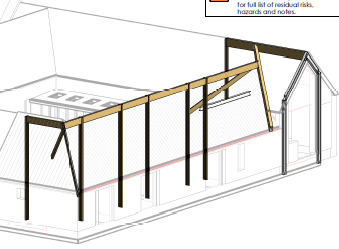
Strongtie have hangers that would work for smaller sections onto a conventionally shaped hip end construction (2 hips coming off the end of a ridge beam). Their detail shows nails being driven in at a slant, so that would be the way with nails or screws. With bolts it should be feasible too, other than right in the corner. Coach bolts won't work. The geometry is pretty horrible, see 3d below. I have had less complex hip shapes to do in steel, (with the steel all designed by very sophisticated computer) and the only solution was to have sliding cleats to fix by eye and cut at height.. Wood is much more accommodating, but I still think these have to made in situ. The hinge idea is interesting...maybe huge ones exist ready-made in some other world (I mean agriculture or sailing or some such.)
-
Why are there no surveyor's in Scotland?
saveasteading replied to SuperJohnG's topic in New House & Structural Warranties
There are multiple routes to being a Chartered Surveyor, (Auctioneer or Land manager may be the at the extremes away from construction knowledge, and then there are estate agents.) ) let alone any technician levels. I would be surprised if they were equally qualified and able in these regards. -
Why are there no surveyor's in Scotland?
saveasteading replied to SuperJohnG's topic in New House & Structural Warranties
Not necessarily the same people. There are so many exclusions on house reports that only very obvious stuff is seen. Then they perhaps say that an SE should also be consulted. I' guessing though, that the insurers have different criteria of experience and qualifications. -
Average 1.25 /hour, and you have 24kVA. 100A x 240V = 24000 VA = 24kVA. Sounds like plenty. Somebody else check please.
-
Only once he had the pattern, which I think is nigh impossible to predict. The trouble I see though is that the angles are horrible. Drawn square above, but in reality all on skews. So I would anticipate tacking the timber up once cut and making a template of tin plate. Then lower the beam, fabricate the joints, and then erect. And this is one at a time. Unless there is a welder standing by on site, with something else to occupy his time, this will add time and cost. BUT, thinks...can they be calculated and premade? A 45deg roof has a 30??deg hip or valley. One valley joins into another hip, so the cuts are both......head hurting. And then there are the site tolerances. Or learn to weld , and do it in-situ while the joiner waits. This is the one place where appearance may matter, as the rest of the ridge beam will be concealed.. There are 3 more, all different, hidden, at the other end. It is very high though so reasonable tidiness will suffice.