
saveasteading
-
Posts
10895 -
Joined
-
Last visited
-
Days Won
93
Everything posted by saveasteading
-
Adding extra insulation to the wall service-void?
saveasteading replied to Dreadnaught's topic in Timber Frame
Our groundworker (come general builder) says that we can't use eps backed plasterboard, even with a service gap, unless the cables are in ducts. I doubt this but will check it out, unless anyone here knows already. -
This is often 'not to hand', 'haven't got a hard copy', or a poor copy. When you do see it, look at what it is for. Roofing insurance costs a lot more than general building. There may be a clause that excludes roofing, or working above a certain height. I had a roofer once, all set to work at 10m above ground, whose insurance certificate said he was a metalworker, limited to work up to 4m (He had taken the cheapest cover available). We had to take out cover for him. Hopefully none of this applies to yours....but if there was an accident then you need to have carried out reasonable enquiry.
-
Why are there no surveyor's in Scotland?
saveasteading replied to SuperJohnG's topic in New House & Structural Warranties
I would think that the inspection is critical to the risk taken by the insurer, and is basically the only cost they have outside the office. The surveyor will have huge insurance premiums to pay to protect themselves in case of a claim, plus their time of course. So I can see why it is expensive. Would I want to be a surveyor for insurers? No. It wouldn't be very satisfying, has a lot of admin, and a lot of risk in spotting and judging other peoples' mistakes. So I can see why there is a shortage. -
My understanding is that the vehicle always shows zero to 100% charge (as for phones/laptops etc.), but that the capacity will become reduced and so the mileage too. Isn't that something that can be measured easily though? So the battery capacity could be stated/ displayed just as the mileage is? I imagine it will become a carrot and stick process. If you charge with off-peak it will be much cheaper, and if you give back to the grid when required you get discounts. Yes it uses the battery, but avoids a new power station or the existing power stations storing off-peak power in ....batteries.
-
ProDave needed to explain this perhaps, but you may not need more power. 15kW output needs something like 4kW electric supply. Most houses are using less power because of LED lights. Do you know what power you have available? On your bill, or see the fuse. Now you are among us you must promise to use capitals for any famous scientist recognised in the terminology. So kW , kVA , kN etc. On a positive, to my surprise solid stone walls have been found to be a better insulator than the calculations allow. In our reg's application we inserted a figure for it from these studies (we have 600mm of granite) and it was accepted (though perhaps not noticed).
-
That may not be pleasant reading, but essential information before that commitment. If someone has suggested 12kW then they have presumably estimated your current or proposed heat loss. There is a heat loss programme in Buildhub somewhere, created and gifted by a clever member. Others can point you to it, as I can't find it for the moment. It will let you play with options and see what is worth doing. FYI we are building 400m2 (conversion but effectively new-build) and will have an aggregate of 16kW ASHP. That may give some comparison to your building's efficiency.
-
(Some) Cheap and unbranded stuff is very skinny and difficult to fix. I suspect some of it is a poor clone and not thought through. If it goes up twisted it not only looks poor but functions badly, as any dip reduces the whole capacity. So Brett Martin/ Marley/ Hunter etc would be my choice. Make sure it is big enough for the job, especially if there is a long run of gutter before the dp.
-
It is inside the vcl so should be pretty neutral conditions. It will get hot in the summer (but not too bad as the tiles and wind will keep it out) and cold in the winter. But will that cause any harm? No worse than any other attic, albeit tiny. Packing with insulation will help the room beneath a bit. 4m3 of the cheapest fibreglass £80? But where are all your PIR offcuts? stack them in, no cost, save on skips and nothing to landfill or incineration. I think this is a gut feeling decision.
-
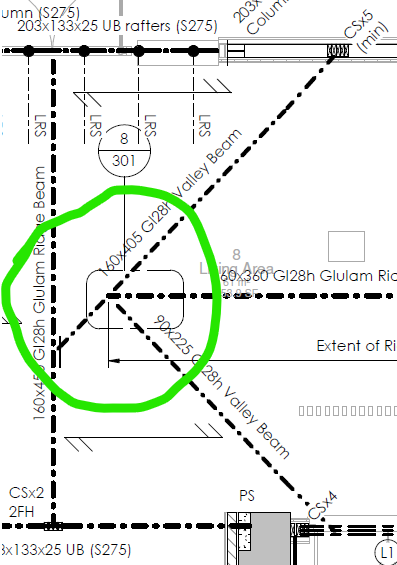
Thanks you clever lot. Decision made. WE will go for the simple joist hanger solution, with a triangle cut out, or just a horizontal chase. to adapt to the horizontal base This will not require explanation to the BCO, whereas the traditional timber idea probably would. The hangers are under £1 each even if branded Strongtie, as compared to £19 with an adjustable bottom. Everything is held by a myriad of nails, resisting in all directions. the base is, I feel, a temporary support until the nails take the strain. The links from Markocosic are interesting, but they don't resolve this next problem... SE has shown glulam to glulam connections using very heavy, and rather lovely, brackets as shown below. Unfortunately they are silly money and only come as right angles. We have hips and valleys converging, which I conveniently ignored on the detail My initial thought was to get nail plates and simply bend them to shape and nail in...but it will need a very small hammer to get into the acute angles. Then to do the same but with the plates as templates, and make up a heavy bracket on the ground....welding one by one to suit. But it doesn't seem right. The existing (remaining) hip/rafter/ridge connections involve two long twist nails only. Any brilliant ideas?
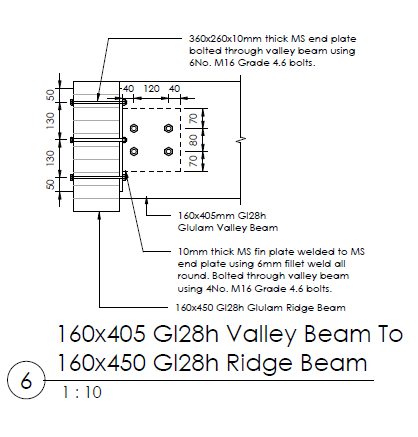
-
We got our as-built EPC
saveasteading replied to Conor's topic in Energy Efficient & Sustainable Design Concepts
There are still advisors out there who think that? The SBEM and Breeam calculations are full of such nonsense, but I thought real people knew better by now. -
How to estimate plasterboard quantity?
saveasteading replied to shuff27's topic in Building Materials
DIY 2% waste. Contractor 5% Labour only contractor 10% -
How does your garden grow?
saveasteading replied to recoveringbuilder's topic in Landscaping, Decking & Patios
No that is fine. Roots and all doesn't matter tho I read that juicy leaves are best. I opened up a gallon container from last year and it looks just like commercial stuff. Brown just like the seaweed stuff, or tomato feed. Doesn't smell horrible though, so has possibly lost a bit of potency. When ready it makes your hands stink despite a couple of washes. Remember to allow extra time before meeting anyone. -
How to estimate plasterboard quantity?
saveasteading replied to shuff27's topic in Building Materials
They (or some) do take it but don't want it mixed in the skip. It is nasty in landfill so they have to separate it. Then most of it goes to Germany to be recycled. All very expensive. Although I fear that rather a lot gets 'disappeared'. Not by people on BH obv. -
How does your garden grow?
saveasteading replied to recoveringbuilder's topic in Landscaping, Decking & Patios
I will take reflected pleasure when your beans are being harvested and mine are still feeble. The problem is in going away for 2 weeks too often, so I blame the highland project which has to be priority. I come back to dried out or waterlogged (or eaten) seedlings. -
How does your garden grow?
saveasteading replied to recoveringbuilder's topic in Landscaping, Decking & Patios
These are just about safe from slugs and snails now. They don't eat the stems once they get woody, and seldom climb above the bottom leaves. -
How does your garden grow?
saveasteading replied to recoveringbuilder's topic in Landscaping, Decking & Patios
Miracle Gro are owned by a huge US corporation that used to dig up our peat bogs until paid a fortune (of taxpayers money of course) to stop. Perhaps they have stopped doing terrible things now. I like to make my own as described. Garden compost is the best thing you can do, and it is immensely satisfying to get several barrowloads of free and better compost every spring. Then the worms do most of the garden work for you. -
How does your garden grow?
saveasteading replied to recoveringbuilder's topic in Landscaping, Decking & Patios
And if you leave the roots in the ground after your harvest, they leave nitrogen nodules in the ground. I have grown the same beans in the same spot for many years, and there has been no loss of quality. Contrary to the usual rotation method requirement. Just some compost heap mixed in before planting. -
This explains everything
saveasteading replied to Pocster's topic in General Self Build & DIY Discussion
I suspect Stanley would be shocked, and give you a new one.. For very, very accurate measurement I was taught not to use the end, so we would start at 1m or whatever, as long as we remembered to add that to the number. Some special tapes have a long pull handle to allow this to be done from a proper zero. There are different categories of accuracy and some are remarkably approximate to be considered to be to a standard. That is understandable for a rough survey through undergrowth where a fibre tape is better and an approximation will suffice. BUT I once bought an own-brand steel tape from TS which was out by over 100mm over 30m. (The worst Class 3 would have allowed 15mm error). Could have been expensive and we had all the foundations, bolts and walls in using it before, fortunately, using another tape. I got the money back but declined to take it back to the shop. Presumably that level of error is known at the factory but deliberately overlooked. -
How does your garden grow?
saveasteading replied to recoveringbuilder's topic in Landscaping, Decking & Patios
You shouldn't need any for a bit. meanwhile make your own miracle mix. Collect fleshy weeds, esp nettles, groundsel, dandelion. You can add coffee grounds, banana skins etc if you want. Put in a bucket with a lid. Cover with water and a weighted lid and wait 2 weeks. with it outdoors! Drain off into a container and chuck the solids in the compost heap. It really stinks, but seems to work very well, is gentle on the plants and the earth. I add about 10% to watering can but perhaps should be more/less/ Then keep making more. It keeps ok for a decent while in a sealed container. -
Regs for self builders - Which parts did you read?
saveasteading replied to giacomo_z's topic in Building Regulations
Of course most people can't do it well. But many can. What is 'design' anyway. a concept or the whole caboodle? -
I think because the priority is to get the inside cold, so they chuck away heat as fast as they can. Then capturing any of that is not efficient. Pouring the heat into an adjacent cold warehouse that should be warm would heat it very quickly, but would soon become less efficient all round. Putting it through a heat exchanger would work of course, but on a very small scale compared to the primary function.
-
-
I gave up asking chill-store contractors about harvesting the waste heat to use for adjacent offices. Still sees feasible to me in my ignorance. Eventually I found one guy who seemed to understand it, and he said you can only get about 10% of the energy out of the expelled hot air, so it was not worth it. The big heat pump companies have systems allow for different zones in an office, so the waste heat is used elsewhere. But I don't know how well it works. I think the various heating and cooling returns are merged before recharging....or is that simplistic?
-
Fixing timber firring pieces to steel joists
saveasteading replied to Modernista's topic in Garages & Workshops
The good ones do. As for many such things, it is worth the extra for a known brand, other than an own-brand. -
I will PM you.
