
saveasteading
-
Posts
10895 -
Joined
-
Last visited
-
Days Won
93
Everything posted by saveasteading
-

Fire proofing stairs.
saveasteading replied to Russell griffiths's topic in General Self Build & DIY Discussion
2 sheets of grey is plenty but, as above, you don't need it. -
No , easy. I have done stacks of new steel portal frame buildings as offices and classrooms, and the same logic will apply to a house. BUT the advantage of a portal frame is clear open space. If you have normal domestic subdivisions then the the walls provide support. For anything of domestic scale a conventional construction is more likely to be best value, but if you want big spaces in any dimension then steel portals come into their own. For the upper floors, my preference is steel z rails as joists, then decking. Against precast concrete is the craning operation without smashing the steel frame and especially any purlins.. I designed such buildings so that half the columns and beams were erected first, then the slabs put in, and then the rest of the columns and rafters, but this was for a very big 2 storey warehouse, and the costs would be prohibitive for a house. I have not read the thread fully, so forgive any errors of understanding. Would I build my own house as a steel portal? Definitely, but it wouldn't look like a barn, but a boxy modern shape, and with big rooms and feature cut-outs. I would avoid all the latest gimmicks, and also the ones that won't go away such as straw.
-
Fixing timber firring pieces to steel joists
saveasteading replied to Modernista's topic in Garages & Workshops
Designed for the job, and will cut and self-tap screw itself in one. A wood screw might work fine but is a compromise. Just be sure to get 'heavy' self tap screws that will go through an rsj, and get a few extra just in case any don't quite get through. Hex head for maximum torque and certainty, or torx head if it has to countersink into the wood. I look at these screws and all the complexity and wonder how we can buy them for 10p each. -
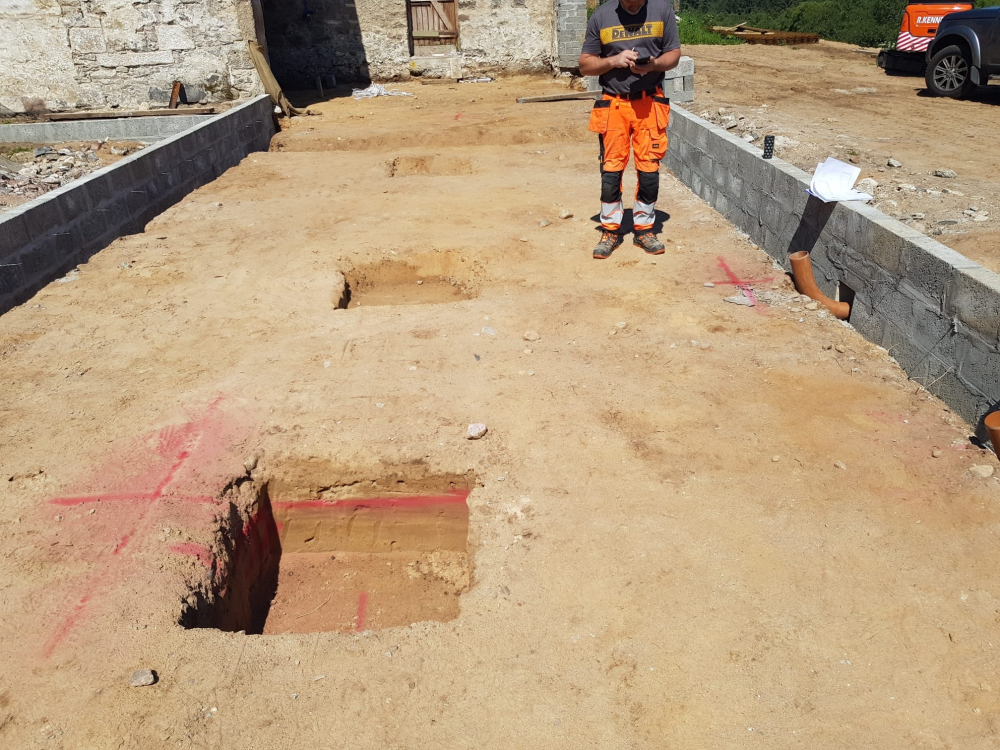
Working at ours today. Our ground is remarkable, and something I had never come across before. About 12m thick pure, single sized, sand, plus some bands of cobbles, as laid down by glaciers. It is strong and dense as can be see by this picture of the ground, with deepenings for columns, hand dug with vertical faces. 300kN/m2 by our tests. Ask for details if interested.
-
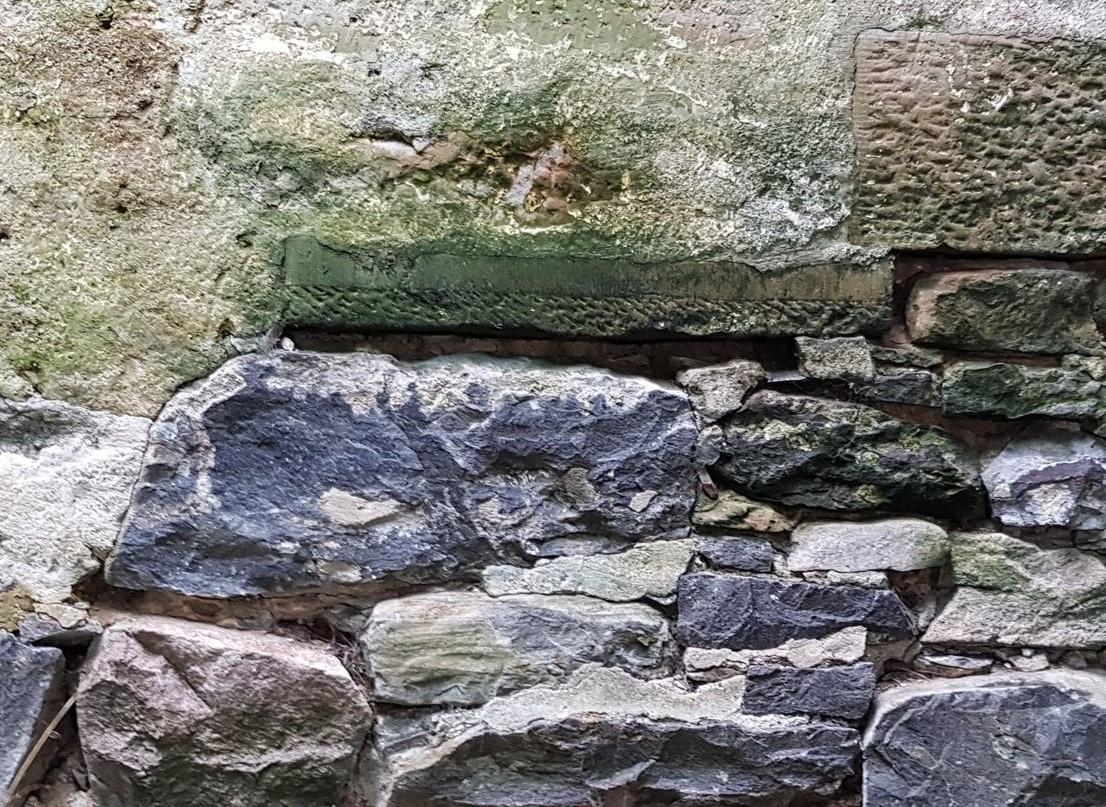
Yes. Left one probably Victorian. The newer wall even has printing on it but prob not a date. 70s? Houses from Victorian times were very much to a pattern, so someone who knows this can see if any walls are missing.
-
Fire proofing stairs.
saveasteading replied to Russell griffiths's topic in General Self Build & DIY Discussion
Nod is right BUT. I have had a very extensive argument with BCO on this. He was adamant that the regs said that the stairs must be non-combustible. The fact that we had completely boarded with 2 layers of plasterboard was of no interest to him. 'Wood is combustible.' Eventually we prevailed. I think you still have to board to protect the timber in a 'cupboard under the stairs'. The risk being that a fire might start in a vacuum cleaner/plug etc, and go undetected until it burst through. Sounds sensible to me. -
Given that trench block is intentionally lightweight, 7N does seem excessive. But it depends on the construction and where the loads are coming from. Hence ask the SE why, and there is likely to be a good reason. Anyway your situation is sorted. However I prefer 7N blocks because the quality is usually much better, the finish is better, and they are denser and more durable,
-
Our SE told us that fibres were not considered as too expensive. I think he may have been thinking of steel fibres as used for airport runways and for military tank strength. The plastic fibres are made by SIKA who were very helpful in persuading the SE that this was not something new. Local concrete suppliers both quoted an additional £9/m3 for fibres, so you can work out how much cheaper this is. The only trouble is that it is sticky to handle (no slump). I first used fibres about 35 years ago. There are issues, but as a sub-layer I have no problem in specifying it. We will use 150m2, so it saves us a lot. Steel mesh provides a little comfort if the ground is iffy. But with rock underneath nothing is about to move.
-
How does your garden grow?
saveasteading replied to recoveringbuilder's topic in Landscaping, Decking & Patios
Home after 2 weeks away to find that the beans are badly eaten, with one of them just a stem. Meanwhile a bean (seed) I placed in the ground has grown 25mm and may overtake the pot-nurtured ones. Back to midnight torchlit slug sessions from tonight. The courgettes have barely progressed either, but perhaps are concentrating on roots. -
And you don't know what a previous owner has done. Remove an old load-bearing wal and add another nearby with whatever timber is handy for example. The SE should be able to 'read' the building.
-
We have been getting sensible delivery costs for 25 miles out of inverness, from HIS, Travis, MKM. And better (£15) from the nearest merchant who won''t cover you though. The mesh itself is very expensive. £32 and £82 / sheet of 3.6 x 2m For half our floor slab we are going to use fibre-mesh (plastic fibres in the mix) this will cost £1/m2 and free delivery with the concrete, so is a huge saving. It depends on many other factors, but we only need crack control. Why only half? too late to convince the SE, who I don't think even knew of the existence of the product.
-
Headline this week: 'Invergordon man retains world's strongest man title'. You were quiet for a couple of days, so your secret is out.
-
Good advice. to which I add or confirm: Clear tank is a bad idea, and black should not be expensive, making sure to get potable quality. This is very heavy. just supporting on blocks is not enough as it needs lateral stability, either by more blocks at 90 deg, or triangulating whatever other material you use. We are currently detailing our off-grid water supply. Have decided on 3m3, as plenty for a large house. There are use calculators on the water companies' websites. In emergency of course it will run out, but that applies to everybody, and modern houses don't have any cold water storage. Have you worked out how to connect the 2 tanks one above the other, so that they work together and are secure? Better to have a commercial tank of the right size.
-
32mm Waste Pipe in Metal Frame wall
saveasteading replied to MortarThePoint's topic in Waste & Sewerage
So totally different chemically. stays flexible long-term? Is the expansion controllable? -
32mm Waste Pipe in Metal Frame wall
saveasteading replied to MortarThePoint's topic in Waste & Sewerage
Not me, It is in the back of every bodger's van. What is so good about this Illbruck, as I might look into it. -
32mm Waste Pipe in Metal Frame wall
saveasteading replied to MortarThePoint's topic in Waste & Sewerage
Maybe it was you that cost me all that money! -
Demolition main contractor's responsibility?
saveasteading replied to Mr Blobby's topic in Demolition
All those bigger bits should be filtered out automatically. I once ordered 20t of crushed concrete from a well known local supplier. It came off the lorry looking moderately robust but handled like the mud it was supposed to be covering. Mud with a lot of wood in it. So I took a sample and swirled it in a jar of water and showed up the fines and topsoil, and a lot floating as it should not. I complained by email and they cancelled the bill without any argument or excuse or apology at all, but we still had 20t of **** in the way. And another time I wandered onto a crusher site, and saw the 2 piles...one of hardcore for crushing and the other of muck, basically topsoil. Owner of the company observing it all. Blatant selling of junk, and presumably getting away with it. Not all suppliers are like this of course. Some will even certificate it. Best surprises? Toilet seat (whole), squash ball, thousands of tiny springs. -
Demolition main contractor's responsibility?
saveasteading replied to Mr Blobby's topic in Demolition
Yes but with some added filth from an adjacent pile. -
32mm Waste Pipe in Metal Frame wall
saveasteading replied to MortarThePoint's topic in Waste & Sewerage
I hate it. It gets used to overcome all sorts of issues that have better solutions. It has cost me thousands, when it leaks over metal cladding, doesn't come off again and needs a whole wall replacing. Mt nobody did it but my cleient didnt care who did it. It fills voids with potential damage through damp. It probably shrinks over time. It drips and sticks. So even for my own job with my own control, I would find another way. Probably stuffing the gap with surplus foam packaging, which will be a more reliable and flexible solution. And can be removed if necessary. -
As Russell, but this must be official. As MarkC, there are proper transition pieces in plastic. There will be turbulence but should be ok. How long is the duct? Flexi ducting will cause more flow resistance than the change in section, so use smooth pipe instead of bendy ducting and it will all work better.
-
Demolition main contractor's responsibility?
saveasteading replied to Mr Blobby's topic in Demolition
As a main contractor I did not want novated or nominated subcontractors. That is those chosen by the qs but to be controlled by the main contractor. Why? They would not be my choice, they would more likely be loyal to the qs than me, and I have no idea how competent they will be. And what if they cause problems or delay. And then I would add at least 20% to their cost for the management and risk, which you pay. So your contractors will all add time and money for this. Why does your qs suggest it? Takes responsibility off them. Perhaps uncomfortable managing it. Not their money. Any problems and the contractor has to deal with it. Demo companies are not always the most careful. Make sure you have insurance. This is easily the best argument for main contractor control. -
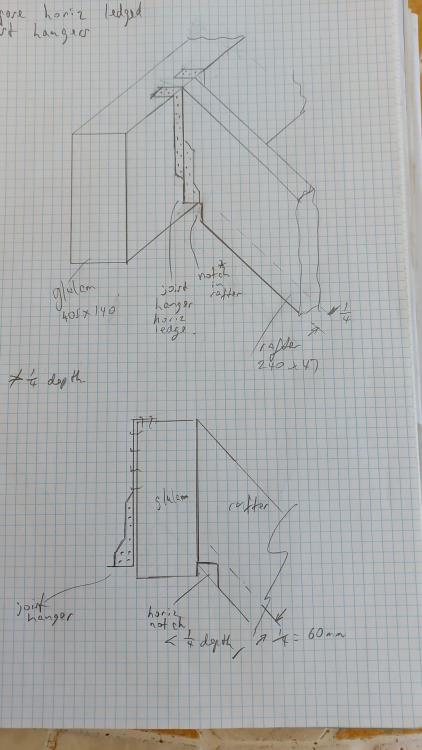
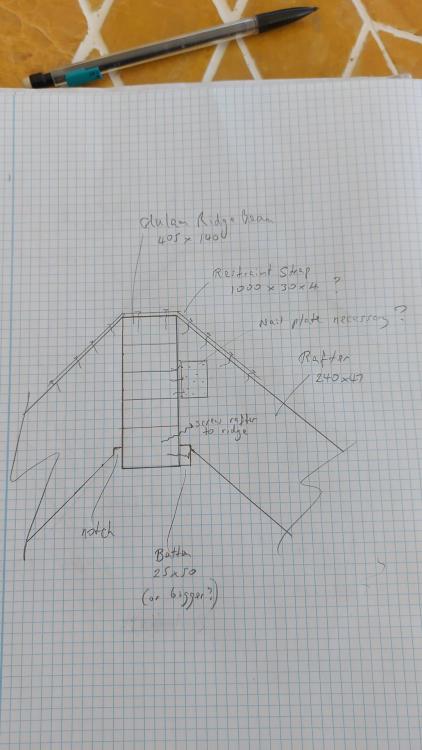
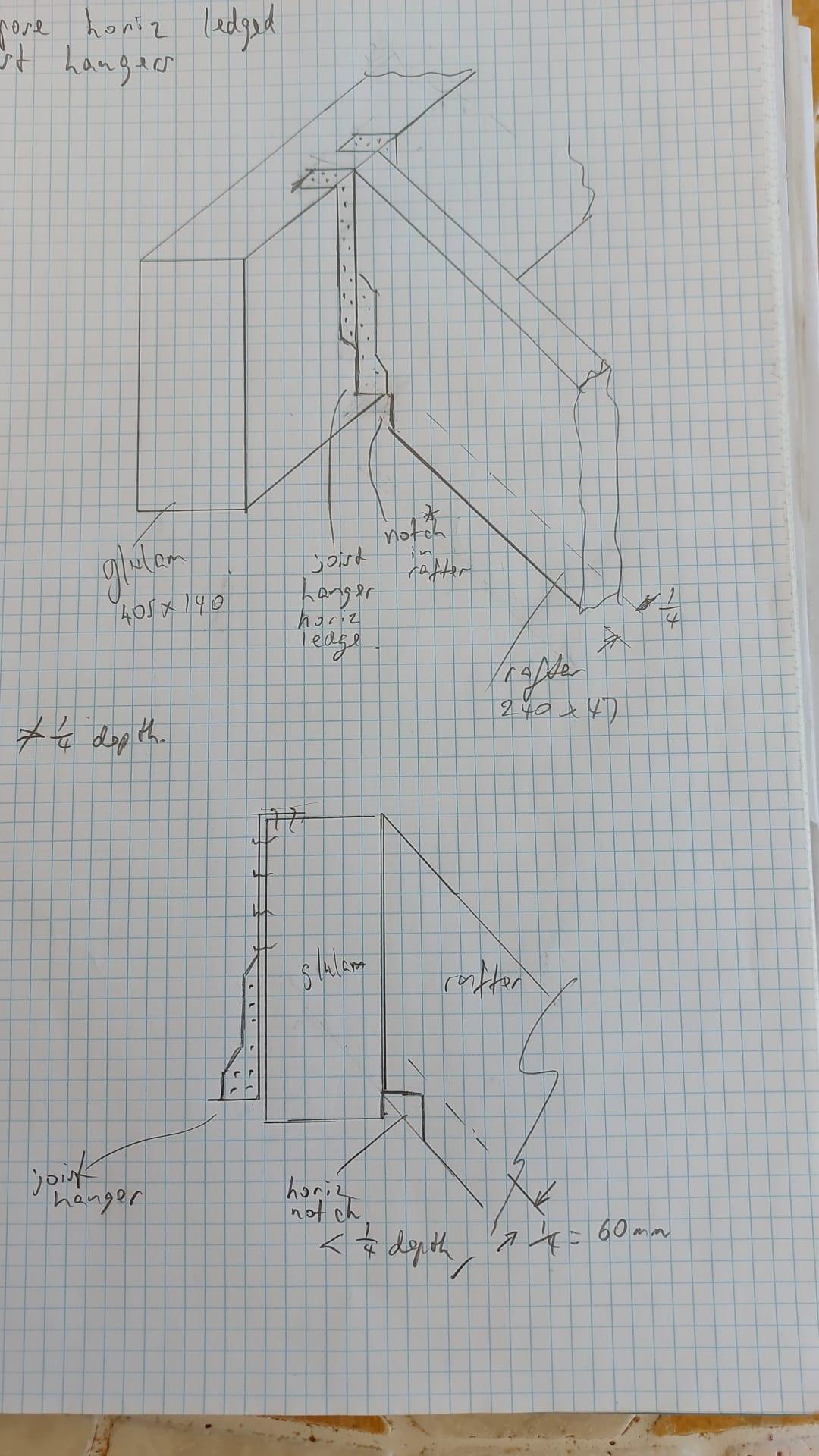
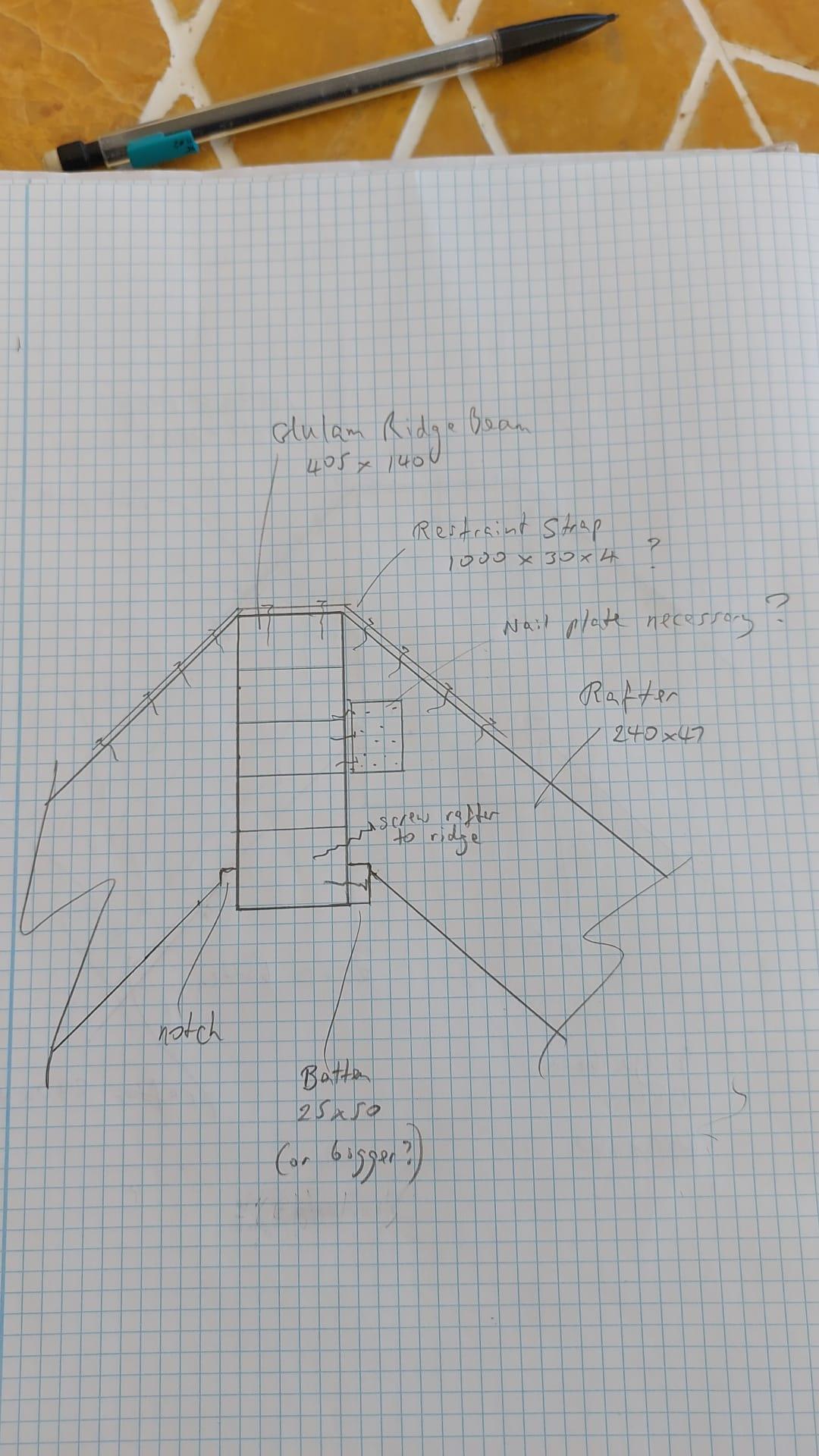
Thanks. You think the angle plate is unnecessary then? Angled through the side of the rafter and into the ridge? I was thinking of that as a temporary fixing, not the finished article. So downwards load is onto the batten, upwards load resistance is only rafter weight plus from the screws....doesn't seem enough, but 8mmand a screw each side, yes that is a lot of shear.. and the timber at the screws is the likeliest failure point., so position half way or above. Held tight against splaying by the band and the screws. How clever. Won't help the strength but is a cut less. I will change the sketch to notch to sit in the hanger or cut to slide onto hanger base.. So use a roll of banding? 20 gauge (= 0.91mm). and lots of nails. Costs will be similar for either method I think, around £4 per rafter for materials as opposed to the sloping strongtie at £17. Labour very slightly more? We will have to put this past the SE who did the warrant, so will ask the joiner if he has thoughts then plump for one. Assuming the SE isn't familiar with traditional construction, the joist hanger is prob easier to 'sell'. But then again...local joiner says this is how to do it.....and a bloke I don't know off the internet.
-
How does your garden grow?
saveasteading replied to recoveringbuilder's topic in Landscaping, Decking & Patios
They aren't great at debates. -
My bad question. I meant that glass/rock wool is fibres that are glued together where they touch. If it gets wet it stinks and falls apart. so maybe that would also fail in heat. If it is compressed enough that wont matter. I have rockwool stuffed hard around an uninsulated pipe, perhaps 50 thick, then plasterboard and it only gets slightly warm so you should be fine, but keep an eye on the surrounding area for any sign of colour change.
-
So Russell, is this second sketch in line with your suggestion? It is certainly very neat with the tiny cut-out. Joiner friendly, and avoids the expensive Simpson brackets. I wonder if 25mm as a ledge is secure enough during construction. so perhaps a 2 x 1? Also I guessed where the screw that holds it in place goes. with a wider batten it could go up from the bottom. And cold feet: I have also added an angle bracket...perhaps unnecessarily. The first sketch is my original idea of using a standard joist bracket, with a notch which is less than 1/4 as instructed by Gus. Sorry about the hybrid 3d, the sloping rafter makes it tricky.