markocosic
-
Posts
979 -
Joined
-
Last visited
-
Days Won
1
Everything posted by markocosic
-
Hack a regular two button bog for micro and standard flush? Half press the button on a regular bog for a second?
-
What is the frame construction? If you only have a membrane between insulation and service cavity, and you only fit sockets in the centre of a 600 stud bay, you can go deeper and flex the membrane slightly (say 10mm) IMO yes back boxes before plastering. Use blanks to stop em getting filled with plaster. e.g. https://www.ebay.co.uk/itm/145306620788 Oversize cuts in OSB work for the "wings" of a back box. Some spray foam as glue between the layers increases strength. You'll still need reinforcing for material loads. Do try to plan ahead.
-
Check valve present. Still technically possible to reverse rotate a single phase pump even with this if you catch it at the right moment. Impossible to reverse rotate three phase pumps though; easier on wiring/currents/harmonic noise/capacitors in the inverter, no need for starting cap etc. Why wouldn't you? Forced cooling doesn't appear to be neccessary on that inverter in a northern climate for what it's worth. Accidentally tripped on overheat - once - when testing with it laid horizontally on the floor and filling the sewage treatment tank. Else fine doesn't get warm enough to need fans that can make noise and fill with dust.
-
Yes. If I had our time again I'd use a three phase pump to reduce any potential for reverse rotation; but the wide head ashtray bought a single phase pump before this and intended to use it equity a basic pressure switch.
-
We run one of these: https://www.electroil.it/en/p-23-inverter-archimede-immp11w.html Approx €350 on fleabay With a VS2/14 GRĘŽINIO SIURBLYS FRANKLIN VS 2_14 0.75kW 230V.pdf borehole pump ~ 40 metres down and providing 3 bar head at ground level for domestic use. Deffo doesn't run at 100% most of the time. It doesn't however provide a residual 3 bar head if you're using a 32 mm pipe to fill a bucket. The pressure drop of the pipework between the pressure sensor and the bucket isn't enough. It will then run at 100%. (and most of the water will bounce off the bottom of the bucket and hit you in the face) Note that a "2 bar" pump might only deliver 2 bar at zero flow; or full flow at zero bar; and half flow at half the rated pressure would be expected. All about the pump curve but marketers can be misleading...
-
I have created myself a water hammer issue. Borehole pump and de-ironing filter means that there is a LOT of air. Big air bubble in the filter. Lots of air in the water. No way to avoid this. Working pressure in the range 2-3 bar after the filters. Manifold setup. 16 mm Pert-Al-Pert. Longest run of the order 15 metres. 16 mm pipework runs through 24 mm holes in joists with 6 mm insulation "sleeves" fitted in an effort to reduce pipe<>joist noise. Joists on 600 centres This was dumb. There's lovely water hammer on the potable cold if you snap the kitchen tap shut. I can add a hammer arrestor at the kitchen tap; but how should I otherwise restrain these to reduce water hammer? Add a noggin and clip between every pair of joists? Every other?
-
If it can't be explained using crayons then it being beyond most domestic trades isn't an unreasonable working assumption! My wife would say that's very nice now start again and build as per the drawing. Then offer to compromise on the understanding that they now owe you and are not to repeat this independent thinking malarkey again. 🤣
-
Weetabix waiting to happen in that case.
-
Still needs an airtight layer. That internal insulation layer is just to sell you more kingspan.ftom insulation perspective is better outside but practically they can't do that without turning the house into Weetabix due to non breathable nature of the insulation so are forced to put it inside and tape the living daylights out of it
-
He's never built or measured jack shite if he's recommending attempting to fill a cavity with rigid foam boards. I wouldn't trust a word he says elsewhere either. Building masonry? Have space on the plot? 300 mm cavity full fill with mineral wool and be done with. Straightforward to build. Idiot proof on site. GSHp is a waste of time. Insulate. Add large ducts. Ultra quiet MVHR with the option to cool. Underfloor heat and hot water wylinder charged by air source heat pump.
-
AIRTIGHT layer can be anywhere in the buildup VAPOUR RETARDER should be on the warm side (e.g. the floor) https://buildingscience.com/documents/insights/bsi-001-the-perfect-wall What is your plan for the build? Treat the garage as you would the outside world. Seconded on going to town on insulation.
-
Mitsubishi vs Samsung Heat pump
markocosic replied to Slippin Jimmy's topic in Air Source Heat Pumps (ASHP)
No - it's mainly down to installation quality and controls Samsung are piled high and sold cheap; often purchased by less clues up or indeed less caring installers; often installed with badly configured headers/mixing buffers and configured with high operating temperatures and inappropriate (on off) controls. Vaillants ship with better controls (for radiators anyhow) and are usually selected not be "sort by price choose cheapest" but "sort by features choose what's needed" type crowd; and installed with more attention to detail. Their hot water performance is also better than that of older units; and their controls manage cycling at low loads well on direct connected/open systems. I'd still pick a Vaillant over a Samsung for a UK radiator heating application; but not because R290 results in higher performance. (other reasons include them being common as heck and having been out since 2020; so well snagged by now and well understood/easy to get bits for) Samsung might be more interesting in a genuinely cold climate and with underfloor heating. That's where some of the party trucks are worth something on performance. -
Should we put a sink in the island or against the wall?
markocosic replied to CalvinHobbes's topic in General Plumbing
So what? Sockets are currently allowed a large enough bathroom. They're just as likely to be sopping wet and with bare feet as in a small bathroom. The IET thinking that they don't come with leads more than three metres long / won't be used with extensions and that you won't sit on the edge of a the bathtub whilst using them is...cute. Washing machines are effectively allowed in bathrooms if 0.6 metres away from the bath and you feed the from a fused outlet by the way. Even under the IET guidance. Has been the case for a long time. https://electrical.theiet.org/media/1450/section-701.pdf 30 mA RCD; don't dunk things in the bathtub; try not to die of diabetes? Pendant lamps. Ring mains. Plenty of dubious in the regs. -
Should we put a sink in the island or against the wall?
markocosic replied to CalvinHobbes's topic in General Plumbing
They're not law. UK regulations. There the regulations of the IET. Equivalent legal standing to say the MCS 'regulations' in heat pumps. Laws which only say "must be safe" but leave it up to you to demonstrate how you made it safe. Such as, but not limited to, following established custom and practice in the IET guidance. Not a valid comparison. Building regulations are a valid comparison. "Must not burn down" being a regulation, which can be met by "made from concrete" for example, but the regulations don't force you to use concrete. As you're seen there's also fudge all chance of consequence even if you did decide to clad a high rise building in flammable materials and kill dozens of people. The burden of proof is on the prosecution to prove inadequacy not the other way around. You'd be hard pushed to do this if following overseas rules proven to work. Or stating that if it can go in there kitchen it can bloody well go in the bathroom about with that metal light fitting etc. -
Should we put a sink in the island or against the wall?
markocosic replied to CalvinHobbes's topic in General Plumbing
The guidance is the guidance. Standard is the standard. They're not regulations of any sort. You'd be just as backside covered with demonstrably equivalent (persons killed per capita per year by leccy?) guidance from an equivalent country. Agree that if being paid you advise following UK regs for ease and for peace of mind but having to justify their validity. I already think it's fine to have euro regs. Then again I also have a wooden bathroom floor so dry get and am as often barefoot in the rest of the house as the bathroom. If it ain't safe to touch whilst naked in a phone booth it probably ain't safe no matter which room it's in. Dead PEN and imported earth exceeding the ground is that scenario IMO. Not washing machine in the bathroom. -
Should we put a sink in the island or against the wall?
markocosic replied to CalvinHobbes's topic in General Plumbing
1) Something to cause a prosecution 2) Proof beyond reasonable doubt 3) Evidence that the protections as afforded elsewhere are sufficient Lost neutral is the concern. It's not materially more of a concern in a bathroom vs a utility room or kitchen. The IET are cautious and also presumptive. Bare feet and wet bodies are the argument. It's fairly damn presumptuous of the IET that folks don't have bare feet or wet hands in utility rooms or kitchens. The houses and machines that the regs were originally written for are also materially riskier than houses of today. Don't tell them about dishwashers and metal sinks also being wet. Or fridges being earthed and not on RCDs. Or ovens. Hobs. Blah blah. The regs are too inconsistent and light in their justification to support a prosecution. Which would require something to happen. Which it won't. Save for a lost neutral. Which is going to screw you no matter where the washing machine is in a PME house? What am I missing; safety wise rather than tradition and custom wise? -
Should we put a sink in the island or against the wall?
markocosic replied to CalvinHobbes's topic in General Plumbing
"followed demonstrably adequate continental custom and practice - here are the death and injury stats for washing machines in tiny bathrooms on RCDs" Earth bonding would need to be spot on though. -
Should we put a sink in the island or against the wall?
markocosic replied to CalvinHobbes's topic in General Plumbing
IEEE guidance isn't law... -
ASHP efficiency report 600%
markocosic replied to saveasteading's topic in Energy Efficient & Sustainable Design Concepts
Absolutely possible given that you're heading to a very low temperature. Enjoy an installation that will perform well. Bloody heat pumps never work blah blah etc. 🙂 -
If just needs to drain the monoblock in order to prevent the monobloc from freezing. The ground is unlikely to freeze and would probably be reasonably resilient if it did (push water back into the house and expansion vessel rather than splitting pipe)
-
I think physical phone lines are done for as far as voice is concerned. Voice comms are SIM cards and mobiles now. Physical lines are dumb data pipes. No physical phone lines in this build anyhow. A SIM based widget with it's own battery that does temperature stuffs; and a router heartbeat for a SIM based router for other stuffs, is probably sufficient to avoid glycol. Only needs to give notice within a few days. 🙂
-
Pah. Use underfloor heating. Mount the monobloc high enough to be clear of the snow. Ensure that the pipework rises from your floor to the monobloc. It will then thermosyphon (cold water falls into the house; warmer water rises into the monobloc) even if the power happens to be off. 🙂 Even if it goes tits up... There shouldn't be much hard pipework outdoors; flexis ought to survive The critical plate separating out the refrigerant will likely survive half a dozen oopsies too; especially if the rest of the monobloc is made of cheese Or better yet use an air to water split system...or an air to air split for the ultimate in walk away peace of mind. I've been debating whether or not to use glycol in the case of a power cut in our cabin (e.g. RCBO trip when -20C out) where the entire building drops below 0C. I'm hoping that the most vulnerable pipework (that in the walls) will also thermosyphon the cold water down into the radiators and can be maintained at temperature e.g. by running the woodstove if the poop hits the fan. The potable water freezing and screwing the pipework / unvented cylinder / water filters would be a pain even if the heating didn't freeze. Question is how you'd know if you weren't there and the power were off. With a mixed work / personal hat on I'm looking at these: https://teltonika-gps.com/products/trackers/fmc125 https://teltonika-gps.com/products/trackers/fmm125 - SIM card - 12-24V DC supply - Built in backup battery and charging circuitry (so you'd know if the house were powered down provided that the mobile cell site still had power form it's backup battery) - Can measure temperature/humidity via bluetooth or temperature via onewire - Can flip a relay - Can also do RS485 (if one wanted to read a heat / elec meter or indeed heat pump where those use RS485) https://teltonika-gps.com/products/accessories/sensors-beacons/eye-sensor-standard https://teltonika-gps.com/products/accessories/other/temperature-sensor I think there's a product offering in the works here for monitoring houses and heating. Waffling. In a UK climate in a house that's regularly occupied I probably wouldn't even both with an antifreeze valve. Just let it thermosyphon in the event of a power cut, and rely on the house being warm enough to avoid it freezing up. In all other scenarios the circulator pump is running or the internal trace heating is active. If it ever gets cold enough to freeze!
-
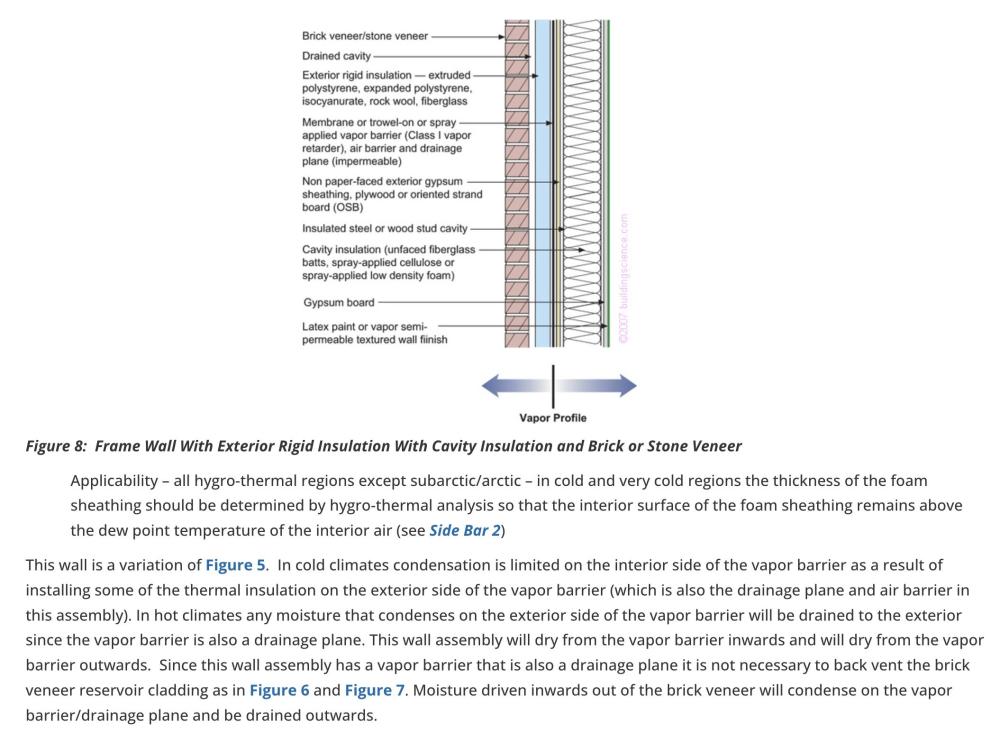
Air barrier - stops bulk movement of air through a structure (important) Vapour retarder/barrier - slows/stops movement of moisture through a structure (less important) Science: https://buildingscience.com/documents/digests/bsd-106-understanding-vapor-barriers SIPs on their own are problematic because: - You have a symmetrical wall/roof (vapour retarders in the form of OSB on BOTH sides) - That vapour retarder is made of weetabix (can't do moisture) - You have leaks in the wall/roof (making joints airtight is difficult/impossible) They don't fail so much at ground level (where cold air is sucked through the wall, heated as it goes through the insulation layer, and dries out in the process) They do fail at the ridgeline (where warm moist air exits and dumps the excess moisture into the SIP assembly) They really fail if the cladding/roof covering isn't well ventilated (and that excess moisture stays in the outer layer of weetabix) I would suggest this variation: stick an airtight vapour barrier (can be polythene) on the OUTSIDE of a skinny SIP then go over the top of that with insulation. The air/vapour barrier on the OUTSIDE is easier to apply well (less likely to be compromise than one inside the house with service penetrations etc) and keeps the SIP dry until it's insulated, roofed, and cladded.
-
Getting frustrated with heating suppliers.
markocosic replied to MikeSharp01's topic in Other Heating Systems
I gave up on that router @sharpener - those schemes are only of interest (or rather you are only of interest to them) if you are intending to do multiple installations / become a regular installer. Currently back in Lithuania finishing the cabin build. Loose plans to work with a decent UK installer (with their own MCS certs) interested in demonstrating compact installations on something of a quid pro quo basis but it'll still be reassuringly expensive to do. R290 and doors and the need to follow manufacturer guidance under MCS to get BUS are a problem. Meanwhile I'll take some pleasure in holding MCS feet to the fire via the ASA for some of the demonstrably false claims they're making about how amazing they are. Partly for karma. Partly to erode their stranglehold on the industry. -
Insulating the pipe AND keeping the air out prevents moisture from the air getting to the cold pipe and turning to liquid water. We have insulation on the PLASTIC pipes and the composite water filters to avoid condensation in summer. 5 degC borehole water and sticky 30 degC summer air makes for rain otherwise!