markocosic
-
Posts
979 -
Joined
-
Last visited
-
Days Won
1
Everything posted by markocosic
-
Wall mounted basic ASHP for workshop
markocosic replied to Mudmouse's topic in Air Source Heat Pumps (ASHP)
Interesting! I wonder what prompted that change. -
Wall mounted basic ASHP for workshop
markocosic replied to Mudmouse's topic in Air Source Heat Pumps (ASHP)
Saturn Air Sales. The warranty is only provided after you've provided the fgas registration number. The unit ships ahead of that though. -
Help! I need to Replace my GSHP
markocosic replied to Nially's topic in Air Source Heat Pumps (ASHP)
Having fitted a gshp partly because I previously thought it a good idea and partly because I wanted to...I would agree. Quality air to water setups are achieving COP 4.5+ in a UK Climate. It's a no brainer. Cheap option: take the heat pump gubbins out of your all-in-one then recycle the brine loop pipe entry to the property to connect to an air to water monobloc (6kW - assume you can't go to big on hot water production unless you KNOW that the chilli in the cylinder is good) Plenty of space inside the all in one to house the three port diverter and the air to water controls. Better option: swap all in one for a plain cylinder of respectable coil size and volume; fit air to water unit. It wants to go by the back door. Learn to love it. -
Loctite 55 leak? After roughing up threads etc? It's effectively hemp and paste, no? Or the pipe seal compound leaking?
-
Try the string and you'll be a convert away from PTFE I promise! Liquid seal is good if - if - you have the time to wait for it to cure and you don't then disturb the joint. The waxed string on the other hand can be busted/moved a little bit after fitting (e.g. to realign a fitting) and will still hold pressure.
-
Generic stuff available at Screwfix https://www.screwfix.com/p/flomasta-pipe-sealing-cord-80m/2272v
-
32mm mdpe to 1" BSP 1" full bore ball valve with female threads as the isolator Then cooper with a male 1" thread on the beginning Don't forget inserts on the MDPE
-
More foundation fun - straw bale garden room on clay
markocosic replied to Nick Thomas's topic in Foundations
I once made the mistake of using "all weather" resin fix here. Indoors. "Rated down to -25C" it said on the package What I didn't clock was this meant it had all sorts of accelerants in the 2-part resin to get it to cure within 24 hrs at -25C. Using it indoors at +25C...fudge me did I have to fit the floating shelf into some brickwork QUICKLY and shortly thereafter the plastic spiral mixing nozzle as good as caught fire. 😂 -
Sketch a schematic of WTF is actually fitted. There must sure;y be some buffer or secondary circulation pump etc for this kind of thing to be going on.
-
Draining external taps prior to the BIG FREEZE
markocosic replied to Adsibob's topic in General Plumbing
Open the inside tap. Open the outside tap to "lift" the washer on it using water pressure. Now close the inside tap and, with the outside tap still open, blow out the water. The rubber washer is probably stuck in th closed position and you're not able to lift it with breathing. "Crack" it with the water pressure first then it'll be lifted and you can blow through fine. 🙂 -
Put the heater in the bathroom and heat the house from there? Else Lidl electric towel rail with built in thermostat and timer for peanuts at the moment.
-
Different vendors have different requirements based on how hot their twinwall gets in the event of a flue fire.
-
(i.e. buy a flue that doesn't require ventilated fire stops)
-
See page 16: https://www.sauresta.com/static/files/3/54/354/Dumtraukiu_instrukcija_EN_Rasu_2018-10-26_No7.pdf Surround with rockwool firerock + minimum spacing to combustibles. Then use a silicone seal membrane (stretchy) to seal against the flue / join to your airtightness layer: https://dumtakis.lt/sandarinimo-detales/356-dumtraukio-prasiskverbimo-manzetas.html I'm going to back that up with some cement board and high temperature sealant to avoid it being a weak point for mice to come visit in our place. It's stick built. Swap the OSB for the fireproof cement boards local to the flue. Use high temperature silicone type sealant between flue and the cement board. Then go over the top of both with the silicone seal membrane taped onto the airtightness layer. Low / high temperature tape is required for joining that membrane to others if it is at roof level. e.g. https://dumtakis.lt/sandarinimo-detales/841-klijavimo-juosta-delta-multiband-m60.html
-
Ah, ok thanks!
-
All much of a muchness I suspect! This is a 9000 BTU nameplate Midea Xtreme Save R32 unit fwiw.
-
What sensitivity? Any examples suitable for leaks of say 5g/year? (about what you could tolerate for kit with a 10 year life/service interval)
-
Heated diodes break down the flourinated/chlorinated molecules to sniff them. You don't get those in R290 (propane) units do can't use the sniffers for these unfortunately. The example was "perhaps you did nothing wrong with your assembly and it is actually the factory part that's leaking" - not unheard of!
-
Cleaning the gutters doesn't work. These were NEW at the start of October. Then the wind blows and the rain pours. Then the leaves wash straight down the downpipes. (if you have smooth half-rounds and enough fall anyhow - plastic U-section gutters seem to collect leaves and moss because the velocity is too low to move them)
-
Perhaps a vacuum is enough. Perhaps you have a Friday unit. This one is going back to the shop. Not my flare leaking but the factory brazing where the pipework branches. I thought it was my flares at first as the sniffer went nuts when inserted in the factory insulation that I'd dutifully wrapped around that pipework; but it was actually refrigerant leaking down the insulation from the factory joined end. Heated diode detector for F-Gases with a fan to suck in air for sampling. About £60 inc VAT. Only lasts about 50 hours but senses F-Gas (R32, R314a, R410A, R...everything except R290) leaks down to 3 grams per year. Sensitivity turned way down here because it went bananas *the moment* I came indoors after checking the outdoor unit. (always zero these outdoors) This gets you about as close, in terms of detecting leaks, as pressure testing with nitrogen to say 30 bar. If the gas wasn't pishing out I'd have the unit in full heating mode to maximise the pressure on the lines / maximise leaks when doing the checks.
-
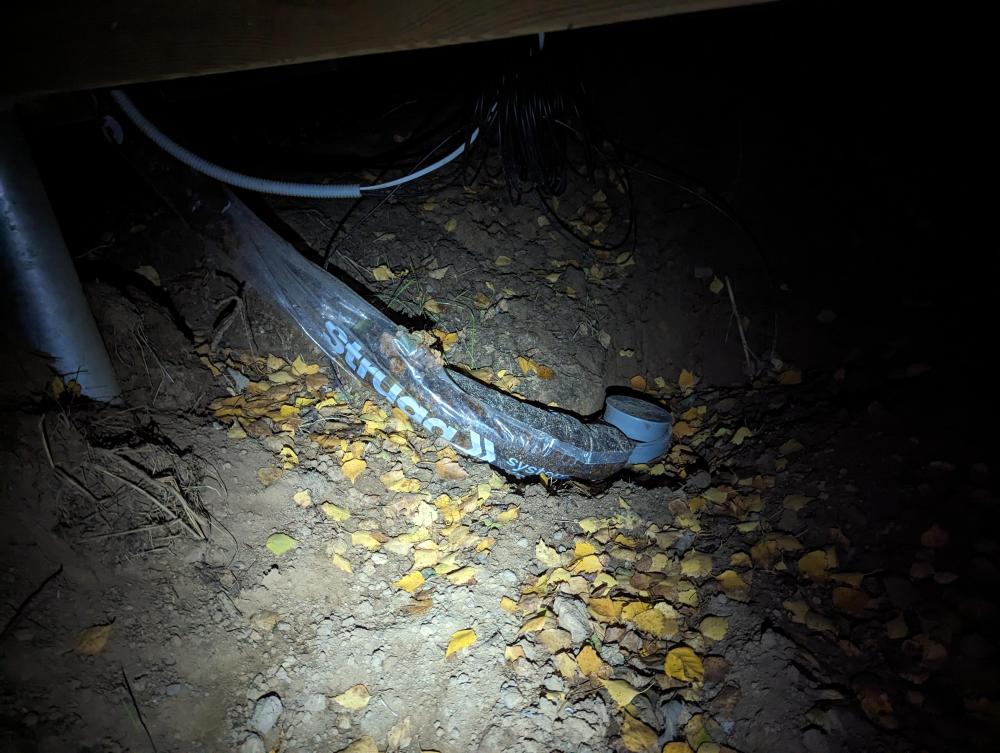
Gutters are up. Downpipes are fitted. I fashioned some temporary connections / leaf filters to the soakway leading down the hill out of bags. There are many leaves. The downpipes currently drop through the decking (nothing visible above the decking) into an a-yet-to-be-improvised connection to 110 mm pipes that lead to a soakaway. How well do these kind of things work? They're probably easier to install inline, above decking level, to kick the leaves out onto the deck (along with many more kg of leaves) rather than having a horizontal "drain" grate and the downpipe finishing above it? https://www.postogu.lt/produktas/issivalancioji-lapu-gaudykle-plastikinis-ruukki/ Sadly I don't have a drone shovel...
-
Check the drains / weep holes. Even if the seals are FUBAR the windows should drain to outside. If these are PVC windows the water which DOES pass the outer seals in driving rain will go into the BOTTOM of the frame, then out of weep holes EITHER in the bottom of the frame or the OUTER face of the frame. If you have inadvertently sealed these (for example by having weep hole on the BOTTOM of the frame, insetting the window and sitting the entire frame on something solid instead of the outer edge of the frame overlapping something that the window can drain onto, then sealing the front face) then the water will weep to the inside. If you have inadvertently made holes straight through the frame (for example by putting screws through the frame from inside; instead of using the mounting straps that lock into a channel on the outside of the frame) then the water will be may be draining through those screwholes instead. Post plenty of photos?
-
heating problem to solve, low on return
markocosic replied to cily35's topic in Central Heating (Radiators)
Can you sketch the pipe layout? Auto bypass failed open perhaps; so water short-circuiting? -
It looks - from the thermal camera - like the flowrate is too high for stratification to happening. A dT of 2 on the heat pump side isn't a catastrophe (will cause increase pumping cost but meh); it's the fact that most of the water "isn't in use" because only a small part is running around in bypass that's causing your cycling.
-
If dT is too low *everywhere* dial back the pump before you throttle valves. If a radiator that's been piped backwards and has the return at the top then hot, buoyant, water, is always going to piss off down the return in preference to staying in the rad. Plumber needs to change that for the rads not to act as bypasses with the flow looking like an "r" shape.