markocosic
-
Posts
979 -
Joined
-
Last visited
-
Days Won
1
Everything posted by markocosic
-
Distributed battery power banking
markocosic replied to Radian's topic in Networks, AV, Security & Automation
Are the commercial solutions now economic given the increase in marginal unit rates / decrease in costs as shenzhen grade kit comes on the market? £800 AC coupled inverter / £800 for 6000 cycles @ 2 kWh / 1 kW(p) https://midsummerwholesale.co.uk/buy/sofar-storage/sofar-me3000sp https://midsummerwholesale.co.uk/buy/sofar-storage/sofar-me3000sp-us2000-type-c-kits Charge @ average 250 W for 8 hours; discharge @ average 125 W for 16 hours; bank £0.50 / day through "screw displacing gas fired generation; play the broken electricity market using batteries and PV instead" game? £18/yr. Will it last 10 years? 15 years? Perhaps; if the peak charge / discharge rates are limited? Is it Depth of Discharge or the cycle count or the charge/discharge rates that kill LFP? -
aroTHERM Plus DHW Flow Temperature
markocosic replied to Dan F's topic in Air Source Heat Pumps (ASHP)
So: Normal: no limit on compressor Balanced: limits max compressor to 50% for finish-heating Eco: limits max compressor to 50% The unit is choosing to run up to that 50% limit though; irrespective of cylinder temperature and the target differential. The latter is confusing. Perhaps it will behave differently charging a "25C" cylinder and a "40C" cylinder and a "50C" sylinder in ECO mode? Are you sure that it's reading the fake cylinder temperature correctly? Perhaps it assumes use of a 3 m2 coil (or equivalent) and it only really controls to the target differential when in normal mode? -
50mm liquid screed UFH with Sunamp as storage
markocosic replied to westcoast's topic in Underfloor Heating
Pedant 😘 -
Ecodan standby power consumption
markocosic replied to LA3222's topic in Air Source Heat Pumps (ASHP)
sCOP calc description: https://studylib.net/doc/6625073/calculation-of-scop-for-heat-pumps-according-to-en-14825 This should include standby -
50mm liquid screed UFH with Sunamp as storage
markocosic replied to westcoast's topic in Underfloor Heating
Let's do the maths by 10s. (24 hours is 86,400 seconds, but for quick easy maths let's call it 100,000). Water: 4200 J per kg per degC Plaster / Wood / Concrete / Mineral Wool: all are about 1000 J per kg per degC 1 kg of water. (1 litre) 4,200 J per degC. Raising the temperature by 1 degC means 4.2 kW for 1 second. (i.e. boiling a 1 litre kettle from 20-100C means 4.2 kW for 80 seconds, or 2.1 kW for 160 seconds) Try 100 kg of water. 420,000 J per degC. Raising the temperature by 1 degC means 4.2 kW for 100 seconds. 420W for 1,000 seconds. 42W for 10,000 seconds. 4.2W for 100,000 seconds. Say we actually raise the temperature of 100 kg by 50 degC. Now 215 kW for 100 seconds. 21.5 kW for 1,000 seconds. 2.15 kW for 10,000 seconds. 215W for 100,000 seconds. 1 kg of plaster / wood / concrete. 1,000 J per degC. Raising the temperature by 1 degC means 1.0 kW for 1 second. 100 kg of plaster / wood / concrete. 100,000 J per degC. Raising the temperature by 1 degC means 1.0 kW for 100 seconds. 100 W for 1,000 seconds. 10W for 10,000 seconds. 1W for 100,000 seconds. Say there's 5,000 kg of plaster / wood / concrete instead. Now 5,000,000 J per degC. Raising the temperature by 1 degC means 50 kW for 100 seconds. 5 kW for 1,000 seconds. 500W for 10,000 seconds, 50W for 100,000 seconds. If there's 20 tonnes of plaster / wood / concrete then a 1 degC shift in temperature (absolutely nothing) is the equivalent to a 50 degC shift in 100 litres of water. You've built from lots of material that all takes about 1000 J per degC to change the temperature. In my view it's utterly pointless installing a bucket of water on a sunamp to store heat. Just dump it into the air and let it soak into the building... -
50mm liquid screed UFH with Sunamp as storage
markocosic replied to westcoast's topic in Underfloor Heating
Most phase change material energy storage "happens" during the phase change. Cooling below that temperature or heating above that temperature has materially less effect. Stupid question time: hl How much thermal mass do you have inside your insulation envelope? Floor AND blocks etc. How does that compare with a bucket of water or phase change goop? How long does it take to change temperature for a given heat loss rate / heat input rate? I suspect instant heating of air +by air to air unit or by a thin screed with low mass) which then transfers heat to the masonry will mean you need nothing clever to feed a thin screed. -
For what it's worth I just had the same thought for a cathedral ceiling / wood floor application. My notes: https://www.cewood.com/products-eng https://izoliacija.com/produktas/cewood-akustine-plokste-naturali/ https://izoliacija.com/produkto-kategorija/akustine-izoliacija/ "Construction" grade cheaper / rougher (3 mm fibres) https://online.depo-diy.lt/product/705 "Decor" grade spendier / finer (1 mm or 1.5 mm fibres) https://online.depo-diy.lt/product/701 Plaster over the rougher construction grade for sound isolation. Leave the decor grade unfinished for sound absorption. https://en.wikipedia.org/wiki/Mineral_bonded_wood_wool_board Some fire and fitting notes: https://www.cewood.com/video-1 Painting sounds like a pain: https://www.baux.com/faq/can-i-repaint-my-installed-baux-acoustic-products/ Pinterests: https://www.pinterest.co.uk/pin/291678513374269376/ https://www.pinterest.co.uk/pin/194991858856196266/ https://www.pinterest.co.uk/pin/111323422029673729/ https://www.pinterest.co.uk/pin/688980442995825160/ Will probably end up with taped and jointed plasterboard. Will probably regret it acoustically! I don't think suspending the ceiling on the 'genieclip' style donuts plus metal bars will achieve the same result. Those are for isolation not absorption. More notes to self: Genieclip: https://www.soundstop.co.uk/soundproofing/soundproofing-ceilings/genie-clip-solution1.php https://www.gyprock.com.au/products/accessories-resilient-mount-clip Equivalent for hanging plasterboard off joists on metal channels https://online.depo-diy.lt/product/2681#2681 https://online.depo-diy.lt/product/2582 Bathroom / bedroom perhaps.
-
aroTHERM Plus DHW Flow Temperature
markocosic replied to Dan F's topic in Air Source Heat Pumps (ASHP)
So you have: 100%? (to minimise the deltaT between flow/return; which for a given coil:water deltaT will minimise the flow temperature and maximise the COP at the expense of increased pump energy) ECO (I would guess that ECO reheats at minimum output; normal at maximum output; and balanced between the two) Target temperature (I did wonder why you were nailing this by running to 55C rather than [better] 48C but we'll come to the WWHRS later) DHW offset (0...could there be a bug here I wonder...where 0 is effectively maximum rather than 0...perhaps try 1C so that it's not an implausible number...or even a more realistic number such as 5C?) Max reheat time (off...I would guess this only exists to prevent the house cooling too much during DHW production) It's definitely choosing to run at that then; rather than being limited by turndown Ok. But as above you're not turndown limited by the primary coil as it stands. How so? [simplistically] the Delta T for a heat exchanger is (mean temperature) - (mean temperature). So for a radiator at 80/60C flow/return and a room at 20C the deltaT is 50C. (70C-20C) That's what drive the heat transfer. Flow 67C / Return 62C / Water 55C gives deltaT of just under 10C. (64.5C-55C) Flow 65C / Return 64C would give you a similar deltaT and power transfer to water at 55C. [calculating properly would involve logarithmic mean temperature differences; but for our purposes this is fine] I disagree - that is assumption is NOT a given. Dumbest option? You try to achieve max (e.g. 65C) flow temperature the entire time. In practice even the dumbest unit trying to achieve 65C the entire time by maxxing out the compressor will probably end up "ramping" to a degree anyway because even at max refrigerant output a cold cylinder will draw more power from the coil than it is able to deliver; thus dragging the flow temperature down Standard option? You run at a fixed compressor speed / pump speed. This will result in ramping. You put approximately "X kW" into the coil and it reheats the cylinder. A cylinder at 10C will draw loads from the coil. Say a 3m2 coil gives a 10C deltaT at 5 kW. Coil runs at 22C flow / 18C return. A cylinder at 50C runs 62C flow / 58C return. A half-full cylinder is trickier. If the coil is top to bottom (minimise convection currents) then initially the coil will cool the top of that cylinder and move the heat to the bottom. It's reasonable to assume that a half full cylinder is the same as a cylinder at 35C so runs at 47/43C. If the coil is only at the bottom the behaviour will depend on the convection currents being setup in the cylinder; iI would guess that it probably stirs it up more than a top to bottom coil but Mixergy will have modelled this better I'm sure. Either way it's definitely ramping. Here's a nice example of output-constrained ramping: for a "half full" cylinder (top at 50C but bottom has dropped to 40C https://heatpumps.co.uk/2015/09/09/heat-pump-performance-monitoring-examples/ Any sales pitch that "only a plate can ramp" is absolutely bunk. Big coils are dirt simple and work adequately well. Better option? (I think) You try to avoid mixing to less than say 45C. If you're feeding a top to bottom coil and your minimum flow temp is 45C then you will never cool the cylinder below a "useful" delivery temperature. Speed up the compressor a bit / reduce the pump speed a bit so that the water into your coil is never below 45C and you avoid losing the hot top. Again works fine with a coil and will ramp. Best option? Desuperheat during space heating. There are three stages of cooling for the refrigerant 1) Desuperheat. This is taking "hot gas" and making it into "cool gas" (if it was water, then imagine steam at 130C cooled to steam at 101C) 2) Condense. This is taking "cool gas" and condensing it into "hot liquid" (if it was water, then imagine steam at 101C turns into water at 99C) - most of your heat is given off at this stage 3) Subcool. This is taking "hot liquid" and making it into "cool liquid" (if it was water then imagine water at 99C into water at 60C) You will get superheat even when you are running in space heating mode. You only want say 35C flow but there will still be some superheat available at 60C+. Heat pumps with desuperheaters will divert the heat from this "hot gas" into the DHW cylinder whilst in space heating mode (subject to an upper limit - usually 95C unless regulations or scaling dictates otherwise). The advantage? You get the same COP as if you were taking all the heat off at 35C; but you get to have 10-20% of it at 60C+ These heat pumps will initially "bulk heat" to the minimum usable temperature (say 45C) then constantly "top off" during space heating to a much higher temperature. I've only seen it implemented with ground source units. Never with monobloc air source units. Not really worth it for low energy houses. Again this works fine...with a coil...and will ramp. An aide? Sillier games with subcooling and hardware cooling. Very big stuff might have subcoolers on it (where you're returning at a particulary low temperature) and oil / electrical cooling of components. Electrical stuff can run hot. Hotter than the condenser. So use that for "top up" heating. Oil can run stupidly hot. So use that for "final" heating. I think the RED / Octopus units implement some of this. (compressor heat / inverter losses as "finishing heat" rather than lost to atmosphere. I'm the kind of saddo that went to see this for tourism. It's an absolute work of art of staged heat transfer to achieve COP 3 from 90C flow / 65C return with a source temperature in the single digits. Plenty of plate heat exchange here because it isn't working to batch heat. 🙂 https://en.wikipedia.org/wiki/Drammen_Heat_Pump Biggest advantage of plates? Cleaning. Single biggest advantage of plates is cleanliness. If you have naff water (well water poorly filtered; hard city water) then it's easier to unbung a plate than it is to unbung a coil. Minimising the cylinder temperature to avoid scaling and filtering your water should probably be the first port of call though! That's fair. It's a definite advantage in a fossil fuelled scenario, or an electric immersion scenario, where there is no penalty for heating at a high deltaT and some benefit in reducing heat losses during the summer. It would be an advantage in a district heating scenario too; only if the mixergy unit were to control the primary flow properly. (it doesn't on a district heating application - you're better buying from thermal integration who understand this use case) And it would be an advantage in a CO2 heat pump scenario; again only if the mixergy unit were to control the primary flow properly. With F-Gas / Propane heat pumps...the performance loss from "top up" heating mostly likely outweighs any benefit from reduced heat losses during the summer. It's a quality tank though and it has neat graphs. 😉 Well volunteered! 😉 (and I'd be interested) If (average) COP = 3 for water heating to 48C the traditional way; vs (average) COP = 2 for water heating to 55C the mixergy way; I'd guess that the standard way wins if your usage is > 2 kWh/day. Don't forget the primary losses. These will be similar regardless of how much you're heating and will not be trivial compared with cylinder losses. That'll be plumbed "wrong" for this application - should be feeding both the UVC and the cold feed to the shower; with the UVC set to 48C. Is it too far from the UVC to make this viable? Does it have too high a pressure drop? More than one shower making it impossible? Inclusion of this will make the performance conclusions very shades of grey. Any potential to monitor it? If plumbed "wrong" yes. (quotation marks used because the ideal plumbing might not be a practical option) Work just fine for preheating the feed to a cylinder. What is your COP for heating water from 10C to 25C though? (likely lots)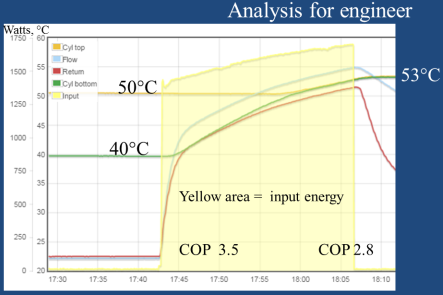
-
Alternatives to silicone for fitting sinks
markocosic replied to markocosic's topic in Kitchen Units & Worktops
Thanks @Nickfromwales - in some ways we can afford to take risk (it isn't for a client so if there's a known risk we can better tolerate it) but in others we can't (don't get to do enough projects so don't know what the risks are) - I'd never have dared use "glue" as a sealant! 🙂 -
aroTHERM Plus DHW Flow Temperature
markocosic replied to Dan F's topic in Air Source Heat Pumps (ASHP)
Is heating the full cylinder a problem? Winter? Space heat leaking out of cylinder = meh useful anyway Summer? Increased volume heated come at a cost; but also at a discount (higher COP); at a time of year where there's ample electricity (PV) The diffuser is worth having in all scenarios in order to extend the runtime of a full cylinder / allow a smaller cylinder. Jury out on the balance in that there are simpler ways to achieve much the same effect when you're running heat pumps with F-Gas or Propane. CO2 heat pumps would do better plate loading though! (these perform well with a high deltaT from flow:return - slowly charging a stratified tank bit by bit) -
aroTHERM Plus DHW Flow Temperature
markocosic replied to Dan F's topic in Air Source Heat Pumps (ASHP)
The ASHP can control: - Compressor speed - Circulator speed - Fan speed (ignore for now) It can control compressor speed and circulator speed to achieve the target operating temperatures. If these are infinitely variable then happy days the AHSP can do what it likes. Perhaps the heat pump attempts to reheat the cylinder at a set power (essentially a set compressor speed) but even on ECO mode (minimum compressor speed / longest reheat time) the available turndown is limited. Tech specs on Mixergy are difficult to find on their website. Via Google here's their external plate kit to make the cylinder compatible with heat pumps. With the plate heat exchanger it can support 4-7 kW input with an incoming flow temperature of 60C and the cylinder at 55C. The returns from will be somewhere between 55 and 60C. https://www.mixergy.co.uk/wp-content/uploads/2021/11/Mixergy-Heat-Pump-Kit-Installation-Guide.pdf I couldn't find an equivalent specification for the coil in a standard cylinder; but I would guess that it is materially lower than this. The effect of this would be that even at minimum turndown / minimum modulation you're seeing a deltaT (from coil:water) of 10 degC and this is in fact what's dictating flow and returns of 67/62C in ECO mode; not the flow temperatures that the heat pump would like to operate at. Bigger coil fixes this BUT in order to get that bigger coil you're probably reheating the entire cylinder at once. (or fitting the PHE that is effectively the same thing and supports a worst case scenario of 5 degC average primary water to potable water deltaT) -
aroTHERM Plus DHW Flow Temperature
markocosic replied to Dan F's topic in Air Source Heat Pumps (ASHP)
Interesting pairing of equipment. I think these two issues: (1) The (shorter) Indirect coil at top of the tank means return temperatures are higher than with a standard HP coil lower down in the UVC. The higher return temperature pushes up flow temperature (which is not constrained) as the ASHP attempts to maintain a [flow temperature that tracks the gradually increasing cylinder temperature] (2) The ASHP doesn't see the UVC temperature increase over time (it's fixed due to resistor switch), so the ASHP [ratchets up the flow temperature to try heat this cylinder that is apparently being drained so fast that it cannot be reheated] You will achieve the highest COP by heating the entire cylinder from cold to hot "in one go" at as low an average temperature as possible, vs incrementally heating a cylinder from full cold to full hot "a bit at a time" at the maximum temperature. In a "standard" cylinder for heat pumps (with a ruddy great coil from top to bottom) the heat pump sees cool water that warms up as the cylinder warms. If it is DUMB them it runs at a fixed temperature. If it is a little smarter the heat pump can set flow temp = 10C above return temp (or some other number that achieves a reasonable power input / reheat time) and up the temperature gradient it runs until the cylinder is satisfied. If the heat pump is bit smarter again it can, if tsenses that he cylinder is already part heated, always run at a minimum of say 50C output in order to avoid cooling the top part (that's ready to use) whilst it's heating the bottom part. If it is REALLY clever it will have a desuperheater on it to top up the cylinder whilst providing space heating. The "mixergy" coil is configured for heating a cylinder "a bit at a time" from a heat source that doesn't much care about temperature. It's the total opposite of what you want for a heat pump. If you do everything that you can to minimise this stratification and heating in parts - i.e. defeat most of the purpose of the mixergy tank except for the inlet diffuser - then you will maximise heat pump performance. I don't think these are remotely appropriate for use with heat pumps myself. Your heat pump is going to do "whatever it wants to" in order to achieve a tank at the target setpoint - in your case 55C. It has two ways to see what the temperature is. (1) flow and return temps from cylinder primary (2) temperature probe on cylinder I would guess that is is kinda smart. If given a totally cold tank it would ramp the temperature up at return + X degC until setpoint achieved to maximise efficiency. If given a part warm tank it would ramp up at return + X degC, subject to a minimum of say 50 degC so that it doesn't discharge what's already at the top of the cylinder. It will use (2) to decide when to stop and (1) to decide what temperature to use. If the heat pump were DUMB then you can set it to X and rely on an external contact. X is 50C for slow reheat to 45 or 65C for faster reheat to 55C etc. The Arotherm is probably too smart for this application. Try heating a stone cold tank in ECO mode and watching the flow tempeatures? If that works then you know the issue. The Mixergy tank, unless the smarts are defeated, is going to cause problems. You're trying heat the cylinder from full cold to full hot "a bit at a time" as it were. This will result in fairly high return temperatures to the heat pump and the heat pump thinking that the cylinder is almost fully heated. It is logical for it to increase the setpoint in this scenario. You don't have any way to recreate the effect of a "top to bottom" coil. Running a destratification pump to try mimic the effect of a "top top bottom" coil will blend the tank temperature; improving heat pump performance; but killing the "hot top" that you get with a heat pump tank. Running the water through a plate is more flexible but ultimately has the same drawback. Low flow through the plate means "heating a bit of the tank from cold to hot in one go" whilst high flow through the plate mixes up the entire cylinder and loses your "hot top" again. Perhaps set to space heating mode to make the setpoint dumber and allow mixergy to control it? Swap the mixergy tank for one that's more suitable? -
- Fold the top of the sheet to that you have a "french cleat" (like the flush-mount firings listed earlier from toolstation) to hook it onto some clips? No. the bottom will flap and it will fall off. - Fold the top AND bottom of the sheet with the bottom one LONGER than the top one; hook over the bottom clips, slide up, hook over the top clips, allow to fall. Can't come off the bottom clips without lifting it up and over the top clips. Same effect can be achieved using the flush mount clips and same size flanges on the sheet. If you don't want the edges being different? - Fold all found edges - Weld the clips on. Not with a farmer's arc welder all in one go out in a field but an automotive type MIG welder in short bursts that isn't going to blown through or distort 2 mm plate. Spot welding would leave marks both sides. Could be a design feature. Could be ugly. I wouldn't want an arm / head sliced off by a piece of 2 mm steel plate and wind / gravity.
-
Alternatives to silicone for fitting sinks
markocosic replied to markocosic's topic in Kitchen Units & Worktops
Thanks 🙂 Stixall is definitely MS Polymer - I'll look for a local brand MS Polymer and use that in place of silicone. Wood top with an inset sink feels like something that I can get past SWMBO. Have you ever worked with veneered worktops? Seem to be a few or there with 3-5 mm of wood over either cheaper wood or chipboard - could work insetting a sink, or even an induction hob come to that... -
Alternatives to silicone for fitting sinks
markocosic replied to markocosic's topic in Kitchen Units & Worktops
Underslung is going to restrict worktop choices more - that might not be in my remit. The other option would be carefully (!) routing out a rebate in the [laminate] worktop to take a sink with a "flat" rim and bedding it on goop such that the top of the sink were flush with the worktop. Something like this: chosing IKEA because convenient for examples) https://www.ikea.lt/en/rooms/kitchen/kitchen-taps-sinks-and-sink-accessories/kitchen-sinks-and-sink-accessories/norrsjon-inset-sink-1-bowl-spr-49157909 Mask the worktop. Router the rebate to say 6 mm depth if the sink edge is 3 mm thick and make the rebate say 3 mm larger than the sink all round. Cut the hole for the main sink body. Attach something to the top of the sink so that it cannot fall too deep into the hole (i.e. so that gravity would hold it flush with the worktop). Goop the rebated edge thoroughly. Mask the edge of the sink. Drop the sink in hole, wiggle into alignment so that there's a consistent 3 mm border around the sink. Wipe, wait, unmask. Hopefully the sink is now flush with the worktop and sealed. Feels ambitious for a laminate worktop not turning to weetabix. Might work well for a wooden worktop? Is there anything special about CT1 vs other "MS Polymer" sealants/adhesives? (CT1 isn't sold here) http://www.soudal.eu/soudalweb/productDetail.aspx?w=9&p=231&ID=1905 https://www.toolstation.com/soudal-fix-all-crystal-adhesive-sealant/p61251 https://www.ermitazas.lt/Statybines-medziagos/Sandarinimo-montazines-priemones/Hermetika-montaziniai-klijai/Klijuojantis-hermetikas-SOUDAL-FIX-ALL-CRYSTAL-bespalvis-290-ml-131091.html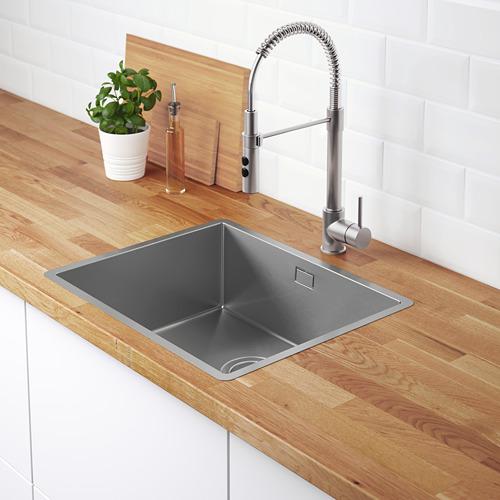
-
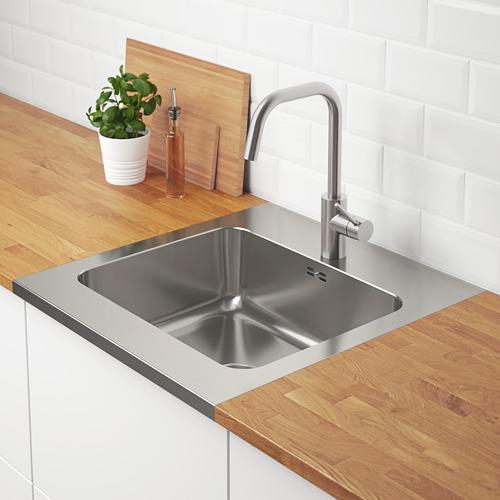
This is standard sink: https://www.ikea.lt/en/products/kitchen/kitchen-taps-sinks-and-sink-accessories/kitchen-sinks-and-sink-accessories/langudden-inset-sink-1-bowl-spr-29157477 The edges are annoying if you like to sweep crumbs into the sink from the worktop. This is a sink that replaces a chunk of worktop: https://www.ikea.lt/en/products/kitchen/kitchen-taps-sinks-and-sink-accessories/kitchen-sinks-and-sink-accessories/ammeran-onset-sink-1-bowl-spr-59158164 Those edges could be flush with the worktop. Ordinarily you'd silicone that gap. Silicone is rubbish for longevity though. Scrub it unsympathetically and it will peel. Is there anything else that can be used? Might an epoxy grout do the trick?

-
RTFM and the interpret what you read correctly😁
markocosic replied to BotusBuild's topic in Tools & Equipment
Better that then popping L, N, and E into a 3-way Wago 221! 😮 -
Distributed battery power banking
markocosic replied to Radian's topic in Networks, AV, Security & Automation
More useful: https://www.topten.eu/private/products/refrigerators https://www.topten.eu/private/products/freezers But we probably don't have a clue how they translate in practice: https://omattos.com/2021/11/11/appliancegate-the-energy-efficiency-fraud.html How does the "0.3 kWh/day" Samsung unit manage it? -
Distributed battery power banking
markocosic replied to Radian's topic in Networks, AV, Security & Automation
Sticking the freezer in an unheated garage and ensuring decent ventilation behind the things is the best we can probably do. MVHR extracts just above/behind the fridge/freezer perhaps?
-
Distributed battery power banking
markocosic replied to Radian's topic in Networks, AV, Security & Automation
Hmmm. Who on earth designed these energy efficiency ratings? Fridges... (D) Liebherr 390 L for 98 kWh/yr @ £1079 https://ao.com/product/k4330-liebherr-comfort-fridge-white-73722-30.aspx (E) AEG - 404 L for 121 kWh/yr @ £700 https://ao.com/product/rkb638e2mw-aeg-fridge-white-76030-30.aspx Ok - seems legit - but then we get this... (E) Beko - 101 L for 137 kWh/yr @ £199 https://ao.com/product/ur4584w-beko-fridge-white-76186-30.aspx How is that even in the same league? Since when is 1/4 of the usable volume for the same energy consumption a sensible comparison? Freezers... (E) Liebherr 276L for 250 kWh/yr @ £1250 https://ao.com/product/agb728e2nw-aeg-upright-freezer-white-77126-34.aspx (E) AEG 280 L for 248 kWh/yr @ £760 https://ao.com/product/agb728e2nw-aeg-upright-freezer-white-77126-34.aspx Less difference when it comes to freezers it seems... (F) Beko 86 litre for 226 kWh/r @ £245 https://ao.com/product/uff584apw-beko-under-counter-freezer-white-26887-35.aspx Again LOL at the utter hopelessness of the "efficiency" ratings though at least this one scores an F rather than an E. Interestingly the "fat upright" white Beko freezer nails them all on "litres per kWh per year" beating even the freestanding chest freezers on this metric: (E) Beko 404 L for 290 kWh/yr @ £629 - but it's 70 cm wide and 75 cm deep https://ao.com/product/ffep3791w-beko-upright-freezer-white-78914-34.aspx Then fridge freezers... (D) Liebherr - 268/103 L for 203 kWh/yr @ £599 https://ao.com/product/cnd5703-liebherr-fridge-freezer-white-92694-28.aspx (E) AEG - 230/94 L for 248 kWh/yr @ £570 https://ao.com/product/rcb632e5mw-aeg-fridge-freezer-white-77129-28.aspx Ok - there's more in it again here - and a couple of absolutely spectacular ones from Samsung: (A) Samsung - 273/114 L for 108 kWh/yr @ £1350 https://ao.com/product/rl38a776asr-samsung-bespoke-fridge-freezer-stainless-steel-85149-28.aspx (C) Samsung - 276/144 L for 169 kWh/yr @ £729 https://ao.com/product/rb38t602cs9-samsung-rb7300t-fridge-freezer-silver-76991-28.aspx How are they managing that? Certainly the way to go if starting from scratch. I wonder if it's worth retiring an A+++ rated fridge freezer from 9 years ago? Not at all it seems. 221/91 L for 158 kWh/yr (if the tests are comparable) and £529 each still isn't terrible. I should check their real world consumption when I get roundtuit. https://www.appliancesdirect.co.uk/p/kg39eaw40g/siemens-kg39eaw40g-iq100-freestanding-fridge-freezer An experiment that's fun - try loading the fridge / freezer with water as they are emptied. Keeping an "I wonder what the load capacity of this shelf is" amount of bottled water in a fridge helps extend the cycle time and reduce start/stop losses I'm told. -
Distributed battery power banking
markocosic replied to Radian's topic in Networks, AV, Security & Automation
Even if they won't do it...is it worth inverting back up to AC for the fridges? Charge at 90% invert at 90% ? That's 1/(0.9*0.9) = 123% of original energy use if you're time-shifting the grid via a 90% efficient charge (and invert) and a 90% efficient discharge (and invert) If you're consuming at PV rates you don't care. Even if consuming at grid rates it's probably worth having if you had ToU with a big enough arbitrage opportunity. Peak startup load on an inverter fridge? -
Distributed battery power banking
markocosic replied to Radian's topic in Networks, AV, Security & Automation
Do "110-230VAC" universal input inverter driven fridges exist that'll actually run ok on DC? That's the other big hotel load. MVHR units with LV EC motors that should by right run on DC? -
Painting wood with wood coloured paint - lessons with cetol 771
markocosic replied to markocosic's topic in General Joinery
I'd say no. Plan B had been pressure treated columns and woodwork; leave these weather over the summer / winter; then pressure wash / beach the surface / colour. Pressure treated decking boards were also to be purchased for the south wall cladding and the roof sarking and again left to weather (become a little less green / rougher) before finishing. I'd still recommend this approach from a treatment prespective. Plan C was what happened though. Biden's 2021 stimulus kyboshed the pressure treated timber. We mostly received what was ordered in February by March; but trying to order pressure treated timber in March was a no-go because timber futures had shot up (€800/m3 not €250/m3) and this meant virtually nothing in stock locally / everything was on a boat to the USA. Hence untreated timber for the structure. The exposed elements are being treated with this this stuff. Don't splash it about. Do coat over it after it has been applied to stop it washing away. Do explain to the wife that if you're giving her waterproofs and industrial rubber gloves to brush it on carefully that she shouldn't scratch her ears... https://www.bochemit.eu/en/opti-f/p-1/ Bees kyboshed using weathered decking boards as sarking and the south 'accent wall' cladding. We don't want any membrane-eating hornets behind the cladding thank you very much. Everything needs to be overlaping / closed jointed but again pretty much all was out of stock locally until the beginning of this year; we ordered when it was available; and it's now either +20% or out of stock again. Next time I'll be allowed Plan A. Either standing-seam rukki-roof...or probably trapezoidal steel with all black landscape oriented PV over the entire thing, clamped directly to the profile, with a small border in either slate or bitumen shingles to size match and make it look like roof integrated PV, and the membrane underneath it for final waterproofing. I'd probably vary this with some solar-thermal collection in the form of 25 mm MDPE between the PV and the trapezoidal steel in hindsight; to cool the PV / building in summer and also rigged up to recharge the ground array for the heat pump. Wouldn't use this 771 in preference to pressure treating though. Would use the bleach if you wanted the colour. (it will kill the green) Time and bleach better yet. -
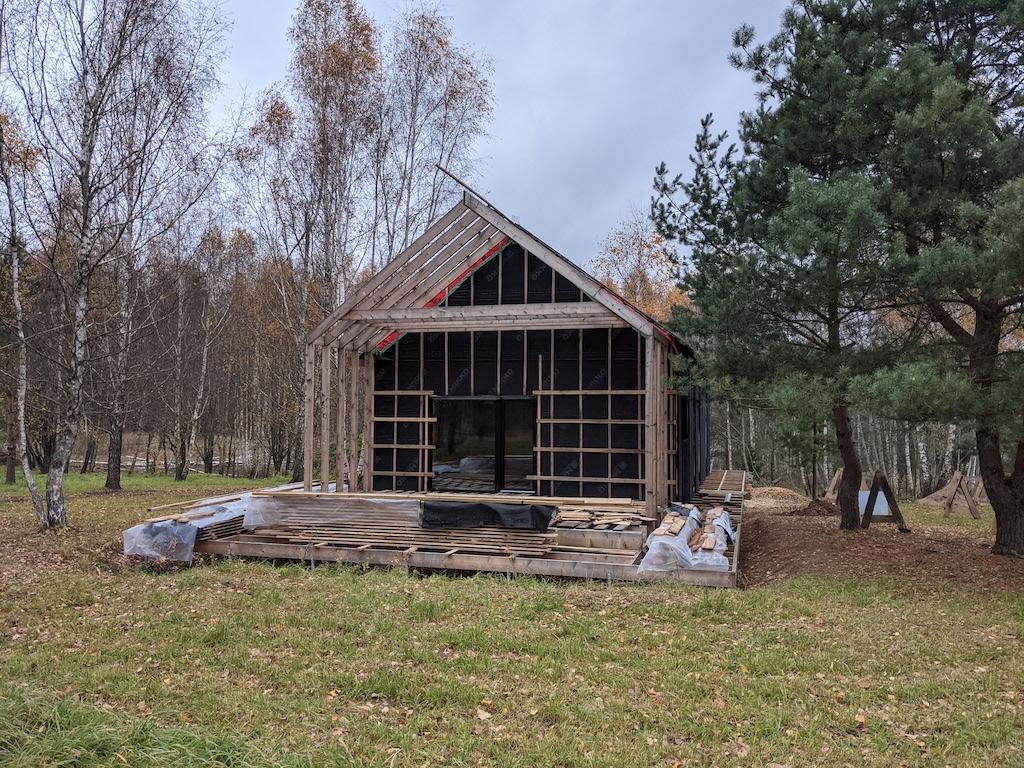
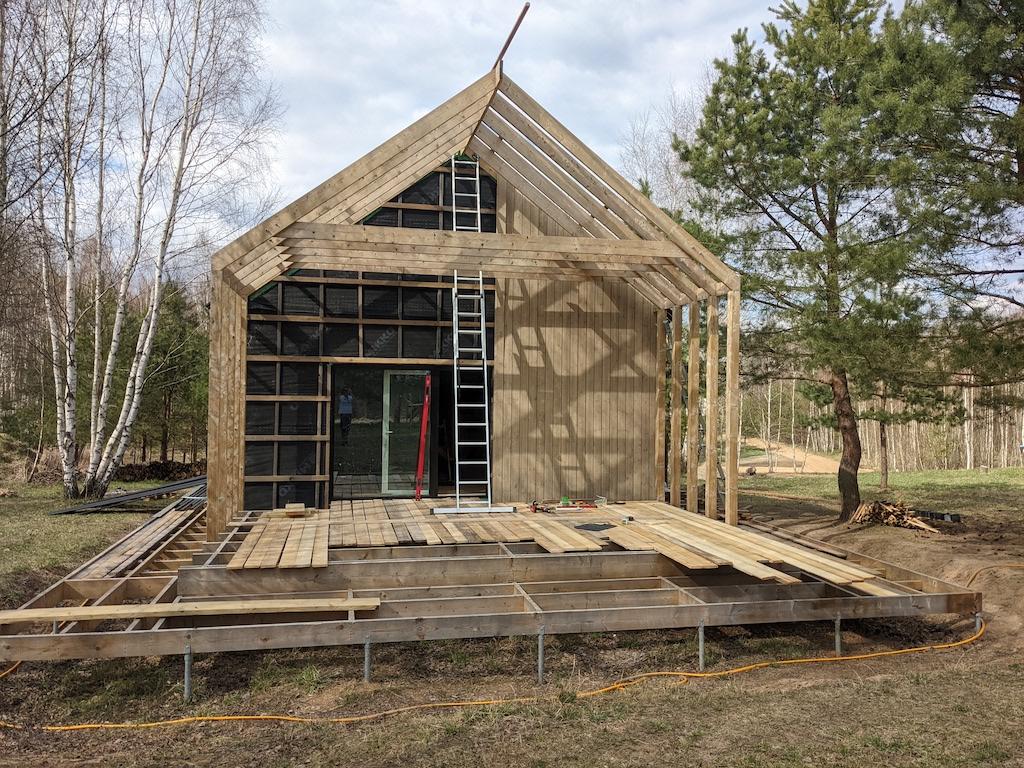
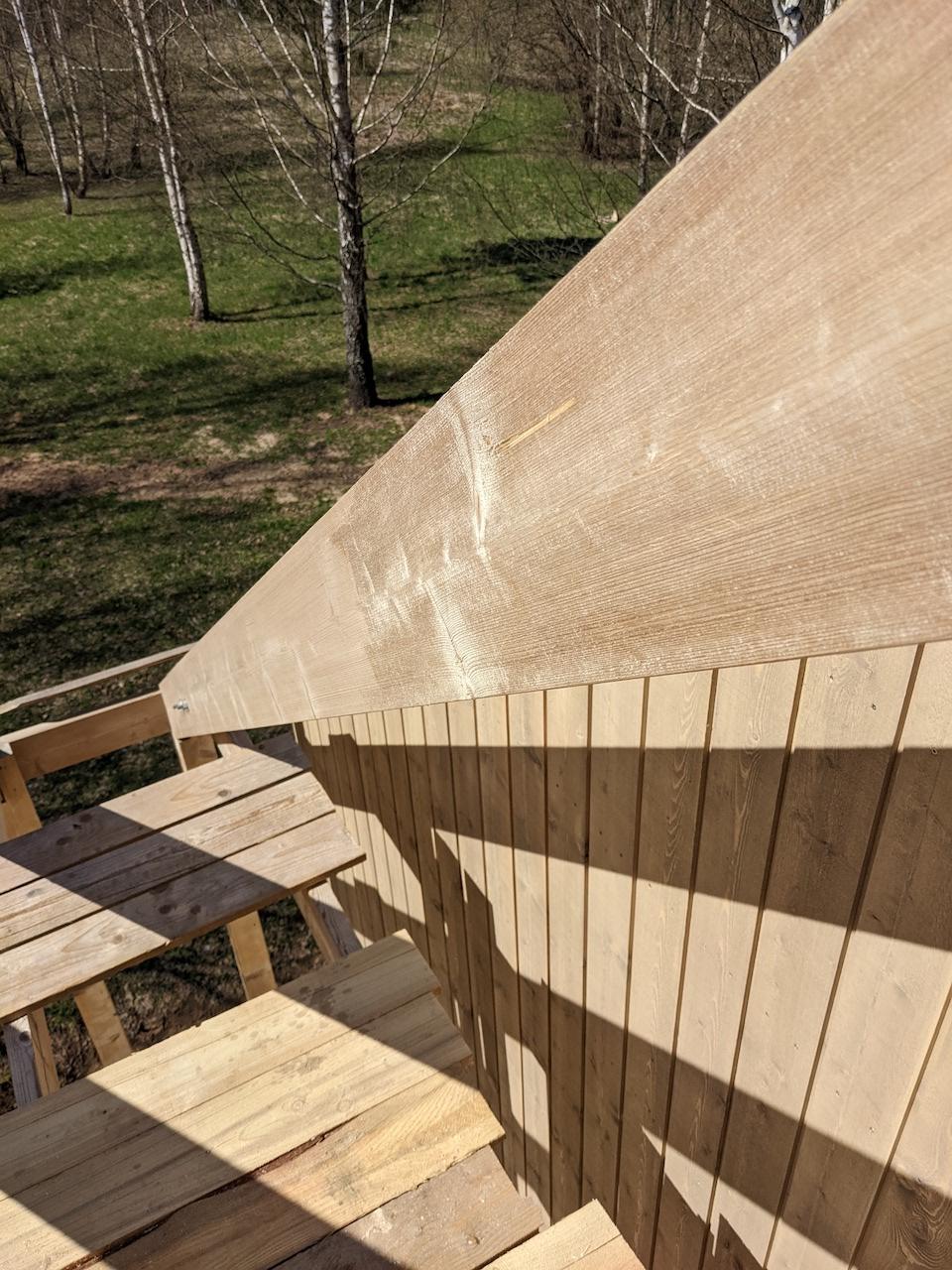
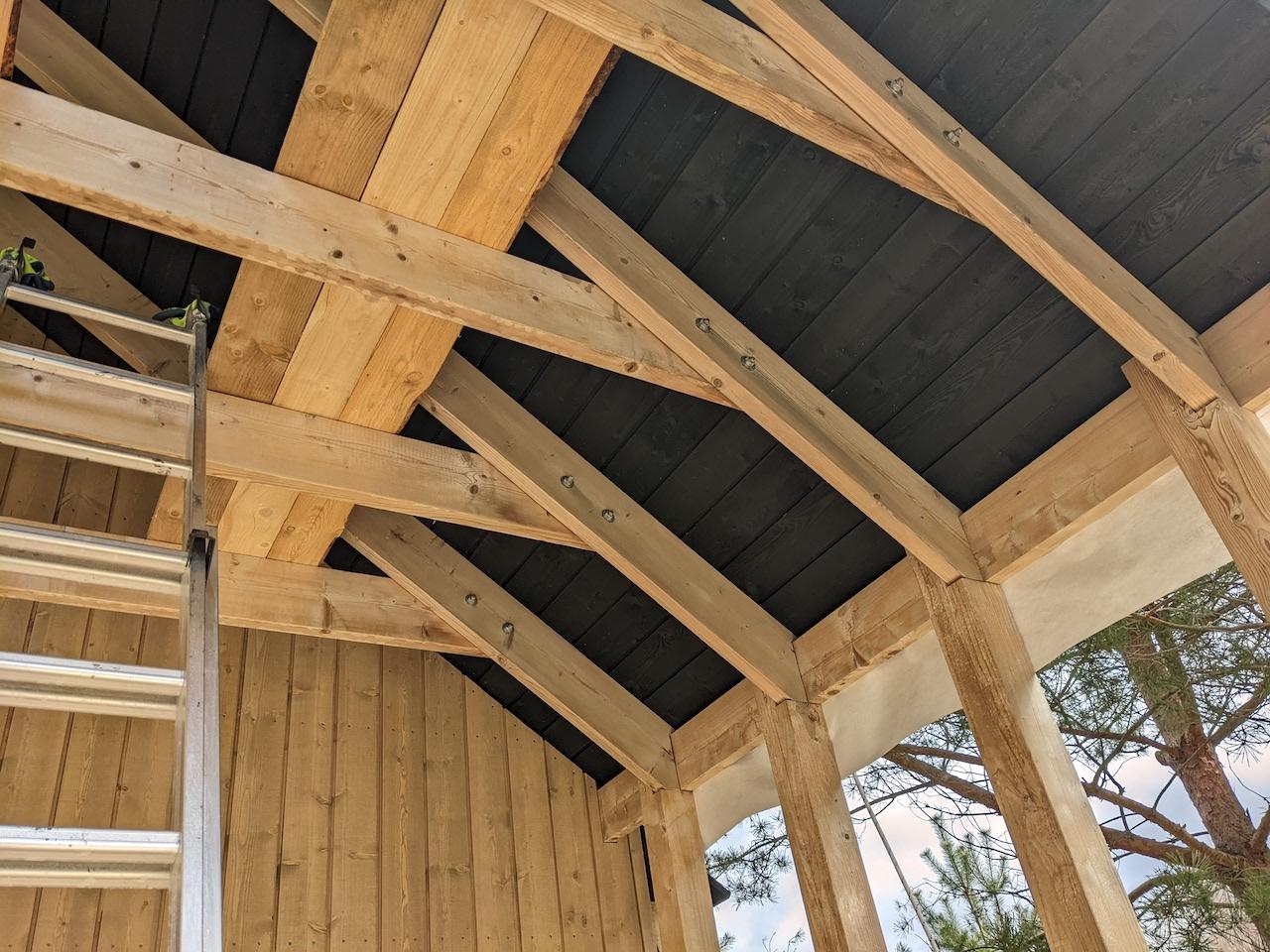
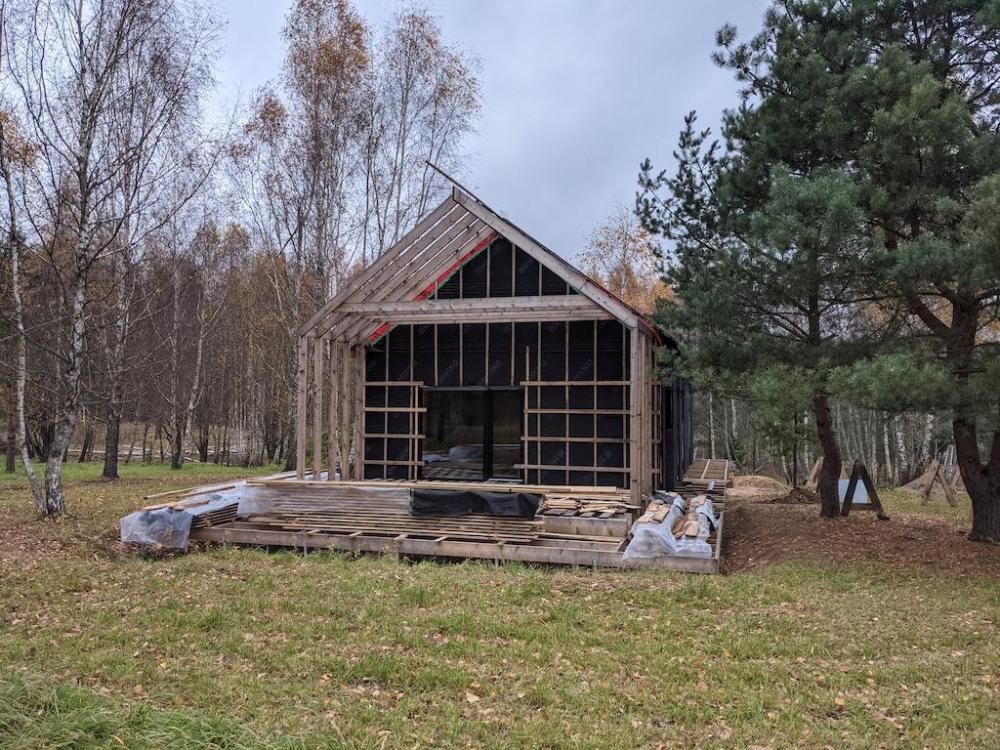
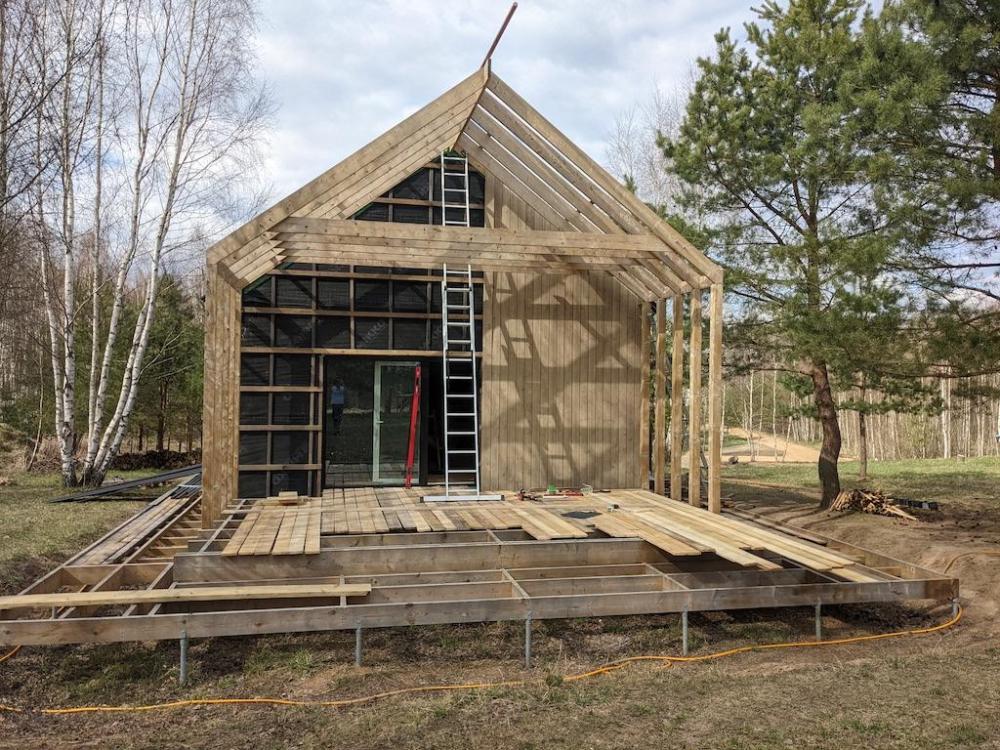
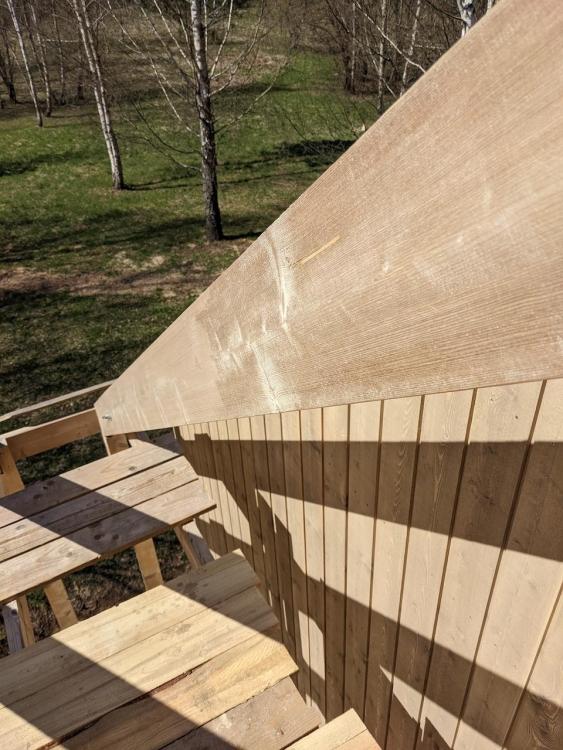
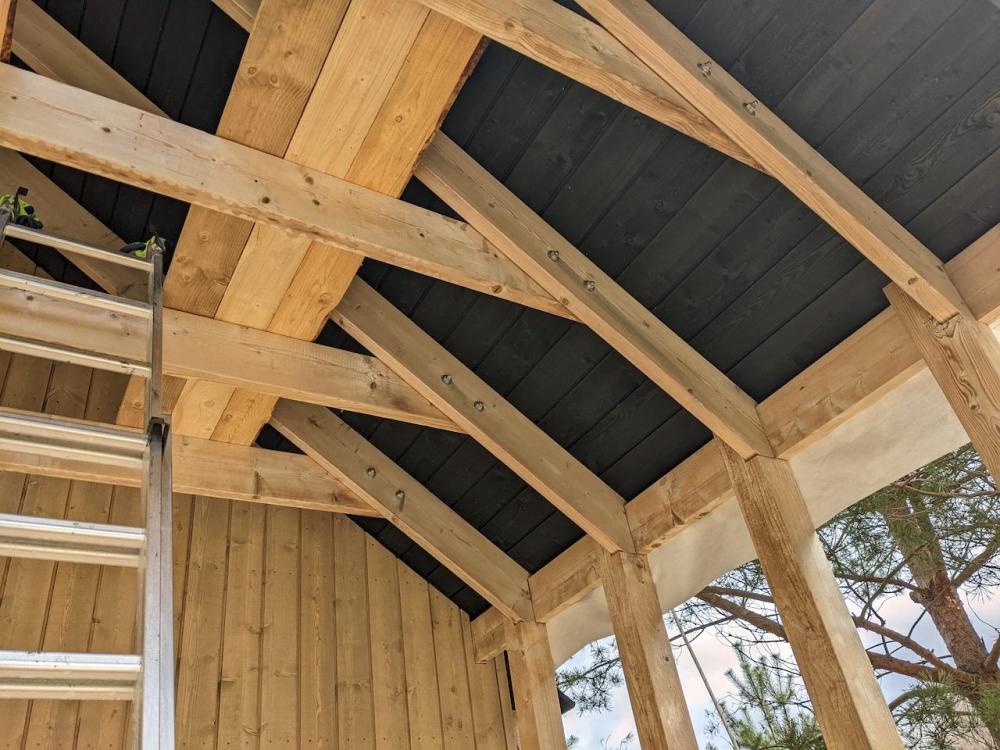
We've been having some fun with paint wood....wood colour. Thought this might be useful here. This is as far as we got before winter came and stopped play - no cladding to the south gable wall yet, no roof over the deck, and all of our (untreated) C16 busy going black... Step one pressure wash then bleach it all to heck then pressure wash again. https://www.stafor.lv/gb/stafor-white-wood-whitener-bleach I don't have photos of this process - too busy cursing the wind whilst trying to spray bleaching agent from a ladder - but you can see the "as dried" look here. It's...clean but scruffy and covered in a fine "fur" of all the half dead / half digested wood that got half blasted off with the pressure washer. Whilst at this: shadow gap vertical cladding is a fag to fit if you're at all OCD. Wood isn't a consistent width and you can see +/- 1 mm on a nominal 10 mm gap from a mile off. Doing full 6 metre runs is a complete pain. Moreso off a ladder solo. Doable if you'd somethign to stand the end of the board on but would not reccommend! Next step: Scrub...scrub off all the furry bits not with a sander or a wire brush but a metal pan scourer. Paint...with a sponge and cetol 771. This looks like coloured water (incredibly runny) and is supposedly a dispersion of acrylic and alkyd in water. Weird stuff to use; soaks in like a stain then "turns into paint" once it's within the wood itself. (or your clothes, gloves, etc) Ask for "ashen" shade with only 50% of the pigment if you want this "bleached beach wood" tone. Not a clear stain; but a stain that's essentially the same colour as the wood. Top half of this photo is scrubbed wood. Bottom half is the cetol 771-ed wood. This is magic - the proverbial lipstick for pig. From a distance the effect is more visible: Untreated columns and horizontal beams that we haven't got to yet look distinctly "scruffy" vs the rafters that almost look plastic yet are definitely wood as no two are the same. Weatherproof too. (water beads as if they were varnished) The underside of the roof is sarking made from the crappier bits of the cladding used on the south wall with a coat of acrylic facade paint in our standard RAL9005. They're a right mix of crappy little bits but being joined on the top of the rafters you'll never see it. Membrane / battens / membrane (it came in a 50 metre roll...don't have any other use for it) / counterbattens / roof then on the top of that. I wouldn't (offer to) do the vertical cladding again but this cetol 771 is cracking stuff. I'd never have thought to paint the wood wood colour to protect it rather than just painting it with something clear. Props to she who must be obeyed for that one!
-
Ecodan standby power consumption
markocosic replied to LA3222's topic in Air Source Heat Pumps (ASHP)
You're correct in thinking that this doesn't show up on the official sCOP figures. If true the your standby loss / their warranty saving. Mitsubishi also advise really terrible heating circuit designs (mixing headers) to avoid callbacks due to insufficient flowrate on the space heating circuit. Again your COP loss / their tech support saving. Air conditioning manufacturer with a bodhe product and an amoral UK sales outfit?