
ProDave
-
Posts
30671 -
Joined
-
Last visited
-
Days Won
423
Everything posted by ProDave
-

Size of Minidigger to remove Treestumps
ProDave replied to Ferdinand's topic in Landscaping, Decking & Patios
This was the largest tree I removed: The one on the right. the trunk was about 18" diameter. It was very hard going with my 3ton digger. I had cut it off about 4ft above ground so I had a good stump to work with. It still took a lot of digging and pushing and pulling. I found the maximum "push" was achieved by positioning the bucket then pushing by tracking the machine forwards. That seemed to give more force than just trying to push it with the boom. Your difficulty is going to be the short stumps, so it will be more a case of dig them out rather than the brute force of push the stump over.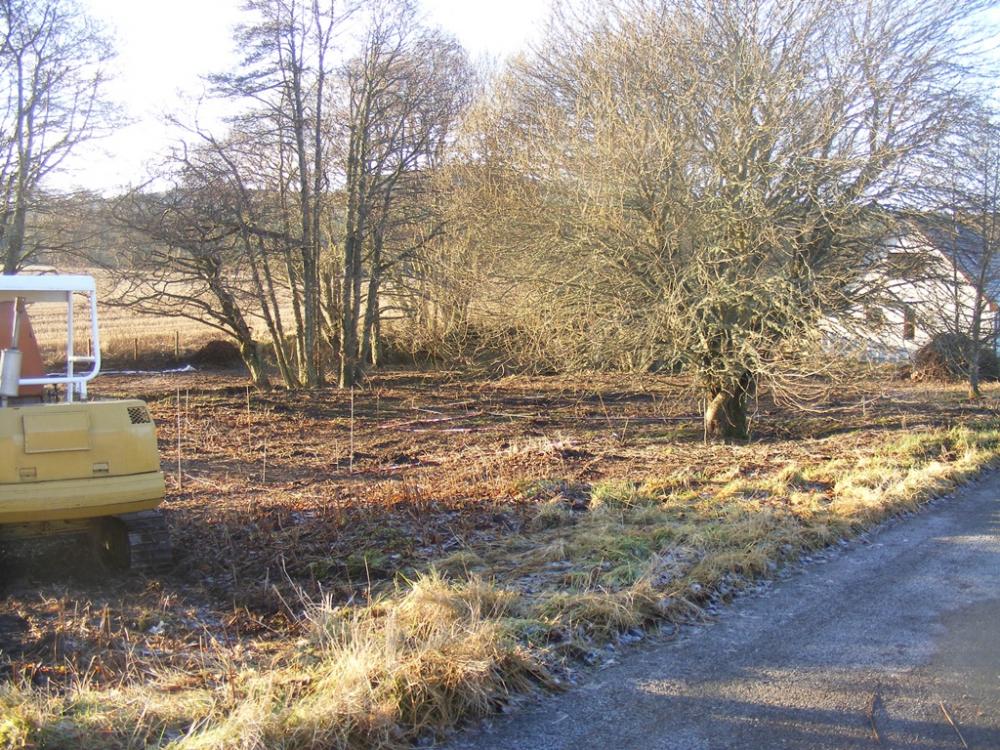
-
There's actually something cute about that little bungalow, almost a shame to knock it down. Before I bought my first house, there was an opportunity like that, a tiny little wooden bungallow with PP to knock it down and rebuild. It had an external brick chimney that was leaning away from the rest of the house. That was when my bubble was burst as everywhere I tried said they would lend money to build a house, but I could not find anybody that would lend the money to buy the site. Hence it was almost 20 years before I got to do any of this self build stuff.
-
Fred Dibnah did this. He dug a ventilation shaft the "old way" building a brick wall round it as he went. Dig a bit more out then lay another few rings of bricks underneath what was there, then dig more etc. Re Dowsing. I beg to differ. Have you tried it? I was your average skeptic until I tried it when visiting my BIL at his farm. He gave me his dowsing rods and said "walk across that yard" and part way across the two rods swung together. "That's a water pipe" says BIL. I got to try it in anger for my water conection. The contractor couldn't find the water main, it was further into the field than the plans showed. They were on the point of giving up so I went and got my dowsing rods and walked slowly into the field. About 1 metre further than they had dug the rods swung together and when they extended the trench there was the water main. If you actually hold a set of rods and try making them come together, you have to tilt them quite a long way, so you can't "trick" it. When they do "detect" something, they come together without you moving them. Like I say I don't even begin to understand it, I just know it works. Re the blindfold thing, perhaps you need to see for it to work? A friend of my BIL says he can see underground springs as a green hue on the ground and thought everybody can see the same as him.
-
Our well was about 20 feet deep. I never saw the water lower than 15 feet below the surface. If I dug one here i wouldn't need to go any more than 6 deet deep, even in summer. I once went down the well to drill the holes for the garage rainwater pipes from the inside. Just lowered my aluminium ladder down and descended it, complete with electric drill and an extension lead and drilled the hole. Someone afterwards told me that was a very stupid thing to do for a number of reaons.
-
Are you suggesting you dig a well or borehole as being a cheaper option than fixing the leaking main pipe? My previous house, a 1930's semi had a well. It was only a shallow well and it drew water from the water table. It was no longer in use being on mains water by the time we bought it, but local knowledge said the well in our garden fed 4 houses and the pub across the road. Water being drawn up by a hand pump in the scullery. The number of pipes leaving the well bore that out. It was very interesting to look down it at different times of year and see how the water table had risen or fallen. I did install a pump down it and used that for watering the garden. Later when I built a garage, I piped the rainwater from the garage into it as a handy soakaway. I wonder if that was SUDS compliant? If you want to know about dowsing, ask. I found I can do it. Please don't ask me HOW it works, but it does.
-
When I was down south and we had an extension built (of masonry) it was normal pratice there to bed a wallplate on mortar, so it was fully supported. Up here sole plates and wall plates are fitted "dry" to the top of the wall / Foundation. I wonder why?
-
We had a "similar" issue. but it wasn't because the foundation walls were not flat, it was the timber for the sole plate came from the merchant warped. The builders bolted it down as hard as they could and still it was clear of the wall in places. It wasn't until it had more weight from the frame on it that it finally "bent" itself flat. Timber, don't you just love it as a building material?
-
Council tax valuation bandings
ProDave replied to Calvinmiddle's topic in General Self Build & DIY Discussion
Ours was quite simple. I submitted my appeal, having found a number of similar sized houses for sale that were two bands lower, so a 2 band reduction is what I asked for. The council did not agree so it was set to go to a hearing, where I would be given the opportinity to present my case as to why I thought it should be lower, and they would present their case as to why it was the band the originally set. The day before the hearing I received a phone call offering not to go to the hearing and they would reduce it by one band, which I accepted. -
For a temporary fixing of the bottom of the membrane, don't nail it directly, fix it down with a batten nailed through and leave the nail heads a bit proud so you can pull them out.
-
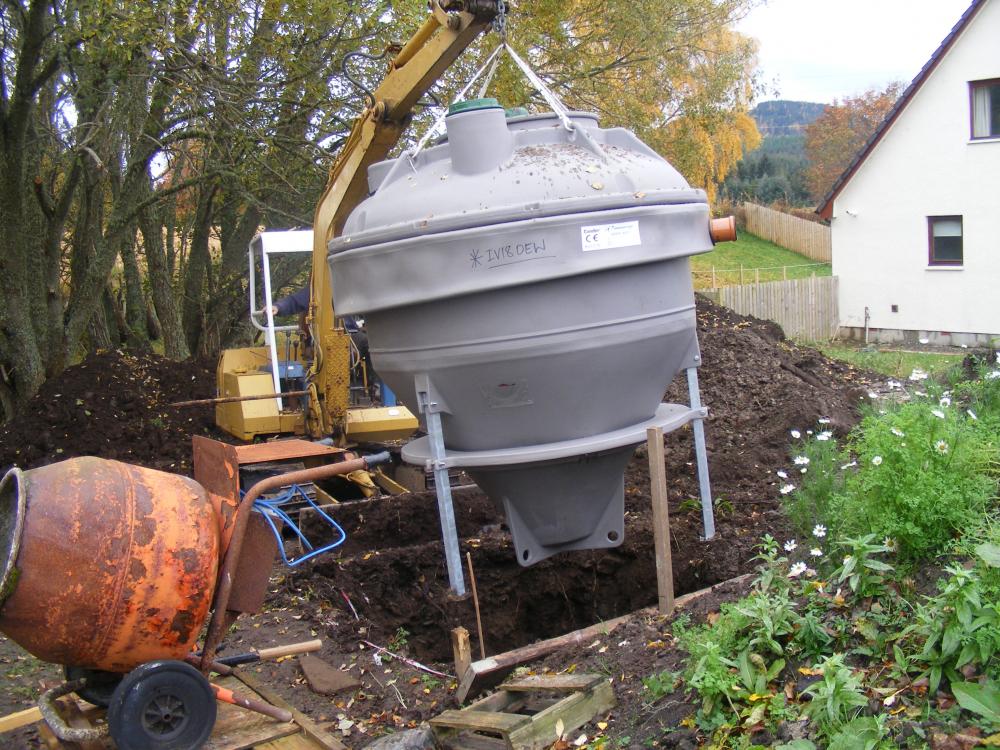
The issue of "anchoring down" the tank was one thing that made me chose the Conder. It has built in legs and the ring around the bottom. So it sits unaided in the hole while you pour enough concrete to encase that ring to anchor it down. Some of tha alternatives that had various anchor kits, seem to involve someone going down into the hole to fix parts of the anchor kit, which frankly sounds a VERY dangerous exercise.
-
When I tried Sketchup I just found I had no idea of scale, I didn't know if I was drawing a microdot, or something the size of the moon. And trying to draw two lines that touched but not overlapped seemed beyond the wit of man. I use ORCAD, which is an electical circuit CAD program. I have been using it in one form or another for more than 20 years, originally runing under DOS and when it migrated to Windows kept pretty much the same look and feel. I guess the difference is I know it inside out. In my last job, just before I left, they switched to an electrical cad program based on an add on to autocad. I HATED it. Everything was so clumsy and imprecise, just moving a few wires around was a chore. And that's how I found Sketchup. Orcad is pretty lousy for ordinary drawings, but at least I can do something in it very quickly.
-
I tried Sketchup, I just could not drive the damn thing. Nothing at all about it was the least bit intuitive and I just couldn't get it to do anything sensible. Perhaps I should try harder? Or I'm to old and set in my ways.
-
The start of the renovation story.
ProDave commented on TheMitchells's blog entry in Scooby Cottage renovation.
If you have to replace the floor joists, is there any merit in using steel? You can get the strength you need in a much smaller thickness. A nearby pub is doing this where they need to lower the floor level of a bar they are renovating to enable wheelchair access. Lowering it and keeping wooden joists would result in insufficient headroom in the cellar. So instead they are installing a set of steel floor joists that lower the floor level while still keeping enough headroom in the cellar. I take it the second picture shows a single storey rear extension to your house that takes up all but 6" of your back garden? -
Yes that's about it. What are you using to draw that sketch to do it so quickly? TP sell those eaves trays dirt cheap if there is one near you? (don't think there is much "near" you)
-
Yes I admit the picture might be hard to understand. Start with a sloping roof with your cross battens on to support the box profile. your bottom batten say 6" up from the bottom of the roof slope. Now lay something down the roof to represent the box profile roofing. Offer up your fascia board, with a vent strip on top of it and set it at a heght that almost touches the underside of the roof sheeting (small gap to allow for the infill piece) Your fascia board will of course now be higher that the bottom of the slope. This is where the eaves tray comes in. The eaves tray fixes to the top of your fascia and creates the kick up slope to meet the main slope of the roof. This tray is made of plastic, and the joint between the fixing and the main part of the tray, is scored, so you can pre bend it to match the angle it has to be at. Once you have done that mock up you take it all apart, lay the eaves tray first, then the membrane which now kicks up on the tray and over the edge. then fix the vent strip to also fix the bottom end of the membrane, then fix your battens and counter battens. Making any sense yet? If it wasn't hissing down I would go and try to get a better picture.
-
What is wrong with the way I am doing it, in post #6? the bottom horizontal batten is only about 6" up roof so I don't think it will leave much flapping in the wind. Your roof is going to be so high compared to the gutter, I would be worrided the water might miss the gutter.
-
Old (~1970) black MDPE water supply - which connectors?
ProDave replied to DavidWright's topic in General Plumbing
There's this at toolstation, http://www.toolstation.com/shop/Plumbing/d20/MDPE/sd2729/Metric+to+Imp+Conversion+Kit/p51455 Looks like a replacement set of inserts to convert a metric fitting to take imperial pipe. Use two of those and a metric tee and your new branch will come out at metric size mdpe. Buy the fittings and check again with your vernier that it is the right size before cutting the old pipe. If you later want to disconnect the original supply point, either fit a stop end plug into the tee, or replce the tee with an elbow fitting. -
Hear hear. I have lost a stone in weight and 2" off my waist in the last year of building. I have gone back to having to wear a belt to keep my trousers up.
-
A question about describing triple glazed units
ProDave replied to ProDave's topic in Windows & Glazing
I guess the important thing is the overall thickness of the unit must be 52mm as that is what the window is built for. I will have to check building regs, but the bottom of the window will only be about 300mm above the floor of the half landing, so I would expect it to require toughened glass, and probably a handrail across the window opening? (if it does need a handrail that will be made "portable") -
Insurance and container storage
ProDave replied to Triassic's topic in General Self Build & DIY Discussion
This does seem something site insurance does not cover very well. My site insurance covers my static caravan, but it was unclear if it covers the contents. A phone call to the insurer got verbal confirmation that it does, but I couldn't get anything in writing. What about when we do move into the caravan, then all our furniture will be stored in the part built house? On our first build, 13 years ago, that policy made it clear it covered the 'van but not the contents. I tried to buy contents insurance for that, but it seemed nobody wold insure a static caravan unless it was on a recognised mobile home park. -
Interesting point. I have wooden fascias that I intend to over clad with aluminium. Do you think the likely expansion over a 4 metre length would be such that I should machine slots, rather than holes, for the fixing screws?
-
We have Rationel triple glazed doors and windows. Most of them are 4,20,4,20,4 which I understand. The doors however, and one of the larger windows, have toughened glass on the inside, and the make up of those is described as 4,20,4,18,6,4 Now I understand that means the inner pane is thicker and is toughened glass, and hence to keep the same overall thickness, the "inner" gap is 18mm instead of 20mm. But the bit that confuses me is the 6,4 at the end. Does that mean 6.4 (six point 4) mm thick toughened glass? or does it mean something else? I am asking because one window, the landing Window, we want a stained glass unit in that. Because Rationel don't do stained glass, we have bought that window unglazed and are looking for someone to make up the triple glazed unit for it with the middle pane being stained glass. Because it will be quite low on the half landing, I think it also needs to be toughend glass on the inner pane. So I am trying to understand just what we need to specify.
-
SunPipes in Passivhaus? Saw it in Build the Dream.
ProDave replied to TheMitchells's topic in Property TV Programmes
No condensation trouble with ours, it passes through a cold roof space so would be a prime candidate for such a problem. Ours is a "solar tube" if that helps, It is just a steel tube with a very highly polished mirror finish to the inside surface, a plastic dome and flashing at the roof end, and a fairly flat round fitting at the ceiling end, not unlike the cover of a round 2D type light fitting (I have lost count of how many times guests have asked about the "light" on the landing and how to turn it off) A big improvement in our case could be mader by lagging the tube as it goes up through the cold loft, and some sealant to seal the ceiling fitting to the ceiling would help. I will digress to the condensation issue. It is something I have never understood. Our present timber framed house is absolutely bone dry. You can hang wet washing in the utility room on the "pulley" and it makes no difference. You can bath or shower and there's rarely any codensation on the mirrors. Now our previous house was a 1930's semi with solid 9" brick walls. So it was obviously a poorly insulated house. It had run of the mill UPVC double glazing. We never had condensation on the windows, but any cold surface, like a toilet cistern full of cold water, would be dripping with condensation after a bath or a shower. Now the house was heated so it was warm and comfortable. What puzzles me comparing the two houses is why did the 1930's house have so much moisture in the air it condensed on a cold toilet cistern, yet the new house doesn't. It can't be the amount of moisture produced by the occupants, so the extra moisture must have come from the fabric of the building. I can well see in a "damp" house like that, a solar tube might have problems with condensing moisture. -
I think the basic rule, is take the bottom of your foundation trench, project a line outwards and downwards at 45 degrees from the bottom of that trench. Your excavations should not pass through that line. If you are digging 2.2 metres away from the foundations, then even with very shallow foundations, you would need to be more than 2.2 metres deep before you would cause concern, so I think your 1.5 metre hole will be fine.
-
SunPipes in Passivhaus? Saw it in Build the Dream.
ProDave replied to TheMitchells's topic in Property TV Programmes
We have a sun pipe in our house and it does its function of illuminating an otherwise dark space very well. But I agree it would take a lot of detailing to get it completely air tight, and it is bound to increase heat loss. I guess the question is whether the gain from lighting a dark space is worth perhaps a slight reduction in the building's performance?