
ProDave
-
Posts
30861 -
Joined
-
Last visited
-
Days Won
427
Everything posted by ProDave
-
Yes. The "plastic cover" is moulded onto the screw head and not removable If I had known there was even a choice, I would have specified proper screws with a metal head, and a separate cover. I will photograph them and post a picture tomorrow.
-
Well my roof sheets arrived on Friday, and today we got most of it up. the main sheets of roofing on both sides and the main length of ridge piece. Tomorrows job will be cut and fit the verge cloaks, and cut and fit the second, smaller section of ridge capping. No photos yet as it was just about dark (before 4PM) when we finished today. just one observation, I encountered man's worst invention today. Plastic headed screws. Yes all the screws that were supplied to fix it down have plastic heads. Just about okay if screwing into a lovely soft bit of wood, but hit the slightest hard bit and the head strips, leaving me to finish tightening it with a pair of mole grips. Perhaps that's one thing to look out for, is avoid plastic headed screws.
-
What is the substrate you are rendering onto? i.e is the building clad with a blockwork skin, or some kind of board. If blockwork skin then without a doubt I would say cement made with snowcrete to give a white finish. If onto some kind of board, then the render system has to be considered as a whole depending on the board used. e.g in my case render onto a wood fibre board using the baumit.com render system. That was recommended to me as it's less prone to cracking than some other thin render systems. I can't comment on life as it's been on less than a year. A lot of these thin render systems are based on lime, and can't be applied at less than 5 degrees and it must remain above 5 degrees for a couple of days. That would rule out applying it in a normal January, certainly up here.
-
Yes some form of upright corner block is what most people use around here.
-
What is an "eyebrow roof"? I dislike flat roofed dormers (I dislike flat roofs in general) and I dislike the side detail of most dormers (which is why on my new build I extended the pitched rood of the "dormers" all the way down making them more of a "gable end"). But you have what you have so need to make the most of it. I would definitely strip it all off and convert it to a warm roof. You could always do it like mine, 100mm wood fibre board over the rafters (which is strong enough to span the gap without a support board under it) and then also fill the gap between the rafters, in my case with Frametherm 35 earthwool. And I would definitely NOT replace the roof with felt, that is the work of the devil. Get a fibreglass roof cover put on it. No reason not to do the same on the sides of the dormer as well and replace with new cladding, or just put the hanging tiles back if you can, at least they should last a long time unlike timber cladding so that's a detail I would seek to retain. I think the reason a lot of dormers are so poor, is they just build them with sticks of 4 by 2 timber so there is never enough room to fit anything like enough insulation so they end up being the coldest part of the house. So over sheeting with external insulation is an easy way to improve that.
-
I am struggling to understand what the point of this question is? surely you will set the FFL of the house to match the ground levels either existing or proposed on your site. I can only assume if you must set your FFL to the same as next door, then this must be a planning condition, and the difficulty you are having to establish that just shows how difficult it would be for the council to also establish that and check if you have complied or not.
-
A few ASHP / UFH bits of information.
ProDave replied to ProDave's topic in Air Source Heat Pumps (ASHP)
I only raised the idea of no buffer, and no temp control on the UFH manifold as this is what the mitsubishi packaged system appears to do and on the face of it, it seemed like a good idea. Another thing to consider is the big difference between a lot of you with UFH in a concrete slab with a high thermal capacity, compared to me with a timber floor and quite possibly UFH pipes in spreader plates. That's another thing to consider when deciding which way to go. I can't see any benefit whatsoever in keeping the UFH flow going with no heat input in my case. -
That's a good warning about the condensate drain from a BOILER, but as already stated it would not apply to condensate from an mvhr unit.
-
A few ASHP / UFH bits of information.
ProDave replied to ProDave's topic in Air Source Heat Pumps (ASHP)
i think my system "design" will be a lot dependent on the actual ASHP I end up with, and at the moment that is an unknown. Because until I have the heat pump, and get to know the ins and outs of how you can control it (and that seems very hard to find out from the blurb pre purchase) I won't know how low a flow temperature it can be set to, and how accurately it will maintain that set flow temperature. If it can indeed be set to say 22 degrees and it will maintain that to say within half a degree, then there will be no need for a regulating UFH manifold and no need for a buffer tank. But if it can't go that low, or it's control is not very precise then a regulating manifold will be required. What clearly IS needed, for those who are or have set up their own systems, rather than bought a packages system, is just how you can control a particular ASHP and what it can, and more importantly can not do. So what's needed is a technical thread for each make and model of ASHP that forum members have experience of which might help others choose which one to buy to best suit their needs. -
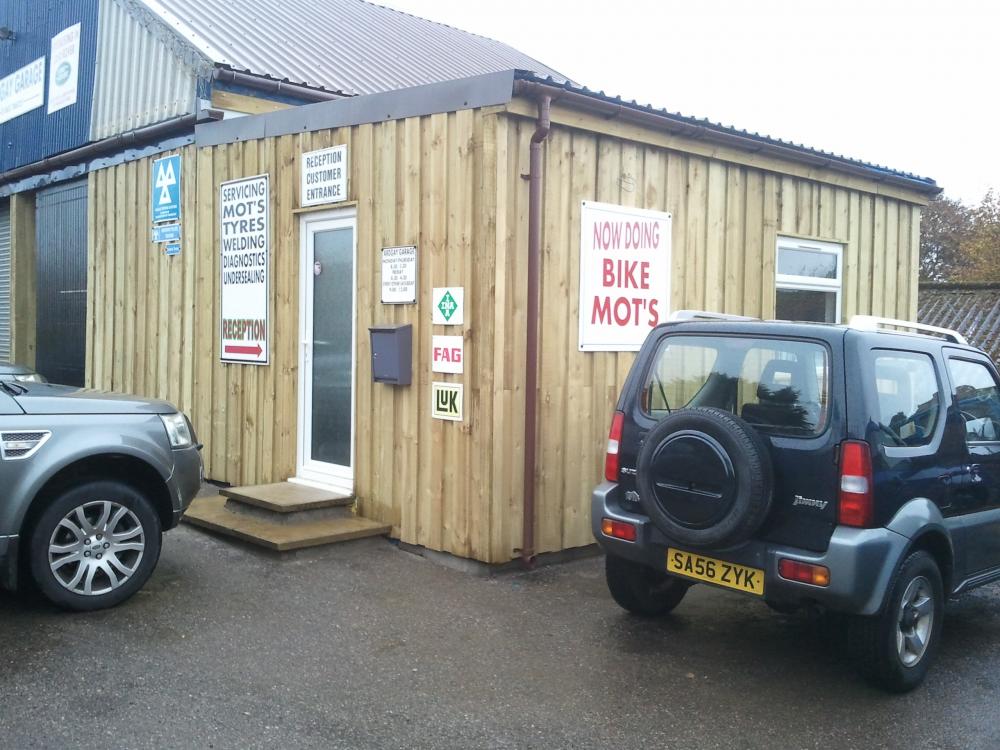
Am alternative I am looking at is cheap pressure treated softwood. I know most people look at various hardwoods for cladding. But how about this: It's pressure treated (presumably softwood) cladding from Jewsons. This has just been applied to my local garage (that's a new single storey extension) I will be looking with interest how this weathers over the next couple of years and see if it retains an even colour any better than untreated hardwoods. I guess you could stain it any colour you want, but any stained colour is likely to fade over time.
-
The "normal" here with timber frame, is the air bricks are entirely under the ground floor joists I have never seen anyone use periscope vents on a timber frame house. I think it's a building regs requirement that the solum (the ground under the joists in case that's a Scottish term you don't recognise) cannot be lower than the ground level outside. In my case, with 300mm thick downstairs joists then the thickness of an air brick, my finished ground level has to be at least 450mm below FFL. Along the front of the house where the ground level needed to sensibly be higher I have accommodated this with a small railway sleeper retaining wall to create a step down in level close to the house then filled that with stones, effectively making a sunken French Drain along the front of the house and leading round the side to where the ground level tapers off.
-
Hi and welcome to the forum. I'm a little way up the road from you in Ross-Shire. After many years of nothing, there do seem to be an increasing number of self builds in Scotland again. Shame that confidence is not feeding through into house sales.
-
That boiler is antique. Mind unless it rusts through, it will just go on forever, there's absolutely nothing to go wrong apart from the burner, and that's servicable. / replaceable. (I doubt that's the original burner) Modern boilers have rockwool type insulation around the water tank before the casing so I personally don't see why not. I can't believe that room is single skin block, the window reveal looks too deep?
-
A few ASHP / UFH bits of information.
ProDave replied to ProDave's topic in Air Source Heat Pumps (ASHP)
My only "concern" at the moment about putting together your own control system, is setting the temperature set point of heat pump. The only control interconnection to the heat pump was a 2 core cable between the controller and the heat pump. So it must be using some form of serial interface. Why do I get the feeling that finding the information on what that interface is, and the communication structure is going to be difficult, and even harder to find out before you buy a heat pump At the end of the day, all I want to be able to do is turn the heat pump on and off, and select it's heat output temperature. a requirement that should not be difficult, but with a system sold to be used with a packaged control system that might not be so easy to find out. -
A few ASHP / UFH bits of information.
ProDave replied to ProDave's topic in Air Source Heat Pumps (ASHP)
I thought your question about the store had been answered. Yes if using a tank like this one that uses a plate heat exchanger, then you need a circulating pump. I would much prefer a cylinder like the one Jack has, with a large area heat input coil. No need for a dedicated pump or the controls that go with it. I also share your concerns about servicability of this system. The control board looked every bit as complicated as a PC mother board, and it's a proprietary item not an off the shelf mother board. So if it goes wrong I just know that's going to be a lot of £££ for a replacement, and in 10 or 20 years will you even be able to buy a replacement? That is why I am so keen to put together a system with simple passive pats and standard central heating control parts. Where that's not possible, any missing control parts will be designed by me and if they go wrong I can fix them, or design a replacement if technology has moved on. That's the theory anyway. I am currently thinking of using an arduino or a Pi as the controller. -
A few ASHP / UFH bits of information.
ProDave replied to ProDave's topic in Air Source Heat Pumps (ASHP)
I suspect the "heat exchange coil too small" was just the installer pushing this cylinder with a plate heat exchanger. Personally like you I would prefer s simple cylinder with a large area heat input coil as it makes a very much simpler system, and almost certainly one that's easier to put together as a system yourself. I am not sold on this weather compensation stuff. I would try and turn that off, or set the curve flat. The house heating controls should take care of putting more heat in when it's colder. -
A few ASHP / UFH bits of information.
ProDave replied to ProDave's topic in Air Source Heat Pumps (ASHP)
I didn't see the installer do any "programming" Yes I saw an SD card slot on the board under that square cover on the cyilider but didn't see anything plugged into it, and I never saw him carying a pc with him. All I saw him do is go through some menu's on the programmer that came with it and set up some parameters. I suspect the SD card is used for software updates and they think putting that in the sales blurb makes it look sophisticated. Sory to me it just makes it lok over complicated. -
Do some research. Start by reading this http://forums.moneysavingexpert.com/showthread.php?t=4399311&page=8#topofpage Hotel California, You can switch supplier but you can never leave.
-
A few ASHP / UFH bits of information.
ProDave replied to ProDave's topic in Air Source Heat Pumps (ASHP)
Terry, I think the thermostat issue is one with mechanical thermostats. Fit one with an electronic sensor and it should have much lower hysteresis. Also the situation you describe would only happen if the water flow temperature was too high and it put too much heat into the slab in one go. As with any control system, it will need some tuning to prevent overshoot. It's just that it takes a long time to tune such a system. -
I must have the same vents (bought them from ebay) and they came with the same triangle bits that I have not used. So I too am interested to know what I should have done with them.
-
Bugger! MVHR Inlet Issue
ProDave replied to worldwidewebs's topic in Mechanical Ventilation with Heat Recovery (MVHR)
You mentioned a boiler flue. THAT would concern me more, achieving a proper separation between that and the mvhr vents. What does building regs say about that? -
A few ASHP / UFH bits of information.
ProDave replied to ProDave's topic in Air Source Heat Pumps (ASHP)
That is a VERY interesting price list. To buy this 8KW mitsubishi air source heat pump and the pre plumbed cylinder would cost £3715 from that price list (presumably plus VAT which on a new build you would get back.) I know for a fact, in this case, the owner has paid in the region of £16K for a local renewable heating contractor to install it. Some of this he will get back via the Renewable Heat Initiative (I will attempt to find out how much) It has so far taken 3 man days to install it, one man yesterday, and two today. I believe he is coming back again tomorrow to plumb in the solar thermal bit, so lets say 4 man days total to install. So lets work on a Plumber in the Highlands charging about £200 per man day, that should be about £800 in installation costs. bringing the total to about £4515. Lets say £5000 total to allow for some pipe and fittings and to make the sums simple. No lets round that up to £6K in case I have under estimated just how much a plumber charges. So (me being very cynical) thinks they are charging something like a £10K "RHI premium" to install this system. So the big question has to be, will you get £10K back in RHI payments? If the answer is no, then I would personally say, avoid getting a packaged, installed system at RHI prices. This confirms my rather cyincal view, that the only people that benefit from the RHI scheme, is the installers who can bump up their prices and charge a premium. This also confirms the view of a poster on ebuild who had concluded much the same thing that it was a lot cheaper to self install and forget the RHI altogether. When the time comes for my own system, I am tempted to get the same renewables company to quote, then look up the component prices and an estimate of reasonable installation costs, and ask them to justify their premium price. -
A few ASHP / UFH bits of information.
ProDave replied to ProDave's topic in Air Source Heat Pumps (ASHP)
My understanding is this is an unvented water tank, so cold mains water (via PRV) goes in at the bottom and hot water to the hot taps comes out of the top. You would normally heat this type of tank with a heat exchange coil at the bottom. But because you are heating it with low temperature water from the HP, it would need a particularly large heat exchange coil. So instead it is heated by a plate heat exchanger. So the water / antifreeze / inhibitor mix of the closed circuit heating circuit passes through one side of the plate heat exchanger, and water from the tank is pumped through the other side via two tappings to the tank. So it only needs power and a pump running while the cylinder is being heated. Once hot, you can draw hot water from it in the same way as any other unvented cylinder without any power. There are 3 pumps on this tank. One is to circulate the hot water via the PHE. One is to circulate the heating circuit to the ASHP whenever that is running, and the third is to circulate heating water to the heating circuit, in this case UFH. I did like this system for what it does and how it does it. but my feeling is the "controls" side of it lack integration. There is a very complicated controller, which I strongly suspect is beyond the ability of most normal home owners to understand or adjust. Then in this case there is a completely separate under floor heating controller with it's own timer clock etc. There is almost no integration between the two. That is probably the fault of the home owner who in this case had originally planned to heat the house with an oil boiler, until he found that it was not possible to get a SAP "pass" with just an oil boiler so he rather reluctantly I think chose the ASHP system. I am still minded to put my own system together along these lines, but built from individual components with a simpler and perhaps better integrated control solution. -
A few ASHP / UFH bits of information.
ProDave replied to ProDave's topic in Air Source Heat Pumps (ASHP)
Almost. It is actually this cylinder https://heating.mitsubishielectric.co.uk/Products/Pages/Monobloc_Pre-Plumbed_Slimline_Cylinders.aspx And I believe it's an 8KW monoblock heat pump/ -
A few ASHP / UFH bits of information.
ProDave replied to ProDave's topic in Air Source Heat Pumps (ASHP)
Yes, but in a really well insulated house, you would not set the UFH temperature to 10 degrees above room temp, you would set it lower. I think the main point is no need to go via a buffer tank between the ASHP and UFH, and no need to heat the water any hotter than the target floor temperature (so the heat pump can run at a lower temoperature and hopefully better COP. One think I did notice, which I will probably be asked to correct later, is the installer did not use the "call for heat" from the UFH controller. So at the moment it looks like the ASHP would still be left idling heating just a short loop if the UFH was satisfied. So in any event the UFH controller with it's room stats would stop the house cooking. In case it's not clear, the system I am describing is not in my own house, but the new build I have just about finished wiring today.

