ProDave
-
Posts
30675 -
Joined
-
Last visited
-
Days Won
424
Everything posted by ProDave
-

Unvented Cylinder D2 discharge pipe calculations
ProDave replied to ProDave's topic in General Plumbing
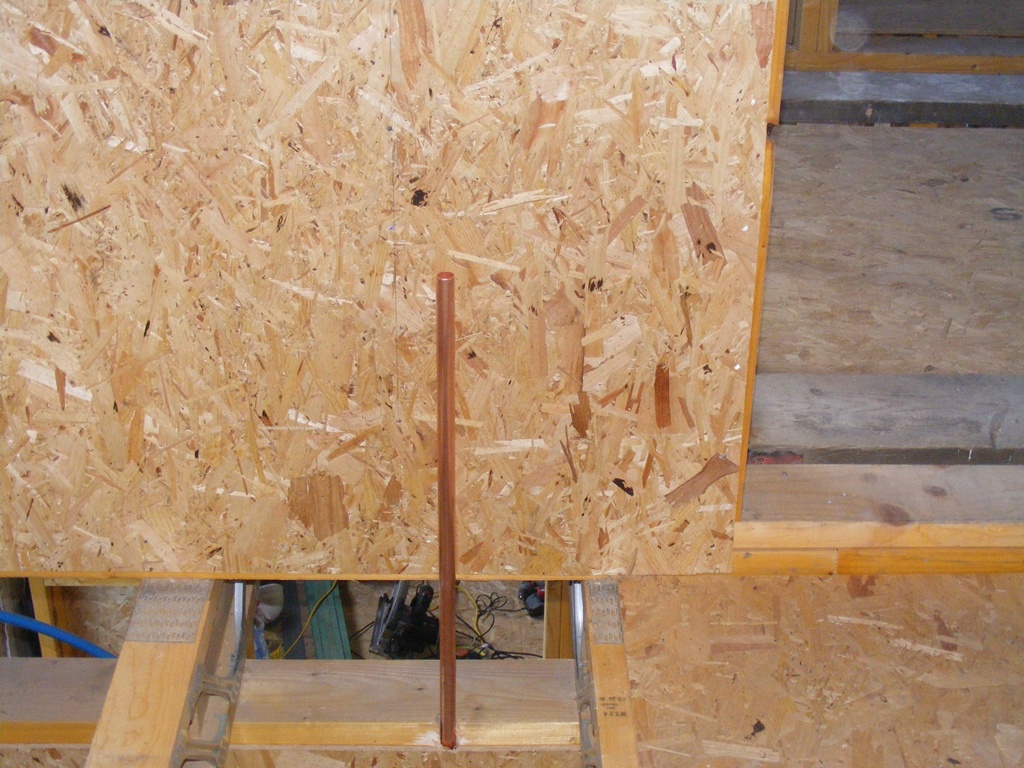
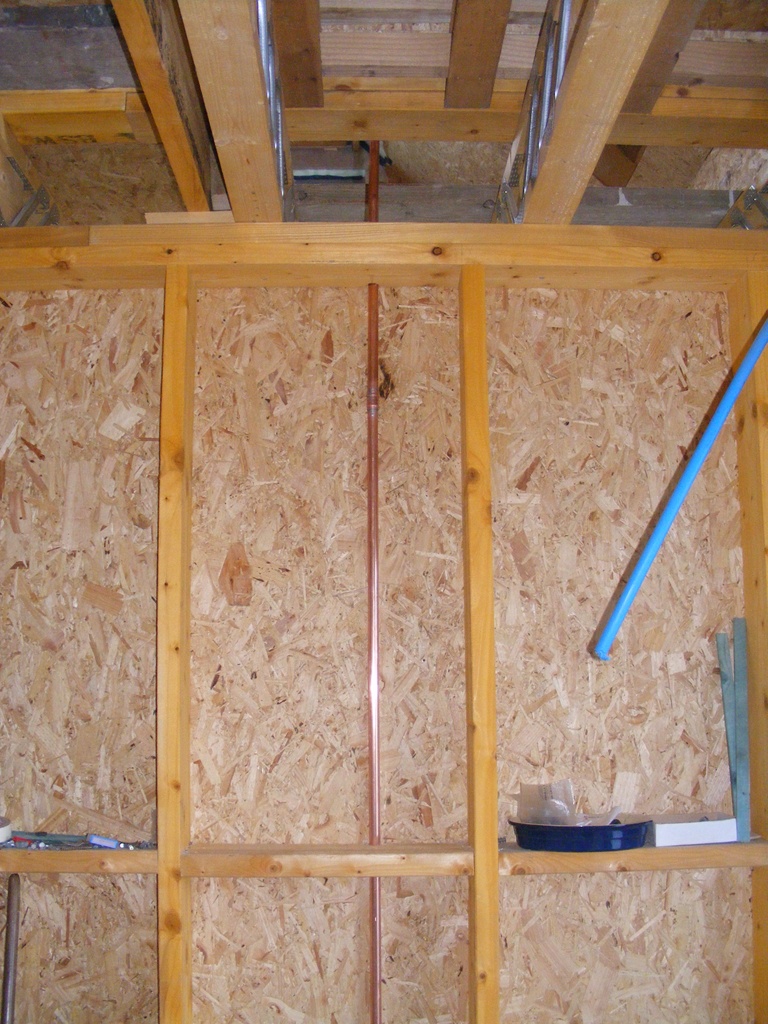
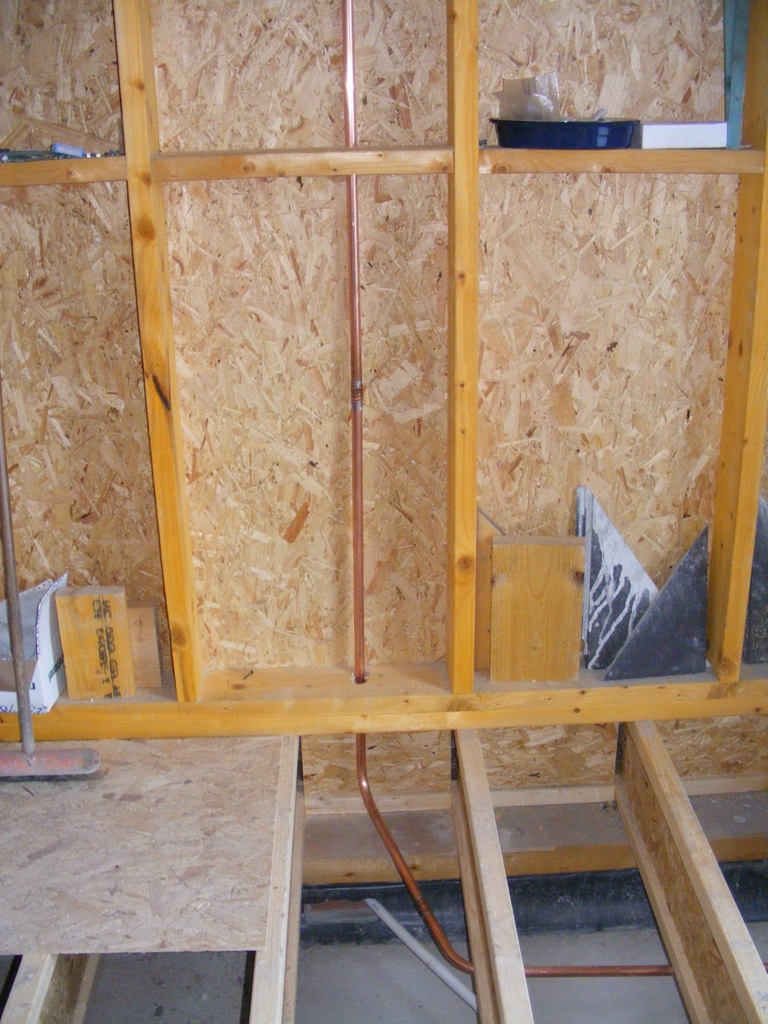
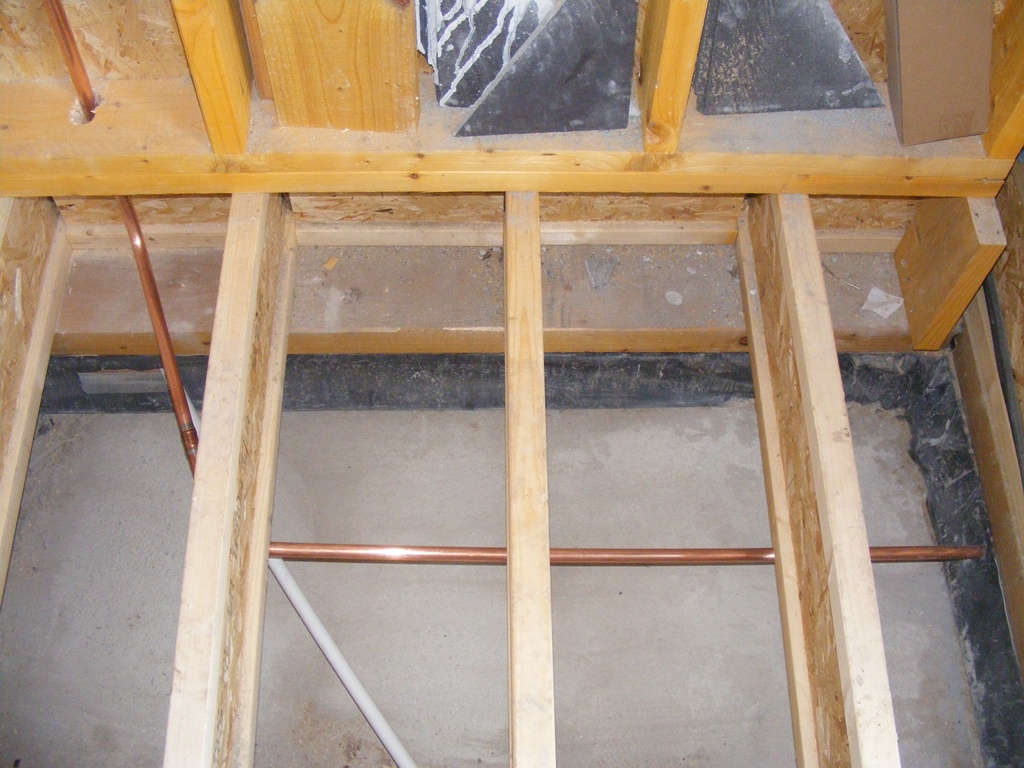
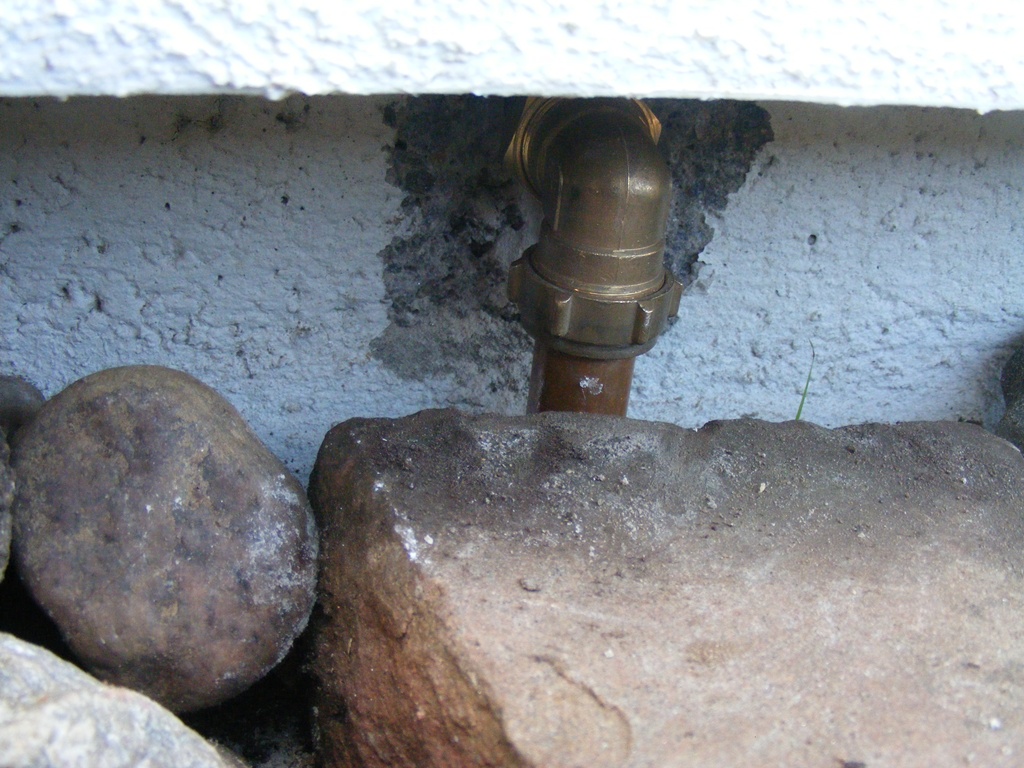
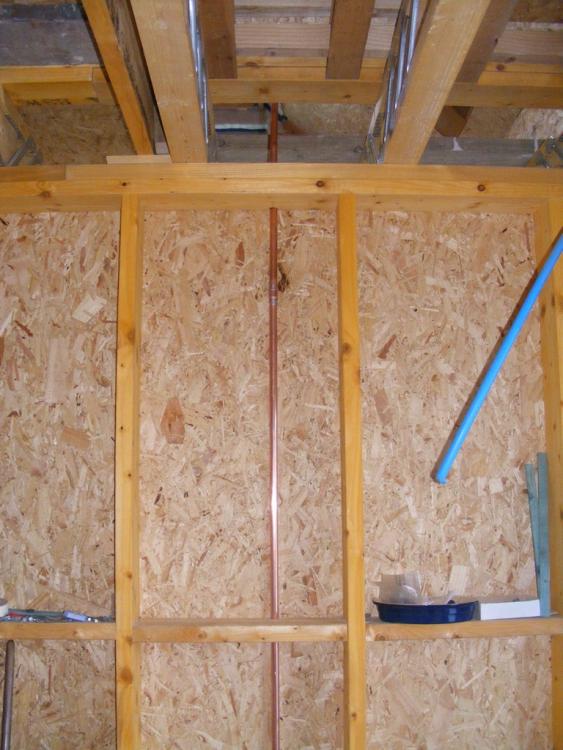
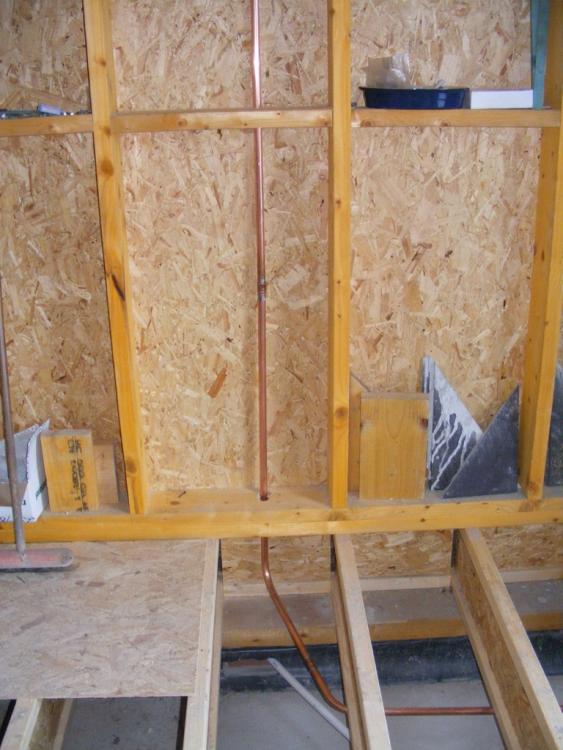
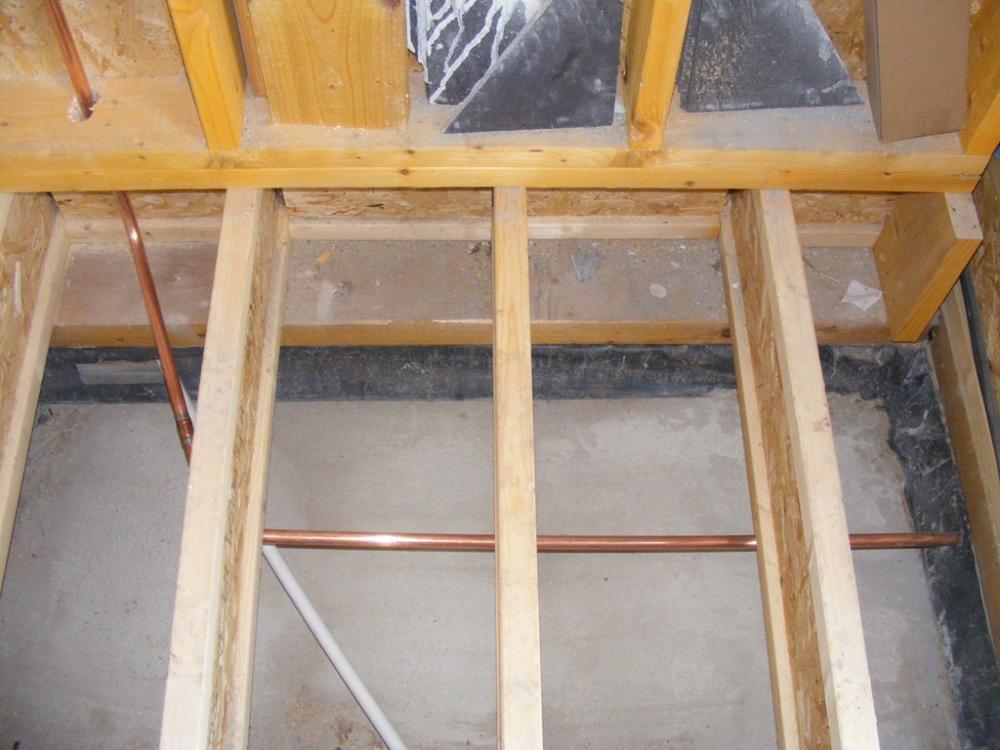
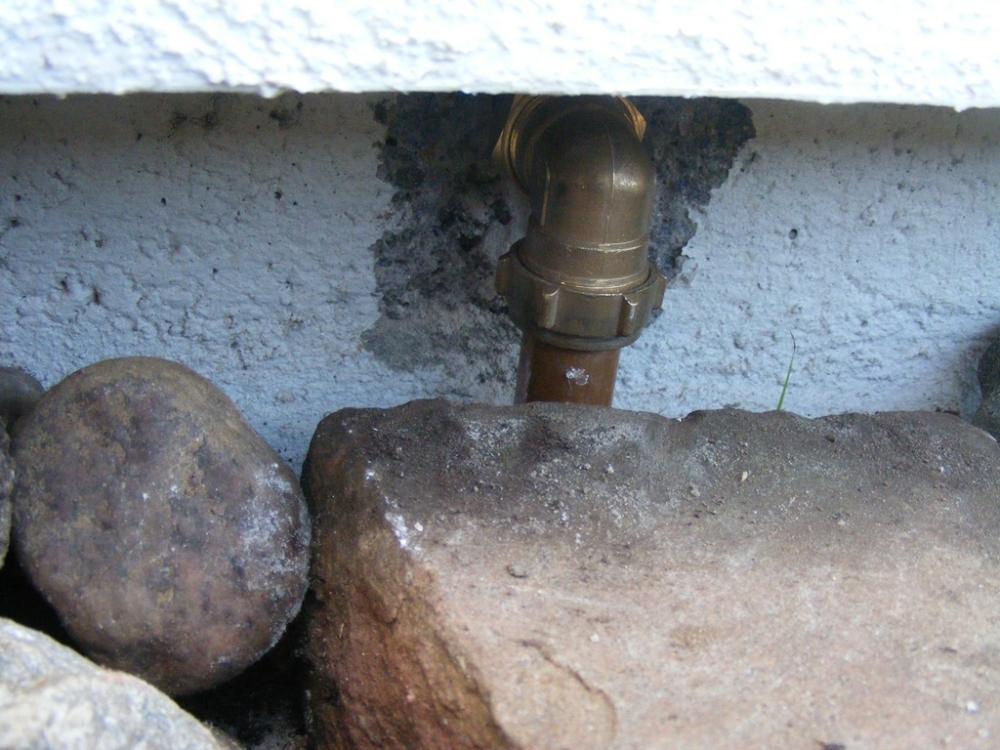
Here you go: The pipe starts in what will be the airing cupboard, 400mm above the floor. I expect the tundish to fit straight onto this. Then it runs down inside an internal wall Then under the floor and out through the wall just under the sole plate Where it discharges into the French drain around the house with a short discharge pipe down into the stones so you can't put your finger under it. All under the overhang of the EWI I have ran the hose into it and it runs free without backing up and discharges with a satisfying gurgle into the French drain. 5.5 metres of pipe, 3 bends @ 0.8M per bend = 7.9 metres. Even if you counted the very slight set to kick it out from the wall as another "bend" it would still just be okay at 8.7 metres.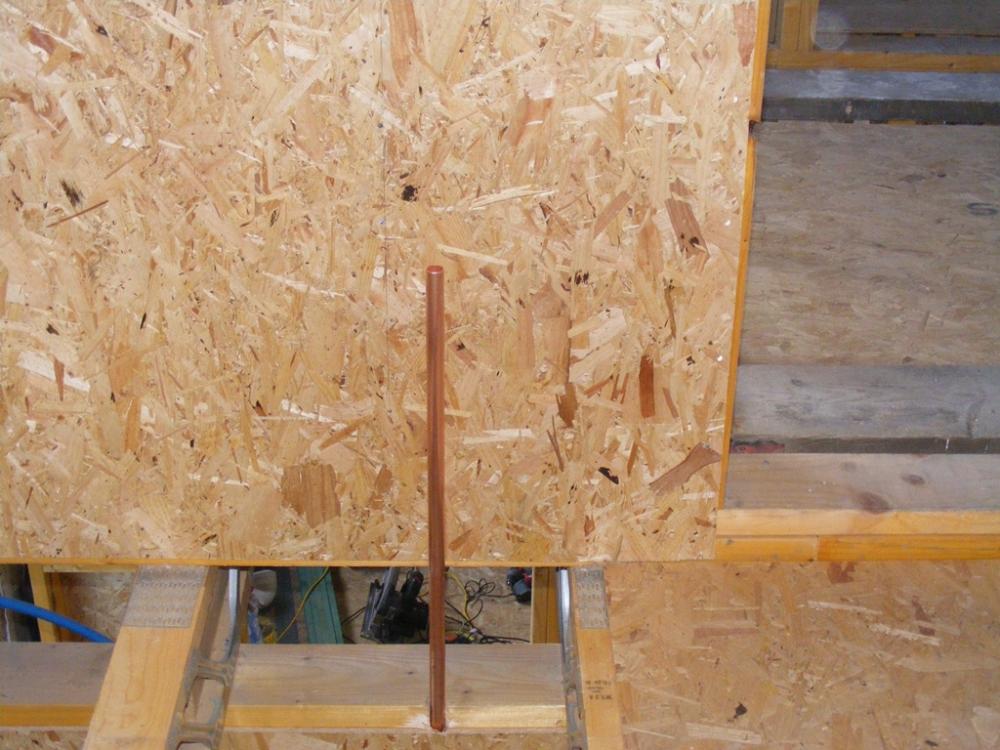
-
Fit the battens at 450mm. Screw the back boxes onto the battens and run the c ables horizontally clipped to the battens. That puts the cables in a safe zone. If you have the battens above the socket, you would have to clip the cables underneath the batten to stay in safe zones, altogether much more fiddly. P.S it's only 400mm in Scotland.
-
Hi and welcome to the forum. I think I could have guessed from your user name where you were located. You are in good company there with lots of local knowledge available. And there are several on here using, or about to use ASHP's etc.
-
Indeed. I could do the entire ground floor of our house as one ring final and still be within the limit. But I won't it will be split in two, then a third for the garage. Our present house (remember it's a B&B) has separate circuits for the guest rooms so if a guest plugs in something dodgy, it does not trip our personal circuits.
-
The joists go in as the frame goes up, so the upper floor frame sits on the joists. Same is true of the internal load nearing walls. I have chosen to build the non load nearing walls straight off the joists so the flooring will go in around them. A lot of joiners will put the floor in first and build the non load bearing walls off the floor as it's less cutting, but I like being different.
-
We had temporary OSB flooring to work from but that has mostly gone from upstairs now (in use downstairs now) so I now have bare joists. Rather than fix the t&g flooring properly I will probably loose lay it for now as a temporary work platform and only fit it properly once the ceilings are up and the accoustic insulation rolled out.
-
Where does it run OUTSIDE. How about a NEW drain from the new WC outside, and join into the nearest inspection chamber? I still don't see why you insist in doing it from a crawl space rather than lift the floor boards around where the stack goes down?
-
Round here, when a tree comes down on the minor roads, it's a free for all, bring your chain saw and help yourself. I doubt the council ever get involved except perhaps on the main roads.
-
Unvented Cylinder D2 discharge pipe calculations
ProDave replied to ProDave's topic in General Plumbing
It will be pretty much straight down vertically 3 metres from the tundish (VERY slight set then opposite set in the pipe to kick it out from the wall very slightly so I am ignoring that) then 90 degree bend, 0.5 meter horizontal * , 90 degree bend 1.5 metre horizontal out through wall, 90 degree compression elbow (as I am not trying to solder there) * All "horizontal" runs will be set to a slight fall. All bends apart from the last elbow formed in the Hilmor. The final horizontal / slight fall section is just to ensure the pipe comes up through the floor in front of where the cylinder will go. I could shorten that if I had to and have the pipe rise up closer to the front wall and come up alongside, rather than in front of the cylinder. -
Then the sail boat won't go far either way before having to drop the mast. A bit of a pointless place to keep a sail boat unless you are happy to short tack up and down the same short bit of river, or have a very eficcient way to drop it regularly (think Norfolk Broads sail boats with counter ballanced masts)
-
Where abouts is the picture taken. I am more intrigued by the small sail boat with his mast up. I don't suppose he can get very far? Which river is this?
-
I am minded to leave my floor boards lose laid for the time being upstairs, so after I have plasterboarded the ceilings, I can fit any accoustic insulation from above before the floor goes down for good.
-
I want to buy some pipe and install this tomorrow so I can get on with my flooring. I need to check some calculations. I was going to play safe and pipe it in 28mm copper. Until I realised I don't have a drill bit to drill a large enough a masonry hole for 28mm. So I am looking for the exact "rules" for the D2 discharge pipe. A quick gogle finds this, for NI http://www.buildingcontrol-ni.com/assets/pdf/P1994.pdf I would have thought it was the same rules in all parts of the UK From that, table 4.1 says if my D1 pipe is 15mm (which it certainly is on my present UVC so is reasonable to assume it will be on whatever one I buy for the new house) then I can use a 22mm D2 pipe up to 9 metres long. Each bend counts as 0.8 metre, and I can do it in 3 bends, so as long as my pipe run does not exceed 6.6 metres then 22mm will be fine. I am confident I can do it with 6 metres of pipe. Can anyone confirm this is so or correct me please?
-
Modern houses with a sealed envelope and all services within a void inside the insulated shell do not pose any issues. Regarding accoustic insulation, to be perfectly frank that's a building regs requirement that I am paying lip service to. I don't want it, it gets in the way, it's expensive and horrible to install. but I must have it. I will absolutely not pass cables through accoustic insulation, where a cable has to go, there will be a gap in the accoustic insulation. End of. I have installed a cable this week for the kitchen island. It will only serve one of those pop up socket things, and the ignitor for a gass hob, and will be a radial circuit on a 16A rcbo. But because it passes down through the 300mm floor insulation, along under the floor, then back up through the 300mm floor insulation, I have run it in 6mm. This will be the only cable passing through the building insulation as it's the only route to the kitchen island (well apart from burying it in the screed with the UFH pipes!!!!!)
-
If that really is a crack in the hull, what's keeping it afloat?
-
It's a grey area. On a new supply one man will install the supply, then a second person will install the meter (often not even on the same day) Last supply move I did (temporary building supply moved into the finished house) we were told one man would move the supply in the morning and a second man would be along to move the meter in the afternoon. But the first man moved the meter as well and I had it all connected up tested and working before the second man eventually arrived. He cut the first man's seals, checked the connections and re sealed it again then went off for an early finish.
-
A tree up here came down a bit like that a few years ago. I cut off all the smaller branches that were hanging down and then people with small cars were driving underneath it, until someone with a bigger chain saw than me came along.
-
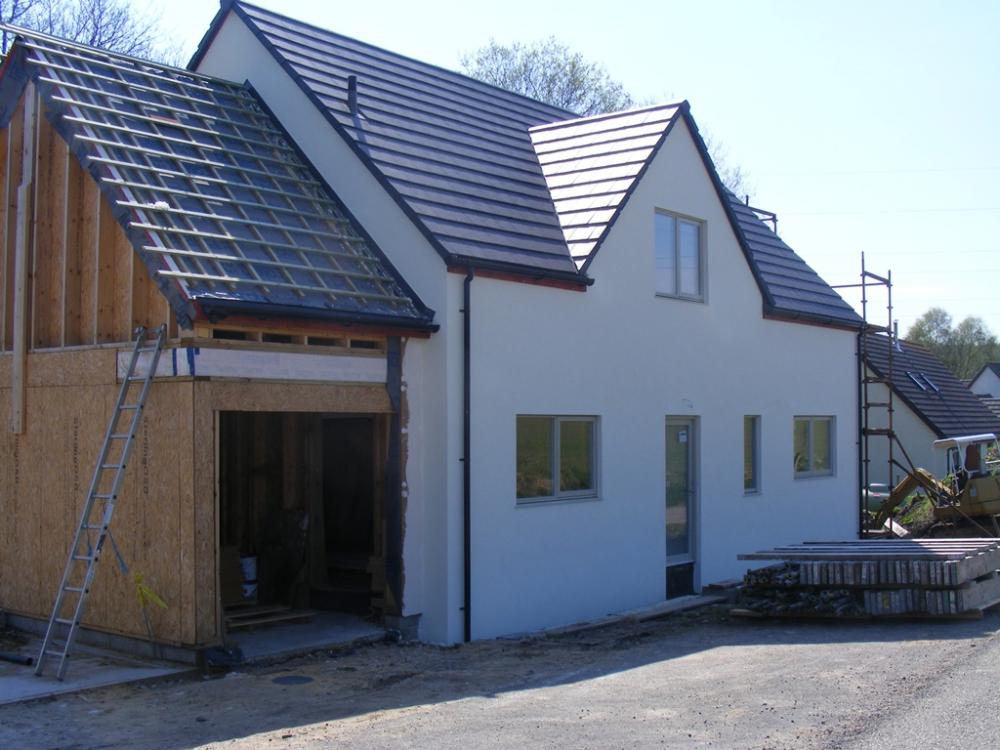
Yes, just to clarify, my BC inspector argued the far end of the drain run must vent to atmosphere. The treatment plant end is ventilated at the plant. I had continued my drain run to serve our static caravan (which is going to remain) and provisioned a vent stack there, thinking that would be sufficient. The BC officer argued someone might remove the 'van and cap off that run of drain. He would have accepted a stack up the gable end of the garage and then allowed just an AAV in the house with no roof penetration, but by this point that was already concreted over as a car parking area so it was too late to install that vent stack so begrudgingly I have vented the pipe through the roof. Being closer to the ridge I don't think it looks too bad.
-
What I mean by run it up inside I thought was obvious. I assume it comes up iin the corner of that front room, so instead of taking it straight up out of the roof, bend it at 45 degrees and follow the roof line up inside before turning again to exit higher up. My BC inspector would not accept an AAV. What he would have accepted had I known at ground works time, would have been an extension to the drain run feeding a vent pipe running say up the gable end externally, then he would have accepted an AAV inside.
-
Take it further up inside the roof, exit higher up where just a short pipe is needed as you will be above the window heights. Even take it to the back and exit just below the ridge?
-
Eerie calm day up here. A light dusting of snow this morning.
-
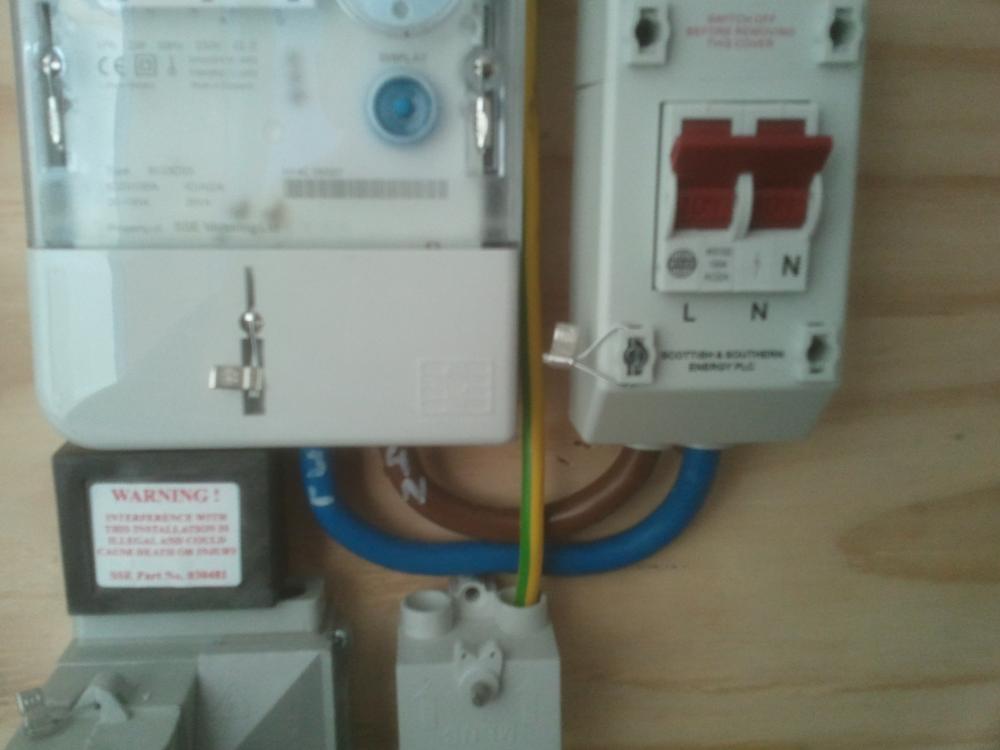
That's the "fault" he labelled the tails backwards. Yes they are double insulated, the DNO up here often uses tails where both the inner core and the sheath are coloured according to function. It's a well known fact that you used to be able to sell red/black cable on ebay for more than the price of new cable. I tried it once, I had some 10 metre lengths of 2.5mm red/black t&e that I pulled out of a rewire, and indeed they sold for more than the cost of new cable.
-
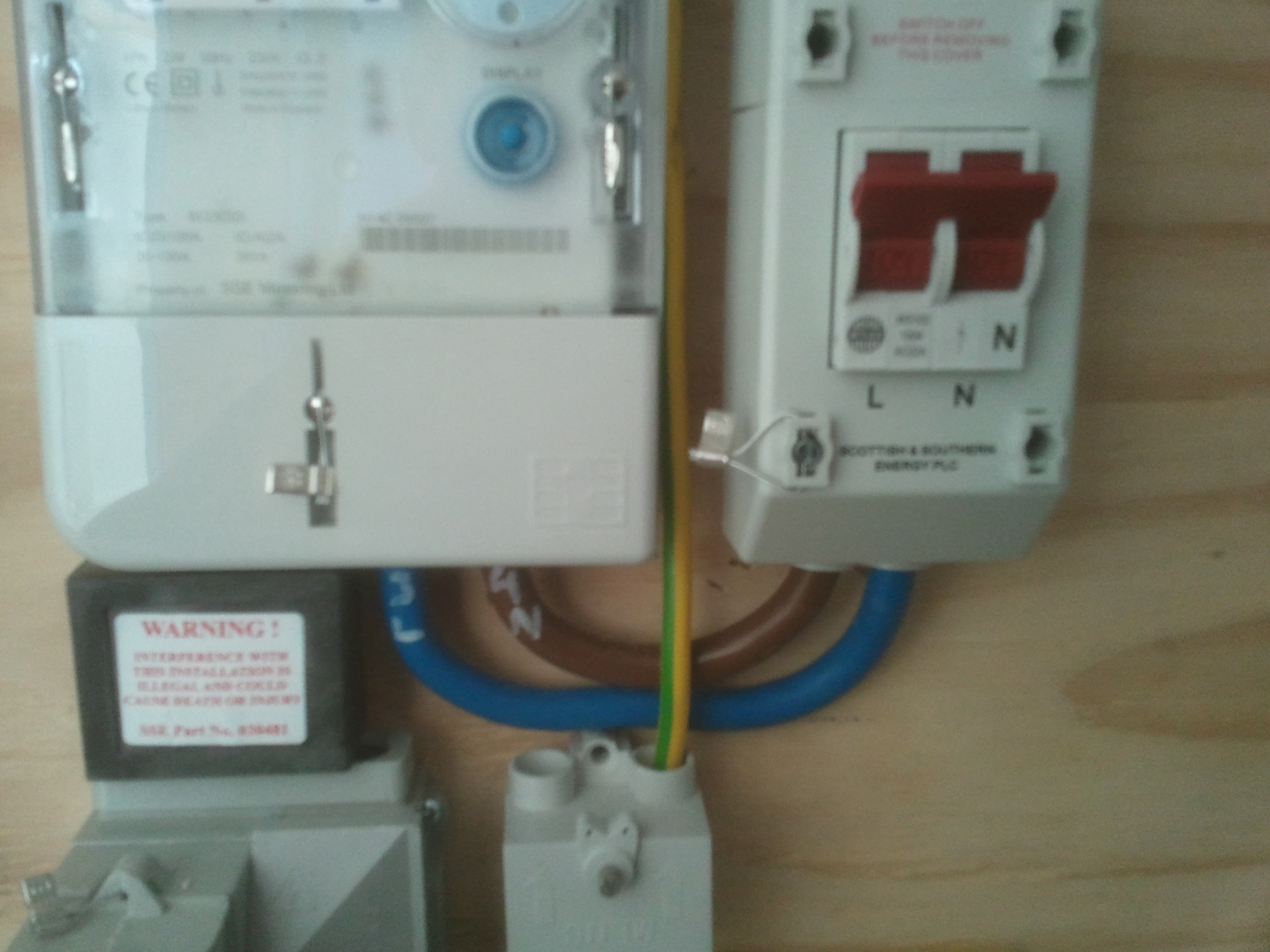
I would have thought in the process of the move, the DNO would fit new coloured tails between the head and the meter. Make sure the electrician fits new coloured tails from the CU ready to connect to the meter. The change of colours bugged my on our present house. When I started wiring it, you could only buy red/black. By the time I finished wiring it, you could only buy brown/blue, so it's a mix if the two, with the obligatory "2 colours sticker" I hope you get a better "meter monkey" than my neighbour got. Spot the error.
-
I like Jeremy's idea of discharging into the lake, if you can get permission for that. It would solve a whole host of problems and be a simple reliable solution. If doing that, I would install an air blower type treatment plant. When I was researching for mine a couple of years ago now (so others may have come to the market since) I found the three best ones were the Vortex, the Biopure and the one I fitted, the Conder. These all had very similar levels of cleanliness of the effluent and were way ahead of any others that I found at the time.
-
Why not just remove the floor boards next to it so you have proper access for the grinder?