
ProDave
-
Posts
30683 -
Joined
-
Last visited
-
Days Won
424
Everything posted by ProDave
-
The IR thermometer says the actual butter temperature is also 20.5 degrees. I guess I need to return the butter dish to the stone worktop, wait for temperatures to equalise and re measure the butter temperature.
-
One of the advantages of a well insulated house that never goes cold overnight when the heating is off, is that the butter in the butter dish in the kitchen remains at a spreadable temperature. Only it has stopped doing that. The reason, is just before Christmas we has the granite worktops fitted in the kitchen. The butter dish sits on that worktop, and now it's just a little too hard to spread. So I tested the theory and moved the butter dish to the island, which has an oak worktop. The butter has returned to being spreadable. According to my IR thermometer, both the wooden and stone worktops are sitting at room temperature of 20.5 degrees. If you hold your (warm) hand on the stone worktop it feels cold, but that is because of the higher thermal conductivity compared to wood, so it sucks heat out of your warm hand quicker than the wood does. But the butter is not generating heat. So how can it be soft when sat on one 20.5 degree worktop, and hard when sat on a different 20.5 degree worktop? The question follows on to SWMBO wants stone shelves when we build the larder to "keep things cool" I had previously dismissed that as an old wives tale. But now I am not so sure? P.S. Leave a cup of tea on the stone worktop and it is cold at the bottom. Again I understand that, the heat from the tea is being conducted away into the room temperature stone.
-

Changing door to terrace to locked access hatch?
ProDave replied to jack's topic in Building Regulations
I don't think locking a door will satisfy BC. We are likely to have the same issue that I will probably want to get completion before the balcony is built. The only solution I can see is a fixed ballustrade 1100mm high across the opening, that will be removed once the balcony is actually built. -
Changing door to terrace to locked access hatch?
ProDave replied to jack's topic in Building Regulations
It becomes hinged or moveable the day after sign off -
Switchable power to every room?
ProDave replied to puntloos's topic in Networks, AV, Security & Automation
Many of us have come across the "lollipop" circuit, which you won't find in any manual. Typically a redundant 6mm radial to a kitchen, with a mini ring final stuck on the end. -
The incoming cable to the site will almost certainly be PME with the inner core as L and the outer as a combined N and Protective earth (PEN) It will look like "1 wire" up on a pole.
-
Water is deepest at 900mm, so it was handy that SW gave the cheapest road crossing quote. I installed a black duct for the electricity, all the way from the joint hole, to my meter box, with a draw string, so SSE just had to pull their cable through and terminate it. I installed the grey duct and SWA phone cable that Open reach had supplied from the joint hole up into the house. No complaints from anybody.
-
The top one is a multicore LV (230V) distribution, and the lower one is BT Lets hope you are not stung for the cost of a new pole, it seems cheeky to possibly be charging you for that.
-
That sounds expensive unless you have a lot or large windows. I had a quick look and those did not look in any way special to me, not even a triple glazed option. Have you looked at the likes of Rationel who do wooden windows?
-
A better picture would be interesting. The 2 cables appear to be different sizes? A picture of where the wires join the poles in both directions might make it clearer.
-
That's an unusual case. It's a long time since I have seen individual cores for LV distribution on a pole like that. That is indeed single phase 11KV at the top.
-
You might look at other options for the road crossing. You can get any contractor with a street works permit to make the road crossing, but when I enquired I could not find a contractor cheaper than SSE The road opening permit is interesting. I was told all the utilities have a permanent road opening permit, so don't have to apply for one for each job, which is one thing that is against a private contractor. Before you make a decision, do you need any other services across the road? In our case water, electricity and telephone had to cross the road, and in fact Scottish Water gave the cheapest price for the road crossing so they installed the water and made the road crossing first, and in the process we installed ducts for the telephone and electricity across the one road crossing.
-
If it is overhead lines, if there are 2 cables it is single phase, if there are three, then it's 3 phase. Assuming a new build with a half decent amount of insulation a single phase supply is plenty to run an ASHP and all the other stuff you want. e.g. our ASHP is rated at 5KW so will rarely draw more than about 2KW of electricity or about 8 amps. There is probably only a compelling need for 3 phase if say you have some machine tools that need it, or you are likely to want a LOT of solar PV. If you only have a normal amount of solar PV then splitting the house load between 3 phases makes it harder to self use all that you generate. It cost us £1K for the electricity connection and £1K for the road crossing under a single track road, so your £10K sounds expensive, but it depends exactly what work is needed (e.g new transformer etc) Have you got an actual quote yet or is that figure hearsay?
-
I am sure I posted here when a neighbour had the same. She now lives in fear of vermin getting in again and more leaks. I have never personally been a great fan of plastic pipe, I have yet to see a mouse chew through copper pipe. In our previous house they got into the cold loft by climbing the rendered walls and in through the obligatory roof vents. No way to stop that. The only "solution" was regular doses of poison in the loft. If one dies in the house you know it with the smell. Usually though they go outside to die. I am now firmly converted to thinking a warm roof is a FAR better idea. At least you can properly seal that making it physically 100% closed off and air tight with no vents needed. We have not had any in the new house, though just before christmas for a few nights we heard one we think was under the roof tiles scurrying around trying to find a way in, but failed.
-
So you are going to have an issue with MVHR vents etc as well?
-
(smart?) things that should be in every room
ProDave replied to puntloos's topic in New House & Self Build Design
multiple cat 5's was an attempt at future proofing. More for non network stuff, e.g 2 cat 5's and the right adaptor at each end = an hdmi link. The spare cat 5's just might do when the next thing after hdmi comes along and I want the next tv standard linked back to my AV cupboard. -
(smart?) things that should be in every room
ProDave replied to puntloos's topic in New House & Self Build Design
And you believe that? -
Switchable power to every room?
ProDave replied to puntloos's topic in Networks, AV, Security & Automation
Our house has what are becoming considered "old fashioned" ring finals for the sockets, we have three, one upstairs and 2 downstairs. Lights are one upstairs, one downstairs. Then there are separate circuits for ovens, hob, smoke alarms, ASHP, immersion heater, treatment plant, provision for panel heaters (unused) etc. If you opt for separate room circuits, why do you want them remotely switched? When will you ever use that? Why not a decent sized consumer unit and a lighting circuit and radial socket circuit for each room? Why make it more complicated? -
(smart?) things that should be in every room
ProDave replied to puntloos's topic in New House & Self Build Design
I put multiple CAT5 cables to every room, Currently only ONE is in use, to give a hard wired ethernet to the desktop pc. The rest are there for "the future"? I am not convinced ceiling speakers will please my ears, I opted for traditional proper hifi speakers in the main rooms. I have burried hdmi cables to the main tv's to put most of the "tv boxes" in the under stair cupboard. My only concern going forwards is what will be the next must have cable after hdmi? That's when I find out if my planned route to pull a new cable through works or not. Put in MORE than you think you need. Don't forget surround sound speaker cables for the main room(s) I am not a fan of a spy in the room that you talk to to do things (and listens to you all the time). I am too much of a dinosaur. We have hard wired wall thermostats in the three downstairs rooms and a simple heating programmer on the wall in the utility room. I wired a dual rate electricity meter specifically to meter electricity separately for heating and DHW use by the ASHP so I know the exact running cost of each. -
I have an outside tap (in a shed) that stopped working after it froze one year. I have never bothered to investigate yet why. I refuse to believe it is an air lock that the mains water pressure cannot push through so I am assuming something has broken within the tap in my case. (I just get a dribble when I open the tap) I will be interested in any other phenomena that can stop water flow when it freezes that won't re start when it thaws. Tip for the future. If freezing is likely, leave the water running through the pipe (and overflowing somewhere safe)
-
Solar DHW with UniQ and PV Diversion
ProDave replied to DamonHD's topic in Boilers & Hot Water Tanks
The balance on the equations of how to use solar PV electricity took a radical change earlier this year with the closure of the solar PV Feed In Tariff system. New installations of solar PV will not get any payment. Though there is supposed to be an export payment scheme starting up any time now * So anyone, like me, installing solar PV now has to be sure of two things. Firstly the install cost has to be cheap. That pretty much as far as I can see means scouring the country to get the kit at rock bottom prices, and installing it yourself to avoid labour costs. Secondly you need to use near 100% of what you generate in some productive way. I got an installed cost of a 4KWp solar PV system down to £1500. I am working on self using £250 per year worth of solar PV electricity and that will give a system payback time of 6 years, after that it will be a £250 per year saving on my energy bills. Unless you have some unusually big and constant load appliances, the ONLY way you will get close to 100% self usage is to dump "spare" solar PV power to water heating or batteries. I chose water heating. Batteries, when I last looked were too expensive. But knowing what I know now you don't need much battery capacity to soak up excess generation that you can't use in real time, so I am expecting at some point batteries will become viable for me. * The new export payment scheme coming into force will only pay for what you export, not what you generate, but only at a rate of around 5p per KWh, not much more than 1/3 of the import rate. So you are still better off self using than letting it export, even with the payment. Also in order to sign up to the new export payment scheme, you would have to have had the system installed by an MCS installer. That rules out DIY install and for me would have made solar PV completely impractical with a ridiculous long payback time. If I had been eligible for this scheme, my payment for the first year would have been less than £10 -
Relatives working on site.
ProDave replied to ToughButterCup's topic in General Self Build & DIY Discussion
I have mostly given up on self DIY motoring, apart from routine things like an oil change, or tinkering with my Landrover. I think the point at which I gave up was when the alternator went on a VW Touran, and I peered down the tiny gap between the side of the engine and the side of the inner wing and thought "someone else can rap their knuckles trying to undo bolts in that stupidly small gap" -
The solution to that is put one of the plugs away out of sight, to emphasise that the half bowl is only for rinsing stuff, not for soaking stuff.
- 71 replies
-
- 1
-

-
- kitchen sink
- kitchen
- (and 1 more)
-
Relatives working on site.
ProDave replied to ToughButterCup's topic in General Self Build & DIY Discussion
For a bit of light relief. This was the extension lead I found IN USE by the roofers at a new build house I was wiring, feeding from a 240V generator to a tile cutter in use on the scaffold.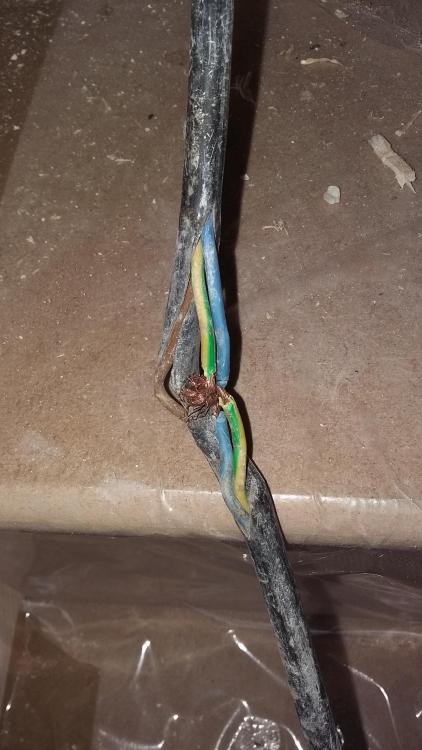
-
I would have thought a 10M head would push any air lock through. I would be more concerned you have a blockage?