

ProDave
-
Posts
30688 -
Joined
-
Last visited
-
Days Won
424
Everything posted by ProDave
-

Problems with Baumit.com thin coat render system - part 3.
ProDave replied to ProDave's topic in Plastering & Rendering
We are not West Scotland, we are 20miles north of Inverness, closer to the East coast / Black Isle. I did see an exposure rating written down somewhere I will see if I can find it. -
I would definitely say fit MVHR. Apart from the energy saving aspect by ventiliating your house with little heat loss, it's other big advantage is the air is always fresh and stale smelly air constantly removed from kitchens and bathrooms. the house never smells or feels stuffy and never has problems with condensation. I would say in your case it is a must have.
-
Semi-final plans --- feedback/critique welcome!
ProDave replied to RK6's topic in New House & Self Build Design
What's the reason for the driveway going up a hill, round the top and back down again? It would be a lot easier to turn right and straight round the bottom where it is nearly all level to the garage before excavations? -
Well done. Advise the owner to give them a good scrub before use.
-
Problems with Baumit.com thin coat render system - part 3.
ProDave replied to ProDave's topic in Plastering & Rendering
I have just sent an enquiry to BBA -
Problems with Baumit.com thin coat render system - part 3.
ProDave replied to ProDave's topic in Plastering & Rendering
I witnessed most of the install, though not watching them like a hawk. All the correct layers were applied in the correct order and in good dry weather. What I did not check was things like were each of the layers applied to the correct thickness? Yes that is my concern, that the system simply can't handle this climate. But if it is a German system sold in many countries, I cannot believe I am the first to try it in this climate. Yes I would like to know when , why and by who was the BBA certificate withdrawn. That alone suggests somebody somewhere know there are certain issues with this system, and I would like to know that information. -
Problems with Baumit.com thin coat render system - part 3.
ProDave replied to ProDave's topic in Plastering & Rendering
If I knew what would stick, and not look silly (clear coating perhaps?) then I might be willing to give this a try. But I would rather hear that from the manufacturer, or someone that has solved a similar problem by painting it with some form of sealant. -
Careful. The pedestall might well be taking some of the weight of the basin. Of you had an assistant who could take the weight while you pull the pedestall out and undo the trap that would be the easiest way.
-
Trimming a door to size: lipping thickness insufficient
ProDave replied to ToughButterCup's topic in Doors & Door Frames
These will do (serious suggestion) https://www.completesafetysupplies.co.uk/protective-footwear-c68/food-environment-wellingtons-shoes-c143/click-work-safety-slippers-steel-toe-cap-white-p1328 You get some interesting hits searching for "steel toe slippers" P.S Note to readers of this thread. Set your door frames high enough to allow for carpet and underlay right from the start (Sorry Ian) -
Trimming a door to size: lipping thickness insufficient
ProDave replied to ToughButterCup's topic in Doors & Door Frames
Can't help with the door trimming. A second new pair of slip on safety boots for "indoor use only"? I learned very early on when I went self employed to wear slip on safety boots, so much easier when you have to take them off in a customers house. but then most of the time I am working indoors I do so in my "working slippers" (old worn out pair that are a bit tatty) -
Problems with Baumit.com thin coat render system - part 3.
ProDave replied to ProDave's topic in Plastering & Rendering
I really don't see the issue is coming from within the house. The whole inside is wrapped in an air tight membrane, and the way the mvhr has been set up the house is at a very slightly negative pressure, so even if there were a breach in the air tight membrane, nothing would pass out into the building structure. A condensation analysis was done at design stage and showed no risk. Last attempt at contacting the manufacturer got that passed to the UK agent to deal with who are the ones that fobbed me off with what looked very much like a standard reply, blaming workmanship. They did this just by looking at some photographs, not by visiting. In the past I have not been shouting the name of the manufacturer, hoping they would resolve it, but now I am not afraid to say it is BAUMIT.COM that manufactures this render system. Perhaps some bad publicity will make them take more interest? If I do have to contact the manufacturer again, I might just go straight to the CEO in which case a German translator might come in handy, thanks for the offer Ian. The issue is definitely related to water in the outer layer(s) of render and then freezing. Yes how the water got there is a question. My wind driven rain and pin holes in the top coat is one theory, I await others. but you would have thought an external render system designed for houses ought to be waterproof and frost proof? Or am I really the first person to use it on such a well insulated house that there is little heat escaping to warm the outside of the house, and in a cold climate prone to frosts in winter? -
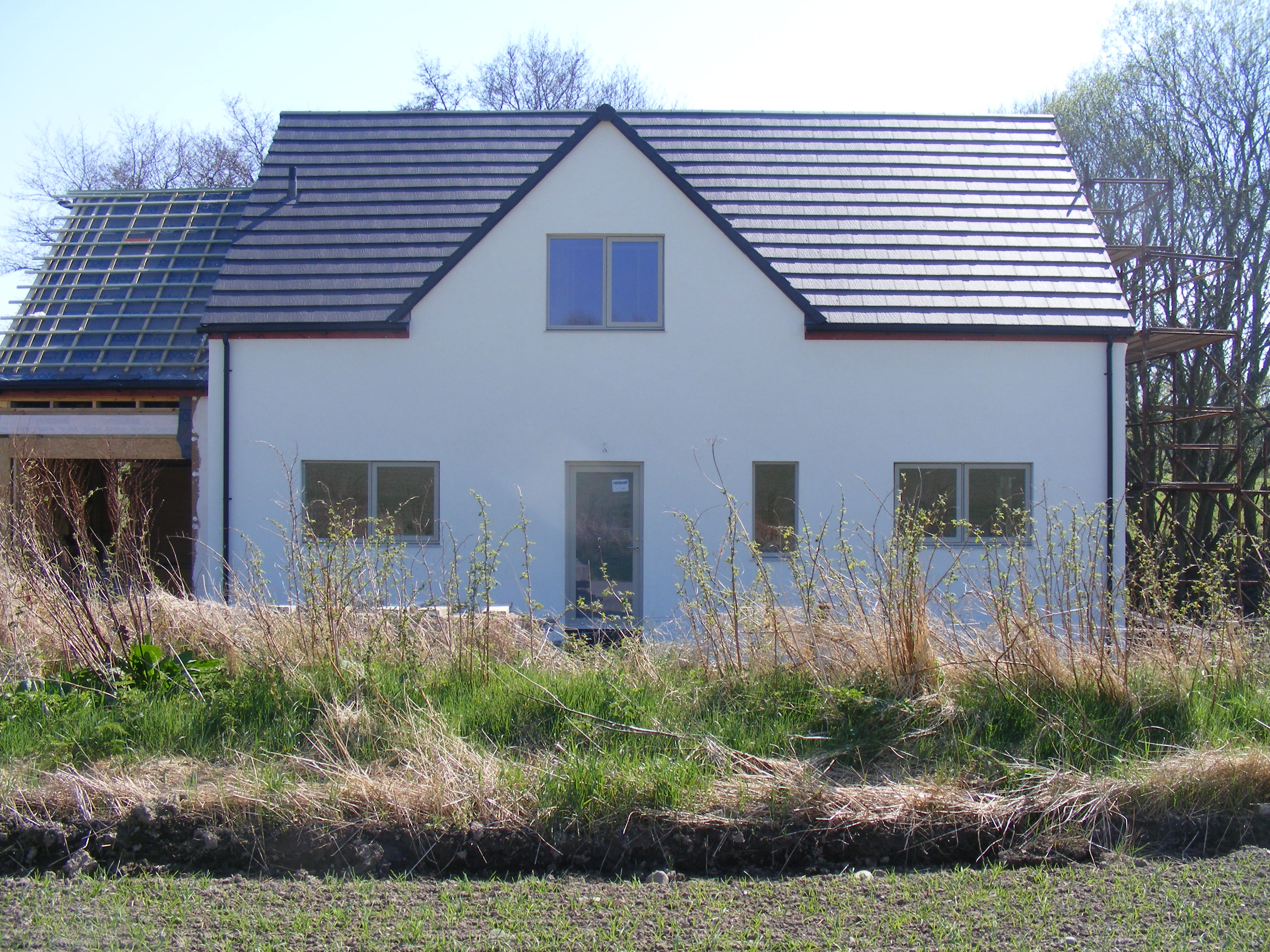
This is part 3 of this sorry continuing story. Part 1 was here where I described the problem and the total lack of interest from the manufacturer Baumit who would not even come and look at the issues to give any proper technical input into what went wrong or why. and just blamed poor workmanship. Part 2 was here, when our plasterer out of good will, not accepting blame, re worked the failed areas, and that thread includes some pictures of what we found and some speculation of what might have happened. So this is part 3. Going into the first winter after the remedial work, it is clear the problems are not over, and further failures are beginning to show. But also my understanding, or at least speculation of what might be happening is growing. A couple of weeks back we had storm Arwen, which lashed the front of the house with a lot of wind driven rain blown on gale force winds for a couple of days. Nothing leaked and all looked well. Until a couple of days ago it got cold here, well below 0 for 3 days. As is normal when it gets frosty, frost forms on the whole of the outside of the house (because it is so well insulated little heat is escaping) and what I noticed were a few "bulges" in the render on that north elevation. These bulges were solid, you could not press them in. Fast forward a few more days and it turned mild, the frost has gone and so have the bulges in the render. They look okay at the moment, but I suspect this is the start of the next failure. So here is my theory about what is happening: The wind driven rain from the north lashing on the rendered wall, some of it has soaked into the wall and into the base coat of render (in part 2 I posted pictures of parts of the top layer that were removed during the re work that had pinholes in them that would allow wind driven rain through) This now wet base coat of render has frozen and expanded, and while it appears to look okay for now after it has thawed, I believe this will fail in time now. If this theory is right, then it raises 2 issues: Why is the Silikon Top top coat of render not waterproof and allowing some water through when the rain is wind driven? And even so, why is it soaking into the base coat of render? The manufacturer, Baumit, say the base coat is waterproof and can be used on it's own without the top coat. That does not appear to be my observation. For the moment I can only watch and wait and see what happens, but it is not looking good. If this theory is right, it will explain why most of the issues with the render have been on the west facing wall, that is the one that gets the prevailing wind and will get more wind driven rain than any other elevation. The east facing wall which also failed, would have been lashed with wind and snow a few years back when "the beast from the east" storm hit us. The south elevation which hardly gets any wind driven rain has been almost untouched by these issues. Also worth noting, that the recent frozen bulges noted have been a little way up the wall, so I think this completely discounts Baumit's claim that the problem relates to detail at the bottom drip bead and water wicking up. If that was the cause, why no bulges at the bottom? And the new bulges are on parts of the original render that had not failed before, not on any of the re worked areas. This is where I really want Baumit to man up to their responsibilities as a manufacturer and come and give some proper technical input into the issues we are having. In the absence of that, my advice continues to be, do not consider using the Baumit.com thin coat render system.
-
Isn't that always the way when things go wrong.
-
Semi-final plans --- feedback/critique welcome!
ProDave replied to RK6's topic in New House & Self Build Design
Definitely bins next to the house and drag them up the drive on bin day. I am convinced my present car had a towbar fitted just for that purpose as it was not wired for towing electrics and the tow ball looked like new. You will need an outdoor clothes drying area for Scottish building regs. Of course you could take it down afterwards. -
Do you have any photographs of the work in progress to compare the good and bad areas?
-
So the cold room is an extension (either original or added on) It is starting to sound like they "forgot" to put any insulation under that floor and most of the heat is going down to heat the earth under the house? Is this a new house? old house? Who did what in terms of insulation and laying pipes etc?
-
Never believe delivery dates (whinge)
ProDave replied to Moonshine's topic in General Self Build & DIY Discussion
Should we make that the official forum motto? -
New door knockers for OnOff
ProDave replied to Pocster's topic in General Self Build & DIY Discussion
I thought it was some bizarre version of "strongest man" contest. -
It would fail in Scotland, perhaps the rules are less strict in England?
-
Optimizing LG Therma V Controller settings
ProDave replied to Hogboon's topic in Air Source Heat Pumps (ASHP)
I once tried turning on weather compensation on mine and the thing promptly switched to cooling mode. I just turned it off again, a project for another time....... -
Have you got a link? I presume that stays on when the spread comes and the "perforated" bit gets plastered over? and the middle bit is a blank to stop the hole filling up? does it work with any back box or does it incorporate the back box (can't see with the cover plate on)?
-
Who is asking you for this? That appears to be an English thing, asking for English plumbers, so point out to them that you are not in England so it does not apply to you.
-
I don't understand your logic? What's wrong with the £16.44 alarms I linked to and no more than £10 of cable to connect each alarm to the next one?
-
The requirements when I built mine (check they have not changed) was smoke alarms in hall, landing (within 3 metres of each bedroom,. may need to id a large landing) living room, and heat alarm in kitchen. So 4 alarms for a typical property. I chose to add additional ones not actually required, another smoke alarm in the utility room (I would rather know the tumble dryer was smouldering long before the smoke started coming under the door, shut to keep the noise in) and plant room (again it is remote I want an early indication of something hot and bothered) You will also need CO alarms for a room with a combustion appliance and a room with a flue passing through it. If cost is your worry, how does £16.44 sound for an Aico mains smoke alarm? https://www.ebay.co.uk/itm/174151783726 I but lots from that seller, always quick delivery and they a re genuine new, up to date units. Heat alarms I usually find about £30 and CO usually about £40
-
Notification of Statutory Undertakers?
ProDave replied to Tracey Gardner's topic in Party Wall & Property Legal Issues
This us a useful document to read https://www.sgn.co.uk/sites/default/files/media-entities/documents/2019-11/Dig-Safely-Measures-to-avoid-injury-and-damage-to-gas-pipes-170503.pdf


