

ProDave
-
Posts
30861 -
Joined
-
Last visited
-
Days Won
427
Everything posted by ProDave
-
My pet hate is stepladders that make the very top step look just like any other step, but make it out of weak plastic, and then in small writing state "no step" Of COURSE people are going to use it as a step. If you don't want them to step on it,make it so you can't step on it, otherwise make it strong enough to step on.
-
I would NEVER use one of those myself. I come from an engineering background and I like good reliable trustworthy mechanisms. With that type of ladder you have a hidden mechanism that locks the extended sections if the ladder in place. I climbed one once and was petrified that the whole damned thing might collapse with me on it as I could not even see the mechanism so have no trust in it. Others may have more confidence in them, but sorry not me.
-
 Pictures please?
 -
Post a link please, not sure what you are describing?
-
I would buy something like this https://www.argos.co.uk/product/2026659?clickPR=plp:1:3 Can be used as a step ladder, straight ladder, or offset step ladder on stairs. Mine are a much older variant on this design and both halves are just an ordinary ladder without that annoying bar on one section that makes it wider at the bottom. If you can find one the older design, imho it is better.
-
This is a catalogue of failures at all levels of the project. The obvious fact is 8 square metres of additional brickwork is going to weigh a lot more than the same area of glazing and the original foundations have started moving under that additional load. Digging a trench a pouring additional concrete alongside the foundations is not underpinning. Underpinning is digging deeper under the foundation and pouring extra concrete underneath to make the foundations deeper, and for obvious reasons it is done in sections allowing time for each section to cure. And building control seem to have been negligent not ecen entering the property to look. As to who is too blame, collectively they all did it wrong. Which one to put it right? I don't know.
-
I've not seen one of those for over 30 years, and they were considered old and obsolete then.
-
That is part of the problem. The sheer number of fixed rate mortgages mean for many the rate rises have not taken effect so no wonder it has not had the desired effect. So rather than wait for it to ripple down, they raise rated further because it "has not worked" Again that shows lack of understanding. Lets raise interest rates it's what we have always done...... Fixed rates were not a "thing" in my day.
-
As usual we have opposing "needs" pulling in different directions. I have never thought raising interest was a good tool to slow an economy. Perhaps that is because I have always (apart from a mortgage) worked on the principle of save up to buy something, I don't borrow money to buy things. So if interest rates go up, it is not going to stop me buying things. When I had a morgtage the payments would go up so yes I would have less to spend, so perhaps that slowed my spending? but i remember at the time late 80's early 90's job security was my biggest worry so I never spent much anyway trying to build up a buffer of savings, or pay down the mortgage quicker. So interest rates are going up to slow the economy. The news then starts telling us how bad that is that mortgage and rent payers will have less to spend. Isn't that the objective? Then they start talking about ways the banks should be helping borrowers like switch them to interest only. Well if you "help" them you diminish the effects of the rising interest rates which surely will mean inflation does not fall so rates will have to go even higher? Then a reporter says "so you are trying to slow spending and reduce inflation by causing a recession"? the BOE bloke blustered and stuttered a bit, of course not. Then there was muttering about the cause being businesses who want to get back to profit (of course they do) and workers want their wages to keep up with inflation (of course they do) and this should all be stopped. So they WANT us all to become poor and struggle thus stop spending = that recession. You might gather I don't have a lot of faith in those in command.
-
Councils banned from charging for....
ProDave replied to Gone West's topic in General Self Build & DIY Discussion
Does this mean they will also ban the silly process of having to register and book an appointment to take stuff in a trailer? (I can't be bothered with that, my old Landrover is handy for taking stuff in it or on it instead of using my trailer and normal car) I have argued before that if they put hurdles in the way of people responsibly disposing of waste, then they should not be surprised when there is more fly tipping. -
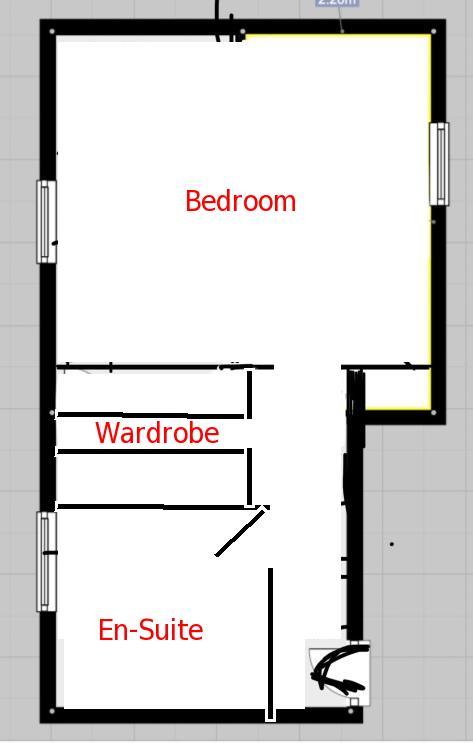
This just makes so much more sense to me, Bigger bedroom, good size bathroom and wardrobe. I tried to describe it earlier and failed, so now a very poor sketch to illustrate my thinking.
-
Primrose Electric awning repair - anyone done it?
ProDave replied to Radian's topic in Electrics - Other
Personally I would take it off the wall, then take the motor out, then dismantle the motor assembly. I would bet in there you will find a failed start capacitor, hence it hums but does not spin. -
can someone share a Howdens account?
ProDave replied to johnhenstock83's topic in Kitchen Units & Worktops
I have a Howdens account as a sole trader. As they advertise "Trade Only" you would lose any battle claiming you bought as a consumer. But what rights are you worried about as a consumer? I had no problem getting a kitchen appliance repaired under warranty. Also had no problem submitting the VAT receipt and getting that refunded as part of my VAT claim. If you really don't want to do that and you know someone with an account, there is nothing to stop someone buying stuff for you and selling it to you at cost price, but then the VAT receipt would be in their name so you probably would not be able to claim the VAT back. -
Cup of tea. Ingredients, one tea bag, a little bit of milk, and perhaps a spoon of sugar. Ingredients <10p, sale price close to £2
-
Yes I do. On the news today they were saying how terrible it was that the average renter would be paying about 28% of their salary on rent. I raise you when I was paying 50% of my salary on my mortgage.
-
We have a shortage of nuclear generation due to so many old plants reached end of life and we have been too slow to replace them. France I believe is in a similar position.
-
If I had done that, with that particular POS it would have burned out the clutch in no time. My biggest regret was not returning that particular POS while it was still within guarantee as it really was useless and unsafe.
-
One could argue you have the narrowest part of the space for the bedroom and the wider space for the wardrobe and en-suite. For something completely different, bedroom door (from landing) into a corridor using the narrow part of the space for en-suite and wardrone and it then opens out into the wider space at the top in the plan as the bedroom. That probably depends on window positions etc?
-
The contrary view is vaulted ceilings is one of the best decisions we made. A cut roof hung from a ridge beam and all insulation following the line of the rafters was so simple to detail and get well insulated and air tight compared to conventional trusses and a cold loft. I would do the same again without question.
-
Yes that is the layout that floats my boat.
-
Planning issue - utilisation of an existing dropped kerb
ProDave replied to StevieP's topic in Planning Permission
It is probably all down to visibility distance and the speed of the road. Just because there is an access there already, does not mean a new one will be approved if it does not meet the required visibility distance of a 40mph road. Of course if, before you applied for planning for the extension you changed the driveway to be using the existing dropped curb to the 40mph road, then you could refer to continuing to use the existing access to the 40mph road. that all depends of anybody notices if you have only just changed that. -
For me, this one, BUT with WC and basin on the same wall (top in picture) Basin to right, wc to left (so WC is not in line with the door so less important to shut it)
-
The big problem with angle grinders, particularly big ones, is the big kick they give at start up. Why oh why they don't have a soft start to wind them up slowly and avoid that big kick beats me (perhaps new ones do, mine are quite old) No chainsaw I have had has such a kick. I did find my old McCulloch chainsaw pretty dangerous because it's throttle mechanism was lousy and more often than not it would not return to a slow idle so if you wanted to put it down, the chain was still running. My new Titan one from Screweys is very much better and this much safer to use. To cut 40cm logs in half you will need a saw horse and you will need to cut about 3/4 of the way from the top and the last 1/4 from below, or better still, put the saw down, rotate the log 180 degrees and cut the remainder from the top.
-
My big issue is having to make the dogleg through the walk in wardrobe to even get to the en-suite. I would have the door to the en-suite straight ahead as you enter the wardrobe from the bedroom, and then start planning the en-suite layout from there. It would probably be better moving the door from the bedroom to wardrobe to the right to align with the existing door into the en-suite.
-
Scaffolding - what happens with the rendering?
ProDave replied to CalvinHobbes's topic in Brick & Block
I knew them as hop ups, and have only seen them in 1 and 2 board widths.


