


ProDave
-
Posts
30861 -
Joined
-
Last visited
-
Days Won
427
Everything posted by ProDave
-
That is why you should have formally submitted the staircase design to building control and got them to either sign it as acceptable, or state what alterations they would need, BEFORE you spent your £30K It's not as if you were not advised to do that. An extra glass panel covering the first 2 steps down after the turn would do it, leaving only the bottom 2 without a handrail.
-

Joule Aero not working with diverter
ProDave replied to Judith's topic in Air Source Heat Pumps (ASHP)
A solar PV diverter normally connects to an immersion heater in a hot water tank, and that heater connects to nothing else whatsoever. So I am struggling to understand why or how, when your solar diverter sends power to the immersion heater how the Joule system even knows that is happening let alone throws some kind of error. That is why I think the immersion must be connected electrically to the Joule system as well. What you need is a competent electrician to confirm the immersion heater your diverter connects to is is ONLY connected to the diveter. -
Now I know how old illegal septic tanks get away with it......
ProDave replied to ProDave's topic in Waste & Sewerage
I had a phone call from someone at SEPA following up mu complaint today. An outcome from that confirmation is that in Scotland, it is NOT illegal for an existing septic tank to discharge to a watercourse, and there is no requirement to upgrade them unless there is a specific problem with pollution. The General Binding rules do NOT apply in Scotland. The reasons given for not outlawing existing septic tanks discharging to watercourses was the sheer number of them in existence and the costs of upgrading. I then got onto the cost issue, £170 to register an existing septic tank which was an entirely automated process that issued a registration within seconds of submitting the details and paying the fee. That is still going to be looked at and I await a response. As part of the discussion I pointed out the fees charged by a public body must be a fair representation of the costs and work involved in providing that service. I pointed out when building my new house I had to get approval from SEPA and a discharge permit to allow my new treatment plant to discharge to the burn. That was a process that involved discussions with SEPA staff to agree a suitable acceptable system. For that, with much interaction with SEPA staff i paid a lower fee than I have just been charged for this automated registration for an old system with no staff time involved. I will let you know what they say about that. -
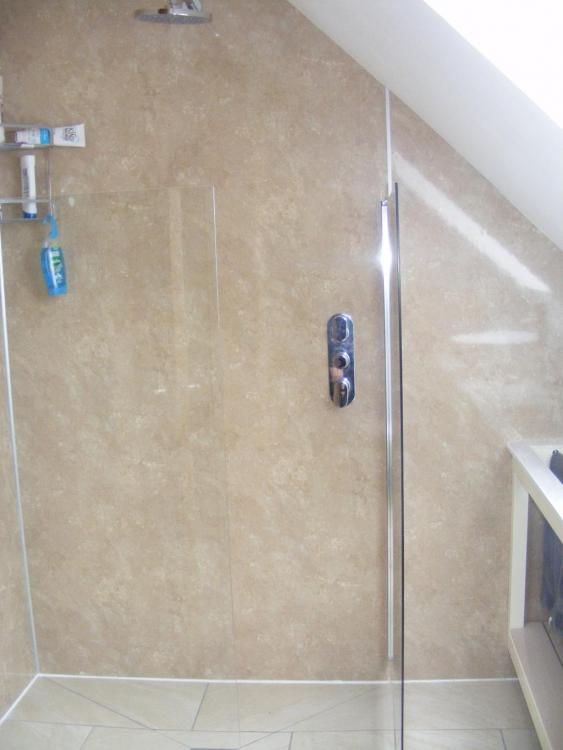
Short hinged glass shower screen. They are dirt cheap, sold in the sheds as an over bath shower screen. Ours are set about 100mm off the floor and the top is about head height for us. Very little water splashes over or under. We have two, one to stop the towels getting splashed and one to stop the door and toilet getting splashed. They hinge either way and fold almost flat against the wall when the shower is not in use.
-
Joule Aero not working with diverter
ProDave replied to Judith's topic in Air Source Heat Pumps (ASHP)
Can you post some pictures of how the immersion heater on the Joule connects to the diverter? Does the immersion heater also connect to any controls on the Joule? They can't both control it without a very thorough understanding of what connects to what. -
Contrary to popular belief, you can do the same in the UK. The wring regs and the competenet persons schemes make provision for someone to do the work and then a competent person to test and certify it. All that building control want is an EIC from someone they trust. The issue is no tmany electricians want to do that, because they won't have seen the cable routing so they would be asked to approve something they had no way of verifying. The best you are likely to get is an electrician happy for you to do some of the grunt of pulling cables through as long as he can inspect that before it is covered over.
-
How would I move this scaffolding?
ProDave replied to CalvinHobbes's topic in General Self Build & DIY Discussion
I moved mine on a hired 7.5t flatbed when I bought it, all loaded and unloaded by hand. Nothing wrong with Kwikstage like that. The metalwork is almost indestructable. It is the battons (boards) that are the trouble, wooden ones particularly if stored badly can be rotten. I "tested" each of mine by resting the 2 ends of each board on a concrete block each end, and then jumping up and down on the middle of it. Steelstage battons are much better if you can get them. Nothing wrong with using Kwikstage or any other system scaffold like cuplock etc. It's how you put it up that makes it safe or not. -
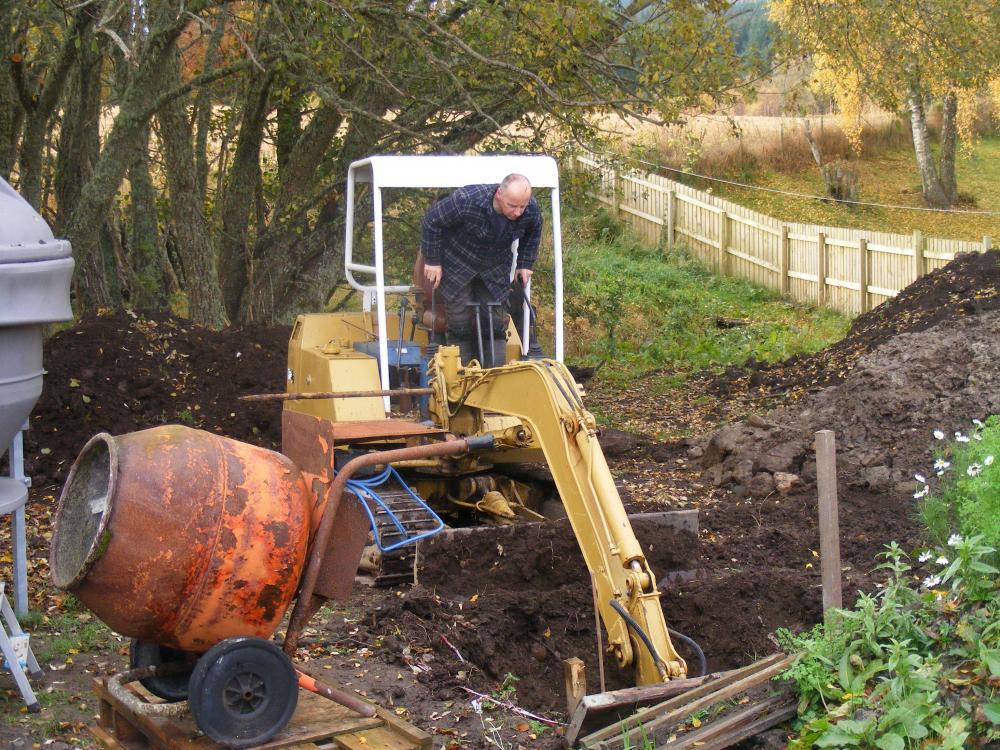
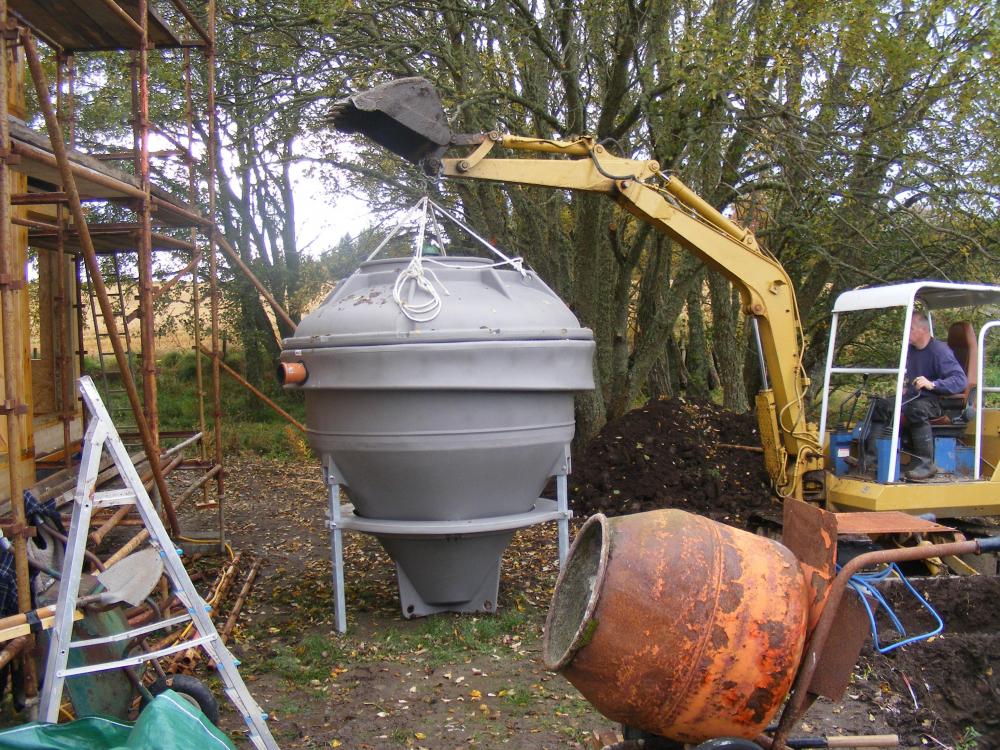
MY very old 3t digger was almost at full reach down digging the hole for the treatment plant. And when lifting the unit, it would not lift it very far off the ground.
-
System working, but meter not counting/solid red?
ProDave replied to Andeh's topic in Photovoltaics (PV)
Left pair of terminals are "in" so they connect to the inverter. So just swap them over. And put a box or a bit of trunking to cover the single insulated cables, left pair in the picture need drastically shortening. -
My 3t digger would barely lift my treatment plant a foot off the ground, it could not have lifted one from above off a truck. That is why when I bought my treatment plant, I ordered it from a builders merchant, Not only did they give a better price than anyone else, it meant it arrived on their delivery truck with it's own hiab to lift it off.
-
9kW heat pump will probably consume 3 or 4kW of electricity. 7kW charger That would all run from my 12kW supply allowing for diversity, ASHP mostly used in daytime, charger mostly used overnight. Especially if you are not even using the charger. To be asking for a 100kW supply for that is madness. A typical domestic supply is about 20 kW. You need to get to speak to someone. When I was enquiring they offered me the 12kW supply at a cheap price, I think they offered that, hoping I would say no, I need more in which case I would then be helping to fund a network upgrade somewhere. But my supply has been entirely adequate.
-
So you are asking for 200KVA total capacity, 100KVA per house. At 3 phase that is 100A per phase. That's 3 times the maximum that most UK houses have. WHAT was on the quote from 2 years ago? Re car chargers, you need supply capacity for ONE per house. The fact you may install cable for more is irelevant. To out this into contect my house has a 12KVA supply and everything works fine.
-
Since you have novices working on this, it is far to warn you the DC side will still be live even without an inverter. The black wired coming from the panels and entering that grey DC isolator switch will be live. So pest screw the switch back into it's box ans ensure that switch remains OFF until you connect your inveter. And yes the inverter needs to be connected to the mains otherwise it will not work. Find an electrician who understands solar.
-
Should I return this immersion heater?
ProDave replied to Radian's topic in Electrics - Kitchen & Bathroom
I have not removed the immersion heater that was supplied with my Telford SS cylinder but it has been working for 5 years now without failure, and as an electrician I have yet to find one of that type that has failed. I have replaced plenty of thermostats and plenty of copper immersions in copper cylinders, but never encountered a failed heating element in a SS cylinder. I am pretty sure my element is made by Cotherm. -
He is talking BS. AS you PV starts to generate power, it reduces what is imported from the grid, and when the power generated by the solar exceeds what is being used in the house it exports to the grid. Your inverter is "grid tied" so that means it has to be connected to the grid and it synchronises the waveform it generates to match the frequency and phase of the incoming mains. If you did switch it over as your guy is suggesting it would promptly switch off as it would not see the grid frequency to synchronise to. Just leave it as it is. You are getting paid a generous FIT rate, so it does not matter is a lot of it gets exported. But as @SteamyTea says you can get a solar PV diverter that sends any surplus to usually an immersion heater for water heating. Those are more important for recent installations that don't get a FIT so you want to self use as much as possible.
-
Not in Scotland you don't you just have to register it, (see my thread on the subject) BC have discretion to bend the rules, e.g a near neighbour could not possibly make the 10 metres from the burn distance for a treatment plant so they allowed him to install one much closer.
-
Ambitious water feature - pumps etc
ProDave replied to Adam2's topic in Landscaping, Decking & Patios
You wait until you work out the size of pump needed to provide that lift and flow, and the electrical power it would consume. I would only consider it if such a thing only ran in the daytime in the summer when it was likely I had surplus from the solar PV to power it. -
Solic 200 mod - scheduled boost for off peak hot water
ProDave replied to RichardL's topic in Photovoltaics (PV)
Have you got a spare thermostat pocket? you could fit a temperature probe and read that, and then only activate the off peak boost if the tank was below a certain temperature. -
Should I return this immersion heater?
ProDave replied to Radian's topic in Electrics - Kitchen & Bathroom
You really need to try a different make of immersion heater. I think you have proved the make you have been using is rubbish. -
In my case the remote dump heater switch is a dumb device. I bought a radio controlled relay and transmitter for it operating on 433.975 MHz. I had hoped it would be "better" than it is and only transmit a code to turn the relay on and again to turn it off. Instead it was rather disappointing that it transmits continuously whenever the relay is on. It blocks my Subaru key, but oddly enough not the Toyota key of my wifes car, even though both use 433 MHz. A simpler solution might be just find a different wireless remote relay to use which does not transmit continuously. For now, my disable switch works. I can either disable it totally, or disable it for 5 minutes (to give me time to get in the car and drive away) It's a good security device, nobody could pinch my car even if they had the key.
-
I would at least put the door opening in the wall if being built out of block. I would make it a normal hinged door opening into the bedroom. You would be creating a Jack & Jill bathroom, nothing wrong with that. Don't forget light switch wiring so the light can be turned on from either entrance.
-
I did our window boards after plastering. Mainly because we had not decided what to use. I left a "slot" in the PB at the bottom of each side for the window board, a bit smaller than I thought was needed. When I eventually fitted the boards I had to trim a little off that with the multitool to slide the boards in, and then there was a little filling with caulk afterwards.
-
The safety valve (actually two, over pressure and over temperature) are on the hot water cylinder . This is where the discharge pipe leads to, it is just an open end of pipe, in this case turned back to face the wall. If the blow of valves open, then it may be very hot water existing this pipe, so it is put behind a cage, and it must be somewhere visible.
-
Now I know how old illegal septic tanks get away with it......
ProDave replied to ProDave's topic in Waste & Sewerage
We have a burn through our garden. Occasionally the water flows a funny colour, almost milky white. So one day when it was like that I walked the burn upstream and found the source, a drain pipe entering the burn from under a farmers field. I took a picture of the milky white liquid exiting and notified SEPA with a photograph, the exact location of the pipe and the date and time. Their reply was "it looks like sediment" and did not even come and look. So agreed, they have no intention of actually dealing with pollution. Not fit for purpose, waste of tax payers money. -
Yes it should be okay. I had a load of "receipts" from the likes of B&Q who won't give you anything more than a till receipt, even when you ask for a VAT receipt. It has the VAT number of the company so it should be okay.




