


MikeGrahamT21
-
Posts
1919 -
Joined
-
Last visited
-
Days Won
2
Everything posted by MikeGrahamT21
-
I got it afterwards as although I was pretty sure smoke smell would come in I wanted to be sure before investing in the box. 125 version is what I went with, only a small property with fairly low throughput. Haven’t noticed any difference between F7 and H13 smell wise, just went with it as there was negligible cost difference.
-
Surely it’s just going to be a manufacturer recall, guy will come out with part and not care whether it’s faulting or not, just replace it…maybe play dumb if not and say that’s what you were led to believe
-
Teething issues with MVHR
MikeGrahamT21 replied to Tom's topic in Mechanical Ventilation with Heat Recovery (MVHR)
Might be worth reminding them that this is part of building regs for an MVHR, from memory -
As you'd expect for gas, they are quite sensitive, i've seen it happen before where it locks out and it doesn't mean anything, but of course worth getting it checked. Could be something as daft as a slight drop in local gas pressure.
-
Teething issues with MVHR
MikeGrahamT21 replied to Tom's topic in Mechanical Ventilation with Heat Recovery (MVHR)
The foiled rockwool, to prevent condensation on the pipe forming, and foil tape on any joints. Glad the unit is behaving now your connected the drain -
Turned it all off and back on again? sorry I work in IT 😂
-
Teething issues with MVHR
MikeGrahamT21 replied to Tom's topic in Mechanical Ventilation with Heat Recovery (MVHR)
ahh, smart, not seen one of those ones -
Teething issues with MVHR
MikeGrahamT21 replied to Tom's topic in Mechanical Ventilation with Heat Recovery (MVHR)
Don’t tundishes have holes in them? Not suitable for MVHR drain if it has -
Teething issues with MVHR
MikeGrahamT21 replied to Tom's topic in Mechanical Ventilation with Heat Recovery (MVHR)
Indeed, but the other stuff is definitely them. For now make sure the drain has got a reasonable bend in it to create a good pool of water for the water trap, the more in there the less likely it is to suck air back up. -
Teething issues with MVHR
MikeGrahamT21 replied to Tom's topic in Mechanical Ventilation with Heat Recovery (MVHR)
100% get them back in for all the issues mentioned above, this is firmly their remit to sort -
Snug and Dining room
MikeGrahamT21 commented on MikeGrahamT21's blog entry in Back on the self-build waggon...
Love getting all the trimmings out, despite not being a huge fan of Christmas

-
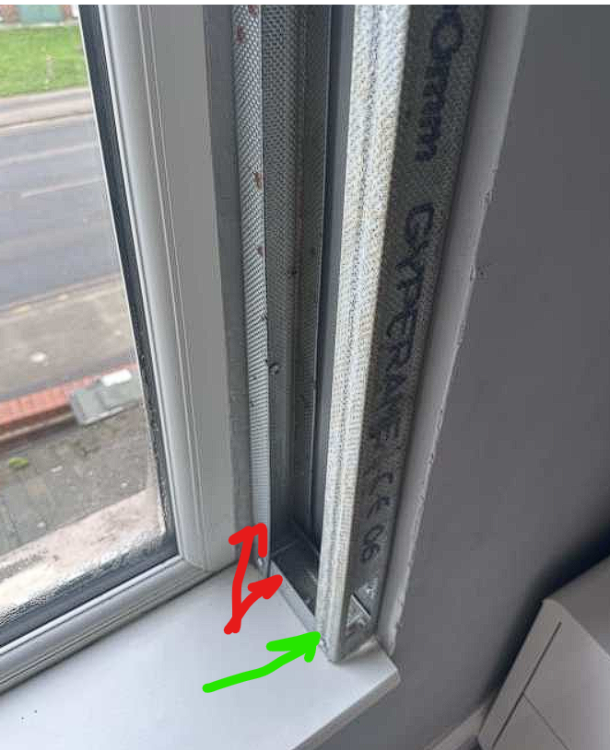
Yeah thats your issue, i'd say its definitely a mixture of both ingress and condensation. Externally, make sure that any pointing is good, no gaps in it, and you could apply a water repellant to the masonry to help further. Inside you are going to need to create an insulation filled cavity, and then an internal wall, with the metal frame. If it were me i'd do the following: Remove the red, keep the green. In between the metal frame kept, and the wall, fill with insulation, PIR will likely be the best choice here, and use some adhesive expanding foam to 'glue' it to the reveal. Then go over with your plasterboard. I would considering using metal frame wider than that too, if possible, or add some timber spacer to it, so your insulation and PB overlap the window. And ensure that the outside is fully sound, and water repellant applied. Make sure to treat any internal mould with either proprietry mould killer, or white vinegar before covering it up too. See what others think of this plan?
-
Are you sure that’s just condensation? What material is the painted bit to the left of the window made of? And what’s on the outside? Looks a bit like water ingress as well as condensation to my untrained eye
-
100mm cavity - Full fill?
MikeGrahamT21 replied to iSelfBuild's topic in House Extensions & Conservatories
Yeah just looked for Bristol, barely any choice and nothing thermal outside of aircrete. Any on eBay that will deliver to your location? -
100mm cavity - Full fill?
MikeGrahamT21 replied to iSelfBuild's topic in House Extensions & Conservatories
It’s a full fill system with unventilated cavity so the board and its HIPS facer gives the 125mm, which is what the cavity has to be built as, I remember it was a snug fit as per the installation instructions. They have a really good fitting outer profile which keeps everything tight and sealed. https://unilininsulation.co.uk/wp-content/uploads/sites/2/2023/01/2913_CTPIR_UK_Final_V2.pdf have a look on huws gray, they always seemed to be cheapest for blocks for me at least, loads of options too -
100mm cavity - Full fill?
MikeGrahamT21 replied to iSelfBuild's topic in House Extensions & Conservatories
im not sure I agree with you on that completely, yes the cut edges where the cells are open will leak the blowing agent, but the rest of the board should stay as manufactured unless punctured in some way. I’ve made fresh cuts in PIR which is more than 10 years old and can still smell the gas escaping from the fresh cut -
100mm cavity - Full fill?
MikeGrahamT21 replied to iSelfBuild's topic in House Extensions & Conservatories
Definitely swap out the aircrete for dense blocks, look out for the ones labelled as thermal blocks but as an aggregate block. I used xtratherm (now unilin) CT-PIR at 125mm in my latest side extension, which is an interlocking board, and having done previous extensions with aircrete inner and full fill 0.032 wool, I can say that the latest build is by far the best in terms of insulation and energy use. if I remember right the Kingspan full full boards need their joints taping on the cold side. normal wall ties are absolutely fine, and another +1 for wet plaster -
Water in cavity during construction
MikeGrahamT21 replied to Professionally nosey's topic in Bricklaying, Blockwork & Mortar
Engineering bricks are definitely less porous than blocks or other bricks, but will allow moisture to pass over time. As @joe90 said, it’s going to be pretty much permanently wet below ground anyway so I wouldn’t worry too much. -
SBR diluted would certainly give a good bonding surface for tile adhesive, much better than paint ever would.
-
Zanussi combi oven/microwave tripping fuse
MikeGrahamT21 replied to Adsibob's topic in Electrics - Kitchen & Bathroom
What is the current rating of the MCB in the fuse board for that circuit? Youd need a 16A MCB for the 3kW device minimum but it all depends on cable thickness as to whether it will take it. -
Plastic airbrick- seeking replacement grilles
MikeGrahamT21 replied to GLPinxit's topic in Ventilation
Yes the inners come out, available in varying colours, here is a terracotta one: https://www.screwfix.com/p/air-brick-terracotta-76mm-x-229mm/13873 A note though, not all of them have replaceable inners, so just watch out when you go to buy As above, whoever put it in, has put it in upside down, so ensure the louvres are pointed down when you replace. -
Sounds like you’ve got a Guinea pig in there 😂 Air bubbles in the water supply?
-
Any ideas what is happening with my PV array
MikeGrahamT21 replied to Omnibuswoman's topic in Photovoltaics (PV)
the live data will be available on the front of the inverter, using the display, assuming that all Solis inverters do it this way, certainly how my AC coupled storage inverter does it -
I can't say for sure 100%, as i've never heard of anyone doing this, but from a technical perspective the inverter doesn't know what type of panels they are, so having the 2 types on differing strings I would say is absolutely fine and shouldn't pose any issues. Speak to your inverter manufacturer if you want a 100% sure answer
-
I’ve had my MVHR running constantly for around 5 years and it still looks like the day I bought it inside, not even a speck of mould. I wash the heat exchanger out once a year (if I remember)





