


MikeGrahamT21
-
Posts
1919 -
Joined
-
Last visited
-
Days Won
2
Everything posted by MikeGrahamT21
-
Proper surround sound
MikeGrahamT21 replied to Pocster's topic in Networks, AV, Security & Automation
I can go days without a ‘glitch’, and then have it happen 3 times in 10 mins, doesn’t seem to be any rhyme or reason to it. You’ll get used to it eventually, think of it as a feature, giving your eyes a break for a second or two 😂 -
Proper surround sound
MikeGrahamT21 replied to Pocster's topic in Networks, AV, Security & Automation
My TV has zero options for HDCP settings, nor does the AVR, must all be auto negotiated. TV is HDMI 1.3, but its so old it doesn't even have a USB port, or any network connectivity! lol. It does have a DB9 serial port though!! -
Proper surround sound
MikeGrahamT21 replied to Pocster's topic in Networks, AV, Security & Automation
I've got a very low opinion of technology, have to work with the damned stuff every day! If its a computer, or has a computer in it, its bound to go wrong. -
Proper surround sound
MikeGrahamT21 replied to Pocster's topic in Networks, AV, Security & Automation
You'll get used to it. My AVR was around £600 when i bought it, was rather annoyed at first for the same reason, and my old Denon never did it. I found changing the HDMI port i was using on the TV reduced its occurrence, I have 1 and 2 together, and 3 is separate, so assuming 3 takes a different route, and this one exhibits the issue the least. -
Proper surround sound
MikeGrahamT21 replied to Pocster's topic in Networks, AV, Security & Automation
Interesting, I also have this same issue, started around 12months after i got it, I call it a glitch, sometimes doesn't happen at all, other times screen goes black, multi coloured etc, and then comes back, lasts 1sec max. They took it in for repair, replaced the entire mainboard, couldn't replicate issues their end, still does it here. Just said it was some kind of incompatibility on my dinosaur TV, odd as it worked fine to start with, and the TV with my TV recorder box directly connected worked without issue. I guess it could be firmware related, but i just live with it, doesn't both me too much. -
Advice on re-roofing and chimney
MikeGrahamT21 replied to REY_UK's topic in Roofing, Tiling & Slating
Definitely remove the chimney if it’s of no use, if you are handy enough you could do this yourself and cover over the area left with some tarp til the roofers begin. As for roof tiles, there won’t be a great deal of weight difference in concrete tiles, and style is a matter of personal choice, architects will probably specify a plain concrete tile which is more contemporary, but be warned, they aren’t quite as strong as this type, and tend to crack a lot more easily if anyone needs to walk on them to get up the roof. Any tiles are suitable for velux and solar in roof, just need the correct flashing/tray to suit. I’d definitely look at the in roof systems, tiles are bloody expensive these days! -
Proper surround sound
MikeGrahamT21 replied to Pocster's topic in Networks, AV, Security & Automation
I’ve got a Marantz AVR, and found that I had to set dynamic compression to low, any other setting and it sounds rubbish -
Proper surround sound
MikeGrahamT21 replied to Pocster's topic in Networks, AV, Security & Automation
Multiple subs allows evenness of bass without any 'boomy' areas and flat spots, and you can run both at a reduced volume, so ideal for houses with neighbours joined on like me. I did have 2 subs, and they were amazing, but one broke, so back down to one now, you can definitely tell the difference. I could absolutely skin you @Pocster this thread has caused me to look at newer better speakers to go with my dinosaur TV, and i've been unfortunate to find the Monitor Audio Apex range 🫢 I am resisting though!! -
Proper surround sound
MikeGrahamT21 replied to Pocster's topic in Networks, AV, Security & Automation
https://www.ebay.co.uk/itm/205396452936 🫡 Unfortunately i live nowhere near Bristol, they've just reduced them to about half price!! Could be a bargain for someone looking -
How to restore 12 year old laminate floor tiles?
MikeGrahamT21 replied to David001's topic in Wood & Laminate Flooring
If they are laminate then it’ll be a plastic surface anyway, and they don’t look like the type that should be glossy. Of course mopping is always going to give a shiny wet look til they dry, but to me they look how they should be on the photo. what colour are you wanting the joints? I’d suggest using a suitably coloured sharpie permanent marker pen, done similar on mine when I’ve scratched it and it works wonders. Have some isopropyl alcohol handy too in case you get it on something you didn’t want to rub it off, but with the joints being slightly rough it’ll stick to them -
Proper surround sound
MikeGrahamT21 replied to Pocster's topic in Networks, AV, Security & Automation
It happened when I redid the living room, so about 3 years ago I think, been spot on ever since. It’s a tough old bugger 😂 -
Terracotta style patio slabs
MikeGrahamT21 replied to Hels13's topic in Landscaping, Decking & Patios
No problems at all 👍🏻 -
Terracotta style patio slabs
MikeGrahamT21 replied to Hels13's topic in Landscaping, Decking & Patios
Maybe these? https://www.huwsgray.co.uk/concrete-paving-slabs/monapave-smooth-slab-450-x-450-x-50mm-ms008-terracotta-red-100010772-5005907?srsltid=AfmBOoqIzwtJauqECJxTc_E9c5I5NcWbnXO0DDqrGpIkpZYL6xKZTleU https://www.monaprecast.co.uk/products/monapave-slab/ MKM stock them too -
Proper surround sound
MikeGrahamT21 replied to Pocster's topic in Networks, AV, Security & Automation
Not sure I could live without my home cinema. Had one in one form or another from day I moved out of parents, started with a Samsung DVD (forget if it had blu ray) with surround sound built in, and then moved onto a Denon 5.1 AVR with Boston Acoustics Soundware XS speakers. During lockdown I decided to upgrade the AVR to a Marantz NR1710 and got two in ceiling Yamaha speakers to make full use of atmos and dts:x, also changed my centre speaker from the Boston to a Tannoy which was much more capable for the centre channel. Physical media will always trump streaming when it comes to sound quality, the amount of data required for really good atmos/dts:x is mind boggling, and it certainly makes a difference, that said I find the streaming services really good, especially Disney+, but even the normal DD5.1 content gets a virtualised height channel via the AVR and it’s surprisingly good, not a million miles behind the real deal. So yeah it’s money well spent, and the sky is the limit with amount, but you really don’t have to spend crazy amounts to get a good system. If you can go with larger form speakers then you’ll likely get good value in terms of sound quality vs price, compared with small speakers which really do cost a lot to make them decent. I prefer mine to blend in and be compact as the living room isn’t huge, and the Boston speakers although really old now, cost me like £250 and have been a delight, of course I will look to upgrading them at some point in the future. I also tried two subwoofers given my AVR had a second port, but in my case it was too much for the smaller room. Ended up with a 5.1.2 setup. It’s my telly that’s the dinosaur in my setup, 17 year old Samsung 40” LCD, I’ve repaired it twice and it’s still going strong. A comparison with a relatively cheap 4K LG LED TV, gives a pretty decent fight, and that’s 4K content but running at 1080P on mine. I had an area of broken pixels on it a while back, which it repaired all by itself, and for that it earned the right to stay!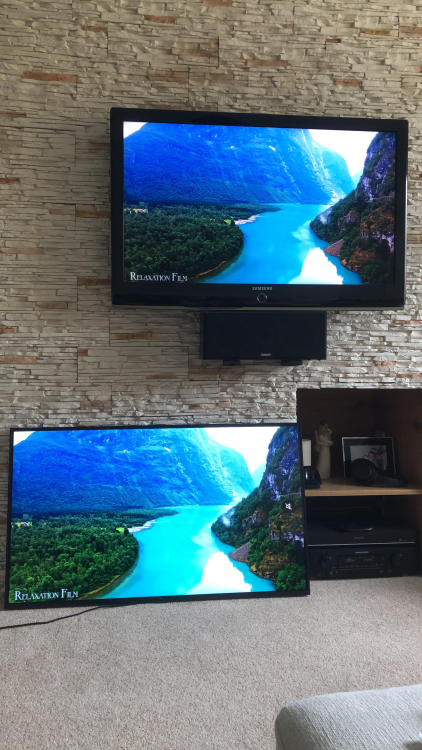
-
Yeah still same shade of black so that’s a win, thanks @nod!
-
Solar PV, more cladding and my first plasterboard jointing.
MikeGrahamT21 commented on Susie's blog entry in The Old Cow Shed
Thats one very posh plant room! -
Worked OK, hard to get an even colour but once again looks better than it did, I guess time will tell if it stays that way, will report back again later next week
-
Ok, have got one of those, will give it a go on a bit which isn’t too obvious and see what happens, will report back thanks!
-
My main fascia boards and soffits are white, but I have a continuous dry verge strip which is black plastic, and over the years it’s started turning grey. got up the ladder last week gave it a good wash down and attacked it with some plastic polish designed for cars (meguiars), and it came up great, back to black again and shiny, so thought brilliant I know what to do on the others now… a week has passed and already its going back grey again!! anyone know of a better way of getting these back black without paint? And then staying black at least for a year or two before needing doing again thanks for any ideas!
-
Smart thermostats - Nest thermostat losing many features
MikeGrahamT21 replied to JohnMo's topic in Other Heating Systems
A piece of technology supported for 20 years?? For a starter it’s far too cheap at the point of sale, even with any subscription. it’s highly unlikely to last 20 years physically. It’s inefficient to support older products, think about still supporting windows xp and windows 11. I think you really need to set your expectations a little more realistic when buying into any technology -
The replacements I’ve had from modernupvcwindows.co.uk seem to have been OK so far, though the larger panes did have to be remade a couple of times due to fingerprints on the inner pane. have just had another one start steaming up, but won’t be replacing til a couple more go to make it make sense delivery charge wise. Around 9 years old that one. I wonder if triple glazing is more prone to the units blowing?
-
Vertical crack in extension through padstone under new steel
MikeGrahamT21 replied to lookseehear's topic in Brick & Block
Every 6m from memory, and yeah could be a cause, I’ve seen walls without expansion gaps literally rip themselves apart -
yeah the lofts are definitely a challenging for pipework, you can only do what you can. If you are able to box in using PIR that would all help. how near are the pipes to your ceiling to work as a heat source? I’ve got 100mm Phenolic between the joists before the pipes so don’t get much heat input, although it’s scary how much gets through the timbers
-
I managed to reduce some of the pipe length in some cases, some of my routes weren't optimal it turns out, the 125mm pipe from the plenum to the ceiling was also too long in some cases, meaning that the plenum sat raised in the loft space, causing the insulation to sit poorly. I went up with the thermal camera on a cold day and found some areas where the insulation wasn't well placed around the pipes too, ended up buying some more and topping up around those areas, was definitely an improvement but i didn't get any figures
-
Rigid PIR boards in cavity Walls. DON'T DO IT.
MikeGrahamT21 replied to Iceverge's topic in Heat Insulation
It’s the same one, they rebranded to unilin. care to elaborate on why you didn’t like it? By far the best system I’ve come across and used



