


MikeGrahamT21
-
Posts
1919 -
Joined
-
Last visited
-
Days Won
2
Everything posted by MikeGrahamT21
-
Rigid PIR boards in cavity Walls. DON'T DO IT.
MikeGrahamT21 replied to Iceverge's topic in Heat Insulation
I totally agree with most of the PIR products, but still think this one is head above the rest with its engineered parts that prevent a lot of the issues mentioned: https://unilininsulation.co.uk/products/cavitytherm/ct-pir-cavitytherm/ This is also the only system with purpose made components for different areas of the build, not relying on someone cutting them by hand and cocking it up -
Full fill: https://www.kingspan.com/content/dam/kingspan/kil/products/kooltherm-k107-gb-and-ireland/kingspan-kooltherm-k107-brochure-en-gb-ie.pdf
-
Did you ever get in touch with cavity removal experts like i mentioned earlier in the thread? Some certainly noted that they removed foam cavity, though not PIR specifically, it may well be do-able. I think your options realistically are going to be removal and reinstatement if possible, or take down the outer skin, sort the issue and rebuild.
-
Brink Flair 400 Maintenance
MikeGrahamT21 replied to Russdl's topic in Mechanical Ventilation with Heat Recovery (MVHR)
Good effort that is 🙂 During the warmer months of the year, my non-enthalpy is bone dry. -
Or another equivalent of compacfoam, one I used recently called Brigifoam. https://www.affixit.co.uk/brigi-foam.html made by a company called iso-chemie who only sell to the trade, and these are a middle man who then sell it rebranded to the public, very good stuff and ideal for what you are wanting, and very cost effective compared to compacfoam.
-
I doubt you will have any PD rights in a conservation area. Whats the reason behind wanting them in a field and not on roof? Presumably more capacity? Do you actually need that capacity?
-
Wireless Access Points or Mesh?
MikeGrahamT21 replied to YorkieSelfBuild's topic in Networks, AV, Security & Automation
If you can get CAT6a cable in lots of places, this will future proof your home, and for very little cost. Termination is fairly easy, most patch panels these days are colour coded, its just fiddly work thats all, especially the RJ45 connectors, but absolutely doable, and you'll get quicker each time. The greater question is how much bandwidth do you need for everything communicating at maximum, plus some additional bandwidth for breathing space? How quick is your internet connection going to be? These are real important questions, for myself i'm still running WiFi-5 AC1200 on a fully wireless Mesh (Tenda), but my internet connection is a maximum of 65/20, and it achieves full speed with a wireless connection of 866Mbps, so for me it would be totally overkill to bother with anything more than this, i wouldn't see the benefit. Also, and I know its contentious, but consider locating access points pumping out serious amounts of EMF somewhere other than bedrooms, just in case the people who say it can cause health issues are indeed correct, i can't think of a requirement which means you need it in there. Range of the APs is often much greater than expected too, this becomes an issue with interference if you overpopulate, and can have the opposite effect, making WiFi slower. Hi from a fellow South Yorkshire resident btw! -
Help: Remove Hard Sealant to replace glass
MikeGrahamT21 replied to LLL's topic in Windows & Glazing
Thats not (or shouldn't be) sealant, its window putty, usually linseed based. Give it some heat with a heat gun, should soften it a little so you can scrape it out, or failing that, knock the glass out towards the putty, and you should then be able to get at it to get it all off. No problems replacing with something like perspex of a similar thickness, you'll need fresh linseed putty and a putty knife to install it too. -
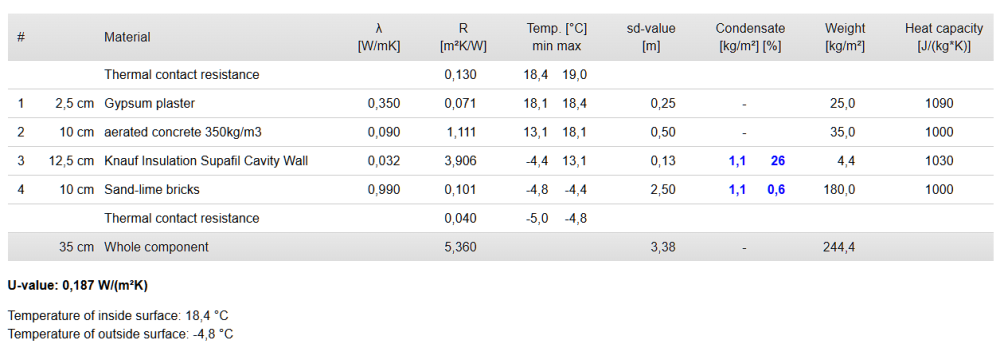
Think i'll stick with ubakus to be fair after looking at that site! Looks like it was designed in the early 2000's lol. https://www.ubakus.de/u-wert-rechner/? Its made by someone who studied Physics, not some random IT Support company. I'd advise using a more accurate tool.
-
https://www.thomasarmstrongconcreteblocks.co.uk/airtec-aerated-concrete-blocks/airtec-xl Aiming for 0.18W/m2K for an extension, so still a fail, but very close
-
Change your glass fibre on to 0.032 and the blockwork to 0.09, currently the best values available for these, not that i'd want to use any more AAC blocks, but they're an option nonetheless
-
Mines 5 years this year and had a couple of mould blobs on the fan blades of the extract, but overall it looks the same as it did when i installed it. I clean the dust from the blades once a year and blast it out with a high powered fan.
-
EPS will have the same results as PIR if poorly installed. You could also consider blown bead once its built too.
-
Give us some extra detail on the roof, what kind of felt/membrane do you have? Are there any counter battens in play on the tile side?
-
I think I’ve seen an old clip of if not the same project, another one which had the same idea, could you imagine that these days? Just wouldn’t happen, everyone would be blaming others for this and that. Most of my bungalow has been covered with varying extensions I’ve put on over the years and the small amount of visible brickwork wasn’t in very good condition, chipped bricks, cracked bricks (old soft London bricks) and it was due a repoint, so I thought I’d fix it all and give it a huge upgrade in insulation levels, did all the work myself over years and it’s turned out really well. just got the top part of the gable end to clad at some point, tho this will be framed, rockwool and cladding board, need some scaffolding for that one though!
-
I've learned from jobs over the years to always keep a very close eye on builders, i still think Unilin's (xtratherm) CT/PIR was a very easy to use product:
-
That is a spectactularly bad job on the builders part, that corner is a proper shocker, basically zilch insulation!
-
Yeah that’s doable, as long as you maintain a 25mm air gap up to the breather membrane your good
-
yeah that’s how it should be above the openings. The dpm is to catch any potential future leaks and channel them to the outside. it’s possible you have a cavity tray all way round, depending on ground conditions, but it’s not necessarily in all situations
-
Black above the openings under the insulation will be DPM, its your cavity tray
-
I think back in the day they probably used a mixture of building sand and grit sand, but for pointing you really want building sand as the grit would likely get in the way. You can get yellow or red sand, dependant on colour you want, the above looks like yellow. I have a 60's bungalow, ideal homes build, they were quite well known for pushing the boundaries of building tech, bringing in some real weird and wonderful build styles, which they tested on live properties, all still standing. I had a builder once who worked on them when they first built these, and he said they had a huge machine mixing the mortar, but its was primarily sand and lime, with very little cement in the mix. Its stood up well, but it wearing out now, not a problem for me, as i've covered it all up with EWI.
-
If its 60s build it'll be stronger than 6:1:1, try 5:1:1, without doubt there will be lime in there like you say. It may just be trial and error trying a few different mixes and see what dries the best, assuming you are wanting it to match?
-
As good as you’ll get. I’ve seen it used on a pure white panel and it’s visible, but a coloured panel will be as good as can be, almost invisible. Not sure how good the pattern matching is from one sheet to the next so you’d have to ask manufacturer about that
-
Use the hydro lock panels if you need extra width
-
Do the hot water taps do the same thing? Any pressure drop on cold taps?


