


Stones
-
Posts
3762 -
Joined
-
Last visited
-
Days Won
23
Everything posted by Stones
-
-
Welcome. Lots of help and support on this forum. Don't be afraid to ask questions. The search function is a good way to research, as any questions you have may well have been answered before. Check out the blogs as well, they are a real goldmine of information. Have you settled on how you are going to build your house? I'm a lot further north (a couple of hours plus a ferry journey north of @ProDave).
-
I'm another satisfied ADW Ltd customer.
-
As detailed in my recent blog entry: ASHP: Heating CoP range between 3.5 and 4, DHW CoP 2.4 (ASHP providing all hot water) I'm paying 12p per kWh for electricity, so DHW is costing 5p/kWh, Heating between 3 and 3.4p /kWh My location is a very exposed, wet marine climate.
-
@swisscheese Space wise, the cylinder and attached pre plumb gubbins takes up 850mm x 750mm, the expansion vessels and UFH manifold a little more. The cupboard is 1900mm x 750mm, so basically we have half left for storage space. I went with a 300 litre cylinder to avoid the need for immersion top up. You could probably drop down to a 250 litre (IIRC that's what @jack has) or even a 200 litre but would need to boost the cylinder to get the same usable DHW volume as from the 300 litre. Given you have to have PV this may well seem sensible, but given the pretty low additional cost of the larger cylinder, I think you would get more benefit going for a 300 litre, plus it means you wouldn't have to use immersion to top up when solar PV wasn't providing. As I'd made the decision not to install PV I didn't look into the technicalities of using an immersun type device with the Mitsubishi pre-plumb cylinder / controller set up.
-
 @recoveringacademic Sorry to hear its come to this Ian, but for long term peace of mind, it certainly sounds like it is the best thing to do. You are where you are, and if the steep and unfortunate learning curve you and Debbie have endured means you have a better house at the end, fate has indeed done you a favour. +1 to what Declan says. If you have legal insurance, may well be worth giving them a ring if you feel you need any advice in respect of the financial side. Are Durisol able to offer you any financial support given the circumstances?
 -
Very smart!
-
Yes, I'm pretty pleased with the overall CoP for DHW as well. We moved in in February and the CoP for that (part) month and March was 2.3 CoP for DHW the past couple of months is 2.5 December and January are pretty much the same temperature wise as February up here, so I anticipate a final annual CoP of 2.4 Obviously different parts of the country will fare better / worse depending on the local micro-climate, but it's certainly encouraging to have such reasonable performance. We've lived with a heat pump before so are aware of their strengths and weaknesses. Our decision to go with a larger 300 litre cylinder was informed by this experience as we didn't want to have to resort to topping off the cylinder with immersion (not that there is anything wrong with this method and it was one method I investigated as part of my cost analysis), and knew we would struggle with a smaller cylinder given the lower temperatures DHW is stored at in a purely ASHP set up. E7 is only really viable or worth using if 50% or more of your usage is within the E7 tariff period. Having lived with E7 before, I know how challenging this can be, and in some senses restrictive (we would have needed larger cylinders / buffers) if you size all your plant to operate solely with E7.
-
To ensure insulation doesn't touch the felt, and to ensure sufficient cross ventilation so that any warm moist air escaping from the house is vented out rather than getting trapped causing the to of to sweat. 50mm may well be more than is actually required to do the job, but ensures there is sufficient working gap taking uneven insulation surfaces or sagging felt into account.
-
@JohnW, thanks for your kind comments. Our resident Welsh Wizard may be able to offer more insight but with gas you start needing buffers or maybe even a TS because of the short cycling issue. I'm only guessing but I believe fuel costs would be lower (for DHW at least), but you end up paying another standing charge for your gas supply. I haven't costed gas vs ASHP, but I suspect there wouldn't be that much in it once capital, running and servicing costs taken into account. If you need cooling, gas isn't going to give you that capability. I can't really give you a definitive answer as it simply wasn't something I had to consider, but my gut feeling is I probably would have still gone with an ASHP set up.
-
+ another 1 I wouldn't consider a roof without sarking. Our last few houses had slate, nailed directly into whitewood board sarking. Very robust.
-
It's 250mm off the wall. Doesn't seem to be affecting its performance. Airflow certainly isn't a problem.
-
In this entry I'm going to discuss in more detail how I came to choose our heating and hot water system, and how it has performed to date. As other forum members have found, deciding which fuel source and type of technology to use in a low energy house, is a challenge given the different requirements each of us has. We had three stipulations – low running costs, hot water available on tap 24/7 and maintenance of the whole house at an even and constant temperature 24/7. Having calculated our heating demand, taking the impact of solar gain, incidental household gain, human occupancy and wind speed into account, I was confident that I had a good indication of the amount of heating I would need. I was also confident, based on historical use, of the amount of hot water we as a family use. Living in an area without mains gas, my options were somewhat limited to using either oil or electricity as my fuel source. LPG was initially considered but discounted due to the lack of availability in my location. As part of the decision making process, I spent a fair amount of time carrying out a cost comparison of both oil and electricity based heating and hot water systems, using 500kWh increments from 2500kWh to 5000kWh. I considered direct electric of various type, oil and air source heat pumps, both air to water and air to air. Solar PV was also considered and costed in terms of each method of heat and hot water delivery. In line with previous cost comparisons that I had carried out, I found direct electric to be the most cost effective in terms of capital outlay and running costs when both heating and hot water demand were less than 2500 kilowatt hours each year. As heating requirement and hot water requirement increases so the balance began to tip in favour of other technologies. Oil was quickly dropped from the list as it became apparent that any rise in fuel prices over then then low point, would significantly increase running costs. Having conducted significant investigation in respect of the viability of Sunamp units, although attractive in many ways, I found that the capital outlay and running cost was simply too high to be able to justify, given that the main benefit (low heat losses) were not as critical for me as they have been for others. Part of that decision was also driven by the cost of fitting Solar PV, which in our remote location was extortionate. I looked into a non MCS DIY install, but couldn’t make the figures stack up, the break-even point being around 17 years. Much as I wanted to install PV, it didn't make any sense financially. In time, I hope to revisit PV, if and when battery storage reduces the break-even point to a more realistic timescale. A wind turbine, given our location and the virtually constant presence of wind, would have been an ideal energy source and paired with Sunamp technology, probably unbeatable. The proximity of nearby houses ruled out that option in terms of planning permission. Air to Air heat pumps were ruled out based on my own experience of them and a road test at a friends house. Neither myself or my good lady found them particularly pleasant as a heat source. Having gone through the list of options, an air to water air source heat pump, paired with a large UVC and UFH for the distribution of heat, represented the best balance in terms of capital outlay, running costs and crucially, comfort and convenience. We opted for a package from Mitsubishi Ecodan, an 8.5kW heat pump and 300 litre pre-plumbed cylinder fitted with the Mitsubishi FTC5 control panel. Given our location, we opted for the coastal model, which is treated with acrylic resin for enhanced corrosion resistance. Whilst a pre-plumbed cylinder is more expensive than a bare cylinder and associated parts, after taking labour (plumber and electrician) into account, I found there was very little difference in cost. I sourced the package from a trade supplier, Secon Solar. I found their price list while searching online and having phoned the company, and perhaps fortuitously speaking to the managing director of the firm, found they were quite happy to sell me package at trade / installer price, the bonus being that delivery to my location was free. The package is configured for the UK market, the only difference to the system as sold in the rest of Europe (AFAIK) being that the cooling function of the heat pump is disabled so that the product complies with MCS approval for claiming RHI. It is however a simple task to activate the cooling function, by flipping a dip switch in the control module on the cylinder. Cooling can then be controlled from the master controller. As stated in an earlier blog entry, the heat pump and cylinder were fitted very quickly with simple connections on the plumbing side – flow and return from the ASHP, cold water, hot water and flow and return to the underfloor heating manifold. Electrical connections consisted of power to the ASHP, a cable from the ASHP to the control module and a plug-in controller. I had initially planned to have the cylinder in the utility room close to the ASHP Monobloc, but changed the location to a service cupboard in the middle of the house, to reduce internal DHW pipe runs. This does mean a 15 metre pipe run for flow and return to the ASHP, but as virtually all is within the insulated envelope, it doesn’t represent much of an issue, and does not appear to be having an adverse effect on performance. The ASHP Monobloc itself is located beside our back door, open to the elements. It seems happy enough where it is, despite the wind that traverses the space between house and garage walls. Locating the ASHP within the garage itself was an option but one I decided against simply on the grounds that I didn’t want to give up floor space within the garage. A timber housing for the ASHP is something we may look at in the future. We opted to fit individual room thermostats to all 3 bedrooms, to give us the option of being able to reduce the bedroom temperatures if we so wished. We have not used these and keep the whole house at one temperature 24/7, treating the underfloor heating as a single zone. At present I only have limited data as to how the heat pump has performed since moving in. On board energy metering (energy consumed and energy produced) shows the CoP for heating has ranged between 3.5 and 4. DHW is maintained at 47C-50C in the cylinder, boosted every fortnight to 60 degrees by the immersion on an anti-legionella cycle. To date the CoP for DHW is 2.4 As members know, heat pumps are best suited to the production of low temperature heat as opposed to the higher temperatures required for domestic hot water. Whilst the CoP for DHW is lower than that for heating, the cost per kWh of our DHW, based on a CoP of 2.4, is 5p, which is significantly better than an E7 electricity tariff. We may be taking a hit on efficiency, but in reality all of the other options would have cost us more. The 300 litre capacity of the cylinder means that we have plenty of hot water on tap and can comfortably run a full bath and still have sufficient left over for another person to shower. The ASHP is currently operating on a 24/7 basis, providing heat input to the UFH and topping off the DHW as and when it determines it needs to, at whatever flow temperature it determines. Whilst that does sound like a recipe for high bills and high flow temperatures, in practice, the heat pump delivers the lowest flow temp it can get away with to maintain our set temperature. If I so choose, the controller lets me set various parameters such as heating curves or set flow temperatures, or indeed a timed schedule for heating and DHW. However,as the system is operating efficiently on its auto setting, and providing the level of comfort we want, I see very little reason to mess around and create my own settings. If say electricity tariffs were to change from a single tariff to a dynamic tariff, then I would have the option of timing the heat pump operation to coincide with lower rate tariffs. After much thought, and indeed discussion on this forum, I opted for an 8.5 kWh ASHP over a 5 kWh ASHP, as I felt happier running a larger unit more gently than pushing a smaller capacity unit harder. A 5 kWh unit would probably have sufficed, and in time, may be what the current unit is replaced with when it reaches the end of its life. We haven’t yet had to activate the cooling function as any overheating (defined as internal temperatures over 23C) caused by solar gain, can, as modeled, be managed by natural cross ventilation. Neither have we found it necessary to constantly circulate the UFH to even out the house temperature / redistribute solar gain from one part of the house to the other. In the heating season, we found that there was sufficient circulation of the UFH during the heating cycle to maintain the house at an even temperature. Outwith the heating season, when solar gain is at its peak, the house zones itself, the bedroom section remaining slightly cooler than the public areas, very useful on a warm summers day. Overall I’m very happy and impressed with our system. It has, so far, delivered everything we have asked of it in terms of comfort and convenience, and the running costs are low. I have the capability to cool the house (via slab cooling) if I so wish, and the option to bolt on a second zone pack onto the pre-plumb cylinder if I ever found it necessary to install a second heating / cooling function – i.e. fan coil or duct heater / cooler. The one criticism that I have is about the controller thermostat function and its hysteresis - 1C increments only. A finer degree of control would have been preferable. Our installation was recently inspected by an MCS accreditor (our plumber is going through the accreditation process). In due course that will give us the option to apply for RHI, although that will be very much dependant on whether the figures stack up.
-
Sometimes nightmares are real: the insurance story
Stones replied to ToughButterCup's topic in Self Build Insurance
Another agreeing with @Barney12 and others. It has to be worth pursuing £1200 in the measured way described, if for no other reason that at some point when the build gets past this current difficult stage, you will wish you hadn't just written it off / it would always niggle you. As others have said, sitting down and writing a suitably worded letter stating your position and your intention need not take hours and there is support on here for peer review of any correspondence should you so wish. Leave it until the next rainy day / until more pressing things (finishing the walls, parting with builder, finding assistance) have been completed, even if this means sending a short holding letter meantime. I pursued a complaint in respect of advice I'd been given on our last build in respect of the heating system. Ended up agreeing to a cash payment and provision of servicing for the system. My position in that case was fairly weak as the paperwork I had was limited, but the company involved didn't want to run the risk of small claims action or indeed the impact of negative publicity. -
If it gets you registered in the system that's all that natters. Next step should be an acknowledgement from OR with contact details for an engineer to see what's required, or At least that's what happened in my case.
-
You could also cut slots in the pipe if you happen to have a grinder or stihl saw to hand.
-
@recoveringacademic, Ian, plenty advice already bit I'll just reinforce, one of our builds we were badly let down by the decorator. We ended up parting ways but not before a huge amount of stress. In hindsight, I wish I had got rid of him far earlier. I think you have made your decision and that with all the support, included those of us who have experience of ICF, you can progress without your builder, but definitely, try any get somebody to assist you if you are going to do a lot if the physical work yourself. Time for an amicable sit down with the builder, be polite and go along the lines of I can see you are struggling to undertake our build due to your order book, and yes we were unlucky with the weather, but we have to finish by x date and need to push on ourselves, can we assess where we are in terms of work undertaken and settle up. Give him a way out and hopefully it will be a relatively easy process.
-
It's annoying me too, and for the sake of a few minutes work could have been a lot better. I suppose this is a good example of the differences between different ICF systems, each system having pluses and minuses. How a lintel is reinforced in our ICF block: This is how our walls were left prior to the gable blocks being built and poured. Is the absence of any rebar simply down to a lack of builder experience with the system being used and a simple (wrong) assumption that because it was only one course, it wouldn't matter?
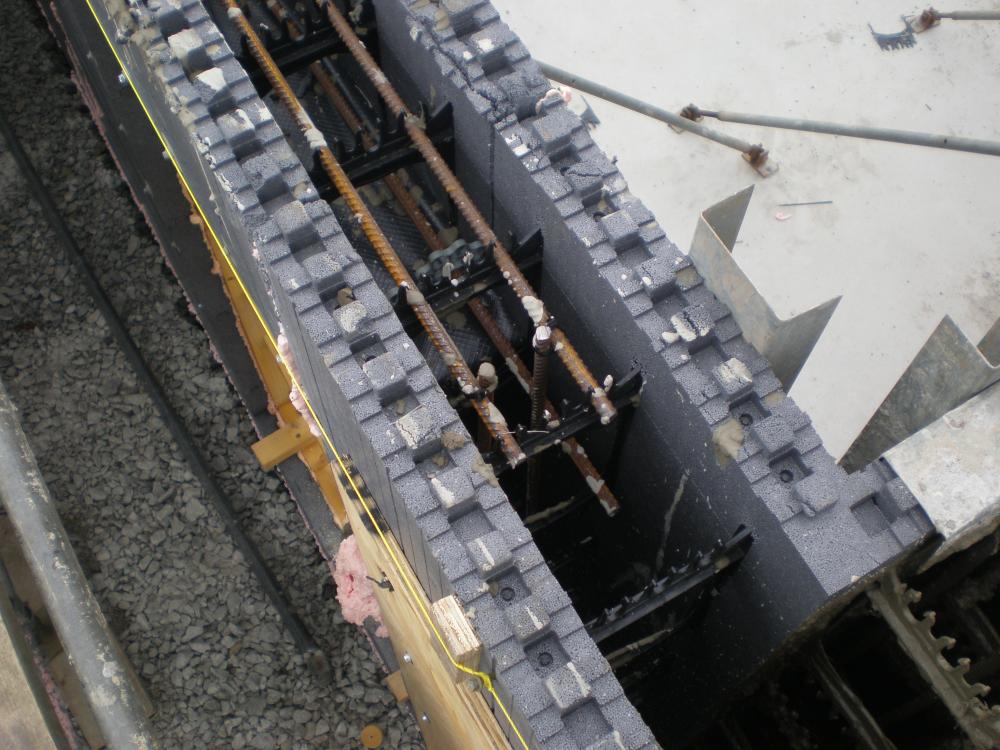
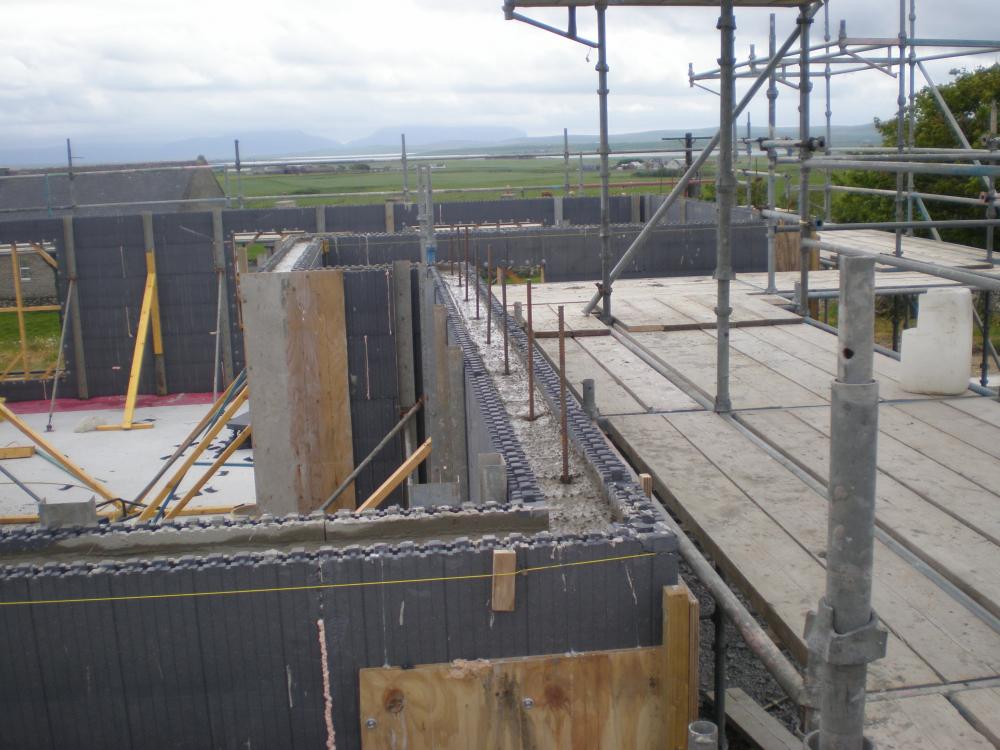
-
Every build we've done, OR has simply dropped off a drum / coil of armoured cable for us to run from the boundary / pole, into the house. Cable buried direct in the ground, brought up into the house where we want the master socket.
-
Scottish Power - Under-grounding of electricity wires
Stones commented on Lucy Murray's blog entry in Lucy Murray
Dare we ask how much they are fleecing out of you? -
Home cinema is what it's all about for me. I can't remember the last time I sat and listened to an album. I'm more of a talk radio man, or low level background music, and have been quite happy with my internet radio for that. My Yamaha RXV640RDS is now 15 years old, paired with the Wharfedale Diamond speakers I bought over 30 years ago. One day the amp will give out, and I'm under pressure to change it for something more slimline - a Marantz NR-1506, to fit in our new media unit. I'm likewise under pressure for something more discreet speaker wise, although I have to say I'm more reluctant in this respect. Top of my list is the Tannoy HTS101XP speaker package. All being well will be visiting Edinburgh in a few weeks time which will give me the opportunity to listen to both components.
-
Credit/Debit Reward Cards, Discounts etc
Stones replied to Ferdinand's topic in General Self Build & DIY Discussion
Absolutely, prior to making any other purchases this way I would check / call the helpline, as I stated earlier. However, for the purchase already made, which was the original question, an explanatory note along with the receipts when submitting the VAT reclaim would seem sensible.- 151 replies
-
- 2
-

-
- credit cards
- rewards cards
- (and 6 more)
-
Credit/Debit Reward Cards, Discounts etc
Stones replied to Ferdinand's topic in General Self Build & DIY Discussion
I would write an explanatory note to accompany the receipt for the goods, attaching the receipt for the gift card purchase, when you submit your VAT reclaim. You could phone the helpline to ask? -
A warm welcome. I really like the concept of clearly defined new extension and link.
-
What a great start. Keep up the good work!


