


ruggers
-
Posts
335 -
Joined
-
Last visited
Everything posted by ruggers
-
Trench block or cavity with infill below DPC advice required?
ruggers replied to ruggers's topic in Brick & Block
I was just focusing on the block selection rather than the correct detail for floor insulation. I understand that but haven't worked with foundation blocks before. All the ones online seem to have strange sizes. I was hoping to just find some foundation blocks 440mm long x 215mm high in varying widths to suit my walls, 350mm, 300mm & whatever will go under the walls supporting 100mm beam ends that will only have single load bearing walls built above them. Most foundation blocks seem to be 3.6Kn not 7.2Kn and made from aerated material. Are these ok to use or problematic like the aerated blocks used above DPC which always have cracking issues? One of the builder I was looking to use still use the double dense block with infill method. Other than time, are there any cons to using this method nowadays? I just had a quick look, jablite 70 at 240mm would probably save me £700, the 160mm PIR was going to cost £1800. I''d need to raise the internal garage floor up by 75mm though to keep the heights correct between the house and garage step down. Jablite customer service staff were the least educated of any company I've ever dealt with in my life. Two women taking calls who said they have no training and no data at all on their own product. -
Trench block or cavity with infill below DPC advice required?
ruggers replied to ruggers's topic in Brick & Block
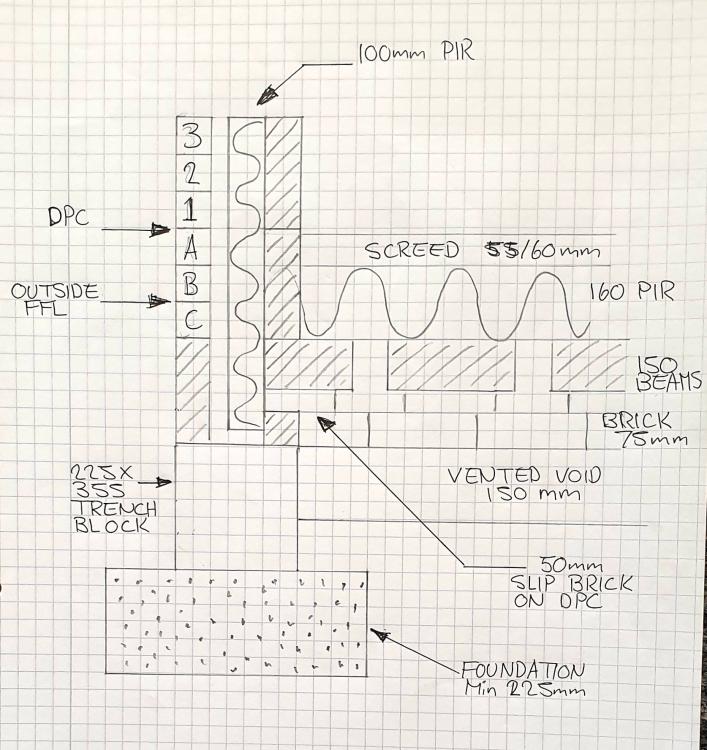
Would the telescopic vents install ok as per sketch where the T beams & slip bricks are set on a course of brick? -
Trench block or cavity with infill below DPC advice required?
ruggers replied to ruggers's topic in Brick & Block
Meaning keep the B&B height the same height but add more insulation to build up to a higher FFL? I'll be installing wet UFH yes, was going to be 165mm PIR & 55mm cemfloor = 0.12W/m2k. It could be upped to 250mm & 50mm screed, it's just so expensive even EPS doesn't seem much cheaper by the time you go 50% more. Yeah my drains are all taken from FGL minus 300-320mm for the first chamber invert which is the shallowest I can have. I've just got the terminology wrong on here. There will be a 150mm step dow from inside FFL to outside FGL path with exception of the low threshold front door. Basically the reason I was working from FGL down, is because I have a set height that FGL needs to be at for all drainage to work, then knowing how deep my soil is, and where my clay levels are, I need to either go down a course deeper because of the lowest ground point, or we don't remove as much soil from that lower side so the founds have a natural shutter but are still laid onto solid ground. It might just be a case of factoring in the cost and seeing what it's like during the dig. -
Trench block or cavity with infill below DPC advice required?
ruggers replied to ruggers's topic in Brick & Block
Thanks Russell. FFL needs to be at a certain height to achieve a drainage fall on a pre existing main. I've got a site that at the back slopes 315mm from one back corner to the other side of the build. The structural engineer has set a dig depth of 750mm from FGL to the invert of the foundation on the higher side for a 225mm concrete strip. I have a couple of areas that need to go down much deeper where trees were to avoid heave, these will be mass filled to bring the foundation top back up to match the standard depth for the rest of the build. Theres 450mm of top and sub soil to be stripped to take it down to clay level ready to mark out the foundations, this will then be returned with a little more to build up to the new FGL at a later date once the build is at DPM or beyond. Due to stripping this 450mm off, it means at the lowest corner, the concrete foundation could be above ground level, so options are to either dig a course deeper so its underground again, shutter the lowest corner until ground around it is replaced which seems a messy idea, or add compacted stone (150-250mm) across the area that the house will sit on, then the foundations to be excavated through it so it acts as a retainer for the concrete on the lowest corner & keeps the site clean when digging out I'm advised. It seems strange to cover a site in stone to then dig back through it & have it taken away. The house needs built up one course to level it with the surround area & road access regardless, but the other issue is potentially needing the foundations to be another course deeper because some points are low. The trench blocks I seen were W355 x H215 x L440mm. Not physically seen them yet, are these usually aircrete & a bad idea? Are the ones you mention 355mm wide x 100mm height x 440mm long? -
Looking for some advice for a self build. I need to raise the height of the house including floor level by 225mm which will include raising the outside finished floor level (FFL) around the house. As per sketch, would it be best to add another course of 225mm trench blocks on top of the existing course, or would it be better to add 2 rows of 225x100mm wide dense solid blocks and infill the 150mm cavity with a lean towards the outside? Cost wise theres not a lot in it, Trench blocks will be quicker for a builder, but I'm thinking of whats best for the construction & are trench blocks ok closer to the surface with freezing? They'll be out of the ground for a good few months before the outside ground is build up to the new FFL.
-
Not from me, I wasn't able to obtain a price being out of their delivery zone. Contact them you'll have a price within a day and post up up the reply.
-
Seems irrelevant, but 6 years ago. When the stat fails on the car its usually in the half open position and stops the engine every fully warming up or takes a very long time, it doesn't blow the engine. If it fails closed you'll have a nice warm engine and cold cab. The anti freeze valves are a pressure relief system that stops your 4 grand bit of kit being damaged in the rare instance theres a power cut and the outside air temperature is 3°C or less. Thats the only reason I asked if they are servicable. These things tend to never need to activate and if they haven't, but in 5, 6 8 yrs time they need to but have sized isn't good. I've never seen them to make a judgement on whether they would fail closed or not.
-
I wasn't aware of them, everyone always say fit 2. Are they a serviceable part because there's a lot riding on them working if it's fit and forget and you get a power cut in 8 yrs time on freezing day. TBH I can't think of the last time there was every a power cut in 15 years, but we do get -5°C periods every year for a few days/week. Did you just mix regular antifreeze used for something else and fill your whole system with it, so it's in your radiators and all pipework? I was hoping not to include any inhibitor in a new install and apply VDI 2035.
-
I'd probably go for the Flush or the esprit 3L, but I made enquires the past week and found that they won't deliver to North England. They asked me to get in touch with Birtley group but I'm waiting on them confirming they have more range than the 3 doors they sent over which weren't very nice.
-
Following this because ive just been looking at the same thing. Current house has attached garage with timber fire door and the garage door is 40mm insulation sectional but not great airtightness around the edges. The timber door to the house i feel is a weakness too despite a 4 sided seal. Looking to start an airtight build with the same internal garage set up id like a good door between house and unheated garage. Drop seals might help routed into the underside, but I'm hopijg theres a rebated upvc fire rated door available for a good seal.
-
Seems so. Maybe concerned where we live is too cold or just not heard of them. I was about to say, It's nearly always 3 degrees or less in a Scottish winter so it would be leaking out constantly. So it's just if the pump has no power to it. If it's not running because theres no heat demand but it then drops down to a low temperature, it would fire the pump up instead of dumping the pressure.
-
Thanks John, What have you got installed in Scotland. We have freeze issues outside up North. If you just used the anto freeze valves, would you not just lose all of the system water every time it's below 3°C outside, is it not like a combi where below a certain pressure the system stops working until you fill it back up?
-
What brand is the 25L buffer? I've no idea why they wanted to use glycol then, especially as a registered installer. You'd expect a random plumber to maybe do things that way. I wouldn't fancy glycol throughout the whole system sounds very messy if you need to drain down or if you got a leak, plus it won't be cheap like water is. Why does glycol lose efficiency. Filling the whole system including radiators would mean even less efficient?
-
I can't see any difference in them two senso comforts but there must be if they're on the same site at such a price difference. Them UFH manifold pump sets with the TRV style mixer are just for on off controls and don't work very well with weather comp. I could probably get away with only one mixer for the UFH and let the radiators demand the highest temperature which they usually do, but some people have rare instances where the UFH demands more than the radiator circuit. I just looked at Vaillant because they get rated highly like eco dans. Boilers I was looking at the Viessmann system boilers for their low modulation. Much cheaper than heat pumps to install. How does the water not freeze in the outside pipes? Why's the Vaillant installer saying it has to have glycol between the compressor unit and whatever it connect to indoors? I'm not up to speed on the terminology of it all. Outdoor unit is the compressor? Whats the monoblock? If the hex unit is the internal heat exchanger between the indoor piping and the outdoor unit, if you don't use one, hows it all connect
-
@HughF Well I plan to have have radiators and 2 towel rails upstairs ran off their own manifold in 15 or 16mm mlc, ground floor 85m2 of UFH all on weather comp. My rough price guide i added up was based on what I'd picked up from brief reading only. Theres other parts I know I'd need but don't know the names or prices of them having never installed an unvented cylinder. With a gas boiler I would install 2 mixed pump sets to independently control the curves. 7Kw ASHP £3832.20 inc vat. Heat pump warehouse. - 5Kw cheaper again. 250L UniStor £1208 inc vat. Hex module £698 inc vat. 25L Expansion vessel £60? Senso comfort - One for each floor? £200 each or 400 each? Will post link at end. 45L buffer tank £560 - This was Vaillant, could be other brand & could be smaller? Underground pipes outside £400 for 4m? Uponor do one in insulation. Flamco Meiflow x 2 mixed pump sets £300 each Electric control box to connect boiler to the mixer valves - £225 each for other boiler brands - Would need 2 Mag filter £75 Lagging - decent type £50 Rotary isolator switch - Better looking black one £50 Armoured cable from consumer unit to ASHP £25 Glycol £? Pipework & press fittings for plant room £500? Press fit tool hire £60 Pump & temperature sensor for buffer £100? Anti freezing valves £200 for 2? Various valves for internal plant room £150? Total £9100 inc VAT - £7300 excluding VAT (1800 VAT reclaim). Whats the difference with these? Why is this £835 for 2, https://www.plumbnation.co.uk/site/vaillant-sensocomfort-wired-pack-2/?fbclid=IwAR0EHaN2sOacqh48JkiexIlu2FueI1lXNCqVRxuQDlPhYNyGgt4V6BvapjY And this is VRC 720 is £195 each. https://www.plumbnation.co.uk/site/vaillant-sensocomfort-vrc-720-weather-compensating-room-thermostat/?fbclid=IwAR2BEGi0orMwCoxM1y-dHu1KyhTJb3XprGW_MnZFdIxlLlFkaJhl8eMkPvM
-
I think if I was to buy Vaillant it would cost me £8750-9000 for components only no labour. I can only guess some prices. Its about 3-4k more than a gas boiler set up. The annual savings would take 15 years to recoup with the more expensive services factored in to keep a warranty unless it was all self install. I've tried calling Vaillant and Viessmann and Vaillant seem useless, only now and again you get someone who knows what they are talking about in renewables or technical. Basic stuff they can't answer. They don't call back. I don't think the UK knows enough about them yet, not everyone but most. Theres not enough info. available for me to feel confident in an installer or myself fitting one. Everyone Ive spoken to has a different way to do things. Your saying no need for a Hex unit, installers say outdoor unit should come to the indoor hex unit with glycol in then from the hex I can have water in my system. Or you can have a full system of glycol which sounds terrible, especially if you had a leak. Others have said no need for any glycol just water between indoor and outdoor units and some anti freeze valves. Some say try not to use a buffer because it loses efficiency and others say to use one. Is this just to make it easier to hide a half thought out design or they really are needed on most installs?
-
I don't understand that part saying it's not a bad thing when you need low output. I thought the low output is what causes it to cycle which is never great? I wouldnt need anything too big for a 4.5-6kw heat loss depending on which figure was used. Bigger pump can reheat a bigger cylinder though and quicker. Does the buffer not end up the same as temperature as the system water so then it just cycles again or is it set to take higher heat with it's own stat? How much efficiency do they remove, 45 litres is quite a lot of volume.
-
What are you running in the outside lines from the compressor to indoors? Whats separating this, theres usually a wall unit isn't there with the heat exchanger in? I've seen the Meiflow jackets housing esbe mixing valves with control units for controlling the heating curves, and grundfos or wilo pump inside. Is that set up for priority hot water with the 3 port valve? The Unistor cylinders have a 15 minute reheat time or 11 mins to 70% for a 250L
-
I have a plumber friend who's gas safe and G3. He's getting old so not up to speed with weather comp and the latest tech but I've been learning as much as I can. He's happy to work & have me involved. Based on everything gas, which i can get my head around a little easier, I was going to fit a low loss header & two pump sets, one mixed, one unmixed. I'm not sure if you still need the hydronic separation with heat pumps but the hex module indoors separates this. It's just with having radiators first floor and UFH down are they not different flow rates or all the same with a heat pump? Arotherm is just because it generally gets a lot of good reviews and seems popular and their cylinders are really good & a tidy package. Impressive reheat times. It seems easier to learn once you've focussed on one brand. If self installing, is there much difference in using other models? I work it out that a lot of these installs are making £1000 a day for 5 days work instead of £300-£400. Even them prices are a lot. I need to see a drawing for a piped system, it's just all the new terminology for component names. Viessmann has a nice display unit with the heating curves, lots on youtube to see. Struggled to find any on Vaillant, only the senso comfort but it just shows program settings like times and temperatures.
-
I agree Mike, I'm not concerned about the coldest days of the year, I will have plenty to cover that. Although it doesn't feel like it, the average temperature for my area is 8°C so having a unit that can cope in the extreme cold but also modulates down low in the warmer months enough not to cycle is very important. I run my heating from October to April normally. How can you draw 600w if the lowest modulation is 2.1 or 3kw pending which model is selected? I know that with gas that the lowest modulation is 1900W & this would mean that the boiler would cycle from outside being 10.5°C. I've no idea how to work this out for electric modulation, haven't found anyone who can. 4.5Kw heat loss is 183W per degree of temperature change for my indoor and outside design temps.
-
@HughF @ProDave I've done my own heat loss survey on heat engineer and spent ages trying all different things, I've got it as accurate as can be from the details I input. I'll be able to shave a little bit more off it, but theres no way anyone coming to do another will spend as much time as I will, they'll just take as close to U-values & air changes where as I've got the exact ones. there should be no reason for someone to do another. MCS seems a farce. If MVHR reduces my heat loss by 25%, then it should be factored in so I require smaller radiators, then if I run it at a lower flow rate to be more efficient, I have room to upsize them to suit. If using my none MVHR heat loss figure, I can't run the flow lower than 40C or the radiators are physically too big for 2 of the rooms. If I'm to fit a heat pump I want to fit an arotherm plus, but I won't get the 7 year warranty if I fit it myself & would need an unvented cylinder. I've done full house combi's but never fit cylinders, expansion vessels & more. If shown I'd learn it easily but theres no source for me to learn it from it would take ages. I think people fitting heat pumps are over charging by thousands, they are no more complex than a gas install for a competent installer.
-
Plastic vs Copper pipes for radiators
ruggers replied to Raks's topic in Central Heating (Radiators)
You can either buy pipe clips that are split lengthways and clip around the pipes, maybe called rad snaps, or buy something like these. https://radiatorvalves4u.co.uk/500-radiator-pipe-shroud-130mm-long-brushed-copper/?gclid=Cj0KCQiAj4ecBhD3ARIsAM4Q_jFK8hVmeIjPzYSJcCcgfNrj4emtMvOcPXF4129rJTGDhiVDEabp9wQaAhctEALw_wcB -
@HughF I can't install it, to obtain the 5k grant you need to go through MCS, to get the full warranty you have to be a registered installer and Fgas certified. I can size everything up & I can fit the underfloor, the radiators and piping but not the plant room install or unvented cylinder. All these new regs, Part L and complying with things that require heat loss surveys for weather compensation, and then we don't stick to the figures used from the results.
-
407mm centres probably won't collapse the house if it's 1220mm sheets. Probably more important to see if it has to be ply or OSB or either.
-
So Looking at the 7kw and 5kw Arotherm plus to install in a self build not started yet, there's a few things I need to understand related to sizing the pump & heat loss. My heat loss with natural ventilation is 6.2Kw, or 4.6kw with MVHR fitted which will be getting installed. I can improve this slightly and both of these figures include 10% added on for exposed location due to height & coastal area up North. Both Vaillant and the Vaillant local installer have said that when sizing for an ASHP, they have to exclude MVHR from the heat loss survey and base it on natural ventilation as thats the worst case situation of when someone returns from holiday to a house that hasn't had it's heating on and theres no heat for the MVHR to recover. It's quite annoying because using the higher 6.2Kw figure means that I need to size my radiators much bigger, and the physical size of them increases which for my largest bedroom & my main bathroom end up huge. I wanted to lower the flow temperature to get the system running as efficient as possible but going below 42.5°C flow (40 MWT at DT5) is the lowest I can go. having a 40°C flow (37.5 MWT) means that my bathroom radiator has to be 2400w and it would look too big for that room. The heat loss for the bathroom is 559W before a scaling factor is applied. A small reduction in mean water temperature has a huge impact on enlarging the radiator size. If I was able to use my lower house heat loss figure of 4.6Kw, it would allow me to run at a lower flow & return as the heat loss per room is much lower.

