


ruggers
-
Posts
335 -
Joined
-
Last visited
Everything posted by ruggers
-
How to determine finished floor height using beam and block?
ruggers replied to ruggers's topic in Foundations
I think what your referring to where you open up the inner leaf lower down is to allow the slab to bridge the cavity to support the insulation and screed above and prevent cracking. If using B&B, this can be done by either cantilevering the beams out to the inside of the outer skin to support all above, or take a risk & only cantilever the insulation out to support the screed & hope it doesn't crack over time as per attached image taken from someone else's post on here. I really wouldn't care about the inside FFL being 20 or 50mm below the door threshold, all of my doors now have 50-70mm UPVC step overs, it's just because building controls involved with it being a new build. As per my sketch above, I could add 160mm insulation to bridge the gap a little, it's just what to do if i have to add 190mm insulation. I think i jus need to avoid this at all costs is the solution i'm coming to or be prepared to add 220mm of insulation if I want to keep the screed at 60mm. it's a numbers game.😒 Ground clay heave issues so he wants suspended beams & deeper founds where trees were. Just paid extra for this after person who done the plans said heave wouldn't be an issue while not knowing the ground. Don't ask.
-
How to determine finished floor height using beam and block?
ruggers replied to ruggers's topic in Foundations
@Temp@Canski Thanks for the diagram. With that diagram it's a slab floor so you can easily add more hardcore or concrete to get to your desired finish height. Beam & block seems to work a brick course at a time so you either have to increase insulation or screed. The screed is only supposed to be 50mm. I've allowed 60 in certain areas for any irregularities. I can't lower outside FFL because theres limited fall for drainage so the house would have to go up but outside isn't really a concern. I was aiming for 150mm (2 bricks) step down from inside to outside on my other doors as it's nicer than 3 bricks & as per below sketch, bricks 3,4,5 line up with the 225 block sat on the beams. If I use 190mm insulation then add screed, this puts my inside FFL at well above the DPM door threshold that needs to be level. adding another brick would mean I need 300mm of make up from the beams unless I'm missing something?
-
How to determine finished floor height using beam and block?
ruggers replied to ruggers's topic in Foundations
I didn't realise it was a whole house calculation. I mean SAP has specified 150mm as 0.10w/m2k, so i could do this and hopefully pass. I only know its incorrect because i was made a few enquiries and some of the insulation suppliers calculated my wall and floor make up for their products and all said i need 180 to 190mm. if i fit 150mm its 0.12w/m2k. Part of my existing house floor has none in, the 10 yr old part has 100mm. Both floors feel as cold as each other. It's easy to get absorbed in figures but having UFH makes sense to insulate better. Was it the inside of the LL threshold that sits 15mm on top of the brickwork? This is what the aluminium ones seem to be on a search. It will be a UPVC door so not sure if it's the same? LABC site says maximum 15mm height difference or you require an internal ramp. I won't know if Im using tiles or karndean until built which will add or remove 15mm by which time it's too late. -
How to determine finished floor height using beam and block?
ruggers replied to ruggers's topic in Foundations
With standard beams 150 insulation seems less of a head ache then. increasing insulation to 190 or more and more screed, plus another house course of bricks is £1000's. I'll have a look into them thanks, have heard the names some time ago but thought some insulation must still have to run over the top of beams and block as the beams otherwise the prestressed concrete would have a lot of cold bridging? Going from slab floor to beams requires 10mm more PIR ecotherm told me. I liked the idea of a thinner screed vs thicker for reaction times although with weather compensation it's probably less of an issue. -
I have some house plans approved for a masonry build which now need to switch from slab floor construction to beam and block which I've never used before. I'm having trouble understanding how you align the inner and outer leaf brick courses so that the inside finished floor height is level with the cavity wall DPC that the external doors will sit on. If I add a 225mm inner leaf block on top of the beams & then use 150mm floor insulation on top of the beams + 50/60mm screed, it works out well at 210mm, which is under the 225mm block DPC level and leaves some room for tiled floor surface before the low door threshold. This makeup = 0.12W/m2k My SAP has specified 0.10W/m2k using 150mm PIR which you can't achieve, it would require 190mm insulation which throws the heights out a lot. 190mm insulation + 50/60mm of liquid screed = 250mm or 270mm with a tile. This sits higher than a block but 30-50mm too low for a block and a brick to match DPC. How do you make up the floor levels to match low level door threshold/DPC, is it a case of you have to add more insulation and more screed to get to 300mm DPC? With a slab floor you can offset the height of the slab to suit so I could have any thickness of insulation. Is 0.10 vs 0.12 W/m2K a massive difference in a heat loss calculation or noticeable in the real world? I planned on having 150mm two brick courses step down to my outside finished floor level with the exception of the front door which is a ramped access low threshold to comply with regs. From the top down, my floor make up is, Minimum 50mm liquid screed containing wet underfloor heating (May need to be 60mm in some places to account for 10mm curve on beams) 150 or 190mm PIR insulation. 150mm concrete T beams with 100mm block infill and 50mm slip bricks.
-
I've had a similar price, £650 pump and labour for a day and then around £1400 for 4.5m3. It worked out better to arrange my own cemfloor and a pump guy after shopping around a bit. Not in a position to do this for a year so prices will change slightly, but as of today it's accurate.
-
Any reason why you chose that one? I'm thinking in some ways, if your well insulated to prevent heat loss and your running it 24/7 with a set back temperature of no more than 2 or 3 degrees, it's all relative especially with weather compensation. I can see a bigger issue with 75-100mm screed and on off timed controls waiting ages for it to heat up from cold and then if it gets too hot you have to live with it for another few hours until the thermal mass is used up.
-
Is the laitance grinding something thats done shortly after the screed has set, like a week later, or just something that needs done prior to tiling in the future? I received two gyvlon quotes from the same company and one was called Eco FD (Fast drying) and theres no sanding required to help the drying process. Not sure if this means that when FD is used, theres no extra tiling prep required.
-
I've just been making further enquires on Gyvlon vs Cemfloor prices & to see if one product is better than another at 50mm over UFH & trying to understand the following... Gyvlon has a thermal conductivity of 2.2W/mk Cemfloor thermal conductivity is 2.9W/mk 1. Does this mean that the Cemfloor is quicker to heat up & lose the heat & Gyvlon will be slower to heat up but then retain it for longer? 2. Can you tile onto one better than the other? This might be better placed in the tiling section?
-
Cavity wall lintel advice for self build required
ruggers replied to ruggers's topic in RSJs, Lintels & Steelwork
@nod Thanks I'll have a look at them, strange how they can offer better prices than the merchants when part of the main group. @CanskiJust had a look, no build base near and they don't deliver to my location. I will save the birtley name to try. It seems theres plenty of suppliers but lots of unheard of local ones and sometimes they offer better prices than the ones that come up on main searches online. My design is quite basic so I'm hoping it's all standard lintels, I've contacted catnic as you mentioned but theres quite a long waiting list at the moment so I'll have to wait. So using facing brick only, did you get away with the SD ones? They now offer a thermally broken lintel but the prices are off the scale for them. -
Can anyone advise on where is best to buy catnic type lintels at a good price and the difference of where you'd use standard or heavy duty lintels. 150/100 have been specified for a 100 block, 150 cavity, 100 face brick outer. There doesn't seem to be as many places selling them as other items online. Last time i priced a load, builders merchants were expensive compared to online.
-
That price was for supply of gyvlon or cemfloor and their labour charge to set tripods to level the floor ready for them pouring.
-
If i'm working it our correct, your screed is £36m2 at 75mm, mine is £29m2 at 50mm. Divide 36 by 3 then x 2 (For 50mm) = £24m2 if i was using your prices. Wagons are often 4,6,8 m3 so you will be a full load at 8m3, I will be 3/4 of a 6m3
-
Thats around £5 per m2 cheaper than what I've been quoted at £29 m2. It's probably a combination of distance from the cement supplier to my site being further away as a local ones stopped providing it, and possibly reduced load compared to you, 8m3 vs my 4.5m3
-
Just jumping onto this post rather than start a new one. Is there much quality difference between Gyvlon liquid screen & Cemfloor? I was set for the Gyvlon but a local plant has stopped supplying it so it would have to come from mixer truck which might be too large for access. Prices last year for 50mm were going to be £21.50 per m2 for 83m2 (£1800) but a recent quote has increased this to £29m2 (£2400) which has increased the price by £600 for either screed.
-
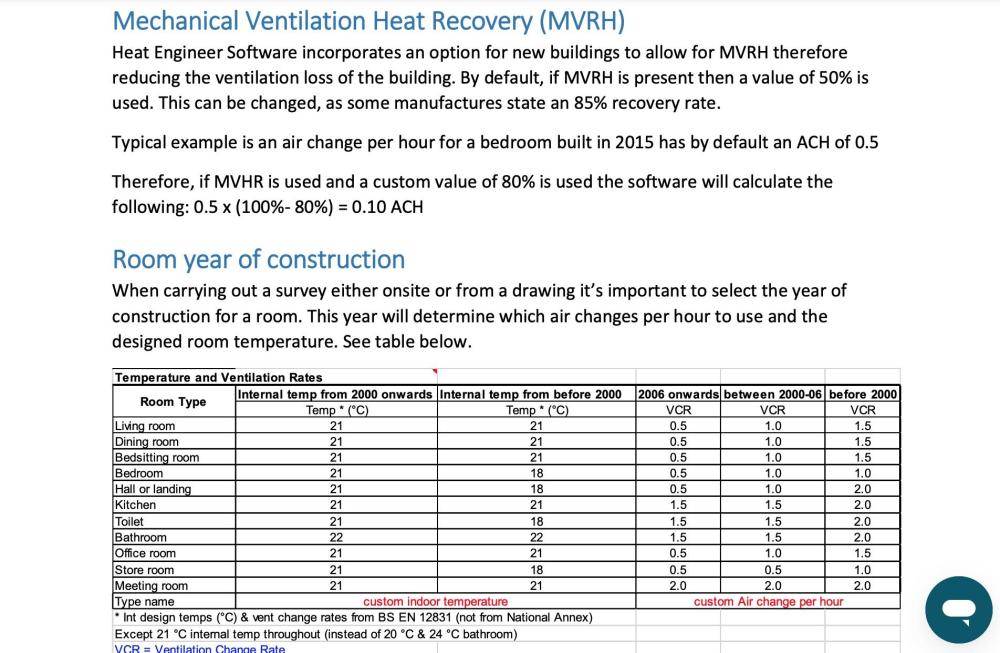
Thanks John, I think what has confused me was standard air changes for a none MVHR house vs a house with MVHR. Although airtight, I wasn't sure if having MVHR increases or decreases ACH. I was thinking it increases the ACH because theres a fan controlling it which will always be more than natural ventilation? As mentioned before, wondering if the heat loss software, although we may change the ACH for a house with MVHR, can the software detect how much heat isn't being recovered at this higher rate or is it just detecting a higher heat loss due to more ACH. I've just found this (See attached) in an online manual for the software. So I've now selected MVHR at the default setting and all of the ACH figures per room have reduced, Is this suggesting I change the figure to 90 if the figure was 90% efficient? It seems a bit dramatic. Without MVHR heat loss is 6.1kw With default MVHR at 50 the heat loss is 4.5kw With setting changed to 90 the heat loss would be 3.24. MVHR doesn't save that much energy so I must be doing something wrong.

-
It was 20 inside and the recovered heat was 19. Can't remember what they said the outdoor temperature was at the time. I do think 90% efficiency isn't uncommon though. Do these figures mean your MVHR at 0.3 ACH is running at twice the capacity expected or half as good? I've not looked researched anything to do with ACH & how it's all calculated at this point only design, functions and performance.
-
I've spoke to the MVHR company today & they've confirmed with some cheaper units it's not always possible to know exactly whats being recovered, but with the likes of the Zehnder units with sensor monitoring, they have plenty of data to show some properties they've installed at having recovered heat at 1°C less than the indoor temperature at 20c. Is this data on a website for set areas anywhere or is it your own data? Interested for my own, I'm sure it's 9°C local. Interesting figures, good to see. Theres no doubt MVHR is of benefit, it's just making sure my calculations will reflect this. I'll check out the sheet Johnmo refers to as a comparison. In layman's, is this something we should consider as a factor or is it minimal and not so noticeable?
-
Storm dry seems an excellent product for this.
-
I will take a look at them John, always good to compare because sizing emitters can only be done once with UFH. I just imagined the sheet would require me doing a lot of long hand calculations with formulas which isn't my forte. Some experienced heat engineers I've been speaking to had said about using the heat eng. software as it was good, although they can do it via others means it would provide me with good results and use it themselves. I'm not sure if they have considered MVHR before though. My concern is how the software correlates with heat losses vs ach & heat recovery. I think I'm with Joe on this one to a degree (No pun intended). The chilled wind could act as a wicking effect at drawing the heat away from the dwelling, especially if wet mortar between face bricks, I may be wrong because the inner and outer skins are independent, but we do know that poorly fitted PIR in a cavity can have the same effect as a radiator in reverse. Air passes between the gaps from poor install and draws heat away from the inner cavity wall. Effectively no wind should be able to get in other than tiny weep hole vents but its possibly just from the difference of temperatures.
-
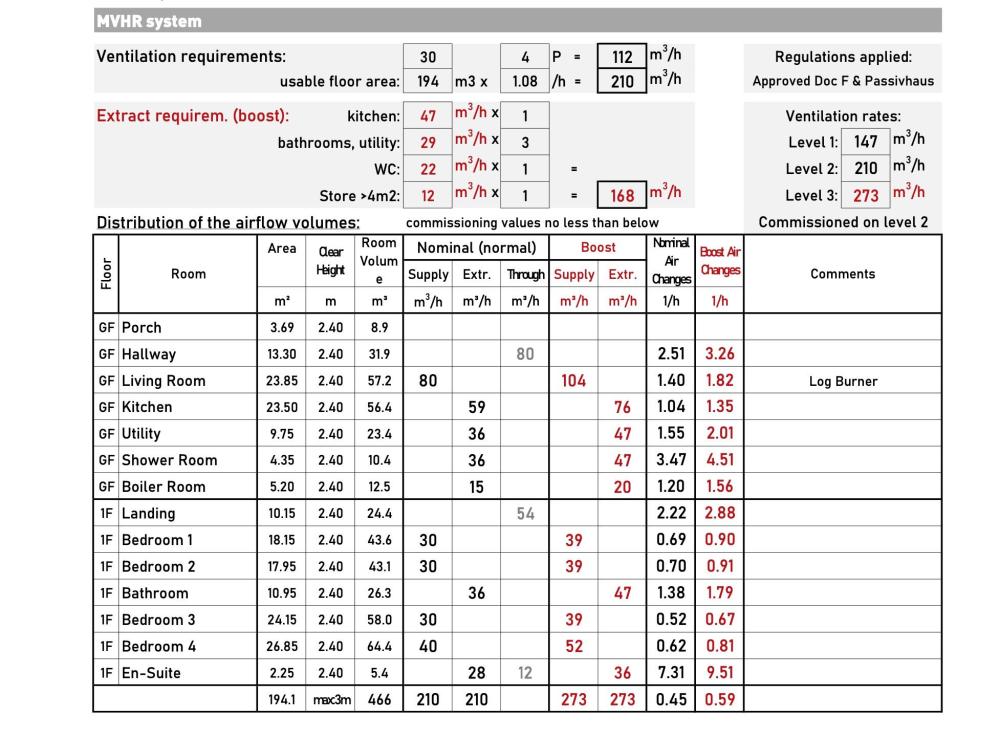
@joth This is my concern, that the software only detects a change of defaults resulting in more air exchanges per hour so it estimates that i require more heat than needed because it doesn't factor in the heat recovery percentage. I will look into this in more detail because a tutorial video i recall a mention of 50% default for MVHR but an option to increase the %. Is PHPP the passive house detailed calculation, do you have a passive house? I've included some attachments, the MVHR report is just one of the 3 companies who provided me with some details & a quote.

-
Of each room value? Why that figure? I'm hoping it will be answered at a later date once i pay for a detailed design with the MVHR company who can advise me what to add but MVHR won't know much about heat loss calculations or care so I need to make sure I can input the correct data to get my results accurate. As mentioned, a whole house of adding insulated plasterboard made very little difference but changing some parallel rooms lowest temperatures from 18°C to 20°C to match the 21°C design temperature shaved off 0.4kw total.
-
I think MVHR is a good idea, and I'm happy with the heat loss calculation although would like to improve it further. What I don't know how to do, is get the most accurate results from the heat loss software when installing MVHR as this could/will affect the air changes beyond their defaults. This can through the calculation out massively & I could end up under or over sizing my heat emitters which defeats the object. I'm aiming to get them as accurate as i can, so when fitted with weather comp the house is sized perfectly & feels good. Question is, what do i set the ach to in the software to reflect the MVHR install?
-
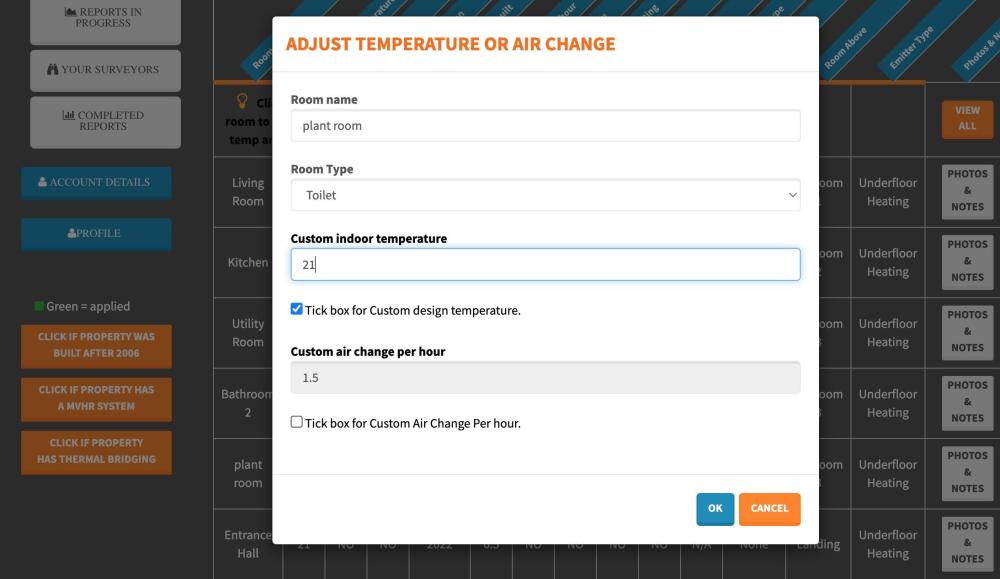
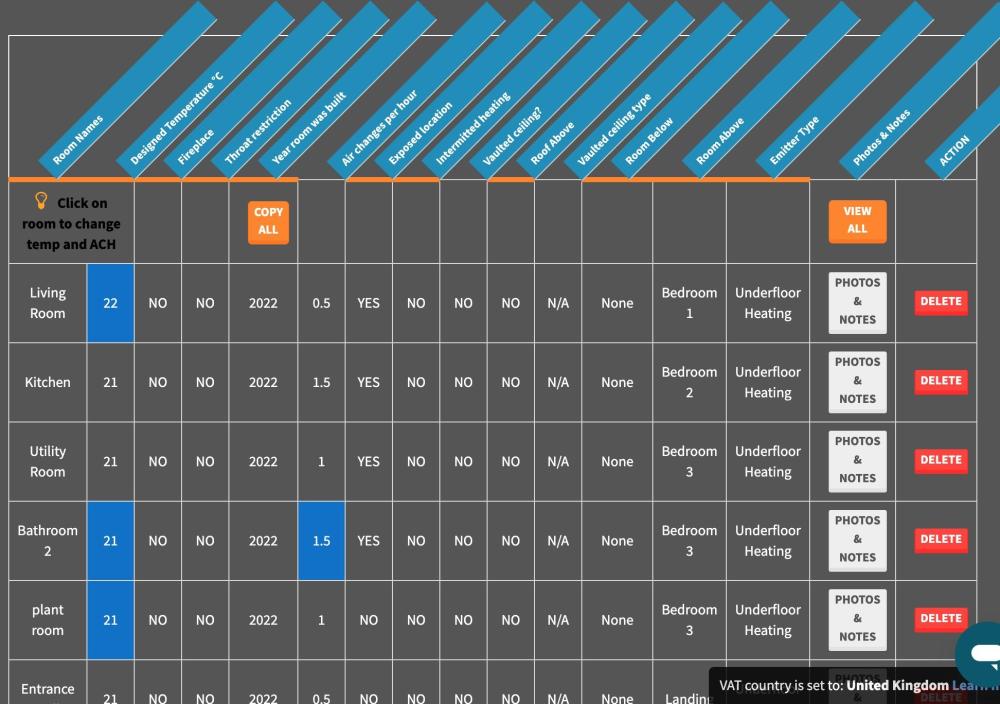
A good few replies from a late night post. I'll answer below. I believe MVHR to be good and having to have an air tightness test on new builds means MVHR or trickle vents, ones cheap, one isn't, but i hate trickle vents with a passion. So going down the MVHR route, I'm fitting a quality unit that can recover up to 94%. I have a good draft design that i will self install and have narrowed it down to two really good companies to complete the design, install & commission after speaking to a few of them. (Will select once overall quotes are in for all trades). So I've decided to make sure I apply a high level of air tightness & insulation detail myself after researching a lot on here & speaking to people. Heat engineer app followed by sending the report to the desk top version to fine tune everything. It will warm the incoming but would it not also be dumping some of the warm air outdoors continuously, 20°C extracted at 90% recovery would mean the supply air is 18°C? I sometime see quotes saying MVHR can lower your heating bills by 20%. In winter I probably wouldn't open my windows & never use trickle vents so it would be less than MVHR. I'd crack them open on catch in bedrooms for an hour or so in the morning or when cooking. It's probably not correct what i done, i was just trying it based on the attached screen shot, the heat loss software defaults all ACH to 0.5, 1.5 or 2 for various room types. Bad choice of words from me sorry, shouldn't have said standard. My calculations are now completed & showing as whole house loss of 6.11Kw based on all of my materials to be used with correct U-Values. This is 10% more than it would be because I've ticked the exposed area option being 125m elevated, 2 miles from the West coast in a windy area. What I'm surprised at, is by changing my 0.17W/m2K cavity wall insulation to a different U-Value to simulate how adding some internal insulated plasterboard at different thicknesses would improve things, it made hardly any difference at all and they cost 3x more than a standard plasterboard. Adding 37.5mm to the inner skin gives a value of 0.14W/m2K, adding 52.5mm gives a value of 0.13W/m2K. My 6.11Kw house heat loss only improves to 5.97kw and 5.92. It seems a waste of money adding the insulated board to the inner walls unless I've done something wrong?





