


ruggers
-
Posts
335 -
Joined
-
Last visited
Everything posted by ruggers
-
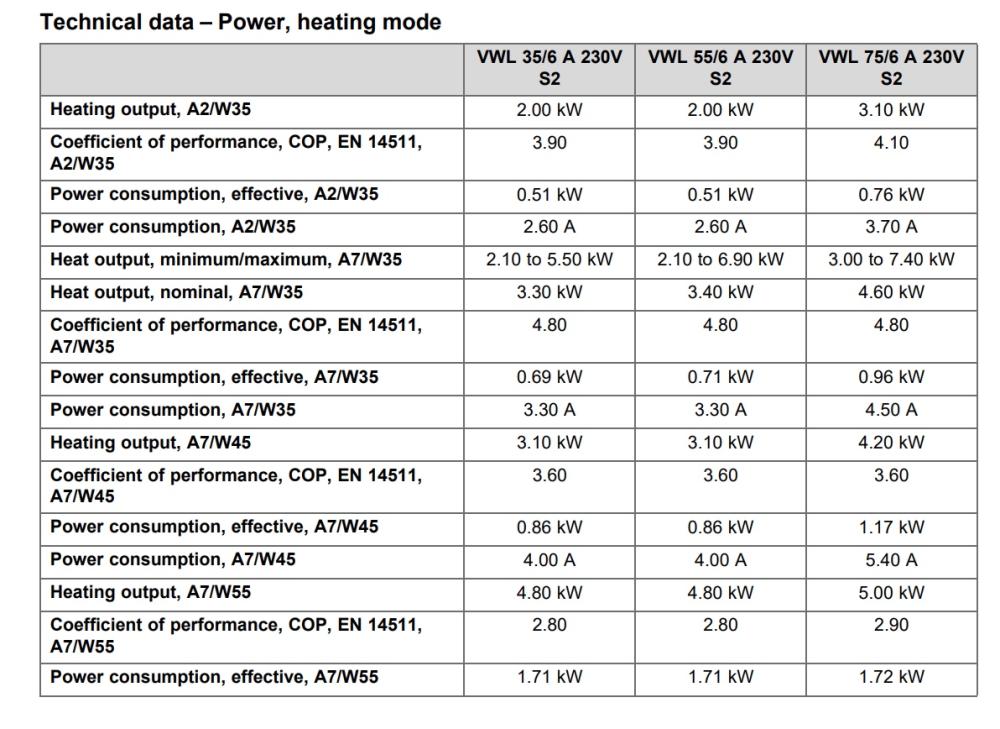
Less load. So if a gas boiler has a maximum output of 19Kw and a minimum of 1.9kw, you know that on a warmer day it will be running closer to 1.9Kw and on a cold day like minus 3, it will be running closer to 8Kw for an average house (Maybe higher pending the heat loss) So I wanted to know does an ASHP rated at 7kw run closer to 7kw when outside is freezing, but on warmer days like +10°C, then ASHP would only run at 3Kw. So drawing 3kw of energy when in use as opposed to 7Kw? I don't have one yet, I've been looking at a Vaillant arotherm plus 5 or 7Kw. @Dan FI've managed to get the arotherm performance date from them but it's not east to understand. If i'm looking at the right part, it says a 5Kw unit heat output min/max = 2.1Kw - 6.9Kw For a 7Kw unit its = 3Kw - 7.4Kw
-
So the Chemical anchors are also for shear strength in vertical loads where as normal masonry screws or screws and plugs could loosen or bend essentially? There would need to be a lot of direct win load and wall movement to move the block work and timber frame though to band screws? The posi webbed joists under each stud wall are designed with noggins so look like a ladder under the 22mm floor decking.
-
Just reading over this old post, Is it better with ASHP's to have a unit larger than what required, I thought as long as the unit is more than the heat loss your covered if using priority DHW. Do larger units not have a higher minimum modulation so in the warmer months cycle more than a unit closer to the max heat loss? Why does a 7Kw rated heat pump run higher than 7kw when it's warmer outside and theres less load on it? I though the unit rating was their max output and anything warmer than the outside design temperature would mean they run at less Kw. Example: 7Kw unit with 6kw heat loss at -3c would be running almost full capacity, but at +10c, it might run at something like 2.5Kw and a much lower flow temperature if using weather comp. I must be misunderstanding it all.
-
They don't, lateral support isn't vertical loading. They are stud walls are to be faced with ply to help prevent the upper elevation walls from falling inwards under high winds over time, they are required because my ground floor load bearing walls don't continue up into the first floor. The Joists are supported on the ground floor load bearing walls and the roof trusses support themselves over the span.
-
It's just what the structural engineers report said, to screw them. Screws are usually bette than nails but much slower. Chemical anchors seems a bit over the top and m10 rawls.
-
Studs at 400 lateral centres, noggins at 600 vertical centres with the vertical timbers attached to masonry walls every 300mm via chemical anchors. Movement joints & outer leaf expansion joints to line up with key areas of where the stud walls are. Walls ties every 225mm around door and window reveals including the expansion joints.
-
The 12mm ply face is to be screwed but the studs it doesn't specify so I'd have thought either. It's for lateral stability to the building not vertical support. Fixings to the masonry walls every 300mm vertical centres via M10 resin chemical anchors.
-
Yeah I'm aware of this, it's a while since I've fit any sheets and will check sizes sure everything 2400x1200 now but some used to be 2440 x 1220mm Your correct, I didn't read the small print on a recent separate structural detail provided by someone else 🤪 It's 400 c/c with 600 vertical noggins including 12mm plyboard.
-
Is that 600mm for both spacings? 600 for the gaps between each vertical stud and just one horizontal run of noggins through the middle 1.2m up?
-
I'm just calculating how much timber is required for non load bearing stud walls with 2.4m ceilings and wanted to know, what are the horizontal spacings between the vertical studs. 400 or 600mm? I'm probably going to use 4x2" timbers unless 3x2" is enough. Whats the spacing for any horizontal noggins required, every 600 or every 1200mm? First first floor I have to screw some form of plywood or OSB onto one side of the stud walls for lateral support to the building if this affect the requirement for any noggins.
-
Gas boiler vs ASHP & short cycling in low heat loss property
ruggers replied to ruggers's topic in Other Heating Systems
Oops, I've posted the same post twice. @JohnMo Whats your house heat loss again, I remember it being low? My understanding is, no short cycling is best, a little bit isn't too big of an issue, but lots of it repeating all day is going to be a problem. I've heard heat pumps dont modulate as well as gas boilers but don't understand enough about them to know if they are affected as badly as gas or worse due to them needing to fire up and build pressure? I'm going to need to try to calculate the flow rate and volume of the system for an idea. I can get all of the pipe lengths for 90% accuracy i think and diameters, can size the radiators but not sure how you know the volume they hold. -
Gas boiler vs ASHP & short cycling in low heat loss property
ruggers replied to ruggers's topic in Other Heating Systems
@Chablais All good feedback thanks. Mine will be 88m2 of UFH ground floor at 100 centres and 55mm screed and upstairs 125m2 8 radiators including the towel rail. Looking to fit 2 mixed units to control a curve for each floor. Heat loss is 6Kw without MVHR, around 4kw with, but need to fine tune this figure & update a few things. 100 fires sounds a lot, how long does the building retain the heat before it needs to fire up once its reached 21C with such a low heat loss? Have you tried lowering the curve, I thought the idea of weather comp was to have it on all the time but with a night set set back 3 degrees less. Do you think the heat loss is too low for the boiler then? I'm not sure if a heat pumps any better in these situations or equally as bad? My knowledge of ASHP's is very basic. What your outdoor design temp in Cumbria? -
Just looking at high efficiency low modulation gas boilers vs modern ASHP for a self build with around 4kw heat loss with MVHR installed running weather comp. Two in mind would be a Viessmann 200-W system boiler vs Vaillant Arotherm plus 7Kw. Before ASHP's became popular in the UK, how did we manage/reduce short cycling of gas boilers in low heat loss homes? A Viessmann will modulate down to 1900W. This means that the gas boiler will be at its minimum modulation & starting to short cycle for anything over 9°C outdoors while maintaining a 21°C indoor temperature. How big of an issue is short cycling really? Are ASHP's better at minimising short cycling issues or more suited than gas boilers? Taking away green credentials, ASHP doesn't save anything. Todays prices the heat pump is £125 per year cheaper to run for me, but the annual service is up to 2 to 3x more than a gas boiler. The unit costs more possibly even after a grant.
-
Land drain/French drain correct way to install?
ruggers replied to ruggers's topic in Landscaping, Decking & Patios
Thanks. From what I've seen, some have a small later of stone under the pipe, others have the pipe right at the bottom of the trench, but all seem to have the non woven membrane wrapping the pipe and the stone for longevity. -
Land drain/French drain correct way to install?
ruggers replied to ruggers's topic in Landscaping, Decking & Patios
thanks @Temp I'll have a look and save that, I've seen the site before its really good. Option B seems the way to go really. -
Land drain/French drain correct way to install?
ruggers replied to ruggers's topic in Landscaping, Decking & Patios
All of the water drains to a low point ditch but I just want to run a pipe across the high point boundary line so the neighbours water don't run across my land. I can terminate the end of the run into my surface water drain pipe. It's not flowing water, its just wet land in places. -
Light coloured building sand - where can I get some near Brighton?
ruggers replied to Mr Punter's topic in Building Materials
Was the hydrated lime for workability or did it alter the colour? -
Land drain/French drain correct way to install?
ruggers replied to ruggers's topic in Landscaping, Decking & Patios
Thanks Conor, the last thing i want to do in 10 years is dig it back up so thought it was worth seeing what others do. I have a mate who worked in groundwork & says that (A) is fine but I think (B) will be my preference. -
I have a site that needs cleared to build on which will require some underground 100mm perforated drainage pipe installed as it sits lower than a neighbouring plot & both have historically been wet woodland. The top soil and sub soil seem to vary between 300-450mm (12 to 18") and then its the clay. Questions: 1. Do I install the drainage pipe onto the top of the clay as this is the lowest point? 2. People have different methods of installing the pipe, which is best? (A) Dig the pipe trench, add a sock over the drainage pipe then surrounding it in stone and then cover with soil. (B) Digging a trench for the pipe, lining it with a geotextile membrane, lying the pipe into it surrounding with stone, and then wrapping the pipe & stone with the rest of the membrane. (A) Seems easiest & some say it works, others say, eventually that the soil works between the stones & clogs the sock sleeve & that (B) is the harder but best option to last a life time. I can't understand how the sock/membrane sheet could clog one way but not the other or is this personal preference?
-
Light coloured building sand - where can I get some near Brighton?
ruggers replied to Mr Punter's topic in Building Materials
What ratio was used to achieve this shade and was it just the buff sand cement? I know cement is different shades too depending on the brand. Nice brick whatever it is, really hard to find a decent grey brick and the price of them are expensive. I have a grey brick to use & need a similar tone or mortar or a bit lighter than that, any hints of beige look terrible with grey. -
I can imagine that not wanting to see any of it again. How accurate was the amount you used vs what you predicted, did you expect 7.5m3 at 70mm deep?
-
Another good job ticked off. Be interested to know what the finished level is like once dry and how smooth. Does it still require a self levelling compound over it if karndean or vinyl click was to be used? Did you go with cemfloor or the anhydrite type?
-
How to determine finished floor height using beam and block?
ruggers replied to ruggers's topic in Foundations
@Canski I was referring to the whole ground floor not just the door thresholds if thats the way it sounded. I was just focussing on heights around LL door openings as thats where the FFL needs to align with. I've just had a look on one site at EPS jablite and it's double the price of PIR while the PIR is competitively priced. -
How to determine finished floor height using beam and block?
ruggers replied to ruggers's topic in Foundations
I think I have a good few options now to work to, just interested to know, if i use B&B for the garage floor which will sit 150mm lower than the attached house. What finish do you normally add to the beams and what thickness to avoid cracking as no insulation is required in there. -
How to determine finished floor height using beam and block?
ruggers replied to ruggers's topic in Foundations
I'll look into that, 0.11 is fine, no ones policing it. Its actually cheaper to buy 100mm and a 50/60mm than it is to buy a 150mm. Strange. Has to be minimum 150mm air gap below the beams Liquid screed is best reaction times at 50mm, EPS requires 30% more to achieve same U-value as PIR but good shout to make up the height difference if I add another brick making it 300mm.

