


ruggers
-
Posts
335 -
Joined
-
Last visited
Everything posted by ruggers
-
https://simplystovesuk.com/product/125mm-230mm-high-temperature-red-rubber-flashing/ bit cheaper
-
It's one of those case by case, area by area things I think. I don't think it's a strict rule, but B.C seem to like it boxed in to prevent fire spread from floor to floor through the vented plates or people resting things against it.
-
@G and J You need to have the twin wall boxed in after it leaves the room with the burner in, and in a cold loft it requires boxing or a cage around it so i believe. For future proofing leave at least 70mm clearance between the twin wall and combustibles and ensure the twin wall starts lower than 450mm from the ground floor ceiling if using single wall before it. Make sure there's no more than 4 bends or offsets in the complete flue. I priced building control to sign mine off at £300 but they were really trying to put me off explaining theres an 8 month waiting list due to only 2 inspectors for a large area.
-
Thanks. I thought these were just for the external roof outlet but probably provides a better seal than a DIY job. At least theres a way forward with it. Do you have a name for this so i can check if they do a 200mm I.D for the twin wall.
-
Great solution. Thanks.
-
Gas boiler vs ASHP & short cycling in low heat loss property
ruggers replied to ruggers's topic in Other Heating Systems
@marshian thanks for the info. I understand what you mean and realise in PDHW is looks to minimise the down time of the CH so gives it max power to reheat the water quicker, but I thought there'd be an option like John suggested to change this. What flow temperature does it provide in PDHW mode, is it 70-80? What do you set the cylinder hysteresis to so that it doesn't cycle too much when showering, or do you operate it based on time only? -
@Roundtuit @Elton Did you find a solution to maintaining the airtighness from ground floor and out of the cold loft? I'm planning the same for an airtight house with MVHR, ground floor 5Kw stove, direct air intake, twin wall that passes through to the first floor bedroom, then through the airtight barrier of the first floor bedroom into the cold loft.
-
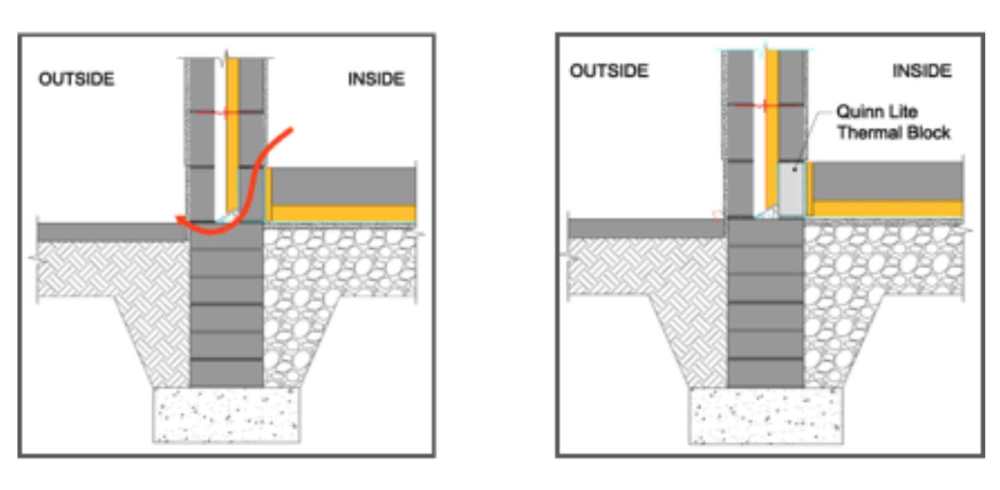
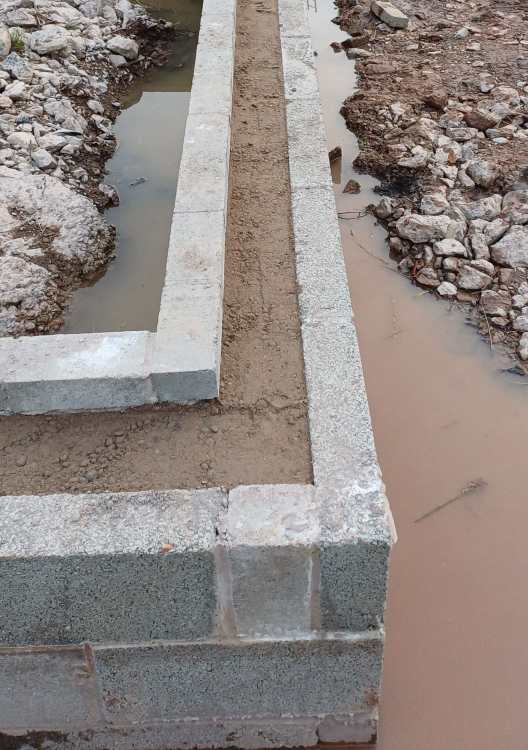
Are you running the 600 dpc the full perimeter, including where beams run parallel with the wall and the cut block end beds on to the slips? The photo looks like you do. I just can't see any overlap at the corners, it looks like one sheet which it can't be. I'm doing a similar detail to this and bringing the cavity insulation down to the top of the B&B where my ties will start so I wont be able to use the 600 dpc wrap. Does the lean infill need angled to the outside or optional?
-
Gas boiler vs ASHP & short cycling in low heat loss property
ruggers replied to ruggers's topic in Other Heating Systems
@marshian I don't know how much the 100W differs from the 200 W system boiler on a 4 pipe set up, but if using viessmanns own cylinder with the temperature sensors within, the cylinder will modulate in DHW mode too based on the demand. This might be possible with 3rd party cylinders with the right components, but generally 3rd party cylinders can't speak to the boiler and have to rely on, on/off stat which will provide max output to reheat. Which cylinder are you using? How are you changing between PDHW and low and slow modes in summer? I though priority hot water just meant what it says in the title, so it takes priority if it's in space heating mode. But in summer it will always be DHW only. -
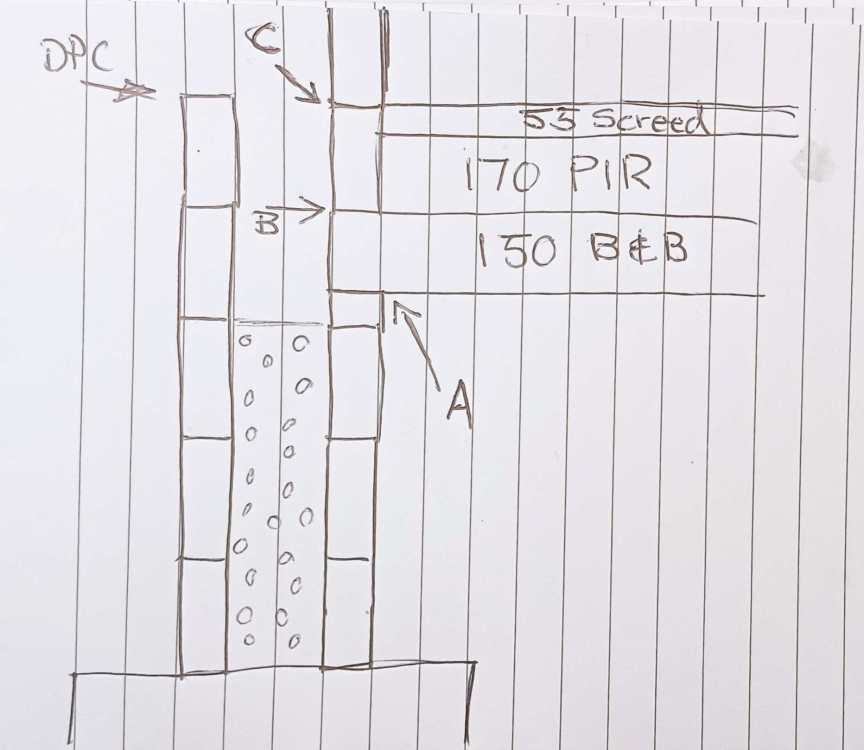
Masonry build here. So to be clear, you're going from under the beams, then turn up vertically to protect the ends of the beams, then coming back in over the top of the first block thats laid onto the beam and block floor? Which on my sketch would be from A to C? 100 under the beam, 150 beam, 225 block, 100 back into the coursing, Total, 600 minimum. Where as I was wanting to wrap from A to B because my wall ties and insulation will start At B, so 400 wide roll.
-
Thanks, it was to check how the beam ends are protected from moisture ingress from the cavity. Some add plastic caps, or bitumen paint the ends, or dpc wrap as described, others just leave them exposed. The bottom of my insulation starts level with the top of the beams and a thermal block will be used for the first inner course to minimise thermal bridging. The original builder wanted to have a dpc wrap from A to B, said they always do it that way. I'm aware of the make up layers for the dpm and ufh, but not which way they under or or over lap the dpc skirt. The newspaper builder will know this, but for my understanding, I'd assume the dpc hangs vertically down the wall into the room, and the dpm comes across the floor then laps up the wall, over lapping the dpc and tape sealed between the two?
-
Gas boiler vs ASHP & short cycling in low heat loss property
ruggers replied to ruggers's topic in Other Heating Systems
Thanks for sharing John -
I'm due to install my beam and block floor and my plans are generic rubbish, I'd like to know where the dpc should be placed. Ive attached a sketch of my build up.(insulation not added to sketch). A: this Will require dpc under the beam ends. Some builders place a wider dpc under the beams, like a 400mm wide and wrap the end of the beams exposed to the cavity, then bringing it back over the top of the infill blocks at B. Is this ok, or does it cause a slip plane since A & C are required. 😄 this will be the dpc skirt 300mm?
-
Gas boiler vs ASHP & short cycling in low heat loss property
ruggers replied to ruggers's topic in Other Heating Systems
If I install a heat pump I'd have to instal a heat pump cylinder with a large coil. Some of the 250L ones I've seen are around 41Kw coil, but the heat pumps don't produce anywhere near that output even in summer which is confusing. I've noticed the 300L heat pump cylinders have only 230L of usable hot water. 250L is 200 or 210L usable. I looked at heat pump cylinders even if I was to install a boiler, so that it's one less thing to think about if a heat pump is later installed but then thought, it's probably better to just size one to the boiler now, because in 15 years time you'd probably want a newer cylinder that matches the heat pump technology at that time. If the boiler PDHW output is 17.9Kw having a larger coil doesn't bring many benefits on reheat times. What output is your heat pump in PDHW and its min modulation? Did you install it yourself? -
Gas boiler vs ASHP & short cycling in low heat loss property
ruggers replied to ruggers's topic in Other Heating Systems
I don't quite understand this quoted suggestion? it will be PDHW so how would this help with a boiler? -
Gas boiler vs ASHP & short cycling in low heat loss property
ruggers replied to ruggers's topic in Other Heating Systems
I've looked into this a lot over the last two years, it's just narrowing it down so it's suited to either system. Change of circumstances means my budget is tight and heat pump quotes were coming in very expensive even with the £7500 grant it's more expensive than gas. Theres just no local installer within a 1.5 hr drive for heat pumps or Viessmann. Everything will be designed for DT5 at max MWT 37.5c either way so it's heat pump ready. . The only suitable boiler to stand a chance on a 5 to 5.65Kw heat loss is the Viessmann 200W 11 Kw system boiler which has the 1.9Kw min modulation and 30 degrees minimum flow temperature, 17.9Kw DHW, this is what I've based things on but don't want the short cycling issue, so might need to look at a buffer or 1st floor UFH. I just need it finalised so I can budget. My house will have a high level of airtightness and MVHR, but the insulation will be fixed at whats been planned and I don't think it will be exceptional and require no need to heat the upstairs like some builds. Some heat engineers like open loop, others have told me it's better to have two mixed circuits than open loop because often the radiators upstairs will require less flow temperature than the ground floor, Vaillant renewables suggested this too. I wondered what the benefits of an ASHP would be over the V200 since it would cost me more to install, the heat geek calculations suggest the same running costs, and then the annual services cost 3x as much. It's just that gas will be easier to get services and repairs done. My preference was to be able to control each floor independently but within 2 or 3 degrees of each other so that I can run the ground floor UFH later in the evening without heating upstairs when kids are in bed with a set back temperature. All rooms will be sized for 21C so that the upstairs bedrooms/WFH office are warm during the day If I was to go ASHP, it will be a Viessmann 150A 6Kw, or a Vaillant Arotherm plus 5Kw. -
Gas boiler vs ASHP & short cycling in low heat loss property
ruggers replied to ruggers's topic in Other Heating Systems
Interesting John. From memory, you have a large house low heat loss but was it one floor and no radiators, all UFH? I had to pause my build after starting and a year on looking to restart and finding it hard to get advice for gas because everyone takes offence if not installing a heat pump if a new build not knowing that theres almost zero installers anywhere near me. With having radiators upstairs they'll heat differently for me so the load phasing you mention could leave me cold upstairs although i did want two mixed circuit heating zones running two curves over just one open loop preferably. -
Gas boiler vs ASHP & short cycling in low heat loss property
ruggers replied to ruggers's topic in Other Heating Systems
Did you ever get a buffer fitted or fix your cycling issue? How do you get a 26° flow temperature when the lowest boiler fliw is 30°? -
Brick bond at window reveals for non metric sized openings?
ruggers replied to ruggers's topic in Brick & Block
I'll PM you the plans over then it makes more sense. The porch to house UPVC lockable door i wanted to be at least the same width 838mm as the internal doors so it's easy for moving furniture about. 1023 is the dimension I required because once you've deducted 140mm for each side of the frame, plus around 25mm for the door when it's open at 90 degrees, this brings you down to the similar sized opening of 850 ish. -
Brick bond at window reveals for non metric sized openings?
ruggers replied to ruggers's topic in Brick & Block
I just noticed this post after I'd replied. The rests all out the ground by 3 courses so I'll check if the 6750 is exactly that, I'm just figuring out how to sort the 2900 to 2025 while i wait for a different builder, lucky i had a sanity check at this stage. For 3 course of block 1.9m long it could easily be took apart and changed. (No trench blocks, or infill) *edit - I think i understand why you've suggested 6740, thinking the right hand side to deduct the end perp for an external corner, but its an internal corner so another bricks there. -
Brick bond at window reveals for non metric sized openings?
ruggers replied to ruggers's topic in Brick & Block
@Canski thanks for the advice. There was a few things changed which i didnt like and when questioned it caused an argument, the porch sside was 1800 but they changed it to 1900, part of house was 12,600 but changed to 12,700 with no explanation. Just to clarify, what size is classed as half a brick is it 107 or 102? The header you mentioned is the brick end at 102.5? What width should a doorway to outside be for wheelchair access to match 838 internal doors. Frames are usually 70mm each side. -
Brick bond at window reveals for non metric sized openings?
ruggers replied to ruggers's topic in Brick & Block
I've read your comments, looked at the plans today with fresh eyes and found a way to simplify it or correct it if it can be classed as wrong. See attached sketch to get the idea. (Red pen is correction which works better) As mentioned, I designed the outside walls corner to corner to match brick sizes by full/half bricks and kept all of the openings between reveals to the same spacing. The person who done the regs plans changed some things that weren't required & said it's not worth changing back. The porch width should be 2925mm not 2900, this would allow the centred 1st floor window above it, to then sit symmetrical with the correct brick bond to each side of the window if the window width is reduced from 1200mm to 1125. It leaves 900mm for full and half cuts, rather than 850mm which would end up messy. @Dave Jones Yes I sometimes overthink things, but I believe this to be something important that should have been correct on the plans.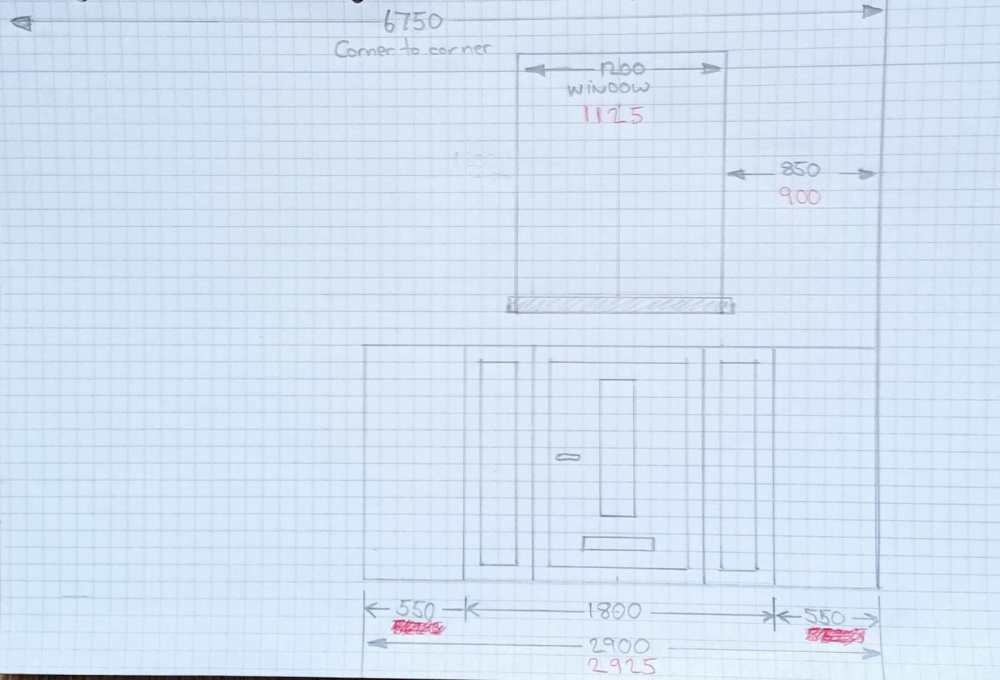
-
Brick bond at window reveals for non metric sized openings?
ruggers replied to ruggers's topic in Brick & Block
This is what I originally done but the sizes were changed on the porch and 1st floor window width which I only thought more about when looking to order sills. Good tips. I was unsure how opening sizes are covered that don't work out well to brick bond spacing. I don't image everyones windows and door opening are designed to whole brick sizes unless this is a rule architects do work to? Block work and render is much less important. I spoke to the supplier today who said if ordered in two sections which large ones come in anyways, they can just be cut down as the bars are set back from the ends however much i ask for when they cast them. Yeah so with slip sills, you have two choices, you can either install them to the width of the window brick opening only, or you can order them longer, say 50mm each side, and do an L shaped cut out (horn). I wasn't sure if the latter is beneficial to direct rain water run off, without leaving dirty streak marks down the face of the wall each side of the sill like you sometimes see. Slip sills have the benefit of being fit once the brickwork is completed, where as stooled sills need the correct sizes and built in as you go along and are already wider than the opening for run off. I'm not sure if slip sills are ever used with face bricks but they do seem less hassle. -
Brick bond at window reveals for non metric sized openings?
ruggers replied to ruggers's topic in Brick & Block
I put this in the OP, 215 long x 102.5 wide x 65mm high. -
Should I add internal insulation to my cavity wall - please help
ruggers replied to Johnny Jekyll's topic in Heat Insulation
Theres a lot of mention that your doing this to the outside but your OP states battens to the inside with PIR between. I considered adding insulated plasterboard instead of regular board to the inside of my self build walls which were the same construction as yours plus a 50mm cavity air gap and these are 0.17W/m2K. The whole property heat loss for 200m2 was only going to improve by 0.3W/m2K when I tried it on my heat loss survey which didn't seem enough for a 2 grand+ outlay on the boards. I was also unsure whether it was worth adding 37.5mm insulated plasterboards because it affects the thermal mass of the building. Some say more insulation trumps thermal mass, but others say having thermal mass is good with weather compensated controls in an unstable weather area so I'm likely to leave the insulation & not to risk it. You need to think how you will heat your home, will it be on all the time weather comp, or will you have on off controls and the house be fluctuate from really cold to full temperature and how fast you want it to respond. Masonry build will take a lot longer to warm from the heating being off than timber frame or if you always keep a minimum set back temperature of no less than 3 degrees of your desired temperature.



